
Quick answer
What Is Cardiac Biomarkers?
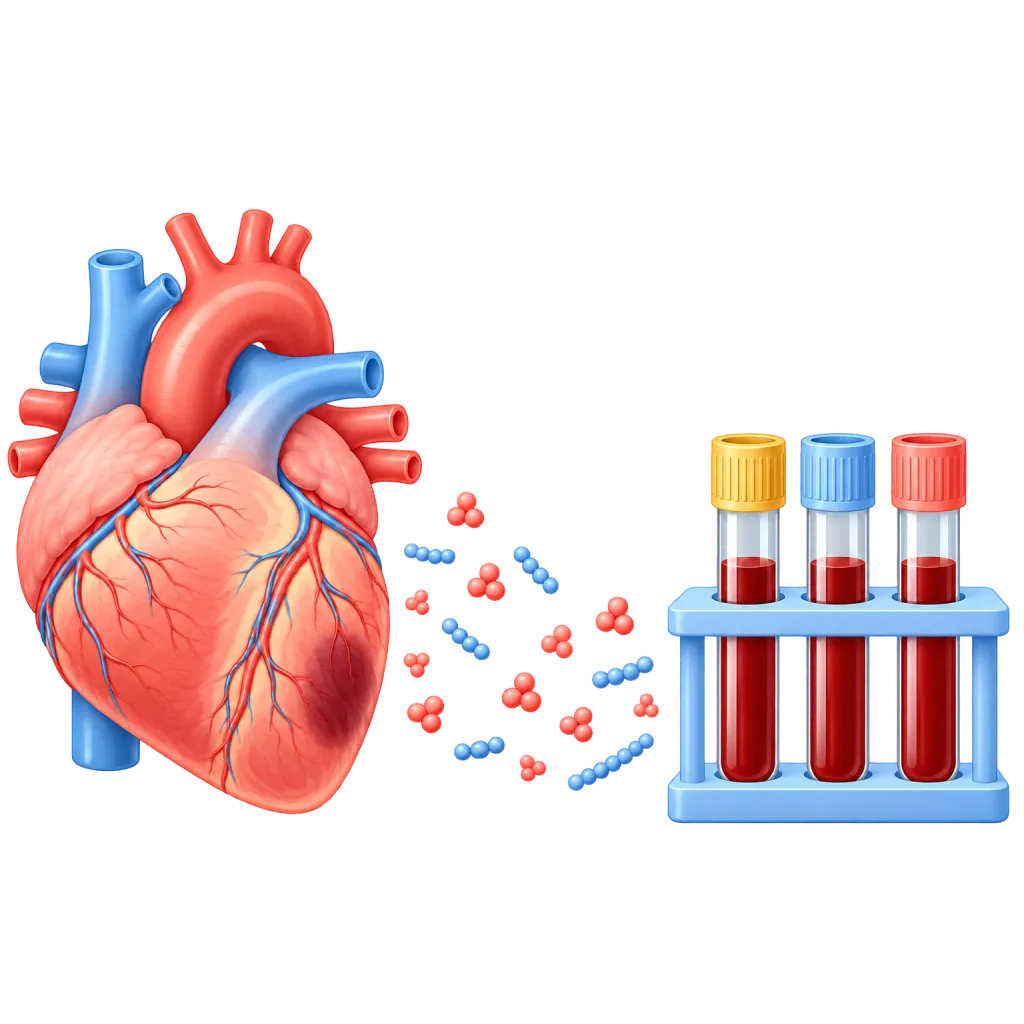
Cardiac biomarkers are a group of blood tests that measure substances the heart releases when its muscle is damaged or under heavy strain, such as troponin and NT-proBNP. These tests help the doctor confirm or rule out a heart attack, assess heart failure, and look for other causes of chest pain or shortness of breath.
Sources01 / Understanding the procedure
About Cardiac Biomarkers
What Are Cardiac Biomarkers
Cardiac biomarkers are substances in the blood whose levels change when the heart is damaged, inflamed, or under excessive strain. The doctor chooses the type of biomarker based on your symptoms, then reads the results together with an ECG and other tests. A single number is rarely enough to make a diagnosis.
How It Works in Brief
When heart muscle cells are damaged, proteins from inside the cells, such as troponin, leak into the bloodstream. When the heart chambers are stretched, the heart releases NT-proBNP. Blood is drawn from your arm and the levels are measured. When a heart attack is suspected, the troponin test is usually repeated after 1 to 3 hours to see whether the level is rising or falling.
Commonly Checked Biomarkers
- Cardiac troponin: the main marker of heart muscle damage and the basis for diagnosing a heart attack. High-sensitivity troponin tests are generally used today.
- NT-proBNP or BNP: assesses strain on the heart and helps diagnose and monitor heart failure.
- CK-MB: a heart muscle enzyme that is now used less often and is checked only in certain situations.
- D-dimer: helps rule out blood clots, such as a pulmonary embolism, when the likelihood is low.
- hs-CRP: a marker of inflammation that can help assess the long-term risk of heart disease.
Reading the Results
Troponin that is raised and changes on a repeat test supports recent heart muscle damage, for example a heart attack or myocarditis. Troponin can also rise in heart failure, kidney disease, severe infection, or pulmonary embolism, so the doctor assesses the pattern together with your symptoms. A result that stays low on a repeat test helps rule out a heart attack, but does not rule out every cause of chest pain.
When to Go to the Emergency Room
If you have chest pain that is severe or lasts more than a few minutes, shortness of breath, a cold sweat, or fainting, go to the emergency room right away or call emergency services. Do not wait for a routine laboratory appointment.
02 / Understanding the procedure
When Is This Procedure Considered?
A doctor may consider this procedure in the situations below. The decision is always made after a thorough assessment.
- Chest Pain Suspected to Be a Heart AttackTroponin helps confirm or rule out heart muscle damage.
- Shortness of Breath or SwellingNT-proBNP or BNP helps assess whether the cause is heart failure.
- Suspected Inflammation of the Heart MuscleFor example myocarditis after a viral infection.
- Suspected Blood Clot in the LungsD-dimer helps rule out pulmonary embolism when the likelihood is low.
- After a Heart Procedure or Major SurgeryTo monitor for possible heart muscle damage.
- Assessing Long-Term Riskhs-CRP can be used together with other risk factors in people without symptoms.
Situations to Consider First
- Chronic Kidney DiseaseTroponin and NT-proBNP can be higher even without a heart attack.
- Very Strenuous ExerciseTroponin can rise temporarily after very strenuous physical activity.
- Pregnancy and Older AgeD-dimer tends to be higher, so the results are read with care.
- Ongoing Infection or Inflammationhs-CRP also rises, so it is not suitable for assessing long-term risk.
- High-Dose Biotin SupplementsThese can interfere with certain test methods. Tell the staff if you take them.
03 / Before the procedure
How Should You Prepare?
Preparation depends on your situation.
Emergencies. If you are having chest pain or shortness of breath, there is no preparation. Go to the emergency room right away.
Scheduled tests. Fasting is generally not needed, unless another test done at the same time requires fasting.
Medicines and supplements. Take your medicines as usual and bring a list of them. Tell the staff if you take high-dose biotin, which is often found in hair and nail supplements.
Activity. For a scheduled test, avoid very strenuous exercise the day before.
Important information. Tell the staff if you have kidney disease, are pregnant, or have recently had an infection.
Previous results. Bring previous heart test results and ECGs if you have them.
Unsure about the preparation instructions? Ask our team before the procedure.
04 / During the procedure
How Is the Procedure Done?
The blood draw is usually finished within 10 minutes. In the emergency room, troponin results are usually available in about 1 hour, and the test is often repeated 1 to 3 hours later.
Initial Assessment
In the emergency room, an ECG is recorded as soon as possible, ideally within 10 minutes of arrival, along with a physical examination. Blood is drawn at the same time.
Blood Draw
Blood is drawn from a vein in your arm or through an IV line that has been placed, then sent to the laboratory.
Repeat Troponin Test
When a heart attack is suspected, blood is drawn again after 1 to 3 hours to see how the troponin level changes.
Reading the Results
The doctor reads the results together with your symptoms, ECG, and, if needed, an echocardiogram. The next step may be going home with a scheduled follow-up visit, longer observation, or cardiac catheterization.
05 / Benefits and risks
Benefits and Risks Should Be Discussed Together.
Every medical procedure has benefits and risks. Your doctor will explain both for your situation before the procedure.
Benefits You Can Expect
- Quick and SimpleOnly a small amount of blood is needed, and troponin results in the emergency room can be available in about 1 hour.
- Confirming or Ruling Out a Heart AttackRepeat troponin tests support a safe decision on whether to be admitted or go home.
- Supporting Urgent Treatment DecisionsThe results help decide whether cardiac catheterization is needed.
- Assessing Strain on the HeartNT-proBNP or BNP helps identify and monitor heart failure.
- Guiding the Next TestsThe pattern of results helps the doctor choose the right follow-up tests.
The benefits of a procedure are not a promise of a cure. Ask how the results will affect your care plan.
Risks You Should Know
- Pain or a Small BruiseAt the needle puncture site, usually mild and goes away quickly.
- Brief Dizziness or FaintingSome people feel dizzy when blood is drawn. Tell the staff so you can lie down.
- Repeat Tests May Be NeededA single test is sometimes not enough, so blood needs to be drawn again.
- Results Affected by Other ConditionsKidney disease, infection, or strenuous exercise can raise levels without a heart attack.
Risks can differ from person to person. A full explanation and consent are given after an individual assessment.
06 / After the procedure
What Is Recovery Like?
There is no recovery period after a blood draw. The next steps depend on your results and condition.
Puncture site. A small bruise is normal and goes away within a few days.
If the results are normal. The doctor may suggest further scheduled tests, such as a treadmill stress test or a cardiac CT scan, if your symptoms need further investigation.
If the results are raised. You may need to be admitted to the hospital, given medicines, or undergo cardiac catheterization.
Warning signs. Go to the emergency room right away if you experience:
- Chest pain that comes back or gets worse
- Pain that spreads to the arm, jaw, or back
- Shortness of breath, a cold sweat, or severe nausea
- Palpitations, severe dizziness, or fainting
Know the Signs That Need Prompt Care.
Follow the team's guidance on warning signs. If severe or sudden symptoms appear after the procedure, go to the nearest emergency department right away or call Heart Attack Center 1500 258.
07 / Team and support
Doctors and Procedure Support
The doctors below are listed for this procedure. Listed by name, not by ranking.

Dr. dr. Dafsah A. Juzar, Sp.JP(K)
Interventional Cardiology
Coronary Intervention Procedures +1 center
Clinical focusComplex Coronary Intervention · Cardiac Catheterization
View Profile
Dr. dr. Jajang Sinardja, Sp.JP(K)
Interventional Cardiology
Coronary Intervention Procedures
Clinical focusAcute Coronary Syndrome · Primary Coronary Intervention
View Profile
dr. Siska S. Danny, Sp.JP(K)
Interventional Cardiology
Coronary Intervention Procedures
Clinical focusPCI for Acute Coronary Syndrome · Primary Coronary Intervention
View Profile08 / Common questions
Before You Plan the Procedure.
Frequently asked questions about cardiac biomarkers. If you are having chest pain now, go to the emergency room right away.
What tests are included in cardiac biomarkers?
The commonly checked tests are troponin for heart muscle damage and NT-proBNP or BNP for strain on the heart. Depending on your symptoms, the doctor may add CK-MB, D-dimer for blood clots, or hs-CRP for inflammation. Tests are chosen to answer a specific clinical question, not all at once for everyone.
Does high troponin always mean a heart attack?
Not always. Troponin shows that there is heart muscle damage, but the cause can vary, for example myocarditis, heart failure, pulmonary embolism, severe infection, or kidney disease. A heart attack is diagnosed when troponin rises or falls on a repeat test and is accompanied by symptoms, ECG changes, or imaging findings.
Why does the troponin test need to be repeated?
Troponin takes time to enter the bloodstream after heart muscle is damaged. That is why a single test done too early may not yet show a rise. A repeat test after 1 to 3 hours shows the change in levels, so the doctor can confirm or rule out a heart attack more safely.
Is CK-MB still checked?
CK-MB is now used less often because troponin is more sensitive and more specific to heart muscle. In certain situations, for example to assess repeat damage shortly after a heart attack, the doctor may still request it. When troponin results are available, CK-MB generally does not add much information.
Do I need to fast before a cardiac biomarker test?
No. Troponin, NT-proBNP, D-dimer, and hs-CRP are not affected by food. If other tests that require fasting are done at the same time, follow the instructions for those tests. In an emergency such as chest pain, do not delay coming to the emergency room over whether you have eaten or not.
Can cardiac biomarkers be used for routine health checks?
Generally not for everyone. Troponin and NT-proBNP are mainly used when there are symptoms or certain risks, such as diabetes or high blood pressure. hs-CRP is sometimes used together with cholesterol and other risk factors to assess long-term risk. Your doctor decides which tests are useful for you.
Sources and Medical Review
Translated from the Indonesian edition medically reviewed by dr. Siska S. Danny, Sp.JP(K).
Sources as cited in the Indonesian edition.
- Byrne RA, Rossello X, Coughlan JJ, et al. 2023 ESC Guidelines for the management of acute coronary syndromes. Eur Heart J. 2023;44(38):3720-3826.
- Thygesen K, Alpert JS, Jaffe AS, et al. Fourth universal definition of myocardial infarction (2018). Eur Heart J. 2019;40(3):237-269.
- Gulati M, Levy PD, Mukherjee D, et al. 2021 AHA/ACC/ASE/CHEST/SAEM/SCCT/SCMR Guideline for the Evaluation and Diagnosis of Chest Pain. Circulation. 2021;144(22):e368-e454.
- McDonagh TA, Metra M, Adamo M, et al. 2021 ESC Guidelines for the diagnosis and treatment of acute and chronic heart failure. Eur Heart J. 2021;42(36):3599-3726.
- Konstantinides SV, Meyer G, Becattini C, et al. 2019 ESC Guidelines for the diagnosis and management of acute pulmonary embolism. Eur Heart J. 2020;41(4):543-603.