
Quick answer
What Is Peripheral Atherectomy?
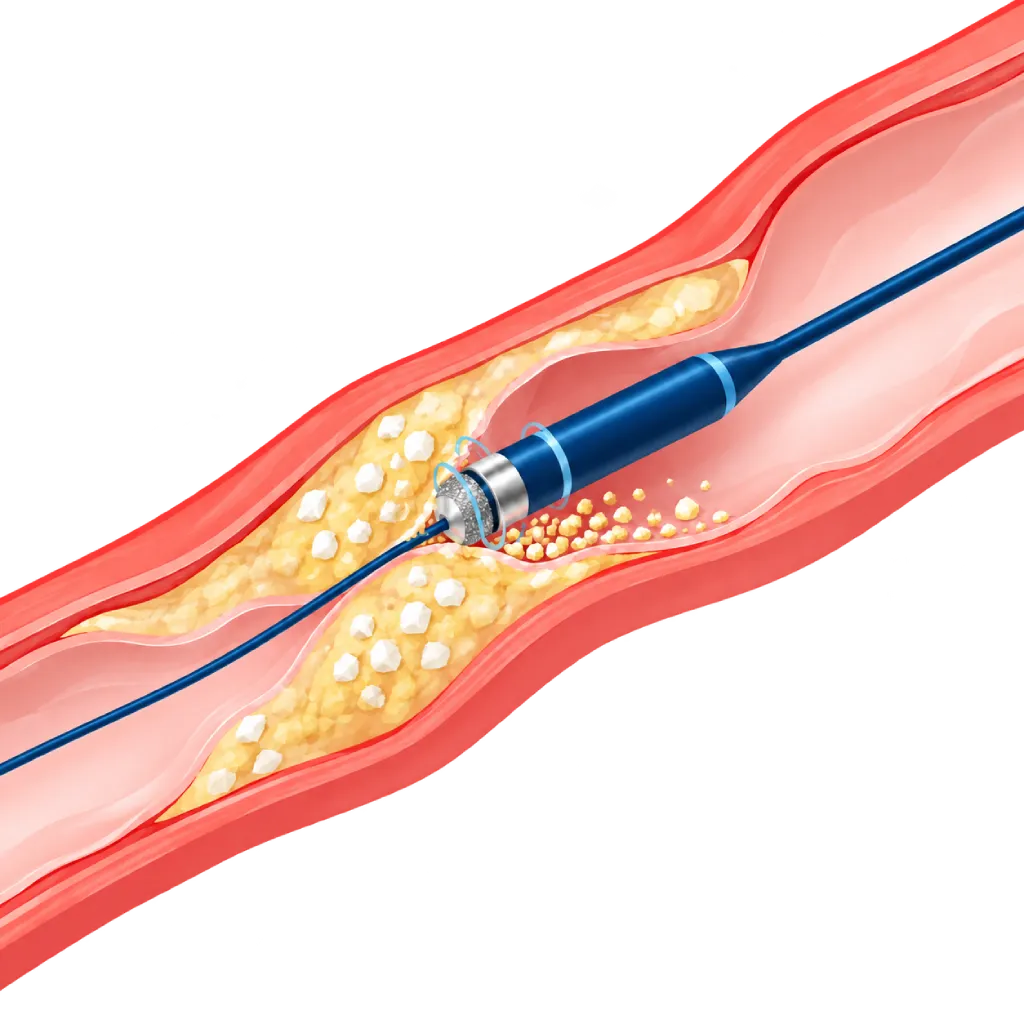
Peripheral atherectomy is a catheter procedure to shave, cut, or break up plaque in the leg arteries. It is mainly used for hard, calcified plaque or re-narrowing inside a stent, as preparation before a balloon or stent. It is done under local anesthesia through a small puncture in the groin.
Sources01 / Understanding the procedure
About Peripheral Atherectomy
What Is Peripheral Atherectomy
In peripheral artery disease, plaque builds up on the walls of the leg arteries. Some plaque contains a lot of calcium, making it very hard and difficult to widen with a balloon alone. Atherectomy uses a catheter with a special tip to shave, cut, or break up plaque from inside the artery, so the channel of the vessel becomes wider and easier to open with a balloon or stent.
How It Works in Brief
The atherectomy catheter is pushed over a guidewire to the plaque. Its tip shaves or cuts the plaque little by little, then the narrowing is widened with a balloon and, if needed, a stent is placed.
Types of Atherectomy
- Directional: a small blade cuts the plaque and collects it inside the tip of the catheter.
- Rotational: a fast-spinning tip shaves the plaque, some with suction of the debris.
- Orbital: a diamond-coated crown spins around the vessel wall to smooth down calcified plaque.
- Laser: light energy vaporizes the plaque, often used for re-narrowing inside a stent.
The type of device is chosen based on the nature of the plaque, its location, and device availability.
When Atherectomy Is Used
Atherectomy is not a replacement for a balloon or stent, but a preparation step in certain cases, for example severely calcified plaque, re-narrowing inside a stent, or locations where a stent is better avoided, such as in the groin and behind the knee. International guidelines state that evidence of its benefit compared with a balloon alone is still limited, so atherectomy is used in selected patients.
02 / Understanding the procedure
When Is This Procedure Considered?
A doctor may consider this procedure in the situations below. The decision is always made after a thorough assessment.
- Very Hard Calcified PlaquePlaque that cannot be widened well by a balloon alone.
- Re-Narrowing Inside a StentTissue that has grown back inside an old stent can be shaved away before it is widened again.
- Locations Better Left Without a StentFor example, arteries in the groin or behind the knee, which move a lot when you walk and bend.
- Limiting Leg Pain When WalkingWhen medicines and walking exercise have not helped enough and the narrowing is suitable for a catheter procedure.
- Foot Wounds That Are Slow to HealAs part of efforts to restore blood flow to the foot to support wound healing.
Situations to Consider First
- Guidewire Cannot Cross the BlockageThe atherectomy catheter can only be used if the guidewire successfully crosses the narrowing.
- Torn or Very Fragile Artery WallShaving the plaque can worsen the wall damage, so the doctor chooses another approach.
- Severe Kidney ImpairmentThe procedure requires contrast dye. The doctor weighs the benefits and limits the amount of contrast.
- Contrast Dye AllergyAllergy-preventing medicines can be given beforehand. Tell the team early on.
- Unable to Take Antiplatelet MedicinesThese medicines are needed after the procedure. If there is a reason you cannot take them, the doctor will discuss other options.
03 / Before the procedure
How Should You Prepare?
The team will give you written instructions before the procedure.
Tests before the procedure. Blood tests, including kidney function and blood clotting, and an ECG. Bring your previous duplex ultrasound, ABI test, CT angiography, or angiography results.
Current medicines. Bring a list of all your medicines and supplements. Aspirin and antiplatelet medicines are usually continued, and may even be started before the procedure. Other blood thinners and some diabetes medicines such as metformin may need to be adjusted. Do not change your medicines without your doctor's guidance.
Fasting. Usually for a few hours before the procedure, according to the team's instructions.
Allergies. Tell the team if you have ever been allergic to contrast dye, medicines, adhesive tape, or latex.
Quit smoking. Quitting smoking helps the results of the procedure last longer.
Companion. Arrange for someone to take you home, because you are advised not to drive after the procedure.
Unsure about the preparation instructions? Ask our team before the procedure.
04 / During the procedure
How Is the Procedure Done?
The procedure usually takes about 1 to 2 hours, depending on the number and length of the narrowings.
Blood Vessel Access
After local anesthesia, the doctor inserts a small tube into an artery, usually in the groin. Mild sedation may be given, and you stay awake.
Angiography and Guidewire
Contrast dye is injected to map the leg arteries. A very thin guidewire is then passed across the narrowing.
Debris Protection If Needed
In some cases, a small filter is placed below the narrowing to catch plaque debris that breaks loose.
Shaving the Plaque
The atherectomy catheter is advanced to the plaque and run several times. You may feel vibration or mild discomfort in your leg.
Balloon, Stent, and Final Check
The narrowing is then widened with a balloon, often a drug-coated balloon, and a stent is placed if needed. Angiography is repeated to make sure blood flows freely to the foot, then the puncture site is closed.
05 / Benefits and risks
Benefits and Risks Should Be Discussed Together.
Every medical procedure has benefits and risks. Your doctor will explain both for your situation before the procedure.
Benefits You Can Expect
- Opening Hard PlaqueHelps widen calcified narrowings that are difficult to open with a balloon alone.
- Better Balloon ResultsA wider channel helps the balloon work more evenly and reduces tears in the artery wall.
- Less Need for StentsUseful in locations that move often, such as the groin and behind the knee.
- Treating Re-Narrowing in a StentTissue inside an old stent can be shaved away without placing a new layer of stent.
- No Large IncisionDone through a small puncture under local anesthesia, with faster recovery than surgery.
The benefits of a procedure are not a promise of a cure. Ask how the results will affect your care plan.
Risks You Should Know
- Plaque Debris Carried DownstreamDebris can block smaller arteries in the foot. This can usually be treated on the spot, and a filter can be used to prevent it.
- Tear or Hole in the ArteryRare, and usually treatable through the catheter, for example with a balloon or covered stent.
- Bleeding or Bruising at the Puncture SiteCommon and usually mild. Sometimes a lump forms that needs additional treatment.
- Kidney Problems or Contrast ReactionEspecially if kidney function is already reduced. Usually temporary and preventable with preparation.
- Re-NarrowingThe artery can narrow again over time, so regular follow-up visits and taking your medicines regularly are important.
Risks can differ from person to person. A full explanation and consent are given after an individual assessment.
06 / After the procedure
What Is Recovery Like?
Some patients stay in the hospital for one night for monitoring. In certain situations, patients can go home the same day.
After the procedure. You lie down for a few hours with your leg straight so the puncture site does not bleed.
Drink water. Drink enough plain water to help your kidneys clear the contrast dye, unless your doctor limits your fluids.
Antiplatelet medicines. Two antiplatelet medicines are usually prescribed for several months, followed by one medicine long term, together with cholesterol medicine. Do not stop them without your doctor's guidance.
Activity. Avoid lifting heavy objects for a few days. After that, regular walking exercise is very helpful.
Regular follow-up visits. Blood flow in your leg is monitored with an ABI test or duplex ultrasound according to your doctor's schedule.
Warning signs to watch for. Go to the emergency room right away or contact the medical team if you experience:
- Growing swelling or bleeding at the puncture site
- A leg or foot that feels cold, pale, numb, or very painful
- Toes that turn bluish or blackish
- Rash, itching, shortness of breath, or a much smaller amount of urine
Know the Signs That Need Prompt Care.
Follow the team's guidance on warning signs. If severe or sudden symptoms appear after the procedure, go to the nearest emergency department right away or call Heart Attack Center 1500 258.
07 / Team and support
Doctors and Procedure Support
The doctors below are listed for this procedure. Listed by name, not by ranking.

dr. Emanoel Oepangat, Sp.JP(K)
Interventional Cardiology
Vascular Diagnostic and Therapeutic Center +1 center
Clinical focusCoronary Intervention · Peripheral Vascular Intervention
View Profile
dr. Suko Adiarto, Sp.JP(K), Ph.D.
Interventional Cardiology
Vascular Diagnostic and Therapeutic Center +1 center
Clinical focusCoronary Intervention · Peripheral Vascular Intervention
View ProfileVascular Interventional Suite
A procedure room with X-ray imaging for diagnosing and treating narrowed, blocked, or enlarged blood vessels outside the heart…
The availability of technology and test support is confirmed with the team. Technology is chosen according to clinical need.
08 / Common questions
Before You Plan the Procedure.
Frequently asked questions about peripheral atherectomy. The decision to use atherectomy is made by your doctor based on the angiography results.
What is the difference between atherectomy and a balloon or stent?
A balloon presses the plaque against the artery wall, and a stent holds the artery open. Atherectomy shaves or cuts the plaque so there is less of it. With hard, calcified plaque, atherectomy is often done beforehand, followed by a balloon and, if needed, a stent in the same procedure.
Does atherectomy hurt?
The puncture site in the groin is numbed with local anesthesia, so you only feel pressure. While the atherectomy catheter is working, some patients feel vibration or mild discomfort in the leg. Sedatives and pain relievers can be given. Tell the team if the discomfort increases.
Do all leg artery narrowings need atherectomy?
No. Many narrowings can be treated with a balloon, a drug-coated balloon, or a stent. Atherectomy is used in certain cases, for example severely calcified plaque, re-narrowing inside a stent, or locations where a stent is better avoided. The decision is made by your doctor after seeing the angiography results.
Where does the shaved plaque go?
It depends on the type of device. Directional devices collect the plaque pieces inside the catheter tip, some rotational devices suction out the debris, and other devices grind the plaque into very small particles. If the risk of debris traveling to the foot is high, your doctor may place a small filter below the narrowing.
How long will I stay in the hospital?
Some patients stay one night to monitor the puncture site and blood flow to the foot. In certain situations, patients can go home the same day. After going home, light activities can usually be resumed within a few days, along with walking exercise and follow-up visits on the schedule set by your doctor.
Can the narrowing come back?
Yes. An artery that has been opened can narrow again over time, especially if risk factors are not controlled. Taking antiplatelet and cholesterol medicines regularly, quitting smoking, controlling blood sugar, and regular follow-up visits with an ABI test or duplex ultrasound help find and treat new narrowing early.
Sources and Medical Review
Translated from the Indonesian edition medically reviewed by dr. Emanoel Oepangat, Sp.JP(K).
Sources as cited in the Indonesian edition.
- Mazzolai L, Teixido-Tura G, Lanzi S, et al. 2024 ESC Guidelines for the management of peripheral arterial and aortic diseases. Eur Heart J. 2024;45(36):3538-3700.
- Gornik HL, Aronow HD, Goodney PP, et al. 2024 ACC/AHA/AACVPR/APMA/ABC/SCAI/SVM/SVN/SVS/SIR/VESS Guideline for the Management of Lower Extremity Peripheral Artery Disease. Circulation. 2024;149(24):e1313-e1410.
- Feldman DN, Armstrong EJ, Aronow HD, et al. SCAI consensus guidelines for device selection in femoral-popliteal arterial interventions. Catheter Cardiovasc Interv. 2018;92(1):124-140.
- Ambler GK, Radwan R, Hayes PD, Twine CP. Atherectomy for peripheral arterial disease. Cochrane Database Syst Rev. 2014:CD006680.
- Conte MS, Bradbury AW, Kolh P, et al. Global vascular guidelines on the management of chronic limb-threatening ischemia. J Vasc Surg. 2019;69(6S):3S-125S.e40.