
Quick answer
What Is In-Stent Restenosis?
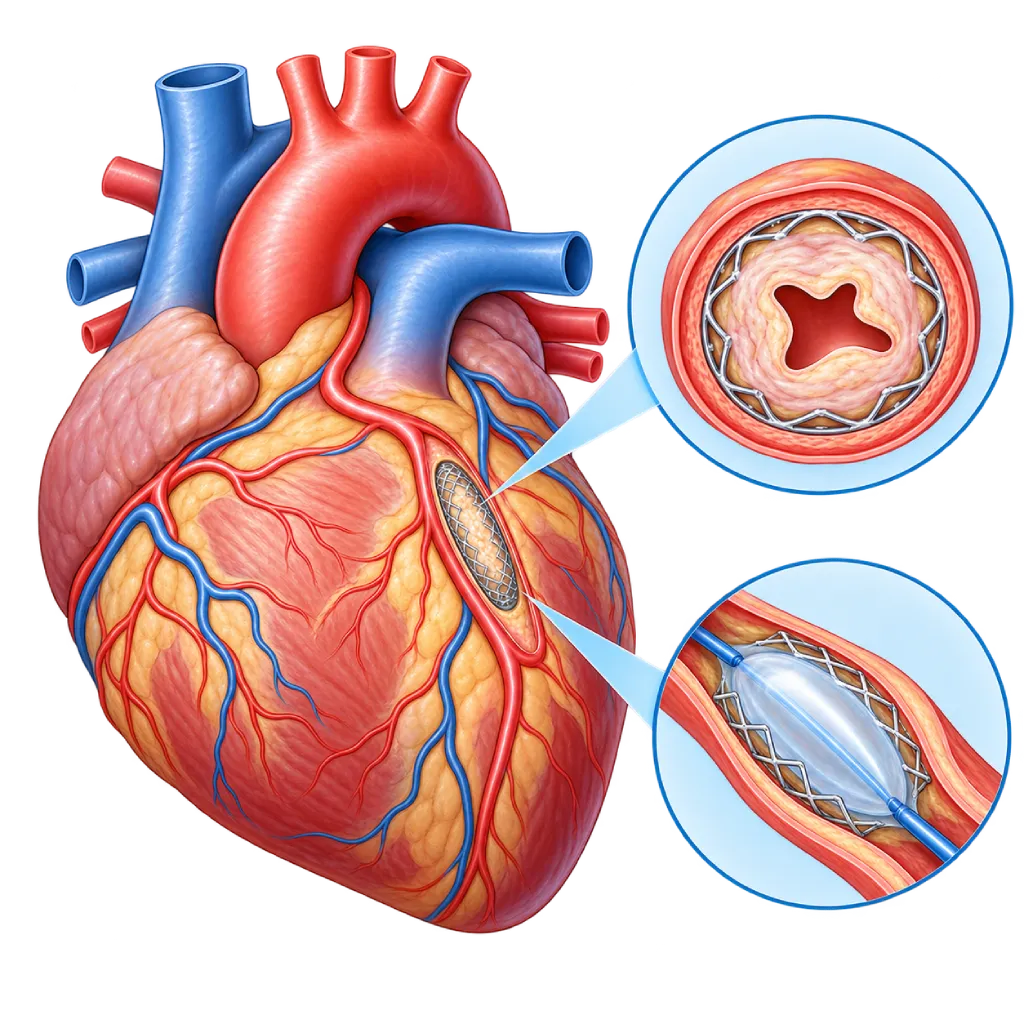
Restenosis is the renewed narrowing of a coronary artery at a spot that was previously widened with a balloon or fitted with a stent, caused by tissue growing inside it. The usual symptom is chest pain during activity that gradually returns.
SourcesSigns That Need Urgent Help
- Chest pain at rest, or chest pain that does not go away after 5 minutes of rest
- Chest pain that becomes more frequent, more severe, or is triggered by lighter activity
- Cold sweats, nausea, or weakness along with chest pain
- Severe shortness of breath
- Fainting or nearly fainting
If these signs appear, go to the nearest emergency department right away or call Heart Attack Center 1500 258.
01 / Understanding the condition
About In-Stent Restenosis
Restenosis is a renewed narrowing in a part of an artery that was previously widened. In the heart, restenosis usually occurs inside a coronary stent placed during angioplasty, which is why it is called in-stent restenosis. Restenosis can also occur in other arteries that have been widened, such as the leg arteries, but this page covers restenosis in the coronary arteries. Restenosis is not a sudden blockage by a blood clot. That sudden event is called stent thrombosis and is covered on the Stent Thrombosis page.
Why an Artery Can Narrow Again
After a balloon and stent widen the artery, the vessel wall has small injuries and then begins to heal. In some people, this healing process is excessive: smooth muscle cells and connective tissue grow thick inside the stent, so the opening of the artery narrows again. This type of narrowing usually appears within 3 to 12 months after the procedure. Years later, new cholesterol plaque can also grow inside the stent. Other contributing factors are a stent that did not expand fully, a stent that is too small, or a fractured stent frame.
How Often It Happens
In the era of bare-metal stents without a drug coating, re-narrowing was found in about 20 to 30 out of 100 patients. Drug-eluting stents, which slowly release a medicine that inhibits tissue growth, reduced this to fewer than 10 out of 100 patients. For this reason, ESC guidelines recommend drug-eluting stents for coronary stenting. The risk is higher in people with diabetes, small-diameter arteries, long narrowings, and narrowings at artery branch points.
How Restenosis Is Treated
Not every restenosis needs a procedure. If the narrowing is mild and does not reduce blood flow, your doctor may choose medicines and monitoring. If the artery needs to be reopened, the main options are a new drug-eluting stent inside the old stent or a drug-coated balloon. Imaging from inside the artery with IVUS or OCT helps your doctor see the cause of the narrowing before choosing an approach. For repeated restenosis or disease in many vessels, coronary bypass surgery may be considered. Artery-opening procedures are covered on the Coronary Angioplasty page and on the Percutaneous Coronary Intervention (PCI) page.
02 / Understanding the condition
Symptoms to Recognize.
Common Symptoms
Some cases of restenosis cause no symptoms and are only found during testing.
- Pain, heaviness, or pressure in the chest during activity, similar to the symptoms before the stent was placed
- Pain spreading to the arm, neck, jaw, or back during activity
- Shortness of breath during activities that used to feel easy
- Reduced ability to walk or climb stairs compared with after the procedure
- Getting tired easily during activity
- Symptoms that ease after a few minutes of rest
03 / Understanding the condition
What Causes This Condition?
- Excessive scar tissue growth inside the stent as part of the healing process of the artery wall
- New cholesterol plaque growing inside the stent after many years
- A stent that did not expand fully or is not well matched to the size of the artery
- A stent frame that has fractured or bent, especially in arteries that move a lot
- Widening with a balloon alone without a stent, which allows the artery wall to shrink back
- Narrowings that are long, located at branch points, or in small-diameter arteries
04 / Understanding the condition
Who Is at Higher Risk?
Medical
Diabetes, chronic kidney disease, and uncontrolled LDL cholesterol increase the risk of restenosis. A previous restenosis also raises the risk of it happening again.
Lifestyle
Smoking, a diet high in saturated fat, lack of physical activity, and excess weight speed up new narrowing both inside and outside the stent.
Other
Bare-metal stents without a drug coating, long or overlapping stents, small arteries, narrowings at branch points, and stents placed in vein bypass grafts.
Groups at Higher Risk
- People with Diabetes: Diabetes promotes tissue growth inside the stent and new narrowing, so the risk of restenosis is higher.
- Patients with Long or Overlapping Stents: Stents that are long, overlapping, or placed in small arteries and branch points narrow again more often.
- Patients Who Have Had Restenosis Before: Restenosis that has already been treated is more likely to come back, especially when there are already two layers of stents.
- People with Chronic Kidney Disease: Kidney problems are linked to calcification of the blood vessels and a higher risk of restenosis.
05 / Understanding the condition
How Is It Diagnosed?
Your doctor will start by asking about your symptoms, when your stent was placed, and whether the pattern of chest pain is similar to your symptoms before the procedure. An ECG and stress tests, such as stress echocardiography or myocardial perfusion imaging, help assess whether any part of the heart muscle is not getting enough blood flow. Coronary CT can be used for large stents, but the metal frame often makes the inside of small stents hard to assess.
If your symptoms are typical or a stress test shows reduced blood flow, your doctor will perform coronary angiography. ESC guidelines recommend imaging from inside the artery with IVUS or OCT to look for mechanical causes of restenosis, such as a stent that did not expand fully or a fractured frame. FFR measurement can be used to decide whether the narrowing is severe enough to be reopened.
Stress Echocardiography
A stress test with heart ultrasound to see whether any part of the heart wall is not getting enough blood flow when the heart works harder.
Myocardial Perfusion Imaging
A nuclear medicine test that compares blood flow to the heart muscle at rest and under stress.
Electrocardiogram (ECG)
Looks for signs of reduced blood flow to the heart muscle, especially during chest pain or a stress test.
Coronary Angiography
Confirms the location and severity of the narrowing inside the stent and serves as a map if the artery needs to be reopened.
Intravascular Ultrasound (IVUS)
Sound waves from inside the artery show whether the stent is fully expanded and how thick the tissue growing inside it is.
Optical Coherence Tomography (OCT)
Detailed images from inside the stent to tell apart scar tissue, new plaque, or a fractured stent frame.
Fractional Flow Reserve (FFR)
Measures the pressure inside the artery to decide whether the narrowing is severe enough to be reopened.
06 / Understanding the condition
Treatment Options.
Treatment is decided by a doctor after an assessment. The categories below can help you follow the conversation with your doctor.
Medicines and Monitoring
If the narrowing is mild or does not reduce blood flow, your doctor may continue antianginal medicines, antiplatelet medicines, and statins with regular monitoring.
New Drug-Eluting Stent
A new stent is placed inside the old stent to hold back tissue growth. Guidelines recommend this option for in-stent restenosis.
Drug-Coated Balloon
A balloon that releases medicine into the artery wall without adding another layer of metal, useful especially when there are already several layers of stents.
Preparation with Special Balloons
High-pressure balloons or cutting balloons can be used to widen a stent that did not expand fully before a drug-eluting stent or drug-coated balloon is used.
Coronary Bypass Surgery
Considered when restenosis keeps coming back, the disease affects many vessels, or the narrowing is at the base of the left coronary artery.
Risk Factor Control
Quitting smoking, controlling diabetes, blood pressure, and LDL cholesterol, and joining cardiac rehabilitation help prevent new narrowing.
07 / Understanding the condition
Complications to Watch For.
Recurrent Angina
Chest pain during activity comes back and limits daily activities until the narrowing is treated.
Heart Attack
Some cases of restenosis appear as unstable angina or a heart attack, so chest pain at rest needs to be checked right away. Covered on the Myocardial Infarction / Heart Attack page.
Recurrent Restenosis
After treatment, restenosis can come back again, especially when there are already several layers of stents, so the next options need careful planning.
Risks of a Repeat Procedure
Reopening the artery with a catheter or bypass surgery carries procedural risks, including bleeding at the puncture site and kidney problems caused by contrast dye.
08 / Understanding the condition
What Can You Do?
- Take antiplatelet medicines, statins, and other medicines as prescribed, without stopping on your own
- Quit smoking completely, including e-cigarettes
- Keep your blood sugar, blood pressure, and LDL cholesterol at the targets set by your doctor
- Join a cardiac rehabilitation program and stay physically active
- Attend follow-up visits as scheduled and bring your stent card or records
- Report returning chest pain or shortness of breath early
09 / Understanding the condition
When Should You See a Doctor?
Go to the emergency room right away if chest pain occurs at rest, does not go away after 5 minutes, or comes with cold sweats and shortness of breath. Make an earlier follow-up appointment with a cardiologist if:
- Pain or heaviness in the chest during activity returns after stent placement
- You get short of breath or tired more quickly when walking or climbing stairs
- Symptoms appear in a pattern similar to your symptoms before the procedure
- You have diabetes and feel that your ability to be active has declined
- You are unsure whether the medicines you take after stent placement can be stopped
Don't Wait in an Emergency.
If symptoms are severe or come on suddenly, go to the nearest emergency department right away or call Heart Attack Center 1500 258, rather than waiting for an appointment.
10 / Common questions
Questions You May Have.
Frequently asked questions about restenosis.
What is the difference between restenosis and stent thrombosis?
Restenosis is a narrowing that develops slowly over months to years because tissue grows inside the stent, so the symptom is usually chest pain during activity that appears gradually. Stent thrombosis is a sudden blockage by a blood clot, usually causes a heart attack, and requires emergency care. Stent thrombosis is covered on the Stent Thrombosis page.
How likely is my stent to narrow again?
With drug-eluting stents, re-narrowing occurs in fewer than 10 out of 100 patients, and even fewer need a repeat procedure. This rate is much lower than with bare-metal stents without a drug coating. Your individual risk depends on diabetes, the size and length of the stent, and the location of the narrowing. Your doctor can explain your risk based on the results of your procedure.
Does restenosis mean my stent procedure failed?
Not necessarily. Restenosis is an excessive healing reaction of the artery wall and can happen even when the procedure went well. Even so, your doctor will look for mechanical causes, such as a stent that did not expand fully, because this affects how it is treated. Imaging from inside the artery with IVUS or OCT helps find these causes so the next procedure can be planned more precisely.
Will I need another stent?
Not necessarily. If the narrowing is mild and does not reduce blood flow, medicines and monitoring may be enough. If the artery needs to be opened, the options are a new drug-eluting stent inside the old one or a drug-coated balloon that does not add another layer of metal. For repeated restenosis or disease in many vessels, your doctor may suggest bypass surgery. The choice depends on imaging results and your condition.
Can restenosis be prevented?
The risk can be reduced. Drug-eluting stents, the right stent size, and stent placement guided by imaging from inside the artery lower the chance of restenosis. On your side, quitting smoking, controlling diabetes and cholesterol, and taking your medicines as prescribed help prevent new narrowing. Restenosis cannot be fully prevented, so tell your doctor promptly if symptoms come back.
Do I need routine angiography even if I have no symptoms?
Usually not. Guidelines do not recommend routine coronary angiography for patients without symptoms after stent placement. The test is done if symptoms return, if a stress test shows reduced blood flow, or in certain situations such as a stent at the base of the left coronary artery. Regular checkups, ECGs, and stress tests as advised by your doctor are usually enough to monitor your condition.
Sources and Medical Review
Translated from the Indonesian edition medically reviewed by dr. Adrianus Kosasih, Sp.JP(K).
Sources as cited in the Indonesian edition.
- Neumann FJ, Sousa-Uva M, Ahlsson A, Alfonso F, Banning AP, Benedetto U, et al. 2018 ESC/EACTS Guidelines on myocardial revascularization. Eur Heart J. 2019;40(2):87-165.
- Vrints C, Andreotti F, Koskinas KC, Rossello X, Adamo M, Ainslie J, et al. 2024 ESC Guidelines for the management of chronic coronary syndromes. Eur Heart J. 2024;45(36):3415-537.
- Giustino G, Colombo A, Camaj A, Yasumura K, Mehran R, Stone GW, et al. Coronary In-Stent Restenosis: JACC State-of-the-Art Review. J Am Coll Cardiol. 2022;80(4):348-72.
- Alfonso F, Byrne RA, Rivero F, Kastrati A. Current treatment of in-stent restenosis. J Am Coll Cardiol. 2014;63(24):2659-73.
- Räber L, Mintz GS, Koskinas KC, Johnson TW, Holm NR, Onuma Y, et al. Clinical use of intracoronary imaging. Part 1: guidance and optimization of coronary interventions. An expert consensus document of the European Association of Percutaneous Cardiovascular Interventions. Eur Heart J. 2018;39(35):3281-300.
- Byrne RA, Joner M, Kastrati A. Stent thrombosis and restenosis: what have we learned and where are we going? The Andreas Grüntzig Lecture ESC 2014. Eur Heart J. 2015;36(47):3320-31.
Doctors Who Treat This Condition

dr. Adrianus Kosasih, Sp.JP(K)
Interventional Cardiology
Coronary Intervention Procedures
Clinical focusPrimary Coronary Intervention · PCI for Acute Coronary Syndrome
View Profile
Dr. dr. Jajang Sinardja, Sp.JP(K)
Interventional Cardiology
Coronary Intervention Procedures
Clinical focusAcute Coronary Syndrome · Primary Coronary Intervention
View Profile
Dr. med. dr. Denio A. Ridjab, Sp.JP(K)
Interventional Cardiology
Coronary Intervention Procedures +2 centers
Clinical focusInterventional Cardiology · Coronary Artery Disease
View Profile