
Quick answer
What Is May-Thurner Syndrome?
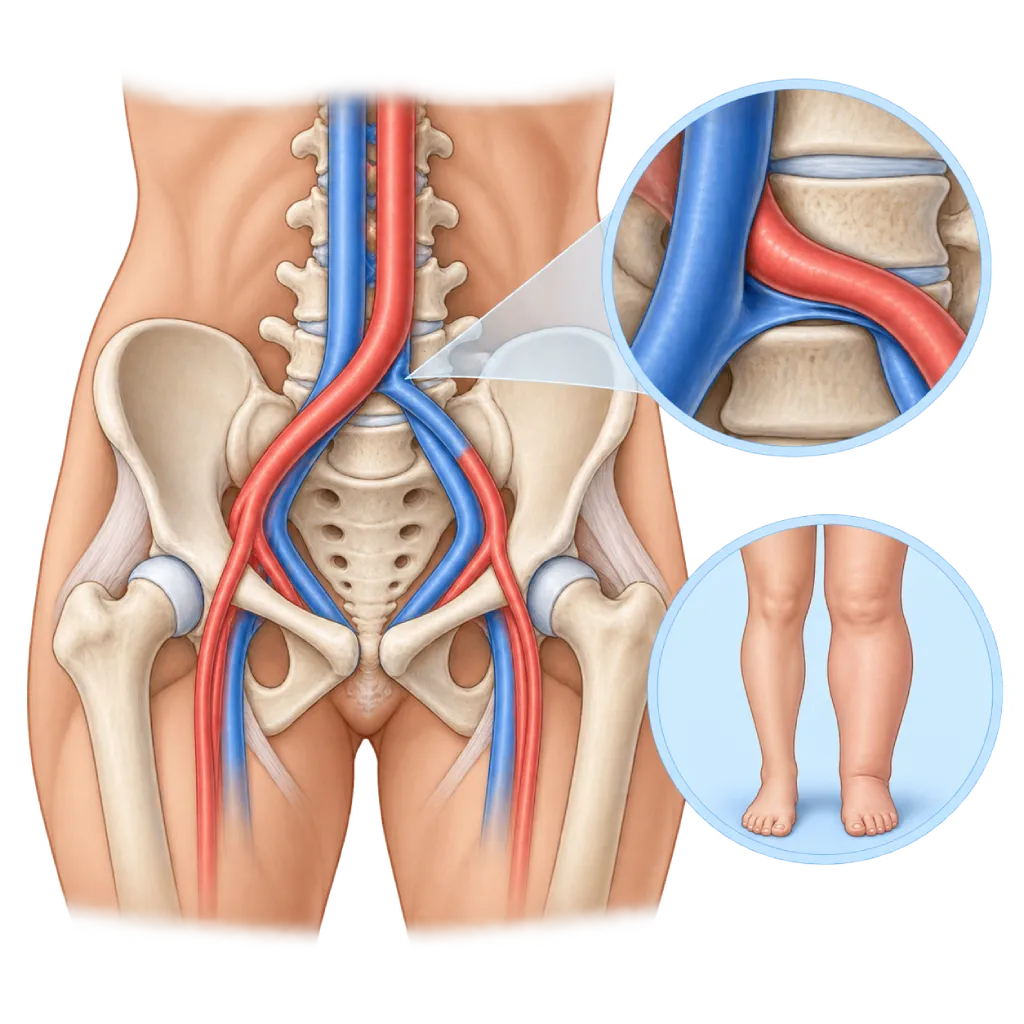
May-Thurner syndrome is a condition in which the left pelvic vein is compressed by the right pelvic artery that crosses in front of it. This compression can make the left leg swell and make blood clots more likely to form in the deep veins.
SourcesSigns That Need Urgent Help
- Sudden swelling, pain, and warmth in the left leg
- Swelling and a bluish color of the entire left leg up to the thigh
- Sudden shortness of breath without a clear cause
- Chest pain that gets worse when you breathe in
- Palpitations, dizziness, or fainting
- Coughing up blood
If these signs appear, go to the nearest emergency department right away or call Heart Attack Center 1500 258.
01 / Understanding the condition
About May-Thurner Syndrome
Blood from both legs flows back to the heart through the veins in the pelvis, called the iliac veins, which then join to form a large vein in the abdomen called the inferior vena cava. In the lower abdomen, the right iliac artery crosses directly in front of the left iliac vein. In some people, this artery presses the vein against the spine beneath it.
Ongoing pressure, combined with the pulsing of the artery, can cause the inner wall of the vein to thicken and form bands or scar tissue inside it. As a result, blood flow from the left leg is obstructed. This condition is called May-Thurner syndrome, after the two doctors who described it in 1957, and is also known as iliac vein compression syndrome or Cockett syndrome.
Many People Have No Symptoms
Compression of the left iliac vein is fairly often found on imaging tests in people who have no complaints at all. One study using abdominal CT found compression of more than half the vein's diameter in about a quarter of people without symptoms. That is why compression alone does not always need treatment. The term syndrome is used when the compression causes symptoms or blood clots.
Two Main Forms
The first form is a blood clot in the deep veins of the left leg that often extends up to the thigh and pelvis. This clot often appears when there is an additional trigger, such as pregnancy, the period after childbirth, birth control pills, surgery, or long periods without moving. Deep vein thrombosis is covered on the Deep Vein Thrombosis page.
The second form develops slowly without a clot: the left leg swells and feels heavy or painful when walking, followed by varicose veins, skin changes, and eventually ulcers, covered on the Chronic Venous Insufficiency page. In women, this compression can also play a role in chronic pelvic pain caused by widened pelvic veins.
Treatment Based on Symptoms
The 2021 ESVS guidelines on venous thrombosis and the 2022 ESVS guidelines on chronic venous disease address the management of iliac vein obstruction. Clots are treated with blood thinners, and in selected patients the clot is removed through a catheter and a stent is then placed in the compressed vein. Compression without symptoms usually only needs monitoring.
02 / Understanding the condition
Symptoms to Recognize.
Common Symptoms
- Swelling of the left leg, especially after standing for a long time or toward evening
- A heavy, tight, or aching feeling in the left leg
- Leg pain that gets worse when walking and eases when the leg is raised
- Varicose veins in the left leg, sometimes in the thigh or around the genitals
- Darkening or thickening of the skin around the left ankle
- A slow-healing wound around the left ankle
Symptoms in Adult Women
This syndrome is more often reported in young to middle-aged women, especially in connection with pregnancy and hormone use.
- Left leg swelling that appears during pregnancy or after childbirth
- Dull pelvic pain that gets worse after standing for a long time
- Varicose veins around the genitals, buttocks, or inner thighs
- A blood clot in the left leg while taking birth control pills
03 / Understanding the condition
What Causes This Condition?
- The right iliac artery crossing over and pressing the left iliac vein against the spine
- Thickening of the inner wall of the vein and formation of bands due to repeated pressure and pulsing of the artery
- Slower blood flow from the left leg, making clots more likely to form
- Additional triggers such as pregnancy, birth control pills, surgery, not drinking enough fluids, or long periods without moving
04 / Understanding the condition
Who Is at Higher Risk?
Other
Women are diagnosed more often, especially between the ages of 20 and 40. Pregnancy and the period after childbirth add pressure on the pelvic veins and increase the tendency of blood to clot.
Medical
Use of birth control pills or hormone therapy containing estrogen, surgery, cancer, inherited blood clotting disorders, and dehydration can trigger clots in a compressed vein.
Lifestyle
Sitting for long periods on long trips, bed rest, and lack of movement slow blood flow from the legs.
Groups at Higher Risk
- Women of Childbearing Age: Pregnancy, the period after childbirth, and birth control pills increase the risk of clots in a compressed vein.
- People with Long-Term Left Leg Swelling: Swelling of one leg, especially the left, that persists or keeps coming back needs to be assessed for pelvic vein compression.
- People with a History of Left Leg Clots: A clot in the left thigh or pelvic vein, especially at a young age, may signal underlying iliac vein compression.
05 / Understanding the condition
How Is It Diagnosed?
Your doctor asks about your symptoms and any history of blood clots, pregnancy, and hormone use, then compares both legs. Swelling or a clot that affects only the left leg, especially up to the thigh, is an important clue.
Duplex ultrasound is the first step to look for clots in the leg veins and assess the pattern of blood flow from the pelvis. The pelvic veins lie deep, so ultrasound is often not enough to see the compression. Your doctor may then order CT venography or MR venography to see the location and severity of the compression and rule out pressure from other causes, such as a mass in the pelvis.
If a procedure is being considered, catheter venography and ultrasound from inside the vessel (IVUS) give a more accurate measurement of the narrowing. Because compression is also often found in people without symptoms, your doctor always interprets imaging results together with your symptoms. Blood tests may be done to look for a tendency to clot easily and to check kidney function before contrast dye is used.
Duplex Ultrasound
Looks for clots in the leg veins and assesses the pattern of blood flow from the pelvis, without radiation or needles.
D-Dimer Test
Helps rule out a new clot when the clinical likelihood is low or moderate. A high result needs to be confirmed with ultrasound.
CT venography to see the location and severity of iliac vein compression and rule out pressure from other causes.
MR venography as an option without X-rays to assess the veins in the pelvis and abdomen.
Catheter venography and ultrasound from inside the vessel (IVUS) to measure the narrowing, usually when a procedure is planned.
Laboratory Tests
Blood tests to look for a tendency to clot easily and to check kidney function before tests that use contrast dye.
06 / Understanding the condition
Treatment Options.
Treatment is decided by a doctor after an assessment. The categories below can help you follow the conversation with your doctor.
Monitoring Without a Procedure
Compression found by chance without symptoms usually does not need treatment. Your doctor explains the warning signs to watch for.
Anticoagulant Medicines
Blood thinners are the basic treatment when a clot occurs. Your doctor determines the type and how long to take them.
Catheter-Based Clot Removal
For a new, extensive clot in the thigh and pelvic veins with severe symptoms and a low risk of bleeding, the clot can be dissolved or removed through a catheter in selected patients.
Iliac Vein Stenting
After the clot is treated, or for severe long-term symptoms, the compressed vein is widened with a balloon and a stent is placed through a catheter. Medicines and ultrasound checkups are needed afterward.
Compression Therapy
Compression stockings can relieve swelling and heaviness in the legs, especially with long-term symptoms.
Open Surgery
Moving the artery or creating a bypass for the vein. This is now rarely done and is reserved for certain cases.
07 / Understanding the condition
Complications to Watch For.
Clots in the Left Leg Veins
A clot that often extends from the calf up to the thigh and pelvis. Covered on the Deep Vein Thrombosis page.
Pulmonary Embolism
Part of the clot breaks off and blocks a blood vessel in the lungs, causing sudden shortness of breath and chest pain. Covered on the Pulmonary Embolism page.
Post-Thrombotic Syndrome
Long-term swelling, pain, and skin changes after a clot damages the vein valves. Covered on the Post-Thrombotic Syndrome page.
Chronic Venous Insufficiency
Long-standing obstruction of blood flow causes swelling, darkened skin, and ulcers on the left leg. Covered on the Chronic Venous Insufficiency page.
Recurrent Clots
Without treating the underlying compression, clots in the left leg can come back, especially when a new trigger appears.
08 / Understanding the condition
What Can You Do?
- Stay active and avoid sitting for long periods without moving, especially on long trips.
- Drink enough water, especially when traveling or in hot weather.
- Discuss contraception options with your doctor if you have iliac vein compression or a history of clots.
- Plan your pregnancy with your doctor if you have had a clot in your left leg.
- Take your medicines and have ultrasound checkups as scheduled after a vein stent is placed.
- Tell your doctor about your history before surgery or when you are admitted to the hospital.
09 / Understanding the condition
When Should You See a Doctor?
Make an appointment with your doctor if your left leg often swells, feels heavy, or develops varicose veins without a clear cause, especially if you have had a blood clot before. Go to the emergency room right away if your left leg suddenly becomes swollen and painful, or if you develop sudden shortness of breath and chest pain.
- Left leg swelling that persists or keeps coming back
- Leg pain when walking that eases when the leg is raised
- Varicose veins in the left leg, inner thigh, or around the genitals
- A history of clots in the left leg, especially at a young age
- Plans to become pregnant or use birth control pills after having had a clot
- New swelling or pain after a vein stent is placed
Don't Wait in an Emergency.
If symptoms are severe or come on suddenly, go to the nearest emergency department right away or call Heart Attack Center 1500 258, rather than waiting for an appointment.
10 / Common questions
Questions You May Have.
Frequently asked questions about May-Thurner syndrome.
Does everyone with iliac vein compression need a stent?
No. Compression of the left iliac vein is fairly often found in people without symptoms, and in this situation monitoring is usually enough. A stent is considered when the compression causes severe symptoms, such as long-term swelling, pain when walking, or ulcers, or after an extensive clot has been removed. The decision is made after your doctor assesses the imaging results together with your symptoms.
Why does this syndrome usually affect the left leg?
Because of where the blood vessels lie. The right iliac artery crosses in front of the left iliac vein, just above the lower spine. It is this left vein that gets squeezed between the artery and the bone. Similar compression on the right side can also occur, but it is less common. That is why swelling or a clot that affects only the left leg is a clue for doctors.
How long do I need to take blood thinners?
The duration differs for each person. After a clot in a deep vein, blood thinners are usually given for at least three months. Your doctor may extend this if there are ongoing risk factors or recurrent clots, and adjust it after a stent is placed. Do not stop or change your medicine on your own. Talk with your doctor before surgery or a tooth extraction, and if signs of bleeding appear.
Can a vein stent become blocked again?
Yes, although in the majority of patients the stent stays open. The risk of blockage is higher if there was a previous clot or long scar tissue. That is why your doctor gives blood thinners or antiplatelet medicines for some time after the procedure and schedules regular ultrasounds. New swelling or pain in the leg after a stent is placed needs to be checked promptly.
Can I get pregnant if I have May-Thurner syndrome?
Usually yes, but it needs to be planned. Pregnancy adds pressure on the pelvic veins and makes blood clot more easily, especially after childbirth. If you have had a clot or already have a stent, your doctor may recommend clot-preventing injections during pregnancy and after childbirth. Discuss your pregnancy plans with a vascular specialist and an obstetrician.
Can May-Thurner syndrome be prevented?
The compression itself cannot be prevented because it is related to the position of the blood vessels from birth. What can be reduced is the risk of clots: stay active, avoid sitting for long periods without moving, drink enough water, and discuss contraception options with your doctor. If you already know you have this compression, tell your doctor before surgery or when you are admitted to the hospital.
Sources and Medical Review
Translated from the Indonesian edition medically reviewed by dr. Radityo Prakoso, Sp.JP(K).
Sources as cited in the Indonesian edition.
- Kakkos SK, Gohel M, Baekgaard N, Bauersachs R, Bellmunt-Montoya S, Black SA, et al. European Society for Vascular Surgery (ESVS) 2021 Clinical Practice Guidelines on the Management of Venous Thrombosis. Eur J Vasc Endovasc Surg. 2021;61(1):9-82.
- De Maeseneer MG, Kakkos SK, Aherne T, Baekgaard N, Black S, Blomgren L, et al. European Society for Vascular Surgery (ESVS) 2022 Clinical Practice Guidelines on the Management of Chronic Venous Disease of the Lower Limbs. Eur J Vasc Endovasc Surg. 2022;63(2):184-267.
- Harbin MM, Lutsey PL. May-Thurner syndrome: History of understanding and need for defining population prevalence. J Thromb Haemost. 2020;18(3):534-42.
- Birn J, Vedantham S. May-Thurner syndrome and other obstructive iliac vein lesions: meaning, myth, and mystery. Vasc Med. 2015;20(1):74-83.
- Kibbe MR, Ujiki M, Goodwin AL, Eskandari M, Yao J, Matsumura J. Iliac vein compression in an asymptomatic patient population. J Vasc Surg. 2004;39(5):937-43.
- Kaltenmeier CT, Erben Y, Indes J, Lee A, Dardik A, Sarac T, et al. Systematic review of May-Thurner syndrome with emphasis on gender differences. J Vasc Surg Venous Lymphat Disord. 2018;6(3):399-407.e4.
- Vedantham S, Goldhaber SZ, Julian JA, Kahn SR, Jaff MR, Cohen DJ, et al. Pharmacomechanical Catheter-Directed Thrombolysis for Deep-Vein Thrombosis. N Engl J Med. 2017;377(23):2240-52.
Doctors Who Treat This Condition

dr. Suko Adiarto, Sp.JP(K), Ph.D.
Interventional Cardiology
Vascular Diagnostic and Therapeutic Center +1 center
Clinical focusCoronary Intervention · Peripheral Vascular Intervention
View Profile
dr. Emanoel Oepangat, Sp.JP(K)
Interventional Cardiology
Vascular Diagnostic and Therapeutic Center +1 center
Clinical focusCoronary Intervention · Peripheral Vascular Intervention
View Profile
dr. Radityo Prakoso, Sp.JP(K)
Pediatrics & Congenital Heart Disease
Congenital and Structural Heart Center
Clinical focusPediatric Cardiology Consultation · Congenital Heart Disease Care
View Profile