
Quick answer
What Is Lead Extraction?
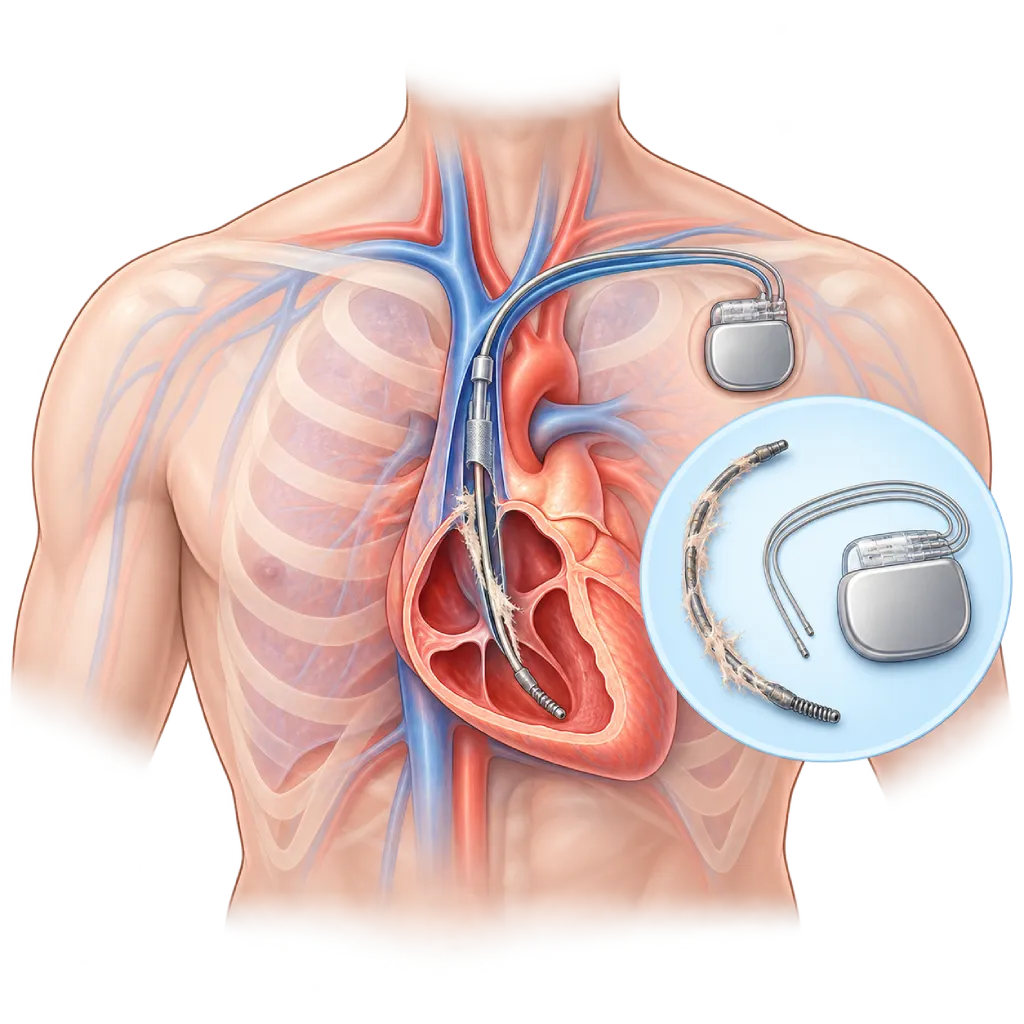
Lead extraction is a procedure to remove the long-implanted wires (leads) of a pacemaker, ICD, or CRT device that have become attached to the blood vessels or heart wall. The main reasons are device infection or a damaged lead. It is done under general anesthesia, usually through the blood vessels, and takes about 1 to 4 hours.
Sources01 / Understanding the procedure
About Lead Extraction
What Is Lead Extraction
Pacemakers, ICDs, and CRT devices are connected to the heart through thin wires called leads. These wires enter through a vein below the collarbone and run into the heart. Over time, the body forms scar tissue that attaches the leads to the walls of the blood vessels and the heart. Lead extraction is a procedure to remove leads that have become attached in this way, usually leads that have been in place for more than one year.
Why Leads Need to Be Removed
The main reason is infection. If the device pocket or leads are infected, or bacteria have entered the bloodstream, the entire device and all leads need to be removed, because antibiotics alone generally cannot clear bacteria that stick to the device. Other reasons include a damaged lead, a blocked vein that prevents a new lead from being placed, a lead that interferes with the tricuspid valve, or a lead that causes persistent pain. Device infection is covered on the Cardiac Device Infection page.
How It Works in Brief
The majority of leads can be removed through the blood vessels without opening the chest. Your doctor inserts a locking wire into the lead so it does not break when pulled. A special sheath is then advanced along the lead to free the scar tissue little by little, using a rotating mechanical tip or laser energy. If needed, the lead is snared and pulled out through a blood vessel in the groin. In a small proportion of cases, for example when there is a large infected clump on the lead, the lead is removed through open surgery.
Risks to Understand
Lead extraction carries a higher risk than device implantation. In a large registry in Europe, leads were successfully removed in more than 95 out of 100 patients, while serious complications, such as a tear in a large blood vessel or the heart wall causing bleeding inside the chest, occurred in about 1 to 2 out of 100 procedures. A small proportion of these complications can be life-threatening. For this reason, the procedure is done with readiness for emergency surgery, blood on standby, and a heart surgery team. Your doctor weighs this risk against the danger of leaving the leads in place, especially when there is an infection.
After the Leads Are Removed
If the reason was infection, intravenous antibiotics are continued, and a new device is usually implanted after blood cultures have been clear for at least 72 hours, or longer if the infection involves a valve. Patients who depend on pacing use a temporary pacemaker until the new device is in place. Implanting a new device is covered on the Pacemaker Implantation and Implantable Cardioverter Defibrillator (ICD) pages.
02 / Understanding the procedure
When Is This Procedure Considered?
A doctor may consider this procedure in the situations below. The decision is always made after a thorough assessment.
- Device Pocket InfectionRedness, pus, or the device pushing through the skin; the entire device and all leads need to be removed.
- Bloodstream Infection or Endocarditis Involving the DeviceBacteria in the bloodstream or an infected clump on a lead or heart valve.
- Damaged or Malfunctioning LeadEspecially if the old lead interferes with a new lead or poses a risk of causing problems.
- Blocked VeinThe old lead blocks the vein, so a new lead cannot be placed during device replacement.
- Lead Interfering with the Tricuspid ValveThe lead causes severe valve leakage and symptoms.
- Persistent Pain Caused by a LeadPain in the device pocket or along the lead that does not improve with other measures.
Situations to Consider First
- Lead Working Well with No ProblemsA lead that is no longer used can be capped and left in place if that carries a lower risk.
- Very Limited Life ExpectancyWhen the benefit of the procedure does not outweigh its risk, other options are discussed with the family.
- Very Poor General ConditionThe procedure may be postponed until the condition is more stable, unless an infection requires urgent treatment.
- Without Heart Surgery BackupThe procedure is only done when the team and operating room are ready to handle complications immediately.
- Very Large Infected ClumpBetter suited to removal through open surgery or a special suction technique.
03 / Before the procedure
How Should You Prepare?
Preparation is thorough because this procedure requires readiness for possible emergency surgery. You are usually already admitted to the hospital before the procedure.
Tests before the procedure. Blood tests, blood cultures if there is an infection, an ECG, a chest X-ray to see the position of the leads, and echocardiography, often through the esophagus (TEE), to look for clumps on the leads or valves. If needed, a CT scan is done to assess the position of the leads relative to the blood vessels and heart.
Device check. The device is checked to find out how much your heart depends on pacing, so the team can prepare a temporary pacemaker.
Medicines. Blood thinners are usually stopped or adjusted before the procedure according to your doctor's instructions. Tell the team about all your medicines and allergies.
Fasting. Fast for about 6 hours before the procedure because general anesthesia is used.
Blood on standby and consent. Blood is prepared on standby. Your doctor explains the reasons, benefits, risks, and plan for replacing the device before you sign the consent form.
Unsure about the preparation instructions? Ask our team before the procedure.
04 / During the procedure
How Is the Procedure Done?
Lead extraction is done in an operating room or hybrid procedure room that is ready for heart surgery, under general anesthesia. The procedure takes about 1 to 4 hours, depending on the number of leads, how long they have been implanted, and how strong the scar tissue is.
Monitoring and Preparation
After you are asleep, the team places a large IV line, an arterial line to monitor blood pressure, and echocardiography through the esophagus to monitor the heart. A temporary pacemaker is placed if needed.
Opening the Device Pocket
Your doctor opens the device pocket below the collarbone, disconnects the device from the leads, and clears the tissue around the leads.
Freeing the Leads
A locking wire is inserted into the lead. The lead is then pulled gently, and if it is still attached, a mechanical or laser sheath is advanced along the lead to free the scar tissue. Sometimes the lead is retrieved from the groin with a snare.
Confirming and Closing
X-ray imaging and echocardiography confirm that the leads have been removed and that there is no bleeding around the heart. The device pocket is cleaned, especially if infected, then closed. A new device is implanted during the same procedure or later, depending on the reason for removal.
05 / Benefits and risks
Benefits and Risks Should Be Discussed Together.
Every medical procedure has benefits and risks. Your doctor will explain both for your situation before the procedure.
Benefits You Can Expect
- Removes the Source of InfectionRemoving the entire device and all leads is the main step for a device infection to heal.
- Clearing the Way for a New DeviceReopens the blood vessel route for new leads when a device is replaced or added.
- No Chest Opening in Most PatientsThe majority of leads can be removed through the blood vessels with special tools.
- Resolves Lead-Related ProblemsFor example tricuspid valve leakage or pain caused by a lead.
The benefits of a procedure are not a promise of a cure. Ask how the results will affect your care plan.
Risks You Should Know
- Tear in a Blood Vessel or the Heart WallRare but serious; it can cause bleeding inside the chest and require immediate surgery.
- Blood Collecting Around the HeartBlood in the sac around the heart can press on the heart and needs to be drained right away.
- Bleeding or Bruising at the Device PocketMore likely if you take blood thinners; monitored by the team.
- Tricuspid Valve DamageA lead attached to the valve can damage it during removal, causing the valve to leak.
- Remaining Lead FragmentA small piece of the lead tip may be left behind; usually not a problem if there is no infection.
Risks can differ from person to person. A full explanation and consent are given after an individual assessment.
06 / After the procedure
What Is Recovery Like?
You will stay in the hospital for several days, longer if there is an infection that requires intravenous antibiotics.
Early monitoring. Blood pressure, heart rhythm, the wound, and breathing are closely monitored, usually in the intensive care unit or a monitoring unit on the first night. Echocardiography may be repeated to make sure there is no fluid around the heart.
Antibiotics. If the reason was infection, antibiotics are given for about 2 to 6 weeks, depending on the type of infection.
Temporary pacing and a new device. If you depend on pacing, a temporary pacemaker is used until the new device is implanted. For ICD users, your doctor decides how to protect you from dangerous heart rhythms while waiting for the new device.
Wound and activity. Keep the wound dry and clean. If a new device is implanted, avoid raising the arm on the device side high and lifting heavy objects for a few weeks.
Warning signs to watch for. Go to the emergency room right away if you experience:
- Shortness of breath, chest pain, or severe dizziness
- Fever, chills, or pus from the wound
- A wound that becomes more swollen or bleeds
- Fainting or a very slow heartbeat
- Swelling of the arm on the side of the procedure
Know the Signs That Need Prompt Care.
Follow the team's guidance on warning signs. If severe or sudden symptoms appear after the procedure, go to the nearest emergency department right away or call Heart Attack Center 1500 258.
07 / Team and support
Doctors and Procedure Support
The doctors below are listed for this procedure. Listed by name, not by ranking.

Dr. dr. Dicky A. Hanafy, Sp.JP(K)
Arrhythmia and Electrophysiology
Arrhythmia and Device Center +1 center
Clinical focusElectrophysiology and Arrhythmia Ablation · Pacemaker and ICD Implantation
View Profile
Dr. dr. Faris Basalamah, Sp.JP(K)
Interventional Cardiology
Coronary Intervention Procedures +1 center
Clinical focusComplex Coronary Intervention · Cardiac Electrophysiology
View Profile
dr. Sunu B. Raharjo, Sp.JP(K), Ph.D.
Arrhythmia and Electrophysiology
Arrhythmia and Device Center
Clinical focusClinical and Interventional Electrophysiology · Cardiac Arrhythmia Ablation
View ProfileElectrophysiology (EP) Laboratory
A dedicated procedure room for electrophysiology studies, catheter ablation, and implantation of heart rhythm devices such as…
The availability of technology and test support is confirmed with the team. Technology is chosen according to clinical need.
08 / Common questions
Before You Plan the Procedure.
Frequently asked questions about lead extraction, or removal of heart device leads.
Why can't the leads simply be left in place?
For a damaged lead without infection, the old lead can often be capped and left in place, with a new lead placed alongside it. However, if there is an infection, bacteria stick to the device and leads, so antibiotics alone are generally not enough and the infection easily comes back. In this situation, guidelines recommend removing the entire device and all leads.
How risky is this procedure?
In a large registry in Europe, serious complications occurred in about 1 to 2 out of 100 procedures, and death due to the procedure in about 5 out of 1,000. The risk is higher if the leads have been implanted for a very long time or there are many of them. For this reason, the procedure is done with readiness for emergency surgery. Your doctor will explain the risk in your situation compared with the risk of leaving the leads in place.
Will I still need a heart device after the leads are removed?
The majority of patients still need a device, because the original reason for implanting it still exists. Your doctor reassesses the need for a device after extraction. If there is an infection, a new device is usually implanted after the infection is under control, sometimes on the opposite side of the body or as a different type of device, for example an ICD with its lead under the skin. While waiting, the team prepares temporary protection if needed.
How long will I stay in the hospital?
Without infection, patients usually stay for several days. If there is an infection, especially a bloodstream infection or endocarditis, the hospital stay can last one to several weeks, because antibiotics need to be given intravenously and a new device is only implanted after the infection is under control. The length of stay also depends on your heart condition and any other illnesses you have.
What are the signs of a heart device infection?
Signs include skin over the device that is red, warm, swollen, or painful; fluid or pus coming out; skin thinning until the device or lead becomes visible; and fever or chills with no clear cause. Do not press on or treat the wound over the device yourself. Contact your cardiologist right away or go to the emergency room if these signs appear.
Does this procedure require open-chest surgery?
Not in most patients. The leads are removed through the blood vessels via an incision at the device pocket, sometimes with an additional puncture in the groin. Open-chest surgery is needed in a small proportion of patients, for example when there is a large infected clump on the lead, when other heart surgery is needed, or when a tear occurs that must be repaired right away.
Sources and Medical Review
Translated from the Indonesian edition medically reviewed by Dr. dr. Dicky A. Hanafy, Sp.JP(K).
Sources as cited in the Indonesian edition.
- Kusumoto FM, Schoenfeld MH, Wilkoff BL, et al. 2017 HRS expert consensus statement on cardiovascular implantable electronic device lead management and extraction. Heart Rhythm. 2017;14(12):e503-e551.
- Bongiorni MG, Burri H, Deharo JC, et al. 2018 EHRA expert consensus statement on lead extraction: recommendations on definitions, endpoints, research trial design, and data collection requirements for clinical scientific studies and registries: endorsed by APHRS/HRS/LAHRS. Europace. 2018;20(7):1217.
- Bongiorni MG, Kennergren C, Butter C, et al. The European Lead Extraction ConTRolled (ELECTRa) study: a European Heart Rhythm Association (EHRA) Registry of Transvenous Lead Extraction Outcomes. Eur Heart J. 2017;38(40):2995-3005.
- Blomstrom-Lundqvist C, Traykov V, Erba PA, et al. European Heart Rhythm Association (EHRA) international consensus document on how to prevent, diagnose, and treat cardiac implantable electronic device infections, endorsed by the Heart Rhythm Society (HRS), the Asia Pacific Heart Rhythm Society (APHRS), the Latin American Heart Rhythm Society (LAHRS), International Society for Cardiovascular Infectious Diseases (ISCVID) and the European Society of Clinical Microbiology and Infectious Diseases (ESCMID) in collaboration with the European Association for Cardio-Thoracic Surgery (EACTS). Europace. 2020;22(4):515-549.
- Baddour LM, Esquer Garrigos Z, Rizwan Sohail M, et al. Update on Cardiovascular Implantable Electronic Device Infections and Their Prevention, Diagnosis, and Management: A Scientific Statement From the American Heart Association. Circulation. 2024;149(2):e201-e216.
- Delgado V, Ajmone Marsan N, de Waha S, et al. 2023 ESC Guidelines for the management of endocarditis. Eur Heart J. 2023;44(39):3948-4042.