
Quick answer
What Is Tricuspid Regurgitation?
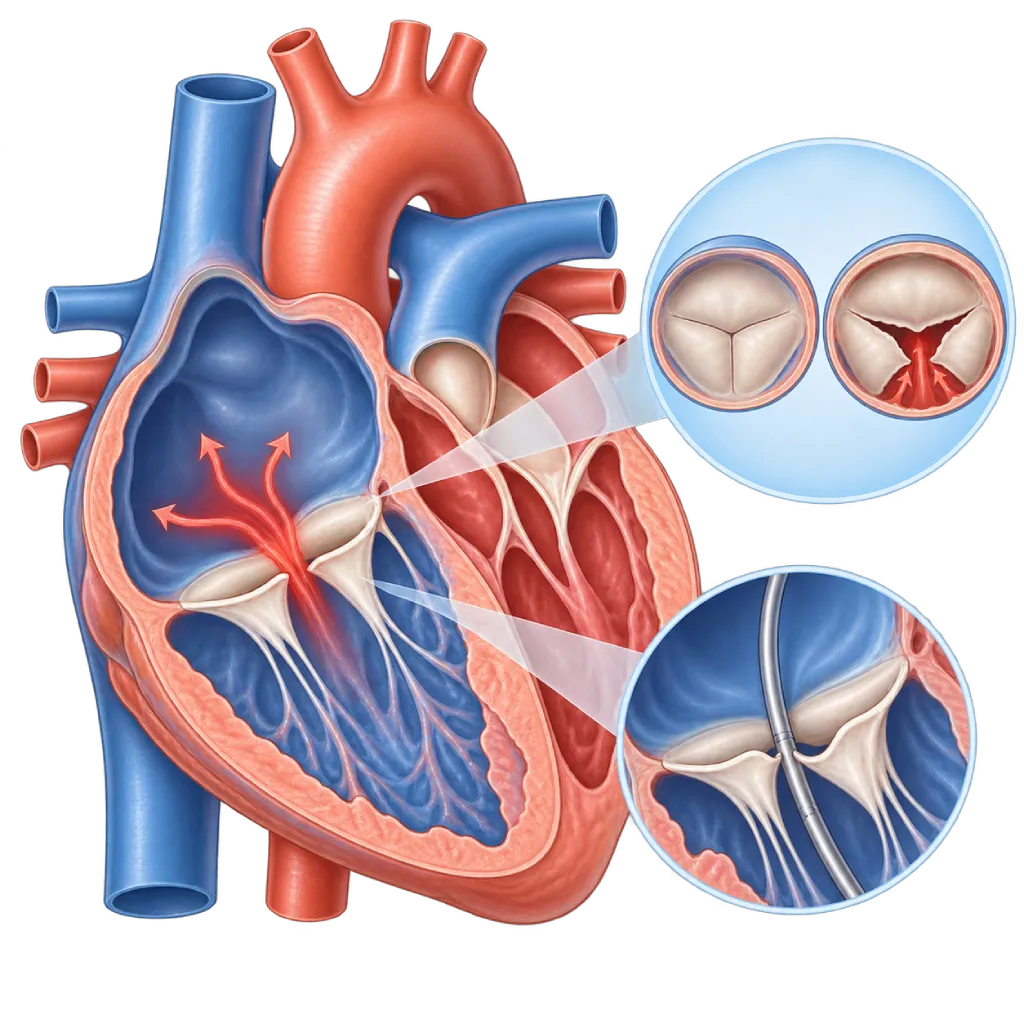
Tricuspid regurgitation is a leak in the tricuspid valve that lets some blood flow back from the right ventricle into the right atrium. A mild leak is often normal, while a severe leak can cause swelling, an enlarged abdomen, and tiring easily.
SourcesSigns That Need Urgent Help
- Severe shortness of breath at rest or being unable to lie down
- Swelling that spreads quickly with weight gain over a few days
- Yellowing of the skin or the whites of the eyes
- Fainting or nearly fainting
- A very fast heartbeat with dizziness or chest pain
- High fever with chills in people with a pacemaker or a heart valve problem
If these signs appear, go to the nearest emergency department right away or call Heart Attack Center 1500 258.
01 / Understanding the condition
About Tricuspid Regurgitation
The tricuspid valve sits between the right atrium and the right ventricle of the heart. When the right ventricle pumps blood to the lungs, this valve closes so blood does not flow back into the atrium. In tricuspid regurgitation, the valve does not close tightly, so some blood flows backward with every heartbeat. Tricuspid regurgitation is a type of leaky valve, covered on the Valve Regurgitation / Insufficiency page.
A Mild Leak Is Often Normal
A mild tricuspid leak is found in many healthy people during echocardiography and usually does not need treatment. If your heart ultrasound report says "mild TR" or "trivial" with no other abnormality, your doctor will usually explain that this is a normal variation. What needs attention is a moderate to severe leak.
Two Types of Causes
In the majority of cases, significant tricuspid regurgitation is secondary: the valve itself is normal, but the valve ring widens because the right ventricle or right atrium is enlarged. This happens with high lung pressure, left-sided heart valve disease, heart failure, or long-standing atrial fibrillation. A small proportion is primary, meaning the valve leaflets themselves are damaged, for example by a valve infection, rheumatic heart disease, a congenital defect such as Ebstein anomaly, carcinoid syndrome, a chest injury, or a pacemaker lead that interferes with valve movement.
Symptoms Develop Slowly
A severe leak causes blood to back up in the body's veins. Symptoms usually appear slowly: swollen legs, an abdomen enlarged by fluid, a feeling of fullness in the upper right abdomen, tiring easily, and a pulse that can be seen in the neck. Some people also feel full quickly, lose their appetite, or lose weight because the intestines are congested too. Because it develops quietly, many people only get checked when the right ventricle has already enlarged.
Treatment Based on the Cause
Treatment starts with the cause, for example controlling lung pressure, repairing a valve on the left side of the heart, or managing the heart rhythm. Diuretics help reduce swelling. A severe leak that causes symptoms, or that is found during left-sided valve surgery, can be treated with surgery to repair or replace the valve. For some people with a high surgical risk, there are now options to repair or replace the valve through a catheter.
02 / Understanding the condition
Symptoms to Recognize.
Common Symptoms
A mild leak usually causes no symptoms; the following symptoms are more common with a moderate to severe leak.
- Tiring easily and feeling weak
- Swollen legs or ankles
- An abdomen that is enlarged or feels full
- Discomfort in the upper right abdomen
- Reduced appetite or feeling full quickly
- A pulse that can be seen in the neck
- A pounding heartbeat or a heartbeat that feels irregular
03 / Understanding the condition
What Causes This Condition?
- Enlargement of the right ventricle or right atrium due to high pressure in the blood vessels of the lungs (pulmonary hypertension)
- Disease of the valves on the left side of the heart, such as mitral stenosis or mitral regurgitation
- Heart failure and cardiomyopathy that enlarge the chambers on the right side of the heart
- Long-standing atrial fibrillation that widens the atrium and the valve ring
- A pacemaker or ICD lead that passes through the valve and interferes with its movement
- Damage to the valve leaflets from a valve infection (endocarditis), rheumatic heart disease, or carcinoid syndrome
- Congenital defects such as Ebstein anomaly, or a chest injury
04 / Understanding the condition
Who Is at Higher Risk?
Medical
Pulmonary hypertension, mitral or aortic valve disease, heart failure, chronic lung disease, and atrial fibrillation are closely linked to secondary tricuspid valve leakage.
Age
Significant tricuspid leakage is more common after age 65 and in women, in line with the rising number of cases of atrial fibrillation and heart failure.
Other
Having a pacemaker or ICD lead, a history of valve infection, injecting drugs, and radiation therapy to the chest increase the risk of valve damage.
Groups at Higher Risk
- People with Pulmonary Hypertension: High pressure in the blood vessels of the lungs strains the right ventricle and widens the tricuspid valve ring, so a leak develops easily.
- People with Long-Standing Atrial Fibrillation: A right atrium that has been enlarged for a long time can pull on the valve ring so the leaflets no longer meet tightly.
- People with a Pacemaker or ICD: A lead that passes through the tricuspid valve can interfere with leaflet movement, so regular echocardiography is needed if symptoms appear.
- People with Left-Sided Heart Valve Disease: Narrowing or leakage of the mitral and aortic valves raises lung pressure, so the tricuspid valve also needs to be assessed at checkups.
05 / Understanding the condition
How Is It Diagnosed?
Tricuspid regurgitation is often first found on an echocardiogram done for another reason. This test is the main tool: the doctor grades the severity of the leak using several measurements, looks at the shape of the valve leaflets and the width of the valve ring, estimates lung pressure, and measures the size and strength of the right ventricle. Underlying causes, such as left-sided valve disease or pulmonary hypertension, are looked for at the same time.
If the picture is not yet clear or a procedure is planned, the doctor may add echocardiography through the esophagus or three-dimensional echocardiography, cardiac MRI to measure the right ventricle precisely, and a CT scan to plan a catheter procedure. Right heart catheterization measures lung pressure directly, because very high lung pressure changes the treatment options. An ECG looks for atrial fibrillation, and blood tests assess liver and kidney function, which can be affected by congestion.
Echocardiography
The main test to assess the severity of the leak, the shape of the valve, lung pressure, and the size and function of the right ventricle; it can be done through the esophagus if needed.
Electrocardiogram (ECG)
Looks for atrial fibrillation and signs of strain on the right side of the heart.
Cardiac MRI
Measures the volume and function of the right ventricle precisely without X-rays, helping decide the timing of a procedure.
Right Heart Catheterization
Measures the pressures in the lungs and the right side of the heart directly before deciding on surgery or a catheter procedure.
Cardiac CT Scan
Maps the valve, the valve ring, and the surrounding blood vessels to plan a catheter procedure.
Liver Function Test
Assesses how blood congestion affects the liver, which helps determine the risk of a procedure.
06 / Understanding the condition
Treatment Options.
Treatment is decided by a doctor after an assessment. The categories below can help you follow the conversation with your doctor.
Monitoring and Treating the Cause
A mild leak only needs monitoring. In a secondary leak, treating the underlying disease, such as pulmonary hypertension, heart failure, or atrial fibrillation, can reduce the leak.
Diuretic Medicines
Help remove excess fluid so swelling and the feeling of fullness in the abdomen decrease. The doctor decides the type and dose and monitors kidney function.
Surgical Valve Repair or Replacement
Considered for a severe leak that causes symptoms or enlarges the right ventricle, and often done at the same time as surgery on a valve on the left side of the heart.
Catheter-Based Valve Repair or Replacement
A clip that holds the valve leaflets together, or an artificial valve, is placed through a vein in the groin without opening the chest, for some people with a severe leak that causes symptoms and a high surgical risk.
07 / Understanding the condition
Complications to Watch For.
Right-Sided Heart Failure
A right ventricle that holds extra blood for a long time enlarges and then weakens, so swelling and tiredness get worse. Covered on the Heart Failure page.
Liver and Kidney Problems
Long-term congestion can impair how the liver and kidneys work, shown by yellowing of the skin or worsening blood test results.
Atrial Fibrillation
An enlarged right atrium triggers an irregular rhythm, and in turn atrial fibrillation makes the leak worse. Covered on the Atrial Fibrillation page.
Abdominal Fluid and Poor Nutrition
Fluid in the abdominal cavity and congestion in the intestines make you feel full quickly and reduce food absorption, so body weight and muscle shrink.
Infective Endocarditis
A damaged valve, or one crossed by a pacemaker lead, is more easily infected by bacteria. Covered on the Infective Endocarditis page.
08 / Understanding the condition
What Can You Do?
- Control your blood pressure and lung disease so the pressure in the blood vessels of the lungs does not rise.
- Follow your treatment for atrial fibrillation and heart failure as scheduled by your doctor.
- If you have a pacemaker or ICD, follow the recommended schedule for device checks and echocardiography.
- Keep your teeth and mouth clean and avoid injecting drugs to prevent valve infection.
- Limit salt and weigh yourself every day if you swell easily.
- If your echocardiogram shows a moderate or severe leak, go for follow-up checks as scheduled.
09 / Understanding the condition
When Should You See a Doctor?
If your echocardiogram shows mild tricuspid regurgitation with no other abnormality, it can usually be discussed at a routine checkup. See a cardiologist sooner if the leak is described as moderate or severe, or if you have the following symptoms.
- Swollen legs or an enlarged abdomen
- A feeling of fullness or pain in the upper right abdomen, or feeling full quickly
- Tiredness that gets worse over a few weeks
- A pounding heartbeat or a heartbeat that feels irregular
- Fever with chills in people with a pacemaker or a heart valve problem
- Severe shortness of breath, yellowing skin, or fainting: go to the emergency room right away
Don't Wait in an Emergency.
If symptoms are severe or come on suddenly, go to the nearest emergency department right away or call Heart Attack Center 1500 258, rather than waiting for an appointment.
10 / Common questions
Questions You May Have.
Frequently asked questions about tricuspid regurgitation.
My heart ultrasound report says mild TR. Is it dangerous?
Usually not. A mild or trivial tricuspid leak is found in many healthy people and is often considered a normal variation, especially when the size of the heart chambers, the pumping function, and lung pressure are normal. Your doctor will look at the echocardiogram results as a whole. Additional follow-up is usually only needed if there are other abnormalities, such as high lung pressure or left-sided valve disease, or if symptoms appear.
Can tricuspid regurgitation improve without surgery?
Yes, especially when the leak is secondary. When the cause is treated, for example when lung pressure is lowered, the heart rhythm is controlled, heart failure is treated, or the mitral valve is repaired, the valve ring can shrink and the leak can lessen. Diuretics also reduce swelling. However, a severe leak caused by damaged valve leaflets usually does not improve with medicine alone and needs to be assessed for a procedure.
When does tricuspid regurgitation need surgery?
Surgery is considered when a severe leak causes symptoms despite treatment, or when the right ventricle starts to enlarge and weaken. If you are having mitral or aortic valve surgery, a tricuspid valve with a fairly severe leak or a widened ring is often repaired at the same time. Timing matters, because once the right ventricle or the liver is severely damaged, the benefit of surgery is reduced.
Can a pacemaker cause a leaky tricuspid valve?
Yes, although not in everyone. The lead of a pacemaker or ICD passes through the tricuspid valve into the right ventricle, and in some people the lead interferes with the movement or closing of the valve leaflets. If swelling or tiredness gets worse after the device is placed, tell your doctor. Echocardiography can assess how the lead relates to the valve and help decide the next step.
What is the difference between tricuspid regurgitation and tricuspid stenosis?
In regurgitation, the tricuspid valve does not close tightly, so blood flows back from the right ventricle into the right atrium. In stenosis, the valve does not open wide, so blood flow into the right ventricle is obstructed. Regurgitation is much more common, while stenosis is rare and usually caused by rheumatic heart disease. Narrowing of the tricuspid valve is covered on the Tricuspid Stenosis page.
Is a catheter valve procedure suitable for everyone?
No. Clip repair or replacement of the tricuspid valve through a catheter is mainly intended for people with a severe leak who still have symptoms despite treatment and who face a high risk with surgery. The shape of the valve, the position of any pacemaker lead, lung pressure, and right ventricular function also determine whether it is suitable. The heart team will assess the suitable options after a complete evaluation.
Sources and Medical Review
Translated from the Indonesian edition medically reviewed by dr. Widya T. Suwatri, Sp.BTKV, Subsp. JD(K).
Sources as cited in the Indonesian edition.
- Vahanian A, Beyersdorf F, Praz F, Milojevic M, Baldus S, Bauersachs J, et al. 2021 ESC/EACTS Guidelines for the management of valvular heart disease. Eur Heart J. 2022;43(7):561-632.
- Praz F, et al. 2025 ESC/EACTS Guidelines for the management of valvular heart disease. Eur Heart J. 2025;46(44):4635-4736.
- Otto CM, Nishimura RA, Bonow RO, Carabello BA, Erwin JP 3rd, Gentile F, et al. 2020 ACC/AHA Guideline for the Management of Patients With Valvular Heart Disease: A Report of the American College of Cardiology/American Heart Association Joint Committee on Clinical Practice Guidelines. Circulation. 2021;143(5):e72-e227.
- Hahn RT. Tricuspid Regurgitation. N Engl J Med. 2023;388(20):1876-1891.
- Topilsky Y, Maltais S, Medina Inojosa J, Oguz D, Michelena H, Maalouf J, et al. Burden of Tricuspid Regurgitation in Patients Diagnosed in the Community Setting. JACC Cardiovasc Imaging. 2019;12(3):433-442.
- Sorajja P, Whisenant B, Hamid N, Naik H, Makkar R, Tadros P, et al. Transcatheter Repair for Patients with Tricuspid Regurgitation. N Engl J Med. 2023;388(20):1833-1842.
- Hahn RT, Makkar R, Thourani VH, et al. Transcatheter Valve Replacement in Severe Tricuspid Regurgitation. N Engl J Med. 2025;392(2):115-126.
Doctors Who Treat This Condition

dr. BRM Ario S. Kuncoro, Sp.JP(K)
Echocardiography & Cardiovascular Imaging
Cardiovascular Diagnostic Center +2 centers
Clinical focusAdvanced and 3D Echocardiography · Transesophageal Echocardiography
View Profile
dr. Widya T. Suwatri, Sp.BTKV, Subsp. JD(K)
Adult Cardiac Surgery
Advanced Cardiovascular Surgical Care +1 center
Clinical focusMinimally Invasive Cardiac Surgery · Coronary Artery Bypass Surgery
View Profile
Dr. dr. Dudy A. Hanafy, Sp.BTKV, Subsp. JD(K), MARS
Adult Cardiac Surgery
Advanced Cardiovascular Surgical Care +1 center
Clinical focusMinimally Invasive Cardiac Surgery · Coronary Artery Bypass Surgery
View Profile