
Quick answer
What Is Muscle Biopsy?
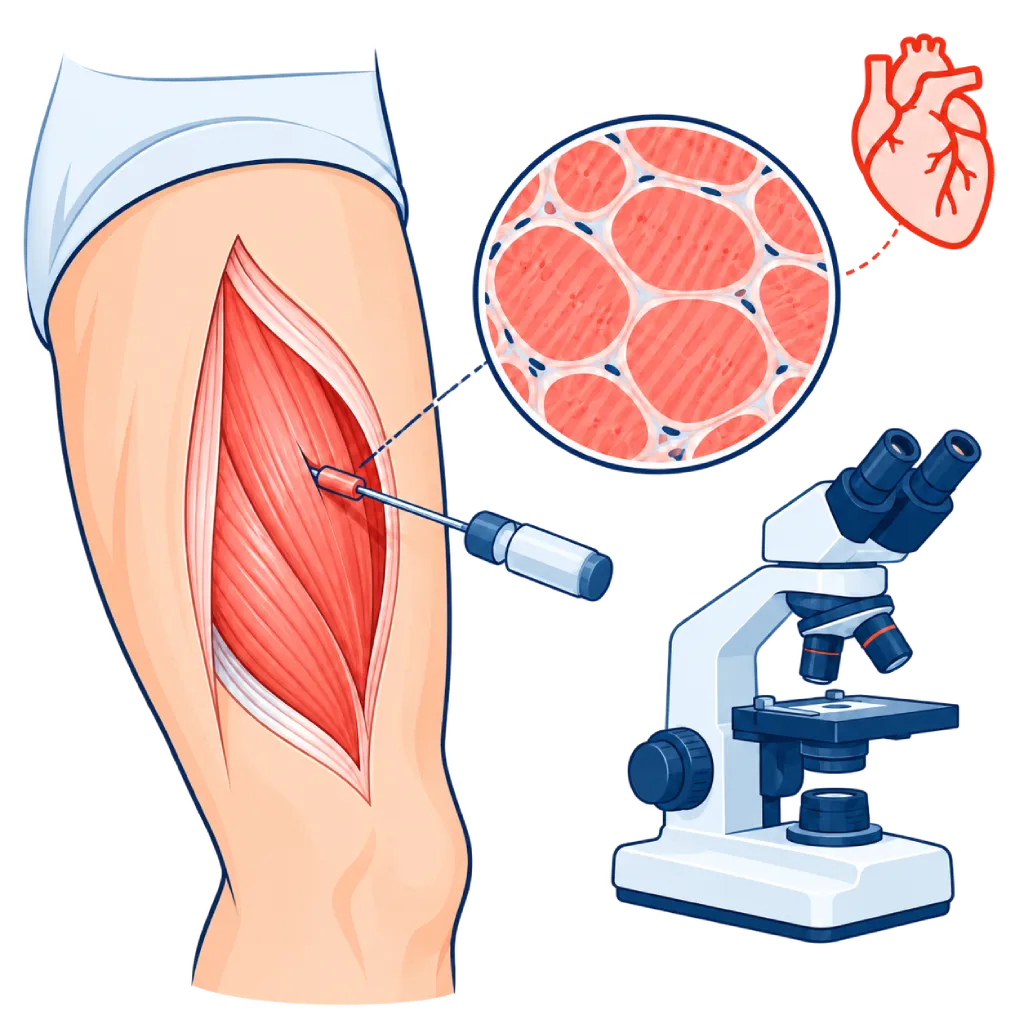
A muscle biopsy is the removal of a small sample of muscle tissue, usually from the thigh or upper arm, under local anesthesia. The sample is examined in a laboratory to confirm the type of muscle disease. Some muscle diseases also affect the heart muscle, so the results help your doctor plan heart tests and monitoring.
Sources01 / Understanding the procedure
About Muscle Biopsy
What Is a Muscle Biopsy
A muscle biopsy is the removal of a small sample of skeletal muscle tissue for laboratory examination. The sample is viewed under a microscope with special stains, and if needed, its proteins, enzymes, or genetic material are also tested. The results help your doctor confirm the cause of muscle weakness, muscle pain, or high muscle enzyme levels.
Muscle Diseases That Also Affect the Heart
Heart muscle and skeletal muscle have a lot in common, so some muscle diseases also involve the heart. Establishing the diagnosis of a muscle disease helps the cardiologist estimate risk and decide on the monitoring needed.
- Duchenne and Becker muscular dystrophy: often accompanied by dilated cardiomyopathy, in which the heart muscle becomes weak and enlarged.
- Myotonic dystrophy and Emery-Dreifuss muscular dystrophy: can cause problems with the heart's electrical conduction and rhythm disorders.
- Mitochondrial diseases and certain storage diseases: can cause thickening or weakening of the heart muscle.
- Muscle inflammation (myositis): sometimes accompanied by inflammation of the heart muscle (myocarditis).
Muscle Biopsy and Genetic Testing
Today, many inherited muscle diseases can be confirmed with genetic testing from a blood sample. A muscle biopsy is still needed when genetic testing has not provided an answer, when muscle inflammation is suspected, or when the doctor needs to see the tissue damage directly to decide on treatment.
Types of Muscle Biopsy
A needle biopsy takes a sample through a small incision a few millimeters long. An open biopsy takes a larger sample through an incision a few centimeters long. The doctor chooses a muscle that is affected but not too badly damaged, sometimes with the help of muscle MRI.
02 / Understanding the procedure
When Is This Procedure Considered?
A doctor may consider this procedure in the situations below. The decision is always made after a thorough assessment.
- Muscle Weakness with an Unclear CauseWeakness that persists or worsens, especially when accompanied by high muscle enzyme (CK) levels.
- Suspected Muscle Inflammation (Myositis)Muscle pain and weakness with signs of inflammation, including when heart involvement is suspected.
- Inherited Muscle Disease with Inconclusive Genetic TestingFor example, suspected muscular dystrophy or mitochondrial disease that genetic testing has not yet answered.
- Cardiomyopathy with Muscle SymptomsThe heart muscle weakens or thickens along with skeletal muscle weakness, so the same muscle disease is suspected.
- Heart Rhythm or Conduction Disorders with Muscle AbnormalitiesWhen problems with the heart's electrical system appear together with signs of muscle disease, for example in suspected myotonic dystrophy.
Situations to Consider First
- Taking Blood Thinners or Having a Clotting DisorderMedications may need to be adjusted, and blood clotting tests are checked beforehand.
- Skin Infection at the Biopsy SiteThe biopsy site is moved or the procedure is postponed until the infection clears.
- Muscle Recently Tested with an EMG NeedleA muscle recently punctured by an EMG needle can give a misleading picture, so a different muscle is usually chosen.
- Risks with General AnesthesiaIn some muscle diseases, certain general anesthetics carry risks. For this reason, the biopsy is usually done under local anesthesia, and the anesthesia team assesses you beforehand if general anesthesia is needed.
- Very Weak Heart FunctionHeart monitoring during the procedure needs to be arranged, especially if sedation is needed.
03 / Before the procedure
How Should You Prepare?
A muscle biopsy is usually done under local anesthesia without a hospital stay. The team will give you written instructions.
Current medications. Bring a list of all your medications. Blood thinners may need to be stopped temporarily as directed by your doctor, and do not stop them on your own.
Blood tests. Blood clotting tests and other tests may be done before the procedure.
Allergies. Tell the team if you have ever been allergic to local anesthetics, antiseptics, adhesive tape, or latex.
Anesthesia history. Tell the team if you or a family member has ever had a severe reaction to general anesthesia.
Clothing and a companion. Wear loose clothing that allows easy access to your thigh or upper arm, and bring someone to accompany you home.
For children. Children may need sedation or general anesthesia. Explain the procedure in simple language and follow the fasting instructions from the team.
Unsure about the preparation instructions? Ask our team before the procedure.
04 / During the procedure
How Is the Procedure Done?
The procedure is done in a procedure room and usually takes about 30 minutes, sometimes longer for an open biopsy.
Preparing the Site
You lie in a comfortable position. The skin over the chosen muscle, usually the thigh or upper arm, is cleaned with antiseptic.
Local Anesthesia
A local anesthetic is injected into the skin and the tissue beneath it. You stay awake, and once the anesthetic takes effect, you only feel pressure or pulling.
Taking the Sample
In a needle biopsy, a special needle is inserted through a small incision to take several small pieces of muscle. In an open biopsy, an incision a few centimeters long is made to take the muscle sample directly.
Closing the Wound
Pressure is applied to the wound to stop the bleeding, then it is closed with special adhesive strips or a few stitches and bandaged.
Processing the Sample
The sample is sent to the laboratory right away and processed in a special way, for example by freezing, so the proteins and enzymes in the muscle can still be tested.
05 / Benefits and risks
Benefits and Risks Should Be Discussed Together.
Every medical procedure has benefits and risks. Your doctor will explain both for your situation before the procedure.
Benefits You Can Expect
- Confirms the Type of Muscle DiseaseIt distinguishes inherited muscle diseases, muscle inflammation, and other causes of muscle weakness.
- Guides TreatmentFor example, muscle inflammation requires medications that suppress inflammation, while inherited diseases require a different approach.
- Assesses Heart RiskAn accurate diagnosis helps determine heart tests and monitoring, including for rhythm disorders.
- Information for the FamilyIf the disease is inherited, family members may be advised to get tested.
- Short Procedure Without a Hospital StayUsually done under local anesthesia, and you can go home the same day.
The benefits of a procedure are not a promise of a cure. Ask how the results will affect your care plan.
Risks You Should Know
- Pain and BruisingCommon, and usually improves within a few days.
- Bleeding or HematomaMore likely in people taking blood thinners.
- Wound InfectionRare, and prevented with sterile technique and good wound care.
- Scarring and NumbnessA small scar may remain, and the skin around the wound sometimes feels numb for a while.
- Sample Does Not Provide an AnswerSometimes the sample does not show the abnormality being looked for, so other tests or a repeat biopsy are needed.
Risks can differ from person to person. A full explanation and consent are given after an individual assessment.
06 / After the procedure
What Is Recovery Like?
You can usually go home shortly after the procedure.
Pain and bruising. Mild pain and bruising at the biopsy site are normal for a few days. Mild pain relievers can be used as your doctor advises.
Wound care. Keep the bandage dry for about two days or as instructed. If you have stitches, they are usually removed after about one week.
Activity. Light activities can be resumed right away. Avoid strenuous exercise involving the biopsied muscle for a few days.
Results. Basic results may be available within a few days, while special stains and further tests can take several weeks. Your doctor will discuss the results along with a plan for heart tests if needed.
Warning signs. Contact the medical team if you have:
- Bleeding that soaks through the bandage or does not stop
- Growing swelling, redness, or pus at the wound
- Fever
- Worsening pain or numbness that does not improve
Know the Signs That Need Prompt Care.
Follow the team's guidance on warning signs. If severe or sudden symptoms appear after the procedure, go to the nearest emergency department right away or call Heart Attack Center 1500 258.
07 / Team and support
Doctors and Procedure Support
The doctors below are listed for this procedure. Listed by name, not by ranking.

dr. Ayu Amalia U. Putri, Sp.KFR
Physical Medicine & Rehabilitation
Clinical focusCardiac Rehabilitation · Postoperative Rehabilitation
View Profile
dr. Indah A. Putri, Sp.N, Subsp, NIOO(K), MSc
Neurovascular, Interventional, Otology, Imaging, and Ophthalmology
Clinical focusStroke and Cerebrovascular Disease · Neurosonology
View Profile
dr. Siska S. Danny, Sp.JP(K)
Interventional Cardiology
Coronary Intervention Procedures
Clinical focusPCI for Acute Coronary Syndrome · Primary Coronary Intervention
View Profile08 / Common questions
Before You Plan the Procedure.
Questions that are often asked before a muscle biopsy. The testing plan for you is decided after a consultation with your doctor.
Is a muscle biopsy painful?
The local anesthetic injection feels like a brief sting. Once the anesthetic takes effect, you usually only feel pressure or pulling while the sample is taken. After the anesthetic wears off, the biopsy site may feel sore and bruised for a few days, which can usually be managed with mild pain relievers.
Why would a cardiologist request a muscle biopsy?
Some muscle diseases also affect the heart muscle, for example muscular dystrophy and myotonic dystrophy. When a heart problem appears together with muscle weakness, confirming the type of muscle disease helps the doctor determine heart risk, further testing, and the rhythm monitoring needed. The results also determine whether family members need to be tested.
Can genetic testing replace a muscle biopsy?
For many inherited muscle diseases, genetic testing from a blood sample is now often the initial test. However, a muscle biopsy is still needed when genetic testing has not provided an answer, when muscle inflammation is suspected, or when the doctor needs to see the tissue damage directly to decide on treatment.
How long does it take to get muscle biopsy results?
Basic examination under the microscope is usually completed within a few days. Special stains and tests of proteins, enzymes, or genetic material can take several weeks, especially if the sample is sent to a reference laboratory. Your doctor will schedule a follow-up visit to discuss the complete results together with your heart test results and other tests already done.
When can I return to my usual activities?
Light activities are usually fine right after the procedure. Avoid strenuous exercise involving the biopsied muscle for a few days so the wound can heal and does not bleed. Keep the bandage dry as instructed, and ask the team when you can shower normally or swim.
Does a muscle biopsy leave a scar?
A needle biopsy usually leaves only a small mark a few millimeters long. An open biopsy leaves a scar a few centimeters long that usually fades over time. Caring for the wound properly, not scratching it, and protecting it from direct sunlight for a few weeks help it heal more neatly.
Sources and Medical Review
Translated from the Indonesian edition medically reviewed by dr. Indah A. Putri, Sp.N, Subsp, NIOO(K), MSc.
Sources as cited in the Indonesian edition.
- Feingold B, Mahle WT, Auerbach S, et al. Management of Cardiac Involvement Associated With Neuromuscular Diseases: A Scientific Statement From the American Heart Association. Circulation. 2017;136(13):e200-e231.
- Joyce NC, Oskarsson B, Jin LW. Muscle Biopsy Evaluation in Neuromuscular Disorders. Phys Med Rehabil Clin N Am. 2012;23(3):609-631.
- Lundberg IE, Tjärnlund A, Bottai M, et al. 2017 European League Against Rheumatism/American College of Rheumatology classification criteria for adult and juvenile idiopathic inflammatory myopathies and their major subgroups. Ann Rheum Dis. 2017;76(12):1955-1964.
- Arbelo E, Protonotarios A, Gimeno JR, et al. 2023 ESC Guidelines for the management of cardiomyopathies. Eur Heart J. 2023;44(37):3503-3626.