
Quick answer
What Is Vasospastic Angina?
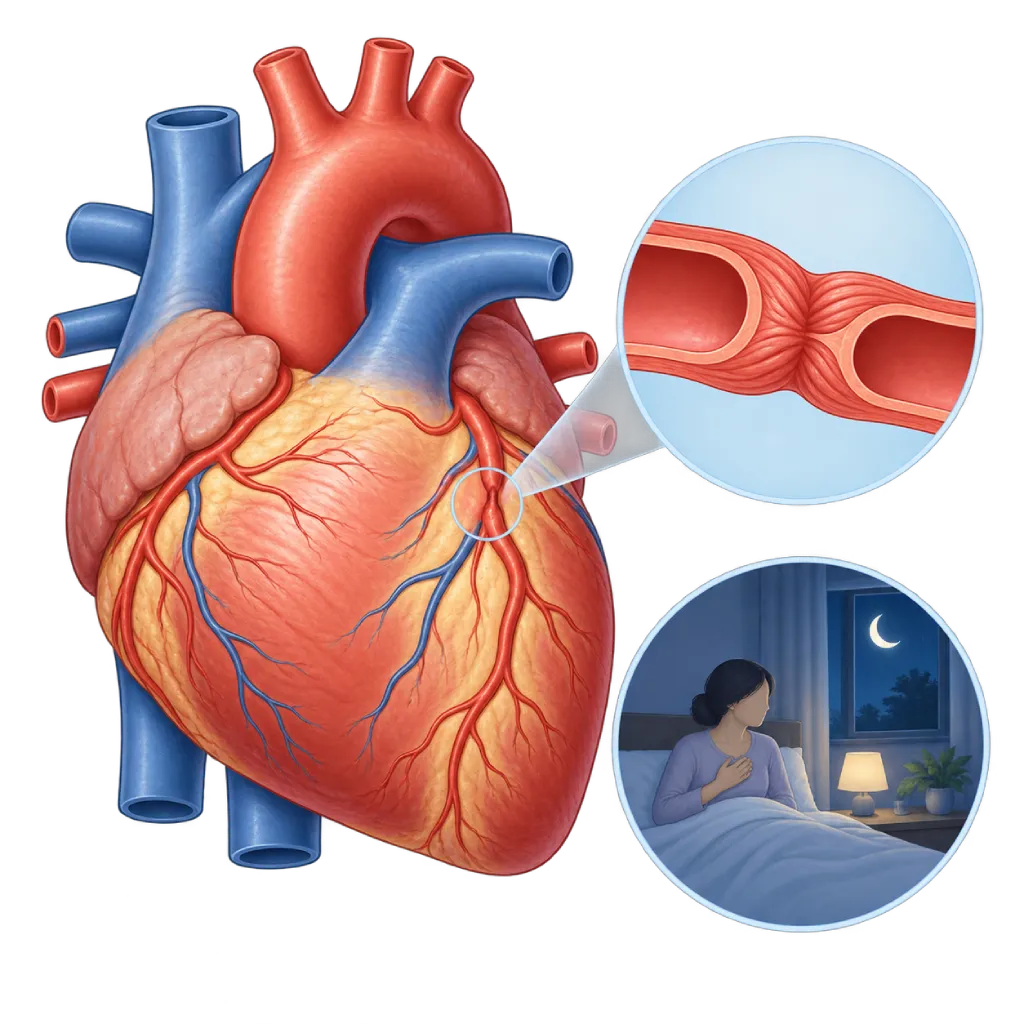
Variant or vasospastic angina is chest pain caused by a temporary cramping (spasm) of a coronary artery that restricts blood flow to the heart muscle. Attacks often occur at rest, especially from midnight to early morning.
SourcesSigns That Need Urgent Help
- Pain that does not ease a few minutes after taking nitrates, or lasts longer than your usual attacks
- Fainting or nearly fainting during chest pain
- A very fast or irregular heartbeat during an attack
- Severe shortness of breath, cold sweat, or pale skin
- Attacks that become more frequent or more severe than usual
If these signs appear, go to the nearest emergency department right away or call Heart Attack Center 1500 258.
01 / Understanding the condition
About Vasospastic Angina
Variant angina, also called vasospastic angina or Prinzmetal angina, is angina pectoris caused by a cramping (spasm) of a coronary artery. The muscle layer in the artery wall contracts too strongly, so the vessel narrows sharply or closes for a moment. Unlike stable angina, which is triggered by physical activity, variant angina attacks usually occur at rest. Between attacks, the coronary arteries may look normal or only slightly narrowed on angiography.
What Happens During an Attack
During a spasm, blood flow to part of the heart muscle drops sharply. An ECG recorded at that moment may show ST-segment changes that resemble a heart attack and then return to normal once the spasm eases. Attacks usually last from a few minutes to about 15 minutes and are quickly relieved by short-acting nitrates. Attacks often come at roughly the same time of day, especially from midnight to early morning, while the ability to exercise during the day often remains good.
Common Triggers
Smoking is the main risk factor. Other triggers include cold air, emotional stress, fast and deep breathing (hyperventilation), excessive alcohol, cocaine or amphetamines, triptan or ergot migraine medicines, some decongestants, and some chemotherapy drugs. Low magnesium levels have also been linked to a tendency toward spasm.
Who Is More Often Affected
Vasospastic angina is reported more often in East Asian populations, such as in Japan and Korea, than in European populations. People with this condition tend to be younger than people with stable angina and are often smokers. Spasm can occur together with a disorder of the small blood vessels of the heart, covered on the Microvascular Angina page.
Outlook with Treatment
By quitting smoking, avoiding triggers, and taking spasm-preventing medicines regularly, most people with this condition can control their attacks, and the long-term outlook is generally good, especially when there is no major plaque narrowing. Spasm-preventing medicines are usually taken long term. Stopping them suddenly can trigger more severe attacks, so any change in your medicines should first be discussed with your doctor. Regular follow-up visits help assess whether treatment needs adjusting.
02 / Understanding the condition
Symptoms to Recognize.
Common Symptoms
- Pain, pressure, or a squeezing feeling in the chest at rest
- Attacks often occur from midnight to early morning
- Pain lasts a few minutes and is quickly relieved by short-acting nitrates
- Attacks recur at roughly the same time of day
- Pain spreading to the neck, jaw, shoulder, or arm
- Palpitations, dizziness, or cold sweat during an attack
- The ability to exercise during the day often remains good
03 / Understanding the condition
What Causes This Condition?
- An overly sensitive muscle layer in the coronary arteries that readily contracts too strongly
- Dysfunction of the inner lining of the blood vessels (endothelium), which reduces the body's natural vessel-widening substances
- Changes in the balance of the autonomic nervous system from night to morning
- External triggers such as smoking, cold air, stress, excessive alcohol, cocaine, or amphetamines
- Certain medicines, such as triptans or ergots for migraine, some decongestants, and some chemotherapy drugs
- Spasm can occur in normal arteries as well as at sites of mild plaque
04 / Understanding the condition
Who Is at Higher Risk?
Lifestyle
Smoking is the main risk factor for vasospastic angina. Excessive alcohol, stress, and the use of cocaine or amphetamines can also trigger attacks.
Genetic
Vasospastic angina is found more often in East Asian populations, which is thought to be related to certain genetic variations.
Medical
Migraine, Raynaud's phenomenon (fingers turning pale or bluish in the cold), and low magnesium levels are linked to a tendency toward blood vessel spasm.
Age
It often appears at a younger age than stable angina, including in people whose only risk factor is smoking.
Groups at Higher Risk
- Smokers, Including Young People: Smoking is the main risk factor for vasospastic angina, and quitting smoking reduces how often attacks occur.
- East Asian Populations: Vasospastic angina is reported more often in Japanese and Korean people than in European populations, thought to be due to genetic factors.
- People with Migraine or Raynaud's Phenomenon: A tendency toward blood vessel spasm elsewhere in the body is linked to coronary artery spasm, and some migraine medicines can trigger it.
- Cocaine or Amphetamine Users: These stimulants can trigger severe coronary spasm, even in young people with no previous heart disease.
05 / Understanding the condition
How Is It Diagnosed?
Because attacks often happen at home at night, your description of the symptoms is the first clue: when the pain starts, how long it lasts, what triggers it, and whether it eases quickly with nitrates. The diagnosis becomes strong when an ECG recorded during pain shows temporary ST-segment changes that return to normal after the attack. To capture such an attack, your doctor may ask for long-term ECG recording with a Holter monitor.
Coronary angiography or CT coronary angiography is done to look for plaque narrowing. If the arteries are not severely blocked, a provocation test with acetylcholine or ergonovine during catheterization can confirm spasm in a controlled way. This test is done under close monitoring, and any spasm that appears is relieved right away with nitrates given directly into the coronary artery.
According to the COVADIS criteria, a definite diagnosis is made when angina that eases with nitrates is accompanied by temporary ischemic ECG changes during an attack or by spasm proven on a provocation test.
Electrocardiogram (ECG)
A recording made during an attack may show temporary ST-segment changes; between attacks, the result is often normal.
Holter Monitoring
Records the ECG for 24 to 48 hours to capture changes during nighttime attacks and any accompanying rhythm disturbances.
Coronary Angiography
Checks for plaque narrowing; in the same procedure, it can be followed by a spasm provocation test.
CT Coronary Angiography
A catheter-free option to rule out major plaque narrowing in the coronary arteries.
A provocation test with acetylcholine or ergonovine during catheterization to trigger and confirm spasm in a controlled way.
06 / Understanding the condition
Treatment Options.
Treatment is decided by a doctor after an assessment. The categories below can help you follow the conversation with your doctor.
Calcium Channel Blockers
The main class of medicines for preventing spasm. Your doctor sets the type, dose, and timing based on your attack pattern.
Short-Acting and Long-Acting Nitrates
Short-acting nitrates relieve an attack. Long-acting nitrates may be added if attacks continue despite calcium channel blockers.
Quitting Smoking and Avoiding Triggers
Quitting smoking and avoiding sudden cold air, excessive alcohol, and stimulants reduce how often attacks occur.
Adjusting Other Medicines
Some medicines, including certain beta blockers, triptans, and decongestants, can worsen spasm. Tell your doctor about all the medicines you use so they can be adjusted.
Statins and Risk Factor Control
Statins may be considered, especially if plaque is present. Blood pressure, blood sugar, and cholesterol are still kept under control.
ICD in Certain Cases
For people who have survived cardiac arrest caused by spasm, the doctor may consider implanting an ICD alongside spasm-preventing medicines.
07 / Understanding the condition
Complications to Watch For.
Heart Attack
A prolonged spasm can damage the heart muscle even when the artery is not blocked by plaque, covered on the Myocardial Infarction with Non-Obstructive Coronary Arteries (MINOCA) page.
Heart Rhythm Disorders
During a spasm, heart block or a fast ventricular rhythm can occur, so some patients need longer heart rhythm monitoring.
Cardiac Arrest
In a small number of patients, a rhythm disturbance during spasm can stop the heart from pumping. Survivors are assessed for an ICD in addition to medicines.
Recurrent Attacks
If triggers are not avoided or medicines are stopped suddenly, attacks can return, even after a long symptom-free period.
08 / Understanding the condition
What Can You Do?
- Quit smoking completely, the main step to reduce attacks
- Avoid sudden exposure to cold air and wear warm clothing
- Avoid cocaine, amphetamines, and excessive alcohol
- Check with your doctor first before using migraine medicines, decongestants, or diet pills
- Take spasm-preventing medicines regularly and do not stop them suddenly without your doctor's advice
- Manage stress and get enough sleep
- Carry the short-acting nitrate prescribed for you and know how to use it
09 / Understanding the condition
When Should You See a Doctor?
Chest pain at rest that you are having for the first time needs prompt checking in the emergency room, because at home it cannot be told apart from a heart attack. If similar attacks recur and ease within a few minutes, make an appointment with a cardiologist to find the cause. Note the time, duration, and trigger of each attack, because these notes help with the diagnosis. If the pain does not ease a few minutes after using nitrates, lasts longer than your usual attacks, or comes with fainting and a pounding heartbeat, go to the emergency room right away.
- Recurring chest pain at rest, especially from midnight to early morning.
- Chest pain after using migraine medicines, decongestants, or stimulants.
- Attacks that keep occurring even though you are already taking spasm-preventing medicines.
- A plan to quit smoking that needs support.
Don't Wait in an Emergency.
If symptoms are severe or come on suddenly, go to the nearest emergency department right away or call Heart Attack Center 1500 258, rather than waiting for an appointment.
10 / Common questions
Questions You May Have.
Frequently asked questions about variant or vasospastic angina.
How is variant angina different from typical angina?
Typical angina, or stable angina, is caused by a fixed plaque narrowing and appears during physical activity. Variant angina is caused by a temporary spasm of a coronary artery, so it appears at rest, often from midnight to early morning, and the arteries may look normal between attacks. The treatment is also different: calcium channel blockers are the main medicines for preventing spasm.
Why do attacks often occur at night or in the early morning?
From night to morning, the balance of the autonomic nervous system and of the hormones that regulate blood vessel tone changes. In people with sensitive coronary arteries, these changes are enough to trigger a spasm. For this reason, your doctor may time your spasm-preventing medicines so they protect you during the hours when your attacks usually occur.
Can vasospastic angina occur in normal coronary arteries?
Yes. Spasm can occur in arteries that look normal on angiography, as well as at sites of mild plaque. This is why a normal angiogram does not rule out vasospastic angina if typical symptoms persist. In such cases, an ECG recorded during an attack or a spasm provocation test can help confirm the diagnosis.
Can I stop taking my medicine if I have not had an attack for a long time?
Do not stop on your own. Stopping calcium channel blockers suddenly can trigger more severe attacks. If you have been free of attacks for a long time and have quit smoking, your doctor can assess whether the dose may be reduced gradually with monitoring. This decision is made together with the doctor who treats you.
What is the outlook for vasospastic angina?
For most people with this condition, the long-term outlook is good if they quit smoking, avoid triggers, and take their medicines regularly. The risk is higher in people with spasm in several arteries, accompanying plaque narrowing, or a history of cardiac arrest. Your doctor will assess these factors to decide on suitable monitoring and treatment.
Is the spasm provocation test safe?
The provocation test is done during catheterization with direct monitoring of the ECG, blood pressure, and images of the arteries. If spasm occurs, the doctor relieves it right away with nitrates injected directly into the coronary artery. Complications are rare and usually temporary. Your doctor will explain the benefits and risks before you decide whether to undergo this test.
Sources and Medical Review
Translated from the Indonesian edition medically reviewed by Dr. dr. Jajang Sinardja, Sp.JP(K).
Sources as cited in the Indonesian edition.
- Beltrame JF, Crea F, Kaski JC, Ogawa H, Ong P, Sechtem U, et al. International standardization of diagnostic criteria for vasospastic angina. Eur Heart J. 2017;38(33):2565-8. Epub 2015.
- Hokimoto S, Kaikita K, Yasuda S, Tsujita K, Ishihara M, Matoba T, et al. JCS/CVIT/JCC 2023 Guideline Focused Update on Diagnosis and Treatment of Vasospastic Angina (Coronary Spastic Angina) and Coronary Microvascular Dysfunction. Circ J. 2023;87(6):879-936.
- Vrints C, Andreotti F, Koskinas KC, Rossello X, Adamo M, Ainslie J, et al. 2024 ESC Guidelines for the management of chronic coronary syndromes. Eur Heart J. 2024;45(36):3415-537.
- Kunadian V, Chieffo A, Camici PG, Berry C, Escaned J, Maas AHEM, et al. An EAPCI Expert Consensus Document on Ischaemia with Non-Obstructive Coronary Arteries in Collaboration with European Society of Cardiology Working Group on Coronary Pathophysiology & Microcirculation Endorsed by Coronary Vasomotor Disorders International Study Group. Eur Heart J. 2020;41(37):3504-20.
- Picard F, Sayah N, Spagnoli V, Adjedj J, Varenne O. Vasospastic angina: A literature review of current evidence. Arch Cardiovasc Dis. 2019;112(1):44-55.
Doctors Who Treat This Condition

Dr. dr. Jajang Sinardja, Sp.JP(K)
Interventional Cardiology
Coronary Intervention Procedures
Clinical focusAcute Coronary Syndrome · Primary Coronary Intervention
View Profile
dr. Puti S. Saus, Sp.JP(K)
Interventional Cardiology
Coronary Intervention Procedures
Clinical focusAcute Coronary Syndrome · Primary Coronary Intervention
View Profile
dr. Adrianus Kosasih, Sp.JP(K)
Interventional Cardiology
Coronary Intervention Procedures
Clinical focusPrimary Coronary Intervention · PCI for Acute Coronary Syndrome
View Profile