
Quick answer
What Is CT Coronary Angiography?
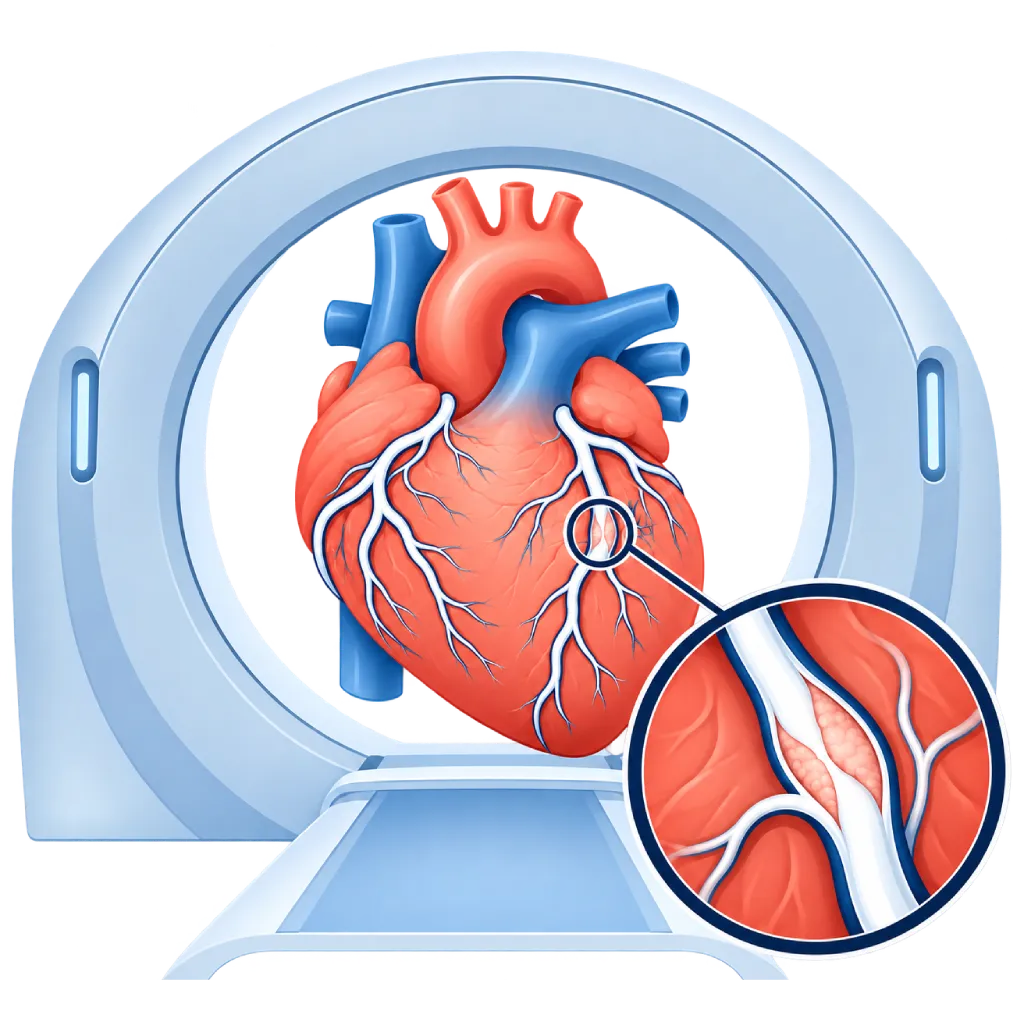
CT coronary angiography is a CT scan with contrast dye injected through your arm to image the heart's blood vessels without a catheter. Its three-dimensional images show plaque and narrowing. Time in the CT room is usually less than 30 minutes, and a normal result almost rules out narrowing of the coronary arteries.
Sources01 / Understanding the procedure
About CT Coronary Angiography
What Is CT Coronary Angiography
CT coronary angiography, often called coronary CT or CCTA, is a special CT scan to view the coronary arteries, the blood vessels that supply the heart muscle. Unlike cardiac catheterization, this test does not require a tube to be inserted into a blood vessel; the contrast dye is simply injected through an IV line in your arm.
How It Works in Brief
As iodine-based contrast dye flows through the coronary arteries, the CT scanner takes X-ray images of the heart from many directions within a few seconds. The images are synchronized with an ECG recording so they are taken when the heart is relatively still, which is why a slow, regular heartbeat produces sharper images. A computer then builds a three-dimensional image of the coronary arteries, complete with any plaque and narrowing.
When This Test Is Chosen
- Chest pain with a low to moderate likelihood of coronary artery disease: guidelines recommend coronary CT as the initial test.
- Inconclusive stress test results: to confirm whether narrowing is present.
- Abnormal origin of the coronary arteries and bypass grafts: CT clearly shows the course of the vessels.
- Before certain heart surgery: for example valve surgery, to rule out coronary narrowing in selected patients.
What the Results Mean
Clear arteries almost rule out coronary artery disease as the cause of your symptoms. If plaque is found that does not yet cause narrowing, your doctor may start preventive medicines and lifestyle changes; in a large study, this approach lowered the risk of heart attack. If the narrowing is severe or its effect is unclear, your doctor may request a stress test or cardiac catheterization. Very heavy calcification, small stents, and an irregular heart rhythm can make the images hard to assess.
02 / Understanding the procedure
When Is This Procedure Considered?
A doctor may consider this procedure in the situations below. The decision is always made after a thorough assessment.
- Chest Pain with Suspected Coronary Artery DiseaseAn initial test when the likelihood of disease is low to moderate.
- Shortness of Breath on Exertion Without a Clear CauseTo look for coronary narrowing as the cause.
- Inconclusive Stress Test ResultsTo confirm whether coronary artery narrowing is present.
- Low-Risk Chest Pain in the Emergency RoomHelps confirm that the symptoms are not caused by coronary narrowing.
- Abnormal Coronary Artery Origin or Bypass GraftsShows the course and condition of the vessels.
- Before Valve or Other Heart SurgeryTo rule out coronary narrowing in selected patients.
Situations to Consider First
- Severe Allergy to Iodine-Based ContrastYour doctor considers another test, or gives anti-allergy medicine beforehand.
- Severely Reduced Kidney FunctionYour doctor weighs the benefits or chooses another test.
- PregnancyX-ray tests are avoided unless truly necessary.
- Uncontrolled HyperthyroidismThe iodine in contrast dye can worsen a thyroid condition.
- Fast or Irregular Heartbeat That Is Hard to SlowThe images may be blurred, so another test may be more suitable.
- Recent Use of Erectile Dysfunction MedicineSuch as sildenafil or tadalafil; nitroglycerin must not be given at the same time.
03 / Before the procedure
How Should You Prepare?
The team will give you written instructions before the test.
Caffeine and smoking. Avoid coffee, tea, energy drinks, and smoking for 12 hours or more beforehand, because they can speed up your heart rate.
Eating. You usually need to stop eating 2 to 4 hours beforehand; plain water is still allowed.
Medicines. Regular medicines are usually still taken. Your doctor may give you a beta blocker to slow your heart rate. Tell the team if you have taken erectile dysfunction medicine in the past 2 days. If your kidney function is severely reduced, metformin may need to be stopped temporarily.
Kidneys, allergies, and thyroid. If you have kidney disease or diabetes, or are older, your kidney function is checked beforehand. Tell the team if you have ever had a contrast allergy, or if you have asthma or a thyroid disorder, or are pregnant.
Unsure about the preparation instructions? Ask our team before the procedure.
04 / During the procedure
How Is the Procedure Done?
The scan in the CT room usually takes less than 30 minutes, while the whole visit, including preparation and monitoring, takes about 1 to 2 hours.
Preparing the Heart Rate
A small IV line is placed in your arm and ECG electrodes are attached to your chest. If your heart rate is still fast, you are given medicine to slow it down. Just before the scan, a nitroglycerin tablet or spray is given under your tongue to widen the coronary arteries.
Lying Down and Practicing Breath-Holding
You lie on the CT table with both arms above your head. The staff will help you practice holding your breath for a few seconds.
Contrast and Scanning
The contrast dye is injected through the IV line. You may briefly feel warm all over or feel as if you need to urinate; this is normal. The scan takes a few seconds while you hold your breath.
Reading the Results
A computer builds three-dimensional images, then the doctor assesses each coronary artery, any plaque, and the degree of narrowing.
05 / Benefits and risks
Benefits and Risks Should Be Discussed Together.
Every medical procedure has benefits and risks. Your doctor will explain both for your situation before the procedure.
Benefits You Can Expect
- Views the Coronary Arteries Without a CatheterOnly an IV line in your arm is needed, with no tube to the heart.
- A Normal Result Is Highly ReliableClear arteries almost rule out coronary narrowing.
- Detects Plaque EarlyPlaque that does not yet cause narrowing can be treated with preventive medicines.
- QuickThe scan takes only a few seconds and the results can be read promptly.
- Maps the Course of the VesselsUseful for abnormal coronary artery origins and bypass grafts.
The benefits of a procedure are not a promise of a cure. Ask how the results will affect your care plan.
Risks You Should Know
- Allergic Reaction to ContrastUsually mild, such as itching or a rash; severe reactions are rare.
- Kidney ProblemsThe risk is low with normal kidneys and receives closer attention in severe kidney disease.
- Radiation ExposureWith modern scanners the dose is low and is kept as low as possible.
- Side Effects of Preparation MedicinesHeadache, dizziness, or a brief drop in blood pressure.
Risks can differ from person to person. A full explanation and consent are given after an individual assessment.
06 / After the procedure
What Is Recovery Like?
You are monitored briefly after the test, then you can go home and resume your usual activities. A mild headache from the nitroglycerin usually goes away on its own.
After the test. Drink plenty of water to help your kidneys clear the contrast dye, unless your doctor limits your fluids. If metformin was stopped, follow the instructions on when to restart it.
Warning signs. Contact the medical team right away or go to the emergency room if you have:
- Itching, a rash, or swelling of the face
- Shortness of breath or chest pain
- Swelling, pain, or redness at the IV site
- Much less urine than usual
Know the Signs That Need Prompt Care.
Follow the team's guidance on warning signs. If severe or sudden symptoms appear after the procedure, go to the nearest emergency department right away or call Heart Attack Center 1500 258.
07 / Team and support
Doctors and Procedure Support
The doctors below are listed for this procedure. Listed by name, not by ranking.

dr. Adrianus Kosasih, Sp.JP(K)
Interventional Cardiology
Coronary Intervention Procedures
Clinical focusPrimary Coronary Intervention · PCI for Acute Coronary Syndrome
View Profile
Dr. med. dr. Denio A. Ridjab, Sp.JP(K)
Interventional Cardiology
Coronary Intervention Procedures +2 centers
Clinical focusInterventional Cardiology · Coronary Artery Disease
View Profile
dr. Ika Ruriana, Sp.Rad
Radiology
Cardiovascular Diagnostic Center
Clinical focusDiagnostic Radiology · Radiography (X-Ray)
View ProfileCT Scan 512 Slices
A CT scanner that produces up to 512 image slices in a single rotation to show the coronary arteries, calcium in the artery…
The availability of technology and test support is confirmed with the team. Technology is chosen according to clinical need.
08 / Common questions
Before You Plan the Procedure.
Frequently asked questions about CT coronary angiography. Your doctor explains what the results mean for your condition.
How is it different from cardiac catheterization?
Cardiac catheterization involves passing a thin tube through a blood vessel in the wrist or groin up to the heart, and any narrowing can be treated right away with a stent. CT coronary angiography uses no tube, only contrast dye through an IV line in the arm, but it is only for viewing. If severe narrowing is found, catheterization may be the next step.
How is it different from a CT calcium score?
A CT calcium score is done without contrast and only measures the amount of calcium in the walls of the coronary arteries to assess risk. CT coronary angiography uses contrast, so it shows the inside of the arteries, soft plaque that has not yet calcified, and the degree of narrowing. The two are often done one after the other in a single visit.
Why does my heart rate need to be slowed down?
The coronary arteries move with each heartbeat. If your heart beats too fast, the images become blurred, like a photo of a moving object. For this reason, your doctor may give you a beta blocker so your heart beats more slowly and regularly. Avoid coffee and smoking before the test because both speed up your heart rate.
Is the contrast dye safe for my kidneys?
With normal kidney function, the risk of kidney problems from contrast dye is very low. If you have kidney disease or diabetes, or are older, your kidney function is checked beforehand and your doctor weighs the benefits. Drinking enough water after the test helps your kidneys clear the contrast, unless your doctor limits your fluids.
Can it be done if I already have a stent or bypass?
Bypass grafts can usually be assessed well because they are fairly large. Stents can also be assessed, especially larger ones, but the metal of small stents can create shadows that hide the inside of the stent. Your doctor will decide whether coronary CT or another test is suitable for you.
What happens if plaque or narrowing is found?
Plaque that does not yet cause narrowing is usually treated with preventive medicines such as cholesterol-lowering drugs, along with lifestyle changes. If the narrowing is moderate to severe, your doctor may request a stress test to see its effect on blood flow, or cardiac catheterization to confirm it and, if needed, place a stent.
Sources and Medical Review
Translated from the Indonesian edition medically reviewed by dr. Sri Diniharini, Sp.JP(K).
Sources as cited in the Indonesian edition.
- Vrints C, Andreotti F, Koskinas KC, et al. 2024 ESC Guidelines for the management of chronic coronary syndromes. Eur Heart J. 2024;45(36):3415-3537.
- Gulati M, Levy PD, Mukherjee D, et al. 2021 AHA/ACC/ASE/CHEST/SAEM/SCCT/SCMR Guideline for the Evaluation and Diagnosis of Chest Pain. Circulation. 2021;144(22):e368-e454.
- SCOT-HEART Investigators, Newby DE, Adamson PD, Berry C, et al. Coronary CT angiography and 5-year risk of myocardial infarction. N Engl J Med. 2018;379(10):924-933.
- Abbara S, Blanke P, Maroules CD, et al. SCCT guidelines for the performance and acquisition of coronary computed tomographic angiography: a report of the Society of Cardiovascular Computed Tomography Guidelines Committee. J Cardiovasc Comput Tomogr. 2016;10(6):435-449.
- Davenport MS, Perazella MA, Yee J, et al. Use of Intravenous Iodinated Contrast Media in Patients with Kidney Disease: Consensus Statements from the American College of Radiology and the National Kidney Foundation. Radiology. 2020;294(3):660-668.