
Quick answer
What Is Coronary Angiography?
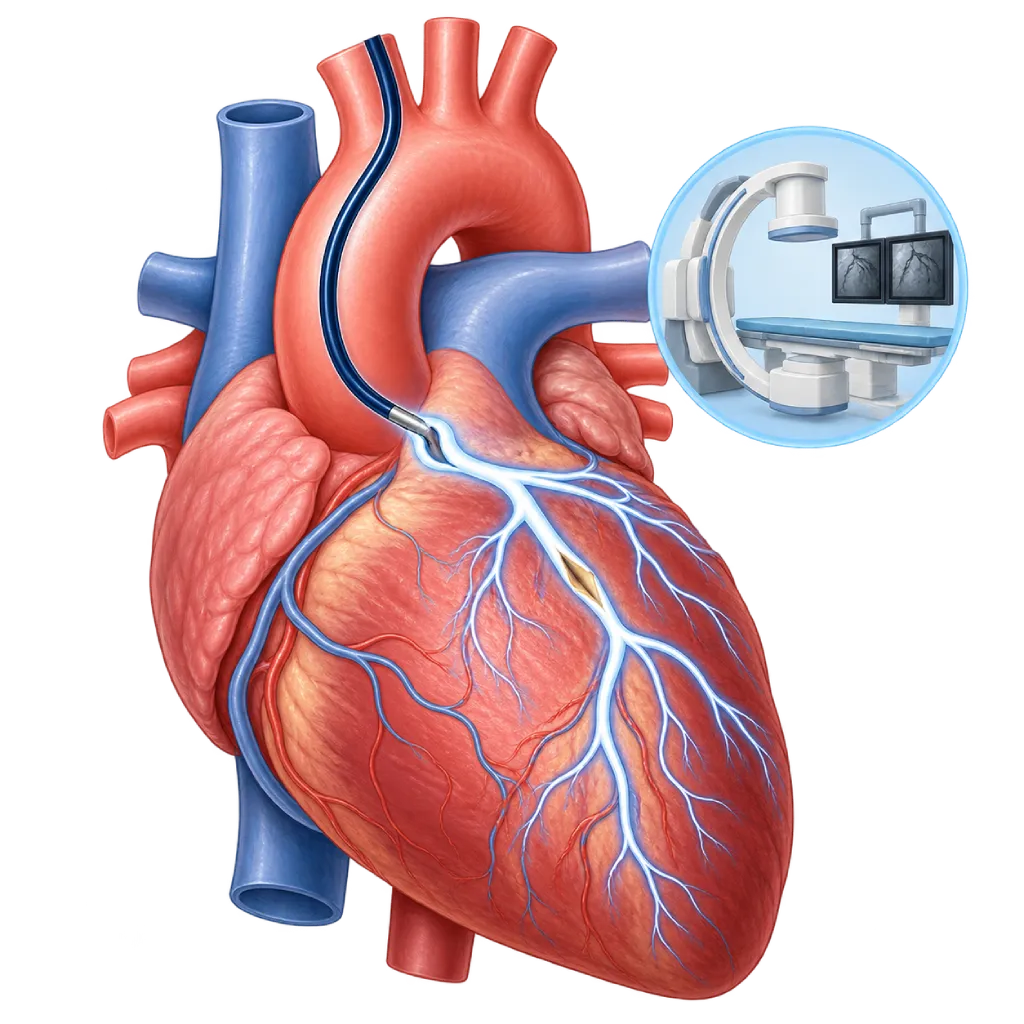
Coronary angiography is a test that shows the coronary arteries, which feed the heart muscle. A thin catheter is passed through the wrist or groin, and contrast dye is injected during X-ray recording. The results show the location and severity of narrowings, so your doctor can choose suitable treatment. It usually takes about 30 minutes to 1 hour.
Sources01 / Understanding the procedure
About Coronary Angiography
What Is Coronary Angiography
The coronary arteries are the blood vessels that carry oxygen-rich blood to the heart muscle. When fatty and calcium deposits called plaque build up in their walls, a condition known as atherosclerosis, the arteries narrow and can cause chest pain or a heart attack. Coronary angiography is a test that takes pictures of the inside of the coronary arteries: a thin catheter is guided to the openings of the coronary arteries, then contrast dye is injected so the arteries show up clearly on X-ray images.
Part of Cardiac Catheterization
Coronary angiography is part of left heart catheterization, which is why people often simply call it catheterization. Cardiac catheterization itself is broader, because it can include measuring pressures in the heart chambers, examining the right side of the heart, and assessing the valves, which is covered on the Cardiac Catheterization page. Coronary angiography focuses on images of the coronary arteries and their narrowings.
When This Test Is Recommended
During a heart attack, angiography is performed immediately or within the first 24 hours, depending on how severe the condition is, so that the blocked artery can be opened right away. For stable chest pain, angiography is recommended when the likelihood of coronary artery disease is high, when symptoms remain severe even though medication is taken regularly, or when a stress test shows a large area of reduced blood flow. This test is also used before valve surgery in certain patients and to look for the cause of heart failure or severe heart rhythm disorders.
Coronary Angiography and CT Coronary Angiography
CT coronary angiography images the coronary arteries with a CT scan and contrast dye given through an IV line in the arm, without a catheter. This test is often chosen first when the likelihood of coronary artery disease is low to moderate, and is covered on the CT Coronary Angiography page. Catheter angiography gives sharper images and allows a narrowing to be treated right away in the same procedure, so it is more suitable when the likelihood of disease is high or during a heart attack.
Reading the Results
Your doctor assesses where the narrowings are, how many vessels are affected, and how severe each narrowing is as a percentage. A narrowing that looks moderate does not necessarily disrupt blood flow. For this reason, guidelines recommend measuring the pressure inside the artery, for example with FFR, before deciding to place a stent in a borderline narrowing. If needed, the vessel wall can also be viewed from the inside with IVUS or optical coherence tomography.
Next Steps After Angiography
The angiography results help you and your doctor choose treatment: medication and lifestyle changes; widening the artery with a balloon and stent, which is covered on the Coronary Angioplasty page; or bypass surgery, which is covered on the Coronary Artery Bypass Grafting (CABG) page. In a planned procedure, a stent can be placed right away in the same procedure if this has been discussed and agreed on beforehand.
02 / Understanding the procedure
When Is This Procedure Considered?
A doctor may consider this procedure in the situations below. The decision is always made after a thorough assessment.
- Heart Attack and Acute Coronary SyndromePerformed immediately or within the first 24 hours, depending on how severe the condition is.
- Chest Pain with a High Likelihood of Coronary Artery DiseaseEspecially when symptoms are severe or persist even though medication is taken regularly.
- High-Risk Stress Test ResultsFor example, a treadmill test or stress echocardiography that shows a large area of reduced blood flow.
- Coronary CT Results That Need ConfirmationWhen CT coronary angiography shows a severe narrowing or the images are difficult to assess.
- Before Heart Valve SurgeryIn certain patients, to find out whether bypass surgery should be performed at the same time.
- Heart Failure or Severe Heart Rhythm DisordersTo look for coronary artery disease as the cause of a weakened heart or a dangerous heart rhythm.
Situations to Consider First
- Severe Allergy to Contrast DyeAllergy-preventing medication can be given beforehand, or a different test can be chosen.
- Severe Kidney ImpairmentThe amount of contrast is limited and IV fluids are given; your doctor weighs the benefits and risks.
- Active Bleeding or Clotting DisordersThese need to be controlled first if the angiography is not an emergency.
- Uncontrolled Fever or InfectionFor a planned procedure, the infection is usually treated first before angiography is scheduled.
- PregnancyX-rays are avoided unless urgent; if needed, the fetus is protected as carefully as possible.
03 / Before the procedure
How Should You Prepare?
For a planned angiography, the team will give you written instructions a few days beforehand. During a heart attack, preparation is done quickly in the emergency room.
Tests before the procedure. Blood tests, including kidney function, complete blood count, and blood clotting, as well as an ECG.
Medications you are taking. Bring a list of all your medications. Blood thinners and some diabetes medications, such as metformin and insulin, may need to be adjusted. Do not stop any medication without your doctor's instructions.
Fasting. Follow the fasting instructions from the team, usually for a few hours before the procedure.
Allergies. Tell the team if you have ever had an allergy to contrast dye, medications, adhesive tape, or latex.
Plan if a narrowing is found. Ask your doctor beforehand whether a stent may be placed right away in the same procedure if needed.
Companion. Arrange for someone to take you home, because you are advised not to drive on the day of the procedure.
Unsure about the preparation instructions? Ask our team before the procedure.
04 / During the procedure
How Is the Procedure Done?
Coronary angiography is performed in the catheterization laboratory (cath lab) by an interventional cardiologist. You stay awake under local anesthesia and may be given a mild sedative. The test usually takes about 30 minutes to 1 hour, longer if a stent is placed right away.
Preparing on the Procedure Table
You lie on your back. ECG electrodes, a blood pressure monitor, and an oxygen level monitor are attached, and an IV line is placed in your hand.
Creating the Access Point
After the skin is numbed, the doctor inserts a short tube into an artery in the wrist or groin. Access through the wrist is now chosen more often because the risk of bleeding is lower and you can move around sooner.
Injecting Contrast and Recording Images
A thin catheter is guided to the openings of the left and right coronary arteries under X-ray guidance. Contrast dye is injected several times while the X-ray camera moves to record from different angles. You may be asked to hold your breath briefly and may feel a brief warm sensation.
Reviewing the Results and Closing the Access Point
The doctor reviews the recordings on the screen. If needed, the movement of the left ventricle is also imaged or the pressure inside the artery is measured. The catheter is then removed; a compression band is placed on the wrist, while in the groin the site is pressed or sealed with a special closure device.
05 / Benefits and risks
Benefits and Risks Should Be Discussed Together.
Every medical procedure has benefits and risks. Your doctor will explain both for your situation before the procedure.
Benefits You Can Expect
- Clear Images of the Coronary ArteriesShows the location, length, and severity of narrowings in each branch of the coronary arteries.
- A Basis for Choosing TreatmentHelps determine whether medication is enough, or whether a stent or bypass surgery is needed.
- Can Proceed Directly to TreatmentA narrowing can be opened in the same procedure, especially during a heart attack.
- No Surgical IncisionOnly a small puncture in the wrist or groin under local anesthesia is needed.
The benefits of a procedure are not a promise of a cure. Ask how the results will affect your care plan.
Risks You Should Know
- Bruising or Bleeding at the Puncture SiteUsually mild, and less common when access is through the wrist.
- Reaction to Contrast DyeRanges from a mild rash and itching to a severe allergic reaction, which is rare and treated promptly by the team.
- Kidney Function ProblemsMore likely if kidney function is already reduced or you have diabetes; the amount of contrast is limited.
- Blocked Wrist ArterySometimes occurs after access through the wrist and usually causes no symptoms.
- Heart Rhythm DisturbancesUsually brief, when the catheter or contrast enters a coronary artery, and they go away on their own.
- Rare Serious ComplicationsSuch as a tear in a coronary artery, a heart attack, or a stroke, in fewer than 1 in 100 procedures.
Risks can differ from person to person. A full explanation and consent are given after an individual assessment.
06 / After the procedure
What Is Recovery Like?
Most patients can go home on the same day after being monitored for a few hours. If a stent is placed right away or the groin is used for access, you may stay in the hospital for one night.
The first few hours. The compression band on the wrist is loosened gradually. If the groin was used, you lie with your leg straight for a few hours.
Drink water. Drink enough water to help your kidneys clear the contrast dye, unless your doctor limits your fluids.
Activity. For a few days, avoid lifting heavy objects with the arm or leg used for access. If no stent was placed, many people can return to work in 1 to 2 days.
Results and follow-up visit. Your doctor usually explains the initial results on the same day, then discusses the treatment plan at your follow-up visit.
Warning signs to watch for. Go to the emergency room right away if you have:
- Chest pain, shortness of breath, or cold sweats
- Bleeding that does not stop with pressure, or a lump that grows quickly at the puncture site
- A hand or leg that feels cold, pale, numb, or very painful
- A rash, itching, facial swelling, or shortness of breath after receiving contrast dye
- Fever, or a puncture site that is red, swollen, and oozing pus
Know the Signs That Need Prompt Care.
Follow the team's guidance on warning signs. If severe or sudden symptoms appear after the procedure, go to the nearest emergency department right away or call Heart Attack Center 1500 258.
07 / Team and support
Doctors and Procedure Support
The doctors below are listed for this procedure. Listed by name, not by ranking.

dr. Adrianus Kosasih, Sp.JP(K)
Interventional Cardiology
Coronary Intervention Procedures
Clinical focusPrimary Coronary Intervention · PCI for Acute Coronary Syndrome
View Profile
Dr. dr. Dafsah A. Juzar, Sp.JP(K)
Interventional Cardiology
Coronary Intervention Procedures +1 center
Clinical focusComplex Coronary Intervention · Cardiac Catheterization
View Profile
Dr. med. dr. Denio A. Ridjab, Sp.JP(K)
Interventional Cardiology
Coronary Intervention Procedures +2 centers
Clinical focusInterventional Cardiology · Coronary Artery Disease
View ProfileRotational Atherectomy System
A system for treating calcified plaque in the coronary arteries. A small diamond-coated burr spins at high speed over a guidewire…
Physiologic Testing System (FFR / iFR)
Measurement of blood pressure inside the coronary artery during catheterization, using a wire with a pressure sensor, to assess…
Intracoronary Imaging System (IVUS / OCT)
Imaging from inside the coronary artery using ultrasound (IVUS) or near-infrared light (OCT). It is used during catheterization…
Catheterization Laboratory (Cath Lab)
A dedicated procedure room for cardiac catheterization, coronary angiography, stent placement, and other catheter-based heart…
The availability of technology and test support is confirmed with the team. Technology is chosen according to clinical need.
08 / Common questions
Before You Plan the Procedure.
Frequently asked questions about coronary angiography, from preparation to results.
Does coronary angiography hurt?
You stay awake, but the skin at the puncture site is numbed with local anesthesia, so you usually feel only pressure. You cannot feel the catheter moving inside the blood vessels. When the contrast dye is injected, some patients feel a brief warmth or a sensation of needing to urinate. Tell the team if you feel chest pain or discomfort so it can be treated right away.
What is the difference between coronary angiography and cardiac catheterization?
Cardiac catheterization is a broad term for procedures that pass a catheter into the heart, including measuring pressures in the heart chambers and examining the right side of the heart. Coronary angiography is the part of cardiac catheterization that specifically images the coronary arteries with contrast dye. That is why the two terms are often used for the same procedure, even though their scope is different.
How is it different from CT coronary angiography?
CT coronary angiography uses a CT scan and contrast dye given through an IV line in the arm, without a catheter, so it is suitable as a first test for chest pain when the likelihood of coronary artery disease is low to moderate. Catheter coronary angiography gives sharper images and allows a narrowing to be treated right away, so it is chosen when the likelihood is high or during a heart attack.
Can a stent be placed right away during angiography?
Yes. If a narrowing that needs to be opened is found and the procedure has been discussed and agreed on beforehand, your doctor can place a stent right away in the same procedure. For a borderline narrowing, the doctor may first measure the pressure inside the artery. When many vessels are narrowed, the choice between stents and bypass surgery is often discussed first with the heart team.
When can I return to my usual activities?
If no stent was placed, most patients go home on the same day and can return to work in 1 to 2 days. For a few days, avoid lifting heavy objects with the arm or leg used for the puncture. Ask your doctor when you may drive. If a stent was placed, your recovery time follows that procedure.
Is contrast dye harmful to the kidneys?
With normal kidney function, the risk of kidney problems from contrast dye is low. The risk is higher with reduced kidney function, diabetes, heart failure, or older age. In these situations, your doctor checks kidney function first, limits the amount of contrast, and gives IV fluids. Drinking enough water after the procedure also helps, unless your fluids are restricted.
Sources and Medical Review
Translated from the Indonesian edition medically reviewed by dr. Puti S. Saus, Sp.JP(K).
Sources as cited in the Indonesian edition.
- Vrints C, Andreotti F, Koskinas KC, et al. 2024 ESC Guidelines for the management of chronic coronary syndromes. Eur Heart J. 2024;45(36):3415-3537.
- Byrne RA, Rossello X, Coughlan JJ, et al. 2023 ESC Guidelines for the management of acute coronary syndromes. Eur Heart J. 2023;44(38):3720-3826.
- Lawton JS, Tamis-Holland JE, Bangalore S, et al. 2021 ACC/AHA/SCAI Guideline for Coronary Artery Revascularization: A Report of the American College of Cardiology/American Heart Association Joint Committee on Clinical Practice Guidelines. Circulation. 2022;145(3):e18-e114.
- DISCHARGE Trial Group, Maurovich-Horvat P, Bosserdt M, et al. CT or Invasive Coronary Angiography in Stable Chest Pain. N Engl J Med. 2022;386(17):1591-1602.
- Valgimigli M, Gagnor A, Calabró P, et al. Radial versus femoral access in patients with acute coronary syndromes undergoing invasive management: a randomised multicentre trial. Lancet. 2015;385(9986):2465-2476.
- Mehran R, Dangas GD, Weisbord SD. Contrast-Associated Acute Kidney Injury. N Engl J Med. 2019;380(22):2146-2155.