
Quick answer
What Is Long-Term Heart Rhythm Monitoring?
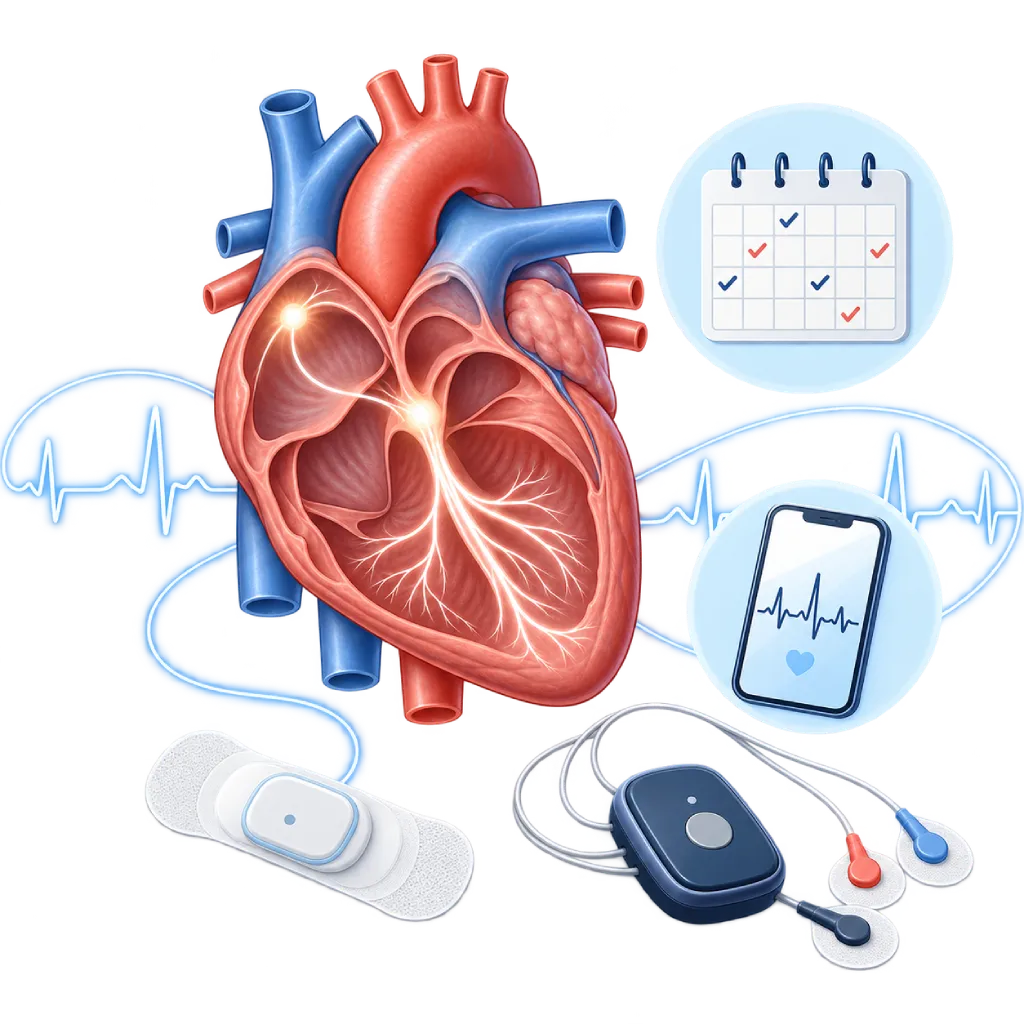
Long-term heart rhythm monitoring is a recording of the heart rhythm that lasts longer than a standard ECG, from 24 hours to several years, while you go about your usual activities. It helps find rhythm problems that come and go, such as the cause of palpitations, dizziness, or fainting, as well as atrial fibrillation after a stroke.
Sources01 / Understanding the procedure
About Long-Term Heart Rhythm Monitoring
What Is Long-Term Heart Rhythm Monitoring
A standard ECG only records the heart rhythm for a few seconds, so rhythm problems that come and go are often missed. Long-term heart rhythm monitoring records the heart rhythm for longer, from 24 hours to several years, while you go about your daily activities. This way, your symptoms can be matched with your heart rhythm at the same moment. The standard ECG is covered on the Electrocardiogram (ECG) page.
How It Works in Brief
Electrodes or a small device pick up the heart's electrical signals and store them in a recorder. Some devices record continuously, while others save a recording when you press a button as symptoms occur or when the device automatically detects an abnormal rhythm. Your doctor then reads the recording and matches it with your symptom diary.
Device Options
Your doctor chooses a device based on how often your symptoms occur and how serious they are.
- Holter: a small recorder with several wires attached to the chest, worn for 24 to 48 hours, sometimes up to 7 days. Suitable if symptoms occur almost every day. This is covered on the Holter Monitoring page.
- Patch recorder: a wireless, sticker-like recorder worn for 7 to 14 days, suitable if symptoms occur several times a week.
- Event recorder: worn for up to about 30 days and saves recordings when symptoms occur, suitable if symptoms occur several times a month.
- Implanted recorder: a very small device placed under the skin of the chest with local anesthesia that can record for up to about 3 years. Suitable if symptoms are rare but serious, such as fainting with no clear cause yet, or to look for atrial fibrillation after a stroke. This is covered on the Implantable Loop Recorder (ILR) page.
ECG recordings from a smartwatch or personal device can be an early clue, but the results need to be confirmed with tests at the hospital.
After the Results Are Out
The recording helps your doctor decide the next steps, for example medicines, ablation, a pacemaker, or blood thinners if atrial fibrillation is found. This is covered on the Arrhythmia Management page. Sending data from an implanted recorder from home is covered on the Remote Heart Monitoring page.
02 / Understanding the procedure
When Is This Procedure Considered?
A doctor may consider this procedure in the situations below. The decision is always made after a thorough assessment.
- Palpitations That Come and GoTo look for rhythm problems when symptoms occur.
- Fainting or Near FaintingEspecially if the cause is still unclear after initial tests.
- Recurrent Sudden Dizziness or WeaknessMay be caused by a heartbeat that is too slow or too fast.
- After a Stroke with No Clear CauseTo look for atrial fibrillation that you cannot feel.
- Assessing Arrhythmia Treatment ResultsFor example, after ablation or a change in heart rhythm medicines.
- Heart Disease with a Risk of ArrhythmiaFor example, cardiomyopathy, to assess the risk of dangerous rhythms.
Situations to Consider First
- Fainting with Injury, Chest Pain, or Shortness of BreathThis is an emergency. Go to the emergency room right away, not to a scheduled test.
- Adhesive Allergy or Sensitive SkinThe type or position of the electrodes can be adjusted.
- Skin Infection on the ChestPlacement of electrodes or an implanted recorder is postponed until the skin heals.
- Taking Blood ThinnersThis needs to be taken into account before an implanted recorder is placed.
- Planned MRI ScanTell the staff. External recorders are removed, and the type of implanted recorder needs to be checked.
03 / Before the procedure
How Should You Prepare?
Preparation depends on the device chosen.
Shower before the fitting. The majority of external recorders must not get wet, so shower before you come. Do not use lotion or powder on your chest.
Clothing. Wear a loose top that buttons at the front. Some chest hair may need to be shaved so the electrodes stick.
Medicine list. Bring a list of your medicines, especially heart rhythm medicines and blood thinners.
Symptom diary. Prepare a notebook or app to record the time, activity, and symptoms during the recording.
Unsure about the preparation instructions? Ask our team before the procedure.
04 / During the procedure
How Is the Procedure Done?
Fitting an external recorder usually takes 15 to 30 minutes. Recording lasts from 24 hours to several weeks, while an implanted recorder can work for up to about 3 years.
Choosing the Device
Your doctor chooses a device based on how often your symptoms occur and how serious they are.
Fitting
The skin of your chest is cleaned, then the electrodes or patch recorder are attached. An implanted recorder is placed through a small incision with local anesthesia.
During the Recording
You go about your usual activities, press the button or use the app when symptoms occur, and note the time.
Reading the Results
After the external recorder is returned, the recording is analyzed and read by your doctor. The results are discussed at your next visit.
05 / Benefits and risks
Benefits and Risks Should Be Discussed Together.
Every medical procedure has benefits and risks. Your doctor will explain both for your situation before the procedure.
Benefits You Can Expect
- Symptoms Matched with Heart RhythmYour doctor sees your heart rhythm at the exact moment symptoms occur.
- Finding the Cause of FaintingAn implanted recorder helps when fainting happens rarely.
- Detecting Atrial Fibrillation Without SymptomsImportant after a stroke with no clear cause yet.
- No Hospital StayRecording takes place while you go about your daily activities.
- Helps Choose TreatmentFor example, between medicines, ablation, or a pacemaker.
The benefits of a procedure are not a promise of a cure. Ask how the results will affect your care plan.
Risks You Should Know
- Skin IrritationFrom the electrode adhesive, usually mild.
- Symptoms Not CapturedIf symptoms do not occur during the recording, the test may be repeated or replaced with a device that records for longer.
- Not an Emergency DeviceThe recorder does not call for help. Severe symptoms still require a visit to the emergency room.
- Bruising or Infection with an Implanted RecorderRare and usually mild.
Risks can differ from person to person. A full explanation and consent are given after an individual assessment.
06 / After the procedure
What Is Recovery Like?
There is no recovery period for an external recorder. You can go about your usual activities during the recording.
Keep the device dry. Avoid showering, swimming, or heavy sweating if the device is not waterproof.
Record your symptoms. Write down the time, your activity, and what you felt each time symptoms occur.
Skin. Mild redness from the adhesive usually goes away within a few days.
Implanted recorder. Keep the wound dry for a few days and follow the wound check schedule.
Warning signs to watch for. Go to the emergency room right away if you experience:
- Fainting, especially with injury or during activity
- Chest pain or severe shortness of breath
- A very fast heartbeat with severe dizziness
- Pus or swelling at the implanted recorder wound, or fever
Know the Signs That Need Prompt Care.
Follow the team's guidance on warning signs. If severe or sudden symptoms appear after the procedure, go to the nearest emergency department right away or call Heart Attack Center 1500 258.
07 / Team and support
Doctors and Procedure Support
The doctors below are listed for this procedure. Listed by name, not by ranking.

Dr. med. dr. Denio A. Ridjab, Sp.JP(K)
Interventional Cardiology
Coronary Intervention Procedures +2 centers
Clinical focusInterventional Cardiology · Coronary Artery Disease
View Profile
Dr. dr. Faris Basalamah, Sp.JP(K)
Interventional Cardiology
Coronary Intervention Procedures +1 center
Clinical focusComplex Coronary Intervention · Cardiac Electrophysiology
View Profile
dr. Sunu B. Raharjo, Sp.JP(K), Ph.D.
Arrhythmia and Electrophysiology
Arrhythmia and Device Center
Clinical focusClinical and Interventional Electrophysiology · Cardiac Arrhythmia Ablation
View ProfileHolter Monitoring System
A small ECG recorder that you wear during daily activities to monitor your heart rhythm continuously for 24 to 48 hours or…
The availability of technology and test support is confirmed with the team. Technology is chosen according to clinical need.
08 / Common questions
Before You Plan the Procedure.
Frequently asked questions about long-term heart rhythm monitoring. The device for you is chosen together with your doctor.
How long does the device need to be worn?
It depends on how often your symptoms occur. A Holter is usually worn for 24 to 48 hours, a patch recorder for 7 to 14 days, an event recorder for up to about 30 days, and an implanted recorder can work for up to about 3 years. The less frequent your symptoms, the longer the recording needed to capture your rhythm during symptoms.
Can I shower and exercise during the recording?
The majority of Holters and event recorders must not get wet, so you need to shower before the fitting and after the device is removed. Some patch recorders are splash-resistant. Light exercise is usually allowed and can actually help if your symptoms occur during activity. Ask about the rules for the device you are using.
What if my symptoms do not occur while I am using the device?
The recording is still useful because your doctor can see your heart rhythm throughout the recording period, including problems you cannot feel. If your symptoms have not been captured, your doctor may suggest repeating the recording or using a device that can be used for longer, such as an event recorder or implanted recorder. Your doctor may also consider other tests to look for the cause of your symptoms.
Is placing an implanted recorder major surgery?
No. An implanted recorder is very small and is inserted under the skin of the chest through a small incision with local anesthesia. The procedure is generally short, and patients can usually go home the same day. The device can be removed in a similar way when it is no longer needed.
Can this device call for help if there is a heart problem?
No. The recorder stores data for your doctor to read and does not call for help. Some implanted recorders can send data from home, but the data is reviewed during working hours. If you faint, have chest pain, or have severe shortness of breath, go to the emergency room right away without waiting for the recording results.
Can a smartwatch replace a Holter?
Not yet. A smartwatch can record a single-lead ECG when you touch it and flag possible atrial fibrillation, so it is useful as a clue. However, its ECG recording is not continuous and the results need to be confirmed by a doctor. Bring your smartwatch recordings to your consultation so they can be assessed together with other tests.
Sources and Medical Review
Translated from the Indonesian edition medically reviewed by Dr. med. dr. Denio A. Ridjab, Sp.JP(K).
Sources as cited in the Indonesian edition.
- Steinberg JS, Varma N, Cygankiewicz I, et al. 2017 ISHNE-HRS expert consensus statement on ambulatory ECG and external cardiac monitoring/telemetry. Heart Rhythm. 2017;14(7):e55-e96.
- Brignole M, Moya A, de Lange FJ, et al. 2018 ESC Guidelines for the diagnosis and management of syncope. Eur Heart J. 2018;39(21):1883-1948.
- Van Gelder IC, Rienstra M, Bunting KV, et al. 2024 ESC Guidelines for the management of atrial fibrillation developed in collaboration with the European Association for Cardio-Thoracic Surgery (EACTS). Eur Heart J. 2024;45(36):3314-3414.
- Sanna T, Diener HC, Passman RS, et al. Cryptogenic Stroke and Underlying Atrial Fibrillation. N Engl J Med. 2014;370(26):2478-2486.
- Barrett PM, Komatireddy R, Haaser S, et al. Comparison of 24-hour Holter Monitoring with 14-day Novel Adhesive Patch Electrocardiographic Monitoring. Am J Med. 2014;127(1):95.e11-95.e17.