
Quick answer
What Is Leg Swelling?
Leg swelling is a buildup of fluid in the lower legs, ankles, or tops of the feet. Its causes vary, from standing too long and vein problems to heart failure, kidney disease, or blood clots, so it is important to recognize its pattern.
SourcesSigns That Need Urgent Help
- Sudden shortness of breath or chest pain, especially after swelling in one leg
- Severe shortness of breath when lying down or a frothy cough
- One leg that swells quickly, with pain, warmth, or redness
- A leg that is pale, cold, or very painful
- Spreading redness of the skin with a fever
- Passing very little urine with swelling throughout the body
If these signs appear, go to the nearest emergency department right away or call Heart Attack Center 1500 258.
01 / Understanding the condition
About Leg Swelling
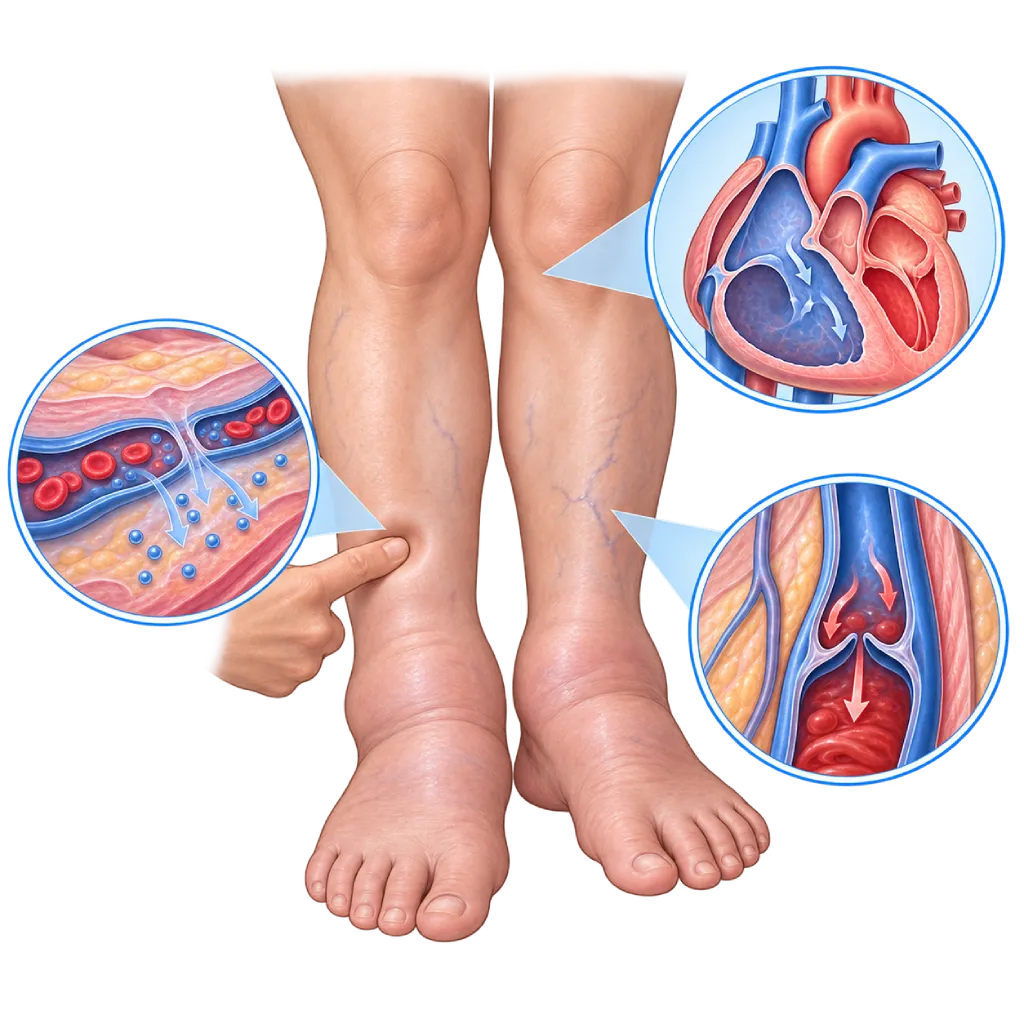
Leg swelling (leg edema) is when fluid builds up in the tissue under the skin of the lower legs, ankles, or tops of the feet. This swelling is not a disease in itself but a sign of another condition. The legs look bigger, shoes or socks feel tight and leave marks, and skin that is pressed for a few seconds may leave a dent. This page helps you recognize swelling patterns and know when to get checked, but it does not replace an examination by a doctor.
One Leg or Both Legs
The pattern of swelling helps the doctor look for the cause. Swelling in one leg, especially if it appears quickly and comes with pain, warmth, or redness, needs to be checked right away because it can be caused by a blood clot in a leg vein, which is covered on the Deep Vein Thrombosis page. Other causes of swelling in one leg are skin infection, injury, or a problem with the lymphatic vessels. Swelling in both legs more often comes from long-term vein problems, medicine side effects, or diseases that affect the whole body, such as heart failure, kidney disease, and liver disease.
The Link to the Heart
When the heart's pumping weakens or the right side of the heart is under strain, blood backs up in the veins and the pressure in them rises, so fluid seeps into the tissues. In heart failure, swelling in both legs usually comes with shortness of breath during activity or when lying down, tiring easily, and rapid weight gain. This condition is covered on the Heart Failure page. High pressure in the lung blood vessels and diseases of the sac around the heart can also cause leg swelling.
Causes Outside the Heart
A common cause is leg vein valves that do not close properly, so blood pools in the legs, which is covered on the Chronic Venous Insufficiency page. Medicines can also cause swelling, for example calcium channel blockers for blood pressure, nonsteroidal anti-inflammatory drugs, and corticosteroids. Do not stop your medicines on your own; talk to your doctor. Other causes include a low blood albumin level, an underactive thyroid gland, pregnancy, standing or sitting for a long time, and lymphedema. Swelling in other parts of the body, such as the hands, arms, or face, is covered on the Peripheral Edema page.
02 / Understanding the condition
Symptoms to Recognize.
Common Symptoms
- Ankles or tops of the feet that look enlarged
- A dent that remains after the skin is pressed for a few seconds
- Shoes or socks that feel tight and leave marks
- Legs that feel heavy, achy, or tight
- Swelling that increases in the afternoon and decreases after sleep
- Darkening or thickening of the skin on the lower legs with long-term swelling
Symptoms in Adult Women
Mild swelling in the feet is common in late pregnancy. The following symptoms need to be checked right away because they can signal preeclampsia, a blood clot, or a weakening of the heart muscle.
- Sudden swelling of the face, hands, or around the eyes during pregnancy
- Swelling with a severe headache or blurred vision during pregnancy
- Painful swelling of one leg during pregnancy or after giving birth
- Swelling of both legs with shortness of breath near or after delivery
03 / Understanding the condition
What Causes This Condition?
- Chronic venous insufficiency and varicose veins, when the leg vein valves do not close properly
- Deep vein thrombosis, a blood clot in a leg vein, which usually causes swelling on one side
- Heart failure or high pressure in the lung blood vessels that strains the right side of the heart
- Kidney disease, including nephrotic syndrome, or liver disease with a low albumin level
- Medicine side effects, such as from calcium channel blockers, nonsteroidal anti-inflammatory drugs, or corticosteroids
- Lymphedema, a problem with lymph flow
- Standing or sitting for a long time, hot weather, pregnancy, or high salt intake
- Skin infection, injury, or a cyst behind the knee, which usually causes swelling on one side
04 / Understanding the condition
Who Is at Higher Risk?
Lifestyle
Sitting or standing for a long time without moving, rarely exercising, excess body weight, and high salt intake make it easier for fluid to build up in the legs.
Medical
Heart failure, kidney disease, liver disease, an underactive thyroid gland, varicose veins, a history of venous thrombosis, and medicines such as calcium channel blockers and corticosteroids.
Age
Older adults more often have vein problems and heart failure, and take several medicines at once, so leg swelling is found more often.
Genetic
A family history of varicose veins or blood clotting disorders increases the likelihood of vein problems and thrombosis.
Other
Pregnancy, long journeys of more than four hours, leg surgery or a broken leg, a long hospital stay, and cancer increase the risk of swelling, including from blood clots.
Groups at Higher Risk
- Older Adults: Vein problems, heart failure, and taking several medicines at once are more common, so the cause of leg swelling needs to be found.
- People with Heart Failure or Kidney Disease: Increasing swelling or rapid weight gain can signal fluid buildup and the need to adjust treatment.
- Pregnant Women: Mild swelling is common, but sudden swelling with a headache or painful swelling in one leg needs to be checked right away.
- Workers Who Stand or Sit a Lot: Too little calf muscle movement lets blood pool in the legs, especially in people with weak vein valves.
- Patients After Surgery or a Long Hospital Stay: Reduced movement increases the risk of blood clots in the leg veins, so swelling in one leg should be reported right away.
05 / Understanding the condition
How Is It Diagnosed?
The doctor asks how long the swelling has been there, whether it is in one or both legs, whether it improves after sleep, and about other symptoms such as shortness of breath, pain, or changes in urination. A list of the medicines you take is also important. The physical examination checks whether the skin leaves a dent when pressed, the color and temperature of the skin, the leg pulses, the heart and lung sounds, and signs of fluid in the abdomen. If the swelling is in one leg, a vascular ultrasound is done to look for a clot in the deep veins, sometimes preceded by a D-dimer test. If the swelling is in both legs, blood tests assess kidney function, liver function, albumin, and thyroid, while a urine test looks for leaking protein. If a heart cause is suspected, an NT-proBNP test, an ECG, and echocardiography assess the heart's pumping, the valves, and the pressure in the lung blood vessels. A duplex ultrasound also assesses leaking vein valves in long-term vein problems.
Physical Examination
Assesses one or both legs, denting when the skin is pressed, skin color and temperature, leg pulses, and heart and lung sounds.
Duplex Ultrasound
Looks for a clot in the deep veins and assesses leaking vein valves, without needles or radiation.
D-Dimer Test
Helps rule out a blood clot when the likelihood is low. A high result needs to be confirmed with ultrasound.
NT-proBNP and BNP Test
Helps assess whether heart failure may be causing swelling in both legs.
Echocardiography
Assesses pumping strength, the valves, the size of the right side of the heart, and the estimated pressure in the lung blood vessels.
Kidney Function Test
Assesses how well the kidneys remove fluid and salt, together with a urine test to look for leaking protein.
Serum Albumin Test
A low albumin level, for example in liver disease, kidney disease, or malnutrition, makes fluid leak into the tissues more easily.
06 / Understanding the condition
Treatment Options.
Treatment is decided by a doctor after an assessment. The categories below can help you follow the conversation with your doctor.
Treating the Cause
Treatment depends on the cause, for example heart failure medicines, treatment of kidney or liver disease, or treatment of a thyroid disorder.
Diuretics
Water pills are used when swelling comes from excess fluid in the body, such as in heart failure or kidney disease. Diuretics are less useful for swelling caused by vein problems alone. Your doctor decides the type and dose.
Blood Thinners
Used when swelling is caused by deep vein thrombosis, to stop the clot from growing and breaking off to the lungs. Your doctor decides how long treatment lasts.
Compression Stockings
Help venous blood and lymph flow back in long-term vein problems or lymphedema, after the doctor confirms that arterial blood flow to the legs is good enough.
Medication Review
If the swelling is related to a medicine, your doctor can switch the type or adjust the treatment. Do not stop your medicines on your own.
Raising the Legs and Staying Active
Raising your legs while resting and moving your calf muscles help fluid return to the blood vessels, especially in vein problems.
07 / Understanding the condition
Complications to Watch For.
Pulmonary Embolism
A blood clot in a leg vein can break off and block a blood vessel in the lungs, causing sudden shortness of breath and chest pain. This condition is covered on the Pulmonary Embolism page.
Worsening Heart Failure
Increasing swelling is often a sign that fluid is building up. Without adjusting treatment, fluid can reach the lungs and require hospital care.
Skin Infection
Stretched, fragile skin from long-term swelling is easily injured and infected, for example with cellulitis, which makes the skin red, warm, and painful.
Chronic Leg Ulcers
In long-term vein problems, high pressure in the veins can cause sores around the ankle that are slow to heal.
Permanent Skin Changes
The skin of the lower legs can darken, thicken, and harden if swelling lasts a long time without treatment.
08 / Understanding the condition
What Can You Do?
- Break up long periods of sitting or standing by walking or moving your ankles
- Raise your legs above heart level when resting
- Limit salt, especially if you have heart failure, kidney disease, or hypertension
- Maintain a healthy weight and stay active
- Wear compression stockings if your doctor recommends them
- Move around and drink enough during long journeys of more than four hours
- Weigh yourself every morning if you have heart failure
- Do not stop or add medicines on your own; discuss side effects with your doctor
09 / Understanding the condition
When Should You See a Doctor?
Mild swelling in both legs after standing for a long time that goes away after rest is usually not dangerous. See a doctor if the swelling persists, increases, or comes with other symptoms. Go to the emergency room right away if a swollen leg comes with sudden shortness of breath or chest pain.
- Swelling in one leg, especially if it is painful, warm, or red
- Swelling in both legs with shortness of breath, tiring easily, or rapid weight gain
- Swelling that does not go down after a night's sleep
- Swelling with foamy urine, puffy eyes, or a swollen abdomen
- Swelling after starting a new medicine
- Sudden swelling during pregnancy, especially with a headache or blurred vision
Don't Wait in an Emergency.
If symptoms are severe or come on suddenly, go to the nearest emergency department right away or call Heart Attack Center 1500 258, rather than waiting for an appointment.
10 / Common questions
Questions You May Have.
Frequently asked questions about leg swelling.
Is leg swelling always a sign of heart disease?
No. Leg swelling is more often caused by leg vein problems, standing or sitting for a long time, medicine side effects, or hot weather. Heart disease is a more likely cause if the swelling is in both legs and comes with shortness of breath during activity or when lying down, tiring easily, or rapid weight gain. An examination by a doctor helps confirm the cause.
Why does swelling in one leg need to be checked right away?
Swelling in one leg, especially if it appears over a few hours to days and comes with pain, warmth, or redness, can be caused by a blood clot in a deep vein. This clot can break off and block a blood vessel in the lungs, which is covered on the Pulmonary Embolism page. A vascular ultrasound can confirm it quickly, and treatment with blood thinners lowers that risk.
Can blood pressure medicine cause leg swelling?
Yes. Calcium channel blockers, such as amlodipine, often cause ankle swelling. This swelling does not mean the heart is weakening. Do not stop the medicine on your own, because your blood pressure may rise. Tell your doctor, who can switch the type of medicine, adjust the treatment, or add a medicine from another class.
Can I wear compression stockings without a doctor's advice?
Compression stockings are helpful for swelling caused by vein problems or lymphedema, but they are not suitable for everyone. In severe narrowing of the leg arteries, the pressure from the stockings can reduce blood flow to the feet. That is why it is better for a doctor to check your leg pulses, sometimes with an ABI test, and then decide the suitable type and pressure level of the stockings.
What is the difference between leg swelling and peripheral edema?
Peripheral edema is a broader term for swelling in parts of the body far from the center, including the legs, hands, and arms, which is covered on the Peripheral Edema page. This page focuses specifically on swelling in the lower legs and feet, which is a common complaint and is often related to vein or heart problems.
Does drinking less reduce leg swelling?
For most people, drinking less does not get rid of swelling and can lead to dehydration. Limiting salt, staying active, and raising your legs help more. Fluid restriction is only recommended in certain situations, such as heart failure or advanced kidney disease, with the amount set by your doctor.
Sources and Medical Review
Translated from the Indonesian edition medically reviewed by dr. Emanoel Oepangat, Sp.JP(K).
Sources as cited in the Indonesian edition.
- Ely JW, Osheroff JA, Chambliss ML, Ebell MH. Approach to leg edema of unclear etiology. J Am Board Fam Med. 2006;19(2):148-60.
- McDonagh TA, Metra M, Adamo M, Gardner RS, Baumbach A, Böhm M, et al. 2021 ESC Guidelines for the diagnosis and treatment of acute and chronic heart failure. Eur Heart J. 2021;42(36):3599-726.
- De Maeseneer MG, Kakkos SK, Aherne T, Baekgaard N, Black S, Blomgren L, et al. European Society for Vascular Surgery (ESVS) 2022 Clinical Practice Guidelines on the Management of Chronic Venous Disease of the Lower Limbs. Eur J Vasc Endovasc Surg. 2022;63(2):184-267.
- Kakkos SK, Gohel M, Baekgaard N, Bauersachs R, Bellmunt-Montoya S, Black SA, et al. European Society for Vascular Surgery (ESVS) 2021 Clinical Practice Guidelines on the Management of Venous Thrombosis. Eur J Vasc Endovasc Surg. 2021;61(1):9-82.
- Lim W, Le Gal G, Bates SM, Righini M, Haramati LB, Lang E, et al. American Society of Hematology 2018 guidelines for management of venous thromboembolism: diagnosis of venous thromboembolism. Blood Adv. 2018;2(22):3226-56.
- Mullens W, Damman K, Harjola VP, Mebazaa A, Brunner-La Rocca HP, Martens P, et al. The use of diuretics in heart failure with congestion: a position statement from the Heart Failure Association of the European Society of Cardiology. Eur J Heart Fail. 2019;21(2):137-55.
Doctors Who Treat This Condition

dr. Suko Adiarto, Sp.JP(K), Ph.D.
Interventional Cardiology
Vascular Diagnostic and Therapeutic Center +1 center
Clinical focusCoronary Intervention · Peripheral Vascular Intervention
View Profile
dr. Emanoel Oepangat, Sp.JP(K)
Interventional Cardiology
Vascular Diagnostic and Therapeutic Center +1 center
Clinical focusCoronary Intervention · Peripheral Vascular Intervention
View Profile
dr. Siska S. Danny, Sp.JP(K)
Interventional Cardiology
Coronary Intervention Procedures
Clinical focusPCI for Acute Coronary Syndrome · Primary Coronary Intervention
View Profile