
Quick answer
What Is Stent Thrombosis?
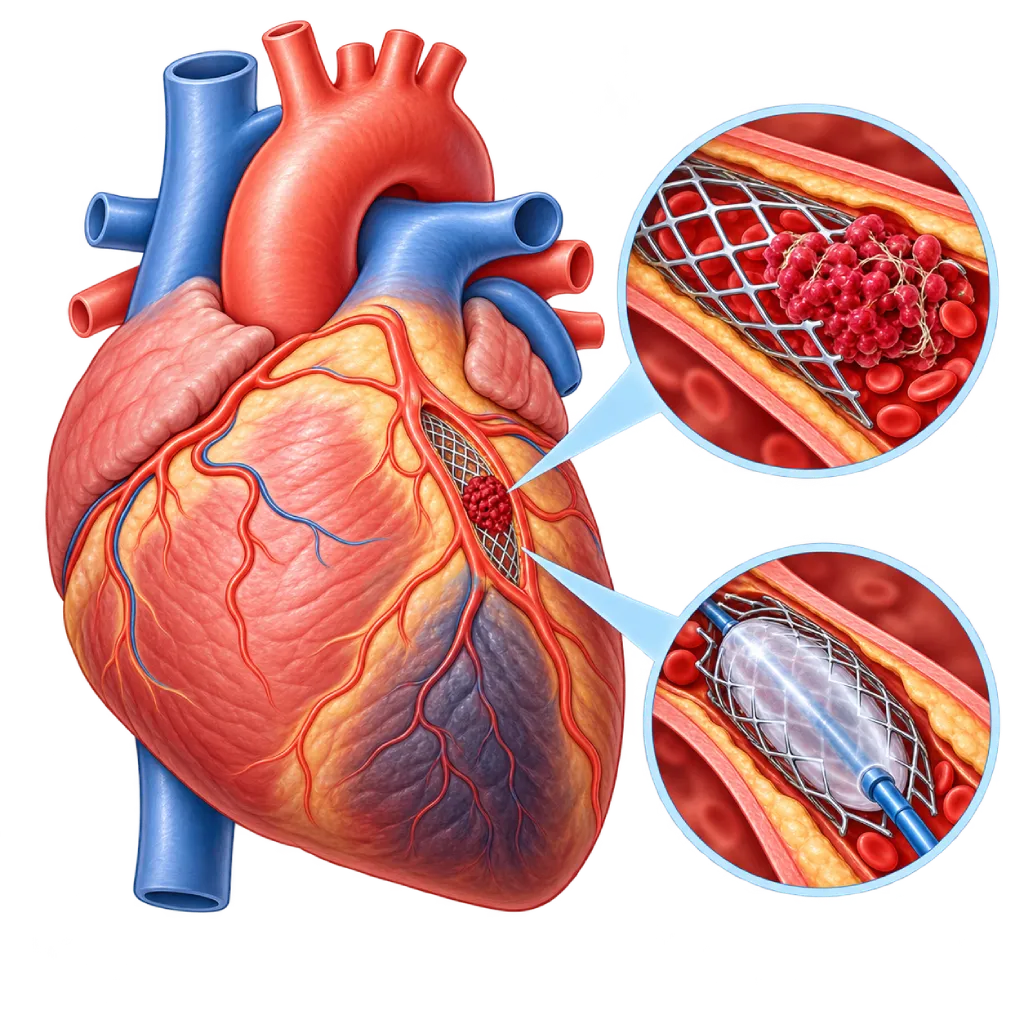
Stent thrombosis is the sudden blockage of a stent in a coronary artery by a blood clot. It usually causes a heart attack and needs emergency treatment in the emergency room.
Sources01 / Understanding the condition
About Stent Thrombosis
Stent thrombosis is a condition in which a blood clot forms inside a coronary stent that is already in place, so the artery suddenly becomes blocked. A stent is a small metal mesh support placed during angioplasty to keep the artery open. Because blood flow to the heart muscle stops suddenly, stent thrombosis usually appears as a heart attack, often as an ST-elevation myocardial infarction. This is different from renarrowing that happens slowly, which is covered on the In-Stent Restenosis page.
When It Can Happen
Doctors divide the timing into acute (within the first 24 hours), subacute (up to 30 days), late (up to one year), and very late (more than one year). The majority of cases occur within the first month after placement. Thrombosis that occurs after one year is usually related to new plaque inside the stent or a stent frame that does not sit tightly against the artery wall. With current-generation drug-eluting stents and antiplatelet medicines taken regularly, stent thrombosis is rare, occurring in about 1 in 100 patients or fewer in the first year.
Why Clots Form
A prominent trigger is stopping antiplatelet medicines too early, especially in the first few weeks. Dual antiplatelet therapy, meaning aspirin together with a P2Y12 inhibitor such as clopidogrel, ticagrelor, or prasugrel, keeps platelets from clumping on the surface of the stent until the artery wall covers the metal frame. Factors related to the procedure also play a role, for example a stent that is not fully expanded, a size that is not well matched, a tear at the edge of the stent, or slow blood flow. Patient factors include having a stent placed during a heart attack, diabetes, kidney disease, cancer, and smoking.
Emergency Treatment
Treatment is the same as for a heart attack: the artery is opened as quickly as possible, usually through emergency percutaneous coronary intervention. The doctor opens the blockage with a wire and balloon, re-expands the stent, and if needed places an additional stent or gives anti-clotting medicines through an IV. Imaging from inside the artery with IVUS or OCT is recommended to look for a mechanical cause, so that a similar event does not happen again. After that, the doctor reviews the antiplatelet medicines and makes sure they are taken regularly. The procedure to open the artery is covered on the Percutaneous Coronary Intervention (PCI) page.
02 / Understanding the condition
Symptoms to Recognize.
Common Symptoms
Symptoms usually come on suddenly, often in the first days or weeks after stent placement, or after antiplatelet medicines are stopped.
- Pain, heaviness, or pressure in the chest that comes on suddenly and persists
- Pain spreading to the arm, neck, jaw, or back
- Cold sweat and pale skin
- Shortness of breath
- Nausea or vomiting
- Dizziness, weakness, or feeling about to faint
Symptoms in Older Adults
In older age and in people with diabetes, chest pain may be mild or absent altogether.
- Sudden shortness of breath without clear chest pain
- Severe weakness or suddenly being unable to carry out activities
- New confusion or disorientation
- Fainting or falling without a clear cause
03 / Understanding the condition
What Causes This Condition?
- Stopping dual antiplatelet therapy too early, especially in the first month after stent placement
- A weak response to antiplatelet medicines, for example in some people taking clopidogrel
- A stent that is not fully expanded or not well matched in size to the artery
- A tear in the artery wall at the edge of the stent or remaining narrowing not covered by the stent
- A stent frame not yet covered by the lining of the artery wall, or inflammation around the stent
- Rupture of new plaque inside the stent, in stent thrombosis that occurs years later
- Conditions that make blood clot more easily, such as a heart attack at the time of placement, cancer, or surgery
04 / Understanding the condition
Who Is at Higher Risk?
Medical
Diabetes, chronic kidney disease, weak heart pumping function, cancer, and stent placement during a heart attack increase the risk of stent thrombosis.
Lifestyle
Smoking makes blood clot more easily. Forgetting or deliberately stopping antiplatelet medicines, for example because of cost or side effects, is a preventable factor.
Genetic
Certain CYP2C19 gene variants make clopidogrel less effective in some people. These variants are found more often in people of Asian descent.
Other
Stents that are long, overlapping, small in diameter, or placed at a branch point, as well as surgery or tooth extraction that leads to antiplatelet medicines being stopped without coordination with a cardiologist.
Groups at Higher Risk
- Patients in the First Month After Stent Placement: The majority of stent thrombosis cases occur within the first 30 days, when the stent frame is not yet covered by the lining of the artery wall.
- Patients Who Stop Antiplatelet Medicines Early: Stopping dual antiplatelet therapy in the first months without a doctor's guidance sharply increases the risk.
- Patients Who Received a Stent During a Heart Attack: Blood clots and inflammation during a heart attack make the risk of stent thrombosis higher than with planned placement.
- People with Diabetes and Kidney Disease: Both conditions make platelets more active and increase the risk of clots inside the stent.
- People with Cancer: Cancer and some of its treatments make blood clot more easily, and cancer treatment sometimes requires antiplatelet medicines to be stopped.
05 / Understanding the condition
How Is It Diagnosed?
Stent thrombosis is suspected when someone who has had a stent placed has symptoms of a heart attack. In the emergency room, an ECG is recorded within the first 10 minutes and blood is drawn for a troponin test. If the ECG shows a heart attack pattern with ST-segment elevation, the patient is prepared right away for catheterization without waiting for the blood test results.
The diagnosis is confirmed by coronary angiography, which shows a clot inside or at the edge of the stent. During the same procedure, the doctor opens the artery. IVUS or OCT helps find a mechanical cause, for example a stent that is not fully expanded, so it can be corrected at the same time. Once the condition is stable, the doctor reviews the history of taking antiplatelet medicines and may check for other factors that make blood clot more easily.
Electrocardiogram (ECG)
Recorded in the emergency room within the first 10 minutes to look for a heart attack pattern, including ST-segment elevation, in the area of the stented artery.
Cardiac Troponin Test
A rise in troponin confirms damage to the heart muscle caused by the blockage.
Coronary Angiography
Confirms that the stent is blocked by a blood clot and is the first step in opening the artery during the same procedure.
Intravascular Ultrasound (IVUS)
Assesses from inside the artery whether the stent is underexpanded, poorly matched in size, or has a tear at its edge.
Optical Coherence Tomography (OCT)
Detailed images from inside the stent to see clots, stent struts not yet covered by tissue, or ruptured new plaque.
Echocardiography
Assesses heart wall motion and pumping strength after the attack, and looks for complications.
06 / Understanding the condition
Treatment Options.
Treatment is decided by a doctor after an assessment. The categories below can help you follow the conversation with your doctor.
Emergency Percutaneous Coronary Intervention
The artery is opened as soon as possible through a catheter with a wire and balloon, then the stent is re-expanded or a new stent is added if needed.
Correcting Mechanical Causes
With IVUS or OCT guidance, an underexpanded stent is widened with a balloon, and a tear at the edge of the stent is covered with an additional stent.
Anti-Clotting Medicines During the Procedure
Anticoagulant and antiplatelet medicines are given through an IV during the procedure to prevent new clots, as decided by the doctor.
Adjusting Antiplatelet Medicines
The doctor reviews the type and duration of dual antiplatelet therapy, for example switching from clopidogrel to a stronger P2Y12 inhibitor, and explains why it is important not to stop on your own.
Intensive Cardiac Care
Rhythm monitoring and circulatory support in the cardiac intensive care unit if shock or severe rhythm disorders occur.
Rehabilitation and Secondary Prevention
A cardiac rehabilitation program, quitting smoking, and control of diabetes, blood pressure, and cholesterol after the emergency phase.
07 / Understanding the condition
Complications to Watch For.
Heart Attack
A sudden blockage usually causes a heart attack, often with ST-segment elevation, covered on the ST-Elevation Myocardial Infarction (STEMI) page.
Severe Rhythm Disorders and Cardiac Arrest
Heart muscle deprived of blood flow can trigger ventricular fibrillation and cardiac arrest, so quick help, and chest compressions when needed, are crucial.
Cardiogenic Shock
If the muscle damage is extensive, the heart cannot pump enough blood to the whole body, covered on the Cardiogenic Shock page.
Heart Failure
Damaged heart muscle can weaken the pump in the long term. Covered on the Heart Failure page.
Recurrent Stent Thrombosis
Some patients may experience it again, so mechanical causes and consistent use of antiplatelet medicines need to be checked.
08 / Understanding the condition
What Can You Do?
- Take your dual antiplatelet medicines every day as prescribed, without skipping doses
- Do not stop antiplatelet medicines on your own, including before a tooth extraction or surgery, without talking to your cardiologist
- Make sure you do not run out of medicine, especially when traveling or during long holidays
- Tell every doctor and dentist that you have a stent and take antiplatelet medicines
- Keep your stent card or procedure record and bring it when you seek medical care
- Quit smoking and control diabetes, blood pressure, and cholesterol
- Report medicine side effects, such as bleeding, so your doctor can adjust your medicines safely
09 / Understanding the condition
When Should You See a Doctor?
If you have had a stent placed and feel sudden chest pain that does not go away with rest, do not wait. Call an ambulance or go to the nearest emergency room right away. Contact your cardiologist in advance, before any symptoms appear, if:
- You are going to have surgery, a tooth extraction, or another procedure and have been asked to stop your antiplatelet medicines
- Bleeding, widespread bruising, or black stools appear while you are taking antiplatelet medicines
- Your medicines have run out or you have trouble getting them
- You are unsure when dual antiplatelet therapy can be reduced to a single medicine
- Mild chest pain during activity starts to come back
10 / Common questions
Questions You May Have.
Frequently asked questions about stent thrombosis.
What is the difference between stent thrombosis and restenosis?
Stent thrombosis is a sudden blockage by a blood clot, usually developing within minutes to hours, and it generally causes a heart attack that needs emergency care. Restenosis is a narrowing that develops slowly over several months because tissue grows inside the stent, so symptoms appear gradually during activity. Restenosis is covered on the In-Stent Restenosis page.
Why should antiplatelet medicines not be stopped on your own?
Antiplatelet medicines prevent platelets from clumping on the surface of the stent. In the first months, the stent frame is not yet covered by the lining of the artery wall, so clots form easily if the medicines are stopped. Stopping medicines without a doctor's guidance is one of the main triggers of stent thrombosis. If you have side effects, bleeding, or planned surgery, talk to your cardiologist so your medicines can be managed safely.
How long do I need to take two antiplatelet medicines?
Your doctor decides the duration based on why the stent was placed and your bleeding risk. After placement for a heart attack, guidelines generally recommend about 12 months, while for planned placement it is often about 6 months. If your bleeding risk is high, this period can be shortened. After that, one antiplatelet medicine is generally continued long term. Do not change this schedule on your own.
What if I need surgery or a tooth extraction?
Tell the doctor performing the procedure that you have a stent, and contact your cardiologist before stopping any medicine. Many dental procedures and minor surgeries can be done without stopping aspirin. Non-urgent surgery is generally postponed until the period of dual antiplatelet therapy is complete. If a medicine must be stopped, your cardiologist and surgeon make a plan together to keep the risks of clotting and bleeding low.
Can stent thrombosis happen years after placement?
Yes, although it is rare. Very late stent thrombosis occurs more than one year after placement, for example because new plaque inside the stent ruptures, the stent frame does not sit tightly against the artery wall, or there is inflammation around the stent. This is why one antiplatelet medicine is generally continued long term, and sudden chest pain should always be treated as an emergency, whenever it happens.
Sources and Medical Review
Translated from the Indonesian edition medically reviewed by dr. Emanoel Oepangat, Sp.JP(K).
Sources as cited in the Indonesian edition.
- Byrne RA, Rossello X, Coughlan JJ, Barbato E, Berry C, Chieffo A, et al. 2023 ESC Guidelines for the management of acute coronary syndromes. Eur Heart J. 2023;44(38):3720-826.
- Valgimigli M, Bueno H, Byrne RA, Collet JP, Costa F, Jeppsson A, et al. 2017 ESC focused update on dual antiplatelet therapy in coronary artery disease developed in collaboration with EACTS. Eur Heart J. 2018;39(3):213-60.
- Vrints C, Andreotti F, Koskinas KC, Rossello X, Adamo M, Ainslie J, et al. 2024 ESC Guidelines for the management of chronic coronary syndromes. Eur Heart J. 2024;45(36):3415-537.
- Garcia-Garcia HM, McFadden EP, Farb A, Mehran R, Stone GW, Spertus J, et al. Standardized End Point Definitions for Coronary Intervention Trials: The Academic Research Consortium-2 Consensus Document. Circulation. 2018;137(24):2635-50.
- Johnson TW, Räber L, di Mario C, Bourantas C, Jia H, Mattesini A, et al. Clinical use of intracoronary imaging. Part 2: acute coronary syndromes, ambiguous coronary angiography findings, and guiding interventional decision-making: an expert consensus document of the European Association of Percutaneous Cardiovascular Interventions. Eur Heart J. 2019;40(31):2566-84.
- Byrne RA, Joner M, Kastrati A. Stent thrombosis and restenosis: what have we learned and where are we going? The Andreas Grüntzig Lecture ESC 2014. Eur Heart J. 2015;36(47):3320-31.
Doctors Who Treat This Condition

dr. Puti S. Saus, Sp.JP(K)
Interventional Cardiology
Coronary Intervention Procedures
Clinical focusAcute Coronary Syndrome · Primary Coronary Intervention
View Profile
Dr. dr. Jajang Sinardja, Sp.JP(K)
Interventional Cardiology
Coronary Intervention Procedures
Clinical focusAcute Coronary Syndrome · Primary Coronary Intervention
View Profile
dr. Siska S. Danny, Sp.JP(K)
Interventional Cardiology
Coronary Intervention Procedures
Clinical focusPCI for Acute Coronary Syndrome · Primary Coronary Intervention
View Profile