
Quick answer
What Is Cardiac Troponin Test?
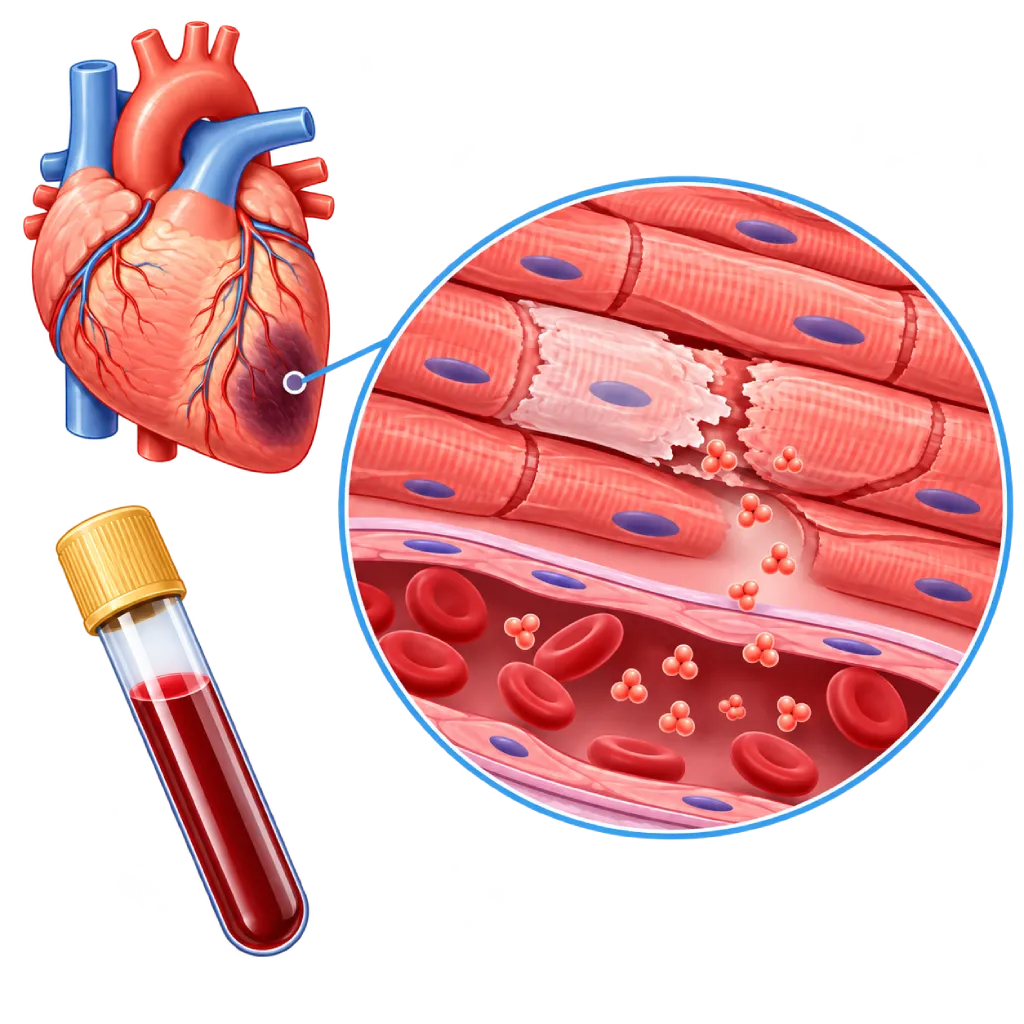
A cardiac troponin test measures troponin, a protein found only in heart muscle that is released into the blood when the muscle is damaged. This test is the basis for diagnosing a heart attack. Because troponin takes time to rise, the test is usually repeated 1 to 3 hours later to see whether the level changes.
Sources01 / Understanding the procedure
About Cardiac Troponin Test
What Is Troponin
Troponin is a protein that helps the heart muscle contract. Two types are tested, troponin T and troponin I, and both are specific to heart muscle. Under normal conditions, their level in the blood is very low. When heart muscle cells are damaged, troponin is released into the bloodstream and its level rises.
How It Works in Brief
The laboratory measures the troponin level in nanograms per liter (ng/L) with a high-sensitivity test that can detect very small amounts. The result is compared with the laboratory's normal limit, which is the 99th percentile of healthy people. What matters is the change, so the test is repeated after 1 to 3 hours.
Reading the Results
- Low and stable: a heart attack is unlikely, especially if the symptoms have been present for several hours.
- Clearly rising or falling: indicates recent heart muscle damage. When accompanied by symptoms, ECG changes, or imaging findings, this supports a heart attack.
- High but stable: more often indicates long-standing damage, for example in chronic kidney disease or heart failure.
Troponin T and troponin I results cannot be compared directly, so monitoring should use the same type of test.
Other Causes of Raised Troponin
Besides a heart attack, troponin can rise in myocarditis, pulmonary embolism, severe infection, very fast rhythm disorders, takotsubo cardiomyopathy, aortic dissection, after heart procedures or surgery, and after very strenuous exercise. For this reason, doctors always interpret the results together with symptoms and other tests.
ST-Elevation Heart Attack
If the ECG shows an ST-segment elevation heart attack (STEMI), treatment to open the blood vessel starts right away without waiting for the troponin result.
02 / Understanding the procedure
When Is This Procedure Considered?
A doctor may consider this procedure in the situations below. The decision is always made after a thorough assessment.
- Chest Pain or Chest PressureTo confirm or rule out a heart attack.
- Sudden Shortness of Breath, Cold Sweats, or FaintingHeart attack symptoms are not always chest pain, especially in older adults, women, and people with diabetes.
- Suspected MyocarditisInflammation of the heart muscle often raises troponin.
- After a Heart Procedure or SurgeryTo monitor procedure-related heart muscle damage.
- Serious Illness That Strains the HeartFor example, pulmonary embolism or severe infection, to assess risk.
- Symptoms That Began Several Days AgoTroponin stays elevated for quite a long time, so it can still help with diagnosis.
Situations to Consider First
- Chronic Kidney DiseaseTroponin can be persistently high, so changes in the level matter more.
- Very Strenuous ExerciseLong-distance running or extreme training can raise troponin temporarily.
- Symptoms That Have Just StartedIn the early hours, the level may not have risen yet, so the test needs to be repeated.
- High-Dose Biotin SupplementsCan interfere with certain test methods. Tell the staff if you take them.
- Certain Antibodies in the BloodRarely, these can cause a falsely high result, so the doctor rechecks it with another method.
03 / Before the procedure
How Should You Prepare?
A troponin test is usually done when symptoms appear and requires no special preparation.
Emergencies. If you are having chest pain, go to the emergency room right away. Do not delay because of eating, drinking, or scheduling.
Important information. Tell the team when your symptoms started, because this timing helps the doctor interpret the troponin result.
Medicines and supplements. Bring a list of your medicines. Tell the staff if you take high-dose biotin, which is often found in hair and nail supplements.
Medical history. Tell the team if you have kidney disease, have had a heart attack, or have recently had a heart procedure.
Previous results. Bring previous ECG and troponin results if you have them.
Unsure about the preparation instructions? Ask our team before the procedure.
04 / During the procedure
How Is the Procedure Done?
The blood draw usually takes 10 minutes. In the emergency room, results are usually available in about 1 hour, and the test is repeated 1 to 3 hours later.
ECG Comes Before the Blood Test
In the emergency room, an ECG is recorded as soon as possible, ideally within 10 minutes of arrival, to look for signs of a heart attack that needs immediate treatment.
Initial Blood Draw
Blood is drawn from your arm or through an IV line when you arrive, then troponin is measured in the laboratory.
Repeat Blood Draw
After 1 to 3 hours, blood is drawn again to see whether the troponin level is rising or falling.
Deciding the Next Step
The doctor combines the troponin results with your symptoms, ECG, and other tests. You may be sent home with a follow-up appointment, observed for longer, or admitted for treatment and cardiac catheterization.
05 / Benefits and risks
Benefits and Risks Should Be Discussed Together.
Every medical procedure has benefits and risks. Your doctor will explain both for your situation before the procedure.
Benefits You Can Expect
- A Marker Specific to Heart MuscleTroponin comes almost exclusively from heart muscle, so it is very helpful for diagnosis.
- Fast ResultsIn the emergency room, results are usually available in about 1 hour.
- Safely Rules Out a Heart AttackLow, stable levels help the doctor send patients home safely.
- Helps Decide on Further TreatmentHelps decide on hospital admission and cardiac catheterization.
- Assesses RiskHigher levels are linked to greater risk and the need for close monitoring.
The benefits of a procedure are not a promise of a cure. Ask how the results will affect your care plan.
Risks You Should Know
- Minor Pain or BruisingAt the needle site, usually mild and quick to fade.
- Brief Dizziness or FaintingSome people feel dizzy when blood is drawn. Tell the staff so you can lie down.
- Several Blood Draws May Be NeededRepeat tests are needed to see changes in the troponin level.
- Raised Results Not Caused by a Heart AttackOther diseases can raise troponin, so additional tests are sometimes needed.
Risks can differ from person to person. A full explanation and consent are given after an individual assessment.
06 / After the procedure
What Is Recovery Like?
There is no recovery period from the blood draw. The next steps depend on the results.
If troponin is normal. Your doctor may recommend scheduled follow-up tests, such as a treadmill stress test or a cardiac CT scan, if the cause of your symptoms needs to be investigated.
If troponin is raised. You are usually admitted for monitoring and given medicines, and you may undergo cardiac catheterization if needed.
Puncture site. A small bruise is normal and fades within a few days.
Warning signs. Go to the emergency room right away if you have:
- Chest pain that comes back or gets worse
- Pain that spreads to the arm, jaw, neck, or back
- Shortness of breath, cold sweats, or severe nausea
- Palpitations, severe dizziness, or fainting
Know the Signs That Need Prompt Care.
Follow the team's guidance on warning signs. If severe or sudden symptoms appear after the procedure, go to the nearest emergency department right away or call Heart Attack Center 1500 258.
07 / Team and support
Doctors and Procedure Support
The doctors below are listed for this procedure. Listed by name, not by ranking.

dr. Adrianus Kosasih, Sp.JP(K)
Interventional Cardiology
Coronary Intervention Procedures
Clinical focusPrimary Coronary Intervention · PCI for Acute Coronary Syndrome
View Profile
Dr. dr. Dafsah A. Juzar, Sp.JP(K)
Interventional Cardiology
Coronary Intervention Procedures +1 center
Clinical focusComplex Coronary Intervention · Cardiac Catheterization
View Profile
dr. Puti S. Saus, Sp.JP(K)
Interventional Cardiology
Coronary Intervention Procedures
Clinical focusAcute Coronary Syndrome · Primary Coronary Intervention
View Profile08 / Common questions
Before You Plan the Procedure.
Frequently asked questions about the troponin test. If you are having chest pain, go to the emergency room right away.
What is a normal troponin level?
The normal troponin limit differs by test type and laboratory, because it is set at the 99th percentile of healthy people. Results are usually reported in ng/L along with the limit. Your doctor looks not only at whether the result is above the limit, but also at whether the level changes on a repeat test a few hours later.
Does high troponin always mean a heart attack?
Not always. High troponin means there is heart muscle damage, but the cause may be myocarditis, pulmonary embolism, severe infection, heart failure, or kidney disease. A heart attack is diagnosed when the level rises or falls and is accompanied by symptoms, ECG changes, or matching imaging findings.
Why does the troponin test need to be repeated?
Troponin takes time to enter the bloodstream after the heart muscle is damaged. A test done too early may not yet show a rise. A repeat test after 1 to 3 hours shows the change in level, so your doctor can confirm or rule out a heart attack more safely.
How long does troponin stay high after a heart attack?
After a heart attack, troponin can stay high for about 1 to 2 weeks. This helps with diagnosis when a patient arrives several days after the symptoms. On the other hand, a repeat heart attack within a short time is assessed by the change in level compared with previous results, not by a single number.
What is the difference between troponin T and troponin I?
Both are part of the troponin complex in heart muscle, and both are used to diagnose a heart attack. The difference lies in the analyzers and their normal limits. Because the numbers are not equivalent, troponin T results cannot be compared directly with troponin I, so monitoring uses the same type of test.
If my troponin is normal, does that mean my chest pain is harmless?
Troponin that stays normal on a repeat test makes a heart attack unlikely. However, chest pain can still be caused by narrowing of the coronary arteries without muscle damage, or by lung or stomach problems. If the symptoms keep coming back, your doctor may recommend a treadmill stress test or a cardiac CT scan.
Sources and Medical Review
Translated from the Indonesian edition medically reviewed by dr. Adrianus Kosasih, Sp.JP(K).
Sources as cited in the Indonesian edition.
- Byrne RA, Rossello X, Coughlan JJ, et al. 2023 ESC Guidelines for the management of acute coronary syndromes. Eur Heart J. 2023;44(38):3720-3826.
- Thygesen K, Alpert JS, Jaffe AS, et al. Fourth universal definition of myocardial infarction (2018). Eur Heart J. 2019;40(3):237-269.
- Gulati M, Levy PD, Mukherjee D, et al. 2021 AHA/ACC/ASE/CHEST/SAEM/SCCT/SCMR Guideline for the Evaluation and Diagnosis of Chest Pain. Circulation. 2021;144(22):e368-e454.
- Twerenbold R, Boeddinghaus J, Nestelberger T, et al. Clinical use of high-sensitivity cardiac troponin in patients with suspected myocardial infarction. J Am Coll Cardiol. 2017;70(8):996-1012.
- Apple FS, Sandoval Y, Jaffe AS, et al. Cardiac troponin assays: guide to understanding analytical characteristics and their impact on clinical care. Clin Chem. 2017;63(1):73-81.