
Quick answer
What Is Anti-dsDNA Test?
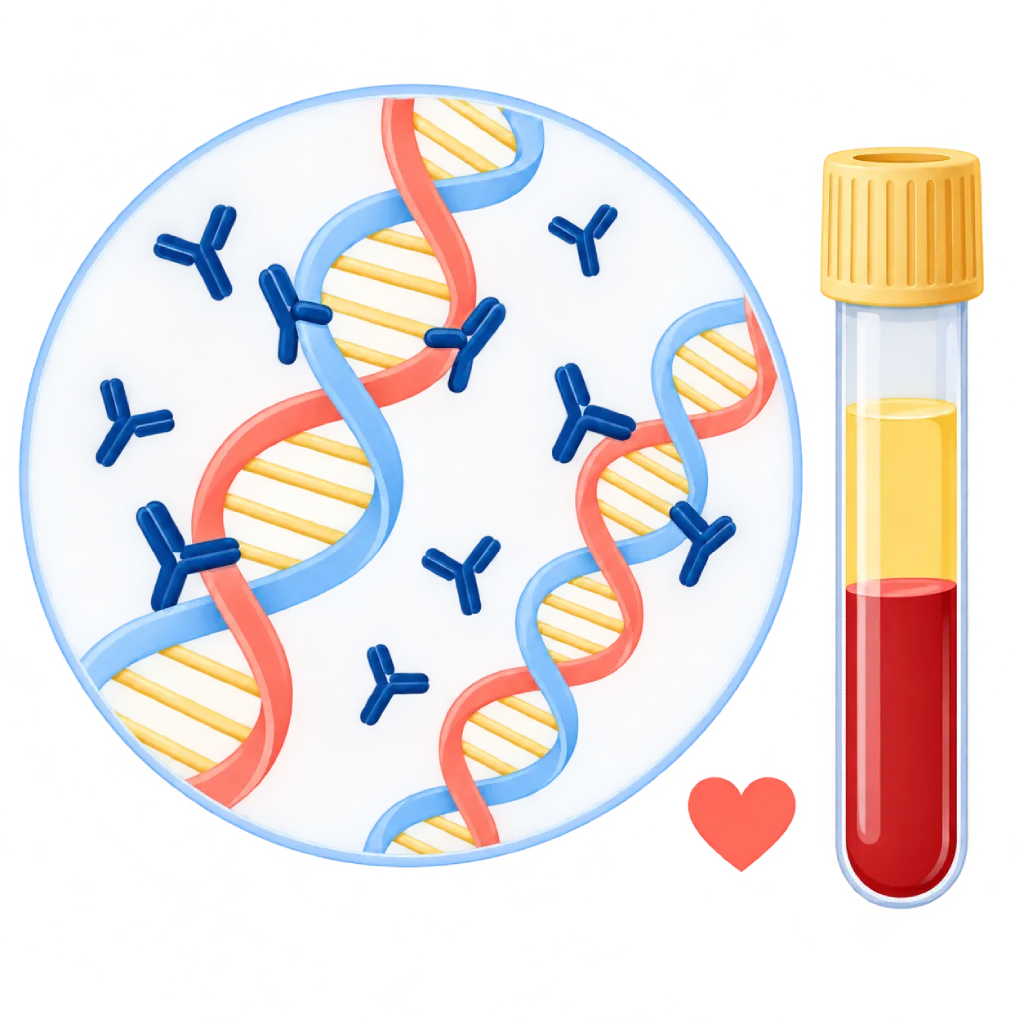
The anti-dsDNA test looks for antibodies that mistakenly attack double-stranded DNA in the cell nucleus. These antibodies are highly specific to lupus, and their levels often rise when the disease flares, especially if the kidneys become inflamed. For this reason, the test is used both to help diagnose lupus and to monitor it, together with complement tests.
Sources01 / Understanding the procedure
About Anti-dsDNA Test
What Is the Anti-dsDNA Test
Double-stranded DNA (dsDNA) is the genetic material inside the cell nucleus. In lupus, the body can make antibodies that mistakenly attack this DNA. The anti-dsDNA test measures these antibodies in the blood. They are found in about half to two thirds of people with lupus and are rarely found in other diseases.
How It Works at a Glance
Your serum is reacted with double-stranded DNA prepared in the laboratory. If anti-dsDNA antibodies are present, they bind to the DNA and are detected by the analyzer. The result is reported as negative or positive, along with the level.
Reading the Results
- Negative: the antibodies are not found. A negative result does not rule out lupus, because some people with lupus do not have anti-dsDNA.
- Positive: strongly supports lupus when accompanied by matching symptoms. Low levels are sometimes found in other conditions, so the result is read together with symptoms.
- Changes in level: in people with lupus, a rising level together with falling complement can indicate a flare, especially in the kidneys.
Laboratories may use different methods, and results from different methods cannot be compared directly. For monitoring, the test should ideally be repeated with the same method.
Anti-dsDNA and the Heart
Lupus can affect the heart, for example inflammation of the lining around the heart (pericarditis), inflammation of the heart muscle (myocarditis), and thickening of the valves. People with lupus also have a higher risk of coronary artery disease than others their age, so risk factors such as blood pressure and cholesterol need to be controlled more strictly.
Some heart and blood pressure medicines, such as hydralazine and procainamide, can cause drug-induced lupus. In this situation, anti-dsDNA is usually negative, so this test helps your doctor tell it apart from typical lupus.
02 / Understanding the procedure
When Is This Procedure Considered?
A doctor may consider this procedure in the situations below. The decision is always made after a thorough assessment.
- Positive ANA Test with Suspected LupusSuch as joint pain, rash, recurrent mouth ulcers, or hair loss.
- Monitoring LupusRepeated regularly or when symptoms change to assess disease activity.
- Kidney Problems in LupusProtein or blood in the urine, to assess kidney inflammation.
- Pericarditis or Myocarditis Without a Clear CauseAs part of the search for an autoimmune disease.
- Suspected Drug-Induced LupusFor example, while taking hydralazine, procainamide, or anti-TNF medicines.
- Pregnancy Planning in LupusTo make sure lupus is inactive before you become pregnant.
Situations to Consider First
- ANA Test Not Yet DoneThis test is usually requested after a positive ANA, not as the initial screening test.
- Different Laboratory MethodsResults from different methods cannot be compared directly. Monitoring should ideally use the same method.
- Low Positive LevelsSometimes found in conditions other than lupus, so the result is read together with symptoms.
- Anti-TNF MedicinesThese medicines can trigger anti-dsDNA. Tell your doctor if you take them.
- Recent Transfusion or Plasma ExchangeAntibody levels may change. Tell the staff.
03 / Before the procedure
How Should You Prepare?
The anti-dsDNA test uses a blood sample and does not require fasting.
Eating and drinking. Eat and drink as usual, unless another test done at the same time requires fasting.
Medicines. Take your medicines as usual, including lupus medicines, unless your doctor tells you otherwise. Bring a list of your medicines, especially if you take hydralazine, procainamide, or anti-TNF medicines.
Important information. Tell the staff if you are pregnant or have recently had a transfusion or plasma exchange.
Previous results. Bring your previous anti-dsDNA, complement, and urine test results, along with the name of the laboratory, so changes can be compared.
Unsure about the preparation instructions? Ask our team before the procedure.
04 / During the procedure
How Is the Procedure Done?
The blood draw is usually finished within 10 minutes. Results are usually available within one to several days.
Identity Check
The staff match your identity with the test request and ask about the medicines you are taking.
Blood Draw
Blood is drawn from a vein at the inner elbow into a serum tube.
Laboratory Testing
The serum is reacted with double-stranded DNA. The analyzer detects whether antibodies bind and measures how much is present.
Reading the Results
Your doctor reads the results together with your symptoms, ANA test, complement, urine tests, and previous anti-dsDNA results.
05 / Benefits and risks
Benefits and Risks Should Be Discussed Together.
Every medical procedure has benefits and risks. Your doctor will explain both for your situation before the procedure.
Benefits You Can Expect
- Strongly Supports a Lupus DiagnosisAnti-dsDNA is rarely found in diseases other than lupus.
- Monitors Lupus ActivityChanges in the level help your doctor assess whether the disease is active.
- Early Warning of Kidney FlaresA rising level can come before kidney inflammation.
- Helps Identify Drug-Induced LupusLupus caused by certain heart medicines usually occurs without anti-dsDNA.
- A Blood Sample Is EnoughNo procedure is needed other than a blood draw.
The benefits of a procedure are not a promise of a cure. Ask how the results will affect your care plan.
Risks You Should Know
- Minor Pain or BruisingAt the needle site, usually mild and quick to fade.
- Dizziness or Brief FaintingSome people feel dizzy when blood is drawn. Tell the staff so you can lie down.
- Results Differ Between MethodsResults from other laboratories may differ, so comparisons should ideally use the same method.
- Infection at the Puncture SiteVery rare because the skin is cleaned and the equipment used is sterile and single-use.
Risks can differ from person to person. A full explanation and consent are given after an individual assessment.
06 / After the procedure
What Is Recovery Like?
There is no recovery period. You can return to your activities right away.
Puncture site. A small bruise is normal and fades within a few days.
If the result is positive. Your doctor will complete the evaluation, for example with complement tests, urine tests, kidney function tests, or echocardiography if you have heart symptoms.
Monitoring lupus. Anti-dsDNA is usually repeated regularly together with complement and urine tests, according to the schedule set by your doctor.
Warning signs. Go to the emergency room right away or contact the medical team if you have:
- Sharp chest pain that gets worse when you breathe in or lie down
- Shortness of breath or palpitations
- Swelling of the face or legs with less urine, foamy urine, or red urine
- High fever with severe weakness
Know the Signs That Need Prompt Care.
Follow the team's guidance on warning signs. If severe or sudden symptoms appear after the procedure, go to the nearest emergency department right away or call Heart Attack Center 1500 258.
07 / Team and support
Doctors and Procedure Support
The doctors below are listed for this procedure. Listed by name, not by ranking.

dr. Debby C. Soemitha, Sp.PD
Internal Medicine
Clinical focusDiabetes and Diabetes Complications · Obesity and Metabolic Disease
View Profile
Dr. med. dr. Denio A. Ridjab, Sp.JP(K)
Interventional Cardiology
Coronary Intervention Procedures +2 centers
Clinical focusInterventional Cardiology · Coronary Artery Disease
View Profile
dr. Khaira U. Yusrie, Sp.PD-KGEH
Gastroenterology & Hepatology
Clinical focusInternal Medicine · Gastroenterology and Hepatology
View Profile08 / Common questions
Before You Plan the Procedure.
Frequently asked questions about the anti-dsDNA test. Your doctor will explain what the results mean for your condition.
What is the difference between an ANA test and an anti-dsDNA test?
The ANA test is a screening test that shows whether there are antibodies against the cell nucleus, and it can be positive in many conditions. The anti-dsDNA test looks for one type of antibody that is much more specific to lupus. For this reason, anti-dsDNA is usually checked after a positive ANA to clarify the diagnosis.
Does a positive anti-dsDNA mean I definitely have lupus?
Anti-dsDNA is highly specific to lupus, especially when the level is high. However, the diagnosis is still made from a combination of symptoms, physical examination, and other tests. Low positive levels are sometimes found in other conditions, so your doctor always reads the result together with your symptoms and other test results.
Why does anti-dsDNA need to be tested repeatedly?
Unlike some other antibodies, anti-dsDNA levels can rise and fall with lupus activity. A rising level, especially when complement also falls, can indicate a flare. For this reason, your doctor checks it regularly, usually together with complement and urine tests, to assess whether treatment needs to be adjusted.
How is anti-dsDNA related to the kidneys?
Anti-dsDNA is closely linked to kidney inflammation in lupus, called lupus nephritis. A rise in its level can come before a kidney flare. If anti-dsDNA rises, your doctor usually checks urine tests and kidney function, because kidney inflammation often causes no symptoms at the start and is better treated early.
I take hydralazine. Can I get lupus?
Hydralazine and procainamide can cause drug-induced lupus in a small proportion of people who take them, with symptoms such as joint pain, fever, or inflammation of the lining around the heart. In this situation, anti-dsDNA is usually negative. Symptoms usually improve after your doctor switches the medicine. Do not stop the medicine on your own; discuss your symptoms with the doctor who prescribed it.
How is lupus related to heart disease?
Lupus can affect the lining around the heart, the heart muscle, and the valves. People with lupus also have a higher risk of coronary artery disease than others their age, because of long-term inflammation and other risk factors. For this reason, regular heart checkups and control of blood pressure and cholesterol are recommended.
Sources and Medical Review
Translated from the Indonesian edition medically reviewed by dr. Debby C. Soemitha, Sp.PD.
Sources as cited in the Indonesian edition.
- Pisetsky DS, Lipsky PE. New insights into the role of antinuclear antibodies in systemic lupus erythematosus. Nat Rev Rheumatol. 2020;16(10):565-579.
- Aringer M, Costenbader K, Daikh D, et al. 2019 European League Against Rheumatism/American College of Rheumatology classification criteria for systemic lupus erythematosus. Arthritis Rheumatol. 2019;71(9):1400-1412.
- Linnik MD, Hu JZ, Heilbrunn KR, et al. Relationship between anti-double-stranded DNA antibodies and exacerbation of renal disease in patients with systemic lupus erythematosus. Arthritis Rheum. 2005;52(4):1129-1137.
- Fanouriakis A, Kostopoulou M, Andersen J, et al. EULAR recommendations for the management of systemic lupus erythematosus: 2023 update. Ann Rheum Dis. 2024;83(1):15-29.
- Kidney Disease: Improving Global Outcomes (KDIGO) Lupus Nephritis Work Group. KDIGO 2024 Clinical Practice Guideline for the management of lupus nephritis. Kidney Int. 2024;105(1S):S1-S69.
- Miner JJ, Kim AHJ. Cardiac manifestations of systemic lupus erythematosus. Rheum Dis Clin North Am. 2014;40(1):51-60.