
Quick answer
What Is Pericarditis?
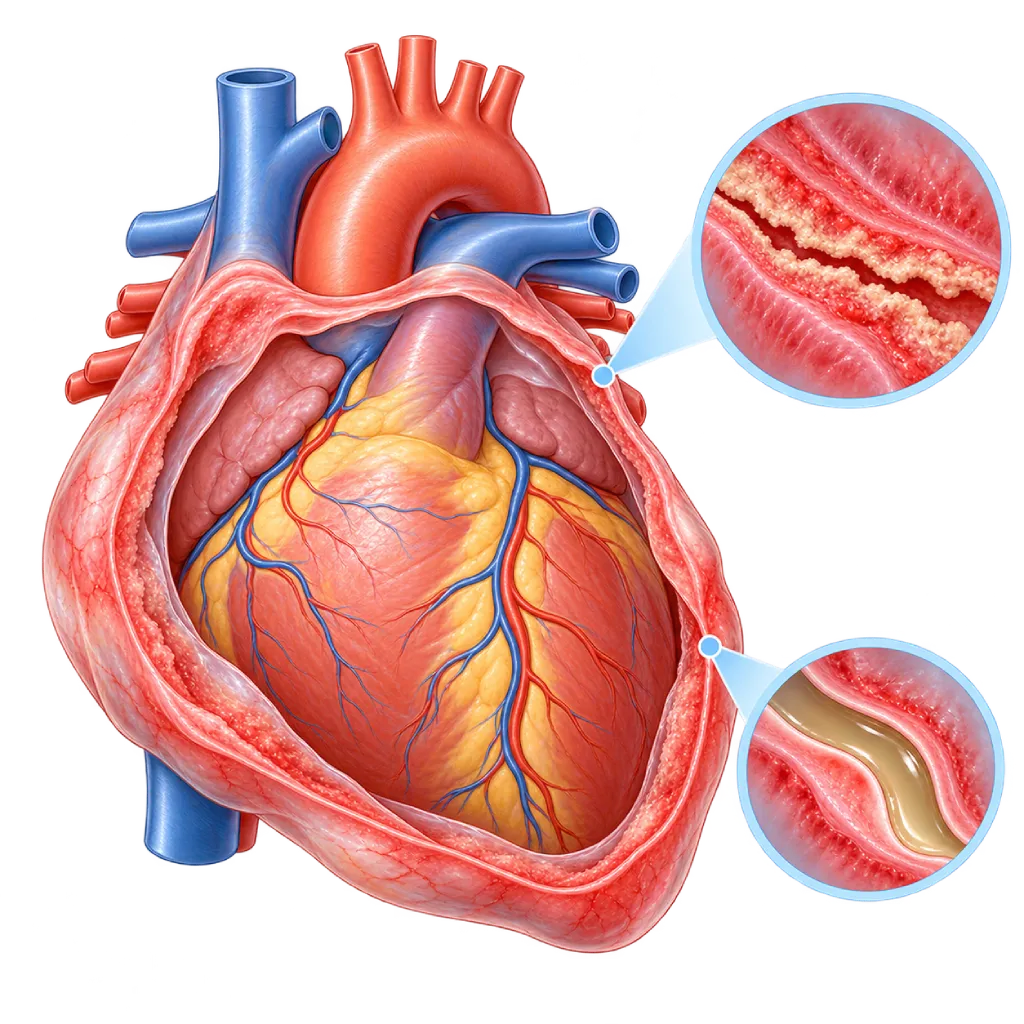
Pericarditis is inflammation of the pericardium, the thin, two-layered membrane that surrounds the heart. Its typical symptom is sharp chest pain that gets worse when you breathe in or lie down and eases when you sit up and lean forward.
SourcesSigns That Need Urgent Help
- Severe shortness of breath, or breathing that gets worse within a few hours
- Fainting, nearly fainting, or feeling very light-headed
- Pale, cold, and sweaty skin
- Very fast heartbeat with weakness
- Severe, pressing chest pain that does not change with body position
- Unusual confusion or drowsiness
If these signs appear, go to the nearest emergency department right away or call Heart Attack Center 1500 258.
01 / Understanding the condition
About Pericarditis
The heart is wrapped in the pericardium, a thin, two-layered sac. Between the two layers is a small amount of lubricating fluid, so the heart can beat without friction. In pericarditis, this membrane becomes inflamed. Its surfaces become rough and rub together every time the heart beats, which causes chest pain. The inflammation can also increase the amount of fluid inside the sac.
Anyone can get pericarditis, but it is more common in adult men. In many people, the exact cause is not found and is thought to be a viral infection. In countries with many cases of tuberculosis (TB), such as Indonesia, TB should always be considered as a cause, especially when symptoms develop slowly along with fever and weight loss.
Types of Pericarditis by Course
Doctors classify pericarditis by how long the inflammation lasts and its pattern. Acute pericarditis is a new episode that usually improves within a few weeks. If the inflammation continues for more than 4 to 6 weeks without a break, doctors call it incessant pericarditis. Recurrent pericarditis means the inflammation comes back after a symptom-free period of at least 4 to 6 weeks. Chronic pericarditis means the inflammation lasts more than three months. When the heart lining becomes thick and stiff so that the heart cannot fully expand, the condition is called constrictive pericarditis. Each type is discussed in more detail on its own page.
Links to Fluid and the Heart Muscle
Inflammation of the pericardium often comes with a small amount of extra fluid. A large buildup of fluid is a separate condition, covered on the Pericardial Effusion page. When fluid builds up quickly and presses on the heart, it is an emergency, covered on the Cardiac Tamponade page. The inflammation can also spread to the heart muscle, covered on the Myocarditis page.
Treatment Principles
For pericarditis without high-risk features, treatment can usually be carried out at home. Doctors usually give an anti-inflammatory medicine, either aspirin or a nonsteroidal anti-inflammatory drug, combined with colchicine to speed recovery and lower the risk of recurrence. Strenuous exercise needs to be postponed until the inflammation settles. If there is a high fever, a large amount of fluid, or symptoms do not improve with medicine, the doctor will recommend hospitalization and look further for the cause.
The majority of people with pericarditis caused by a virus or with no clear cause recover without long-term problems. About 15 to 30 out of 100 people have a recurrence, especially if they do not receive colchicine or their medicine is stopped too soon.
02 / Understanding the condition
Types and Related Conditions
The following conditions belong to the Pericarditis group. Open each one for a full explanation.
03 / Understanding the condition
Symptoms to Recognize.
Common Symptoms
- Sharp or stabbing chest pain, usually in the center or on the left side of the chest
- Pain that gets worse when you breathe in deeply, cough, or lie flat on your back
- Pain that eases when you sit up and lean forward
- Pain that may spread to the shoulder, neck, or upper back
- Mild fever and feeling weak
- Pounding heartbeat (palpitations)
- Feeling short of breath, especially when lying down
04 / Understanding the condition
What Causes This Condition?
- Viral infections, for example respiratory viruses, gastrointestinal viruses, or COVID-19
- Idiopathic, meaning no cause is found despite testing; in the majority of cases a virus is suspected
- Tuberculosis (TB), an important cause in countries with many TB cases
- Other bacterial infections that spread to the heart lining, although this is rare
- Autoimmune diseases such as lupus, rheumatoid arthritis, or scleroderma
- An inflammatory reaction after a heart attack, heart surgery, or a catheter procedure on the heart
- Severe kidney failure with a buildup of metabolic waste (uremia)
- Cancer that spreads to the heart lining, or radiation therapy to the chest area
05 / Understanding the condition
Who Is at Higher Risk?
Age
Pericarditis is more common in young to middle-aged adults, especially men aged 16 to 65.
Medical
Autoimmune disease, severe kidney failure, cancer, a history of heart attack or heart surgery, and radiation therapy to the chest increase the likelihood of pericarditis.
Other
A recent viral infection, close contact with a person who has TB, and a weakened immune system, for example with HIV or the use of immunosuppressive medicines.
Groups at Higher Risk
- Adult Men: Men get pericarditis more often than women, especially between the ages of 16 and 65 and after a viral infection.
- People with Autoimmune Diseases: Lupus, rheumatoid arthritis, and other autoimmune diseases can attack the heart lining and make pericarditis more likely to come back.
- Patients After Heart Surgery: The heart lining can become inflamed days to weeks after heart surgery, a catheter procedure, or a heart attack.
- People with Kidney Failure: A buildup of metabolic waste in severe kidney failure, or inadequate dialysis, can trigger inflammation in the heart lining.
- People with a History of TB Contact: Close contact with a person who has TB, or a weakened immune system, increases the chance of TB affecting the heart lining.
06 / Understanding the condition
How Is It Diagnosed?
The doctor diagnoses pericarditis when at least two of four signs are found: typical chest pain, a rubbing sound of the heart lining (pericardial friction rub) heard with a stethoscope, typical changes on the ECG, and new or increasing fluid in the heart sac. Raised markers of inflammation in the blood, such as CRP, support the diagnosis.
Because the pain can resemble a heart attack, an ECG and a troponin test are done from the start. Echocardiography assesses the amount of fluid and its effect on the heart, while a chest X-ray looks at the outline of the heart and the lungs. Tests for the cause, for example for TB, autoimmune disease, or kidney function, are done if there are high-risk features, symptoms do not improve, or the doctor suspects a specific cause. Cardiac MRI or CT helps in cases that are unclear, recurrent, or suspected to be constrictive.
Electrocardiogram (ECG)
Looks for the typical change of widespread ST-segment elevation across many leads, and distinguishes it from the pattern of a heart attack.
Echocardiography
Shows whether there is fluid in the heart sac, how much there is, and whether it is pressing on the heart.
C-Reactive Protein (CRP) Test
Measures the level of inflammation; the result is also used to monitor the response to medicine and to decide when the medicine can be reduced.
Cardiac Troponin Test
Assesses whether the inflammation also involves the heart muscle and helps rule out a heart attack.
Chest X-Ray
Shows an enlarged heart outline due to fluid, as well as lung abnormalities such as TB or fluid around the lungs.
Cardiac MRI
Used when the diagnosis is unclear, pericarditis comes back, or constriction is suspected, to look at inflammation of the heart lining and heart muscle.
07 / Understanding the condition
Treatment Options.
Treatment is decided by a doctor after an assessment. The categories below can help you follow the conversation with your doctor.
Aspirin or Nonsteroidal Anti-Inflammatory Drugs
The first choice for relieving pain and inflammation, usually given with a medicine to protect the stomach. Your doctor decides the type, how long to take it, and how to taper it.
Colchicine
Added to anti-inflammatory medicine to speed recovery and lower the risk of recurrence, with the length of treatment depending on the type of pericarditis.
Low-Dose Corticosteroids
A second choice if anti-inflammatory medicines cannot be used or do not work, or for autoimmune causes, after infections such as TB have been ruled out.
Treatment Based on the Cause
For example anti-TB medicines, antibiotics for a bacterial infection, more adequate dialysis for uremia, or treatment of autoimmune disease and cancer.
Rest from Strenuous Exercise
Strenuous exercise is postponed until symptoms are gone and inflammation markers return to normal. Athletes usually postpone competitive training for longer, based on the doctor's assessment.
Fluid Drainage or Pericardial Surgery
A large amount of fluid, or fluid that presses on the heart, is removed with a needle (pericardiocentesis). Removal of the pericardium is considered for constriction that persists.
08 / Understanding the condition
Complications to Watch For.
Recurrence
The inflammation can come back after it has settled. The risk is lower with colchicine and when the medicines are not stopped too soon.
Pericardial Effusion
The fluid in the heart sac increases. The majority only need monitoring, but a large effusion can cause shortness of breath and needs to be drained.
Cardiac Tamponade
Fluid that builds up quickly presses on the heart and disrupts its pumping. This is an emergency, and the fluid needs to be removed right away.
Constrictive Pericarditis
The heart lining becomes thick and stiff. This is rare after viral or idiopathic pericarditis but more common after TB or a bacterial infection.
Heart Muscle Involvement
The inflammation can spread to the heart muscle, shown by a rise in troponin. Recovery is usually still good, but it needs monitoring and a longer break from exercise.
09 / Understanding the condition
What Can You Do?
- Take your medicines for the recommended length of time, including colchicine, even after the pain is gone
- Do not stop or reduce your medicines on your own; your doctor will taper them gradually
- Postpone strenuous exercise until your doctor says the inflammation has settled
- Complete your TB treatment fully if you are diagnosed with TB
- Keep autoimmune disease or kidney disease under control with regular checkups
- Attend your checkups as scheduled for CRP tests and echocardiography
10 / Understanding the condition
When Should You See a Doctor?
See a doctor if you have sharp chest pain that gets worse when you breathe in or lie down, especially if it comes with fever or you have just recovered from the flu. Do not guess the cause of chest pain yourself, because the symptoms can resemble a heart attack. If you have already been diagnosed with pericarditis, contact your doctor if the pain does not improve after about one week of treatment or comes back after the medicine is stopped.
Go to the emergency room right away if you have:
- Severe, pressing chest pain, or chest pain with a cold sweat
- Severe shortness of breath, or breathing that gets worse within a few hours
- Fainting, nearly fainting, or feeling very light-headed
- Pale, cold skin with a very fast heartbeat
Don't Wait in an Emergency.
If symptoms are severe or come on suddenly, go to the nearest emergency department right away or call Heart Attack Center 1500 258, rather than waiting for an appointment.
11 / Common questions
Questions You May Have.
Frequently asked questions about pericarditis.
Is pericarditis the same as a heart attack?
No. Pericarditis is inflammation of the membrane that surrounds the heart, while a heart attack happens when a coronary artery is blocked so the heart muscle does not get enough blood. Both can cause chest pain and ECG changes, so doctors check an ECG and troponin to tell them apart. Pericarditis pain is usually sharp, worse when breathing or lying down, and eases when sitting up and leaning forward.
Can pericarditis be cured?
Yes. In the majority of cases, acute pericarditis caused by a virus or with no clear cause heals within a few weeks with anti-inflammatory medicine and colchicine. Some people have a recurrence, so the medicines need to be taken for the recommended length of time and tapered gradually by the doctor. Long-term complications such as constrictive pericarditis are rare after viral pericarditis, but more likely when the cause is TB or a bacterial infection.
Is pericarditis dangerous?
In the majority of cases, pericarditis is not dangerous and improves with medicine. The main danger is when fluid builds up quickly and presses on the heart, shown by severe shortness of breath, weakness, and nearly fainting. Your doctor will recommend hospitalization if there is a high fever, symptoms develop slowly over several days to weeks, there is a large amount of fluid, or symptoms do not improve after about one week of treatment.
Is pericarditis contagious?
Pericarditis itself is not contagious. However, its cause can be a contagious infection, for example a respiratory virus or tuberculosis. If your pericarditis is caused by TB, your doctor will give you anti-TB medicines and recommend testing for the people you live with. Washing your hands, covering your mouth when you cough, and completing TB treatment fully help prevent the spread of the infection that causes it.
Why do I have to limit exercise?
Strenuous physical activity can worsen the inflammation and the symptoms. That is why guidelines recommend postponing strenuous exercise until symptoms are gone and inflammation markers such as CRP return to normal. Light daily activities are generally still fine. Athletes are usually asked to postpone training and competition for longer, then return to training after being reassessed by a doctor.
Can pericarditis come back?
Yes. About 15 to 30 out of 100 people have a recurrence after the first episode, especially if they did not receive colchicine, used corticosteroids, or stopped their medicine too soon. A recurrence usually feels like the first attack. Recurrent pericarditis rarely causes serious complications, and its treatment is covered on the Recurrent Pericarditis page.
Sources and Medical Review
Translated from the Indonesian edition medically reviewed by dr. Sri Diniharini, Sp.JP(K).
Sources as cited in the Indonesian edition.
- Schulz-Menger J, Collini V, Gröschel J, Adler Y, Brucato A, Christian V, et al. 2025 ESC Guidelines for the management of myocarditis and pericarditis. Eur Heart J. 2025;46(40):3952-4041.
- Adler Y, Charron P, Imazio M, Badano L, Barón-Esquivias G, Bogaert J, et al. 2015 ESC Guidelines for the diagnosis and management of pericardial diseases: The Task Force for the Diagnosis and Management of Pericardial Diseases of the European Society of Cardiology (ESC). Eur Heart J. 2015;36(42):2921-2964.
- Imazio M, Gaita F, LeWinter M. Evaluation and Treatment of Pericarditis: A Systematic Review. JAMA. 2015;314(14):1498-1506.
- Chiabrando JG, Bonaventura A, Vecchié A, Wohlford GF, Mauro AG, Jordan JH, et al. Management of Acute and Recurrent Pericarditis: JACC State-of-the-Art Review. J Am Coll Cardiol. 2020;75(1):76-92.
- Imazio M, Brucato A, Maestroni S, Cumetti D, Belli R, Trinchero R, et al. Risk of Constrictive Pericarditis After Acute Pericarditis. Circulation. 2011;124(11):1270-1275.
- Imazio M, Brucato A, Cemin R, Ferrua S, Maggiolini S, Beqaraj F, et al. A Randomized Trial of Colchicine for Acute Pericarditis. N Engl J Med. 2013;369(16):1522-1528.
Doctors Who Treat This Condition

dr. Sri Diniharini, Sp.JP(K)
Echocardiography & Cardiovascular Imaging
Cardiovascular Diagnostic Center +1 center
Clinical focusAdvanced Echocardiography · Transesophageal Echocardiography
View Profile
dr. Debby C. Soemitha, Sp.PD
Internal Medicine
Clinical focusDiabetes and Diabetes Complications · Obesity and Metabolic Disease
View Profile
dr. Radityo Prakoso, Sp.JP(K)
Pediatrics & Congenital Heart Disease
Congenital and Structural Heart Center
Clinical focusPediatric Cardiology Consultation · Congenital Heart Disease Care
View Profile