
Quick answer
What Is Erythrocyte Sedimentation Rate?
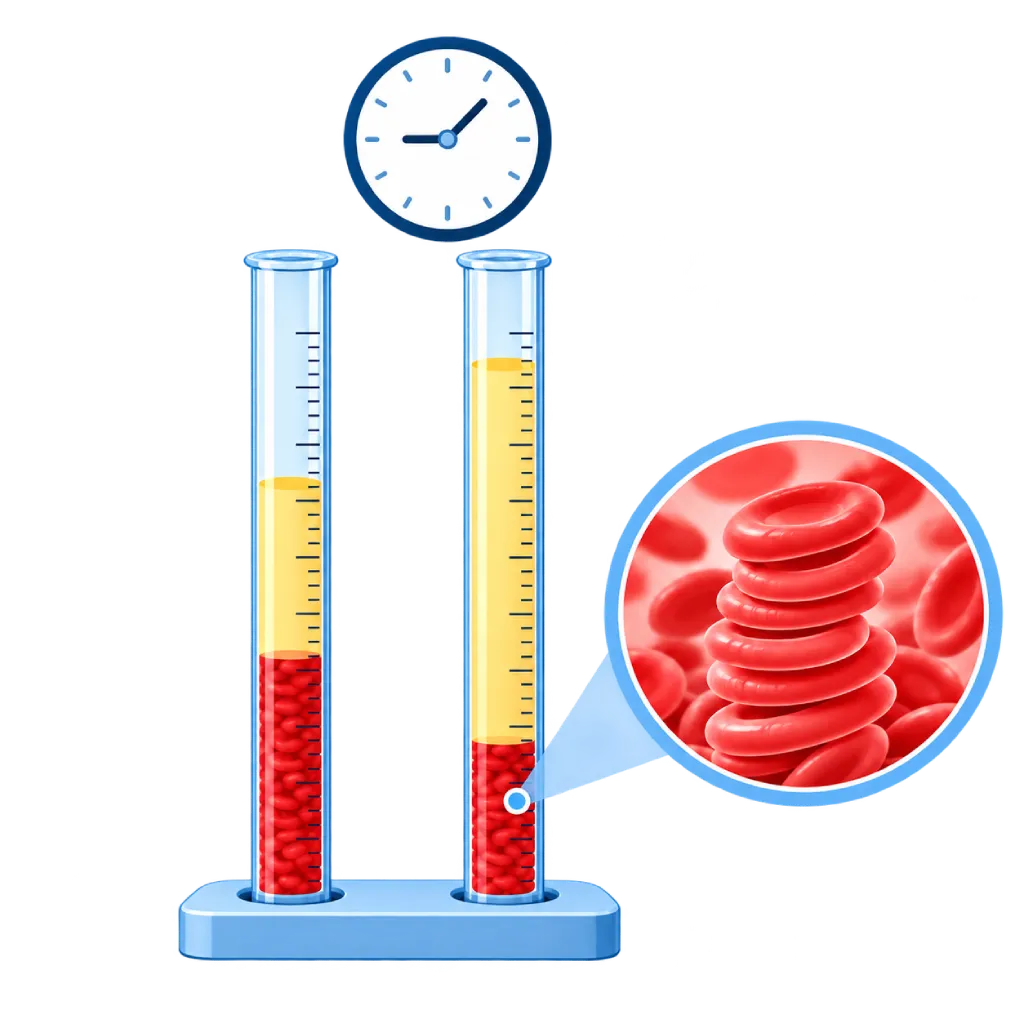
The erythrocyte sedimentation rate (ESR) test measures how quickly red blood cells sink to the bottom of a tube in one hour. When there is inflammation, red blood cells clump together more easily and sink faster. ESR helps your doctor assess inflammation, for example in rheumatic fever, endocarditis, and autoimmune diseases.
Sources01 / Understanding the procedure
About Erythrocyte Sedimentation Rate
What Is the Erythrocyte Sedimentation Rate
The erythrocyte sedimentation rate (ESR) is the speed at which red blood cells sink and settle at the bottom of an upright tube over one hour. The result is reported in millimeters per hour (mm/hour). ESR does not point to a specific disease, but it helps signal the presence of inflammation and monitor its course.
How It Works in Brief
Blood is placed in a tall upright tube and left to stand for one hour. When there is inflammation, certain proteins in the blood make red blood cells stick together and stack up, so they become heavier and sink faster. After one hour, the staff measure the height of the clear fluid above the red blood cells.
Reading the Results
Normal limits differ by age and sex, and each laboratory has its own range. ESR tends to rise with age and is slightly higher in women.
- Normal or slightly raised: often not significant, especially in older adults.
- Raised: can be found in infection, autoimmune disease, blood vessel inflammation, or anemia.
- Very high: the cause needs to be investigated, for example severe infection, inflammation of the large blood vessels, or certain blood disorders.
ESR and Heart Disease
In acute rheumatic fever, a raised ESR is one of the supporting criteria for diagnosis. In regions with many cases, such as Indonesia, the threshold used is 30 mm/hour or more. Recurrent rheumatic fever can damage the heart valves and cause rheumatic heart disease. ESR also helps monitor endocarditis, inflammation of the large blood vessels such as Takayasu arteritis, and autoimmune diseases that can affect the heart.
ESR and CRP
ESR changes more slowly than CRP, both when rising and when falling, and is more affected by anemia, pregnancy, or kidney disease. For this reason, doctors often check both together to get a clearer picture of inflammation.
02 / Understanding the procedure
When Is This Procedure Considered?
A doctor may consider this procedure in the situations below. The decision is always made after a thorough assessment.
- Suspected Acute Rheumatic FeverA raised ESR is one of the supporting criteria for diagnosis.
- Monitoring Rheumatic Heart DiseaseHelps assess whether inflammation is still active.
- Suspected EndocarditisTogether with other tests, it helps assess heart valve infection and the response to treatment.
- Suspected Blood Vessel InflammationFor example, Takayasu arteritis or other types of vasculitis.
- Autoimmune DiseasesSuch as lupus or rheumatoid arthritis, to monitor disease activity.
- Fever or Weakness with No Clear CauseAs an early clue to inflammation or infection.
Situations to Consider First
- AnemiaFewer red blood cells make the ESR appear higher.
- PregnancyESR normally rises during pregnancy.
- Chronic Kidney DiseaseCan raise ESR even without active inflammation.
- Older AgeNormal limits are higher in older people.
- Red Blood Cell DisordersFor example, sickle cell disease or an excess of red blood cells, which can make ESR very low.
03 / Before the procedure
How Should You Prepare?
The ESR test uses a blood sample and requires no special preparation.
Eating and drinking. No fasting is needed, unless another test done at the same time requires fasting.
Medicines. Take your medicines as usual. Bring a list of your medicines, especially anti-inflammatory medicines, corticosteroids, or hormone therapy.
Important information. Tell the staff if you are pregnant, having your period, have anemia, or have kidney disease.
Previous results. Bring previous ESR or CRP results so your doctor can see any changes.
Unsure about the preparation instructions? Ask our team before the procedure.
04 / During the procedure
How Is the Procedure Done?
The blood draw usually takes 10 minutes. Reading the ESR takes one hour in the laboratory, and results are usually available the same day.
Identity Check
The staff match your identity with the test request and ask about medicines and conditions that may affect the results.
Blood Draw
Blood is drawn from a vein in the crook of your elbow and mixed with a substance that keeps it from clotting.
Settling for One Hour
The blood is placed in a graduated upright tube and left undisturbed for exactly one hour. Some laboratories use faster automated analyzers.
Reading the Results
The height of the clear fluid above the red blood cells is recorded in mm/hour. Your doctor interprets it together with your symptoms, CRP, and other tests.
05 / Benefits and risks
Benefits and Risks Should Be Discussed Together.
Every medical procedure has benefits and risks. Your doctor will explain both for your situation before the procedure.
Benefits You Can Expect
- Simple and InexpensiveOnly a small amount of blood is needed, and the test is widely available.
- A Marker of InflammationGives an early clue that there is an inflammatory process in the body.
- Supports the Diagnosis of Rheumatic FeverIt is included in the criteria doctors use for diagnosis.
- Monitors Disease ActivityChanges in ESR help assess treatment results over time.
- Complements CRPTogether with CRP, it gives a more complete picture of inflammation.
The benefits of a procedure are not a promise of a cure. Ask how the results will affect your care plan.
Risks You Should Know
- Minor Pain or BruisingAt the needle site, usually mild and quick to fade.
- Brief Dizziness or FaintingSome people feel dizzy when blood is drawn. Tell the staff so you can lie down.
- Nonspecific ResultsESR rises in many conditions, so other tests are needed to find the cause.
- Infection at the Puncture SiteVery rare, because the skin is cleaned and the equipment used is sterile and single-use.
Risks can differ from person to person. A full explanation and consent are given after an individual assessment.
06 / After the procedure
What Is Recovery Like?
There is no recovery period. You can return to your activities right away.
Puncture site. A small bruise is normal and fades within a few days.
If ESR is high. Your doctor looks for the cause with other tests, for example CRP, autoimmune tests, or echocardiography.
Monitoring. ESR may be repeated to see whether inflammation has settled after treatment, usually after a few weeks because ESR falls slowly.
Warning signs. Contact the medical team right away if you have:
- Fever with joint pain that moves from one joint to another
- Shortness of breath or palpitations
- Chest pain
- A severe headache with vision problems
Know the Signs That Need Prompt Care.
Follow the team's guidance on warning signs. If severe or sudden symptoms appear after the procedure, go to the nearest emergency department right away or call Heart Attack Center 1500 258.
07 / Team and support
Doctors and Procedure Support
The doctors below are listed for this procedure. Listed by name, not by ranking.

dr. Khaira U. Yusrie, Sp.PD-KGEH
Gastroenterology & Hepatology
Clinical focusInternal Medicine · Gastroenterology and Hepatology
View Profile
dr. Sri Diniharini, Sp.JP(K)
Echocardiography & Cardiovascular Imaging
Cardiovascular Diagnostic Center +1 center
Clinical focusAdvanced Echocardiography · Transesophageal Echocardiography
View Profile
dr. Suko Adiarto, Sp.JP(K), Ph.D.
Interventional Cardiology
Vascular Diagnostic and Therapeutic Center +1 center
Clinical focusCoronary Intervention · Peripheral Vascular Intervention
View Profile08 / Common questions
Before You Plan the Procedure.
Frequently asked questions about the erythrocyte sedimentation rate test. Your doctor explains what the results mean for your condition.
What is a normal ESR value?
The normal value depends on age, sex, and the laboratory. As a rough guide, the upper limit for men is about age divided by two, and for women about age plus 10, then divided by two, in mm/hour. For this reason, an ESR slightly above the laboratory range in older adults is often not significant.
What does a high ESR mean?
A high ESR suggests possible inflammation, for example from infection, autoimmune disease, or blood vessel inflammation. ESR can also rise because of anemia, pregnancy, older age, or kidney disease. Because it is nonspecific, your doctor interprets the result together with your symptoms and other tests to find the cause.
How is ESR related to rheumatic fever?
Acute rheumatic fever is an inflammatory reaction after a throat infection with streptococcus bacteria, and it can damage the heart valves. A raised ESR is one of the supporting criteria for diagnosis. In regions with many cases, such as Indonesia, the threshold used is 30 mm/hour or more, together with symptoms and other tests.
What is the difference between ESR and CRP?
Both are markers of inflammation. CRP rises and falls more quickly, so it is well suited to monitoring day-to-day changes. ESR changes more slowly and is more affected by anemia, pregnancy, or kidney disease. Doctors often check both together to get a more complete picture.
Do I need to fast before an ESR test?
No. ESR is not affected by food, so you can eat and drink as usual. If another test that requires fasting is done at the same time, follow the instructions for that test. Tell the staff if you are pregnant, having your period, or have anemia, because these conditions can affect the results.
Why is my ESR still high even though I feel better?
ESR falls more slowly than symptoms and CRP, so it can stay high for several weeks after inflammation has settled. ESR can also be high because of anemia or kidney disease. Your doctor assesses the result together with your symptoms and other tests, and may repeat the ESR after a few weeks.
Sources and Medical Review
Translated from the Indonesian edition medically reviewed by dr. Khaira U. Yusrie, Sp.PD-KGEH.
Sources as cited in the Indonesian edition.
- Jou JM, Lewis SM, Briggs C, et al. ICSH review of the measurement of the erythrocyte sedimentation rate. Int J Lab Hematol. 2011;33(2):125-132.
- Miller A, Green M, Robinson D. Simple rule for calculating normal erythrocyte sedimentation rate. Br Med J (Clin Res Ed). 1983;286(6361):266.
- Gewitz MH, Baltimore RS, Tani LY, et al. Revision of the Jones Criteria for the diagnosis of acute rheumatic fever in the era of Doppler echocardiography: a scientific statement from the American Heart Association. Circulation. 2015;131(20):1806-1818.
- Harrison M. Abnormal laboratory results: erythrocyte sedimentation rate and C-reactive protein. Aust Prescr. 2015;38(3):93-94.
- Hellmich B, Agueda A, Monti S, et al. 2018 Update of the EULAR recommendations for the management of large vessel vasculitis. Ann Rheum Dis. 2020;79(1):19-30.