
Quick answer
What Is Rheumatic Valve Disease?
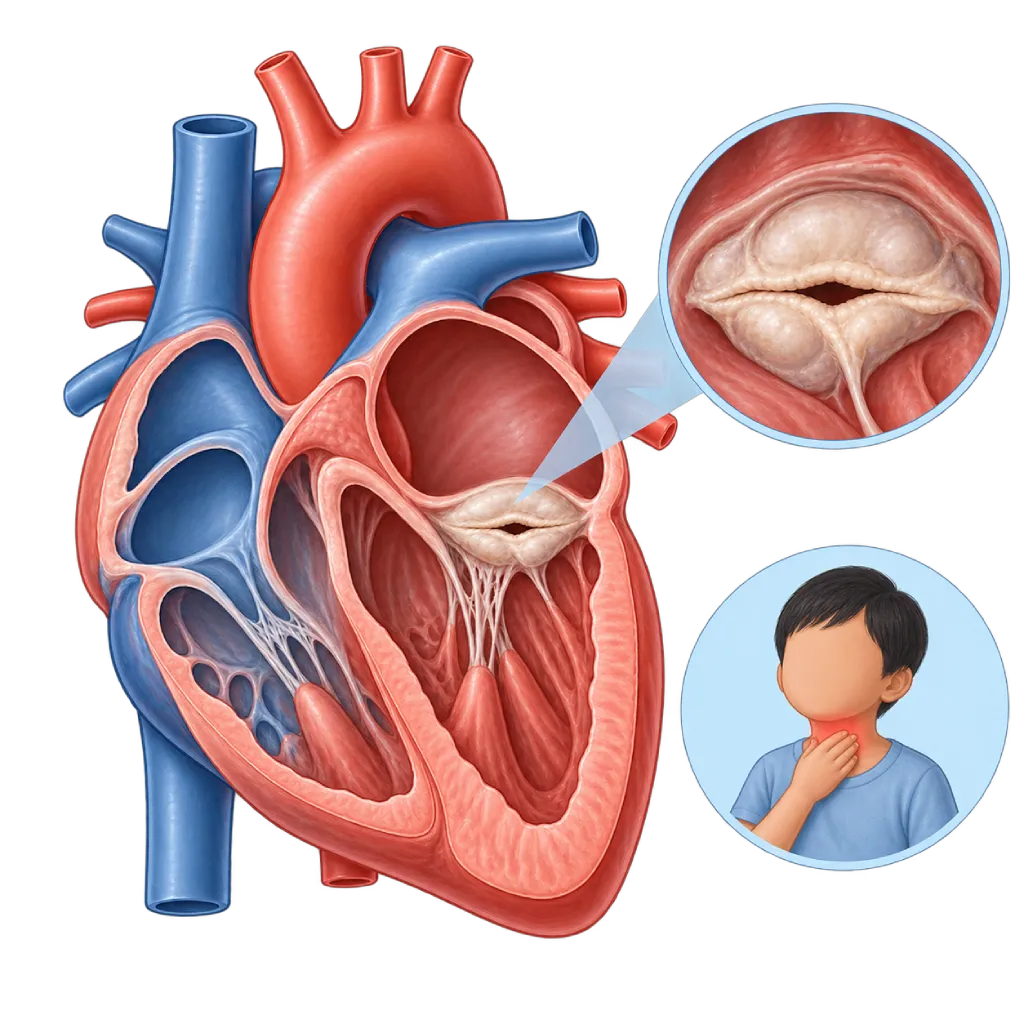
Rheumatic valve disease is damage to the heart valves caused by rheumatic fever, an immune reaction that follows a throat infection with streptococcal bacteria. The valves, especially the mitral valve, thicken and contract, so they narrow or leak.
SourcesSigns That Need Urgent Help
- Severe shortness of breath at rest or being unable to lie down
- Coughing up pink, frothy sputum or coughing up blood
- A very fast, irregular heartbeat with weakness or shortness of breath
- Sudden weakness on one side of the body, a drooping face, or slurred speech
- Fainting or nearly fainting
- Fever with rapidly worsening shortness of breath in people with an artificial valve
If these signs appear, go to the nearest emergency department right away or call Heart Attack Center 1500 258.
01 / Understanding the condition
About Rheumatic Valve Disease
Rheumatic valve disease begins with a throat infection caused by group A streptococcal bacteria that is not fully treated, usually between the ages of 5 and 15. In some children, the immune system then mistakenly attacks the body's own tissues, including the heart, in a reaction called acute rheumatic fever. This process is covered on the Rheumatic Heart Disease page.
The inflammation makes the valve leaflets thicken, their edges stick together, and their supporting cords shorten. The damage increases each time rheumatic fever recurs, then progresses slowly over many years. This is why symptoms are often not felt until young adulthood, around the ages of 20 to 40, when the valve is already quite severely damaged.
Which Valves Are Affected
The mitral valve is almost always affected. In the early stage, especially in children and teenagers, the mitral valve usually leaks. Over time, the fused and stiff leaflets make the valve narrow, which is covered on the Mitral Stenosis page. The aortic valve is affected in some patients, often together with the mitral valve, while the tricuspid valve is affected less often. One person can have several damaged valves at the same time.
Still Found in Indonesia
In developed countries, this disease has become rare. In many low- and middle-income countries, including in Southeast Asia, rheumatic heart disease remains an important cause of valve disease in children and young adults. Crowded living conditions, limited access to health care, and throat infections that are not fully treated play a role in its spread and recurrence.
Why Secondary Prevention Matters
People who have had rheumatic fever can easily have a recurrence if they are infected with streptococcus again, and each recurrence can add to the valve damage. Guidelines recommend regular antibiotic injections or tablets for many years to prevent recurrence. The GOAL study in Uganda (2022) showed that antibiotic injections every four weeks reduced the worsening of early-stage rheumatic heart disease found through screening echocardiography. If the damage is already severe, the valve needs treatment. A narrowed mitral valve whose leaflets are still flexible can be widened with a balloon through a catheter, while a valve that is stiff, calcified, or severely leaking is generally repaired or replaced through surgery.
02 / Understanding the condition
Symptoms to Recognize.
Common Symptoms
- Shortness of breath during activity, and later also when lying down
- Tiring easily and a reduced ability to be active
- Palpitations or a heartbeat that feels irregular
- Coughing or waking up at night because of breathlessness
- Swelling in the ankles, legs, or abdomen
- A heart murmur found by a doctor during an examination
Symptoms in Adult Women
Pregnancy increases blood volume and heart rate, so rheumatic valve disease that previously caused no symptoms often starts to be felt during pregnancy.
- Shortness of breath that gets worse as the pregnancy progresses
- Palpitations that are new or get worse during pregnancy
- Being unable to lie flat because of breathlessness
- Coughing at night or frothy phlegm
Symptoms in Children
Signs of acute rheumatic fever, which can damage the valves. Take your child to a doctor if these signs appear after a throat infection.
- Fever that appears 2 to 3 weeks after a throat infection
- Pain and swelling in large joints that moves from one joint to another
- Uncontrolled movements of the hands, feet, or face (chorea)
- Tiring quickly, rapid breathing, or palpitations
- Ring-shaped red patches on the skin or small lumps under the skin
03 / Understanding the condition
What Causes This Condition?
- A throat infection with group A streptococcal bacteria that is not fully treated
- Acute rheumatic fever, an immune reaction that mistakenly attacks heart tissue
- Repeated recurrences of rheumatic fever due to new streptococcal infections
- Long-term inflammation that makes the valve leaflets thicken, stick together, and contract
- Calcification of an already damaged valve with increasing age
04 / Understanding the condition
Who Is at Higher Risk?
Age
Rheumatic fever usually appears between the ages of 5 and 15, while valve damage often does not cause symptoms until the ages of 20 to 40.
Medical
A history of rheumatic fever, especially if it has recurred or was accompanied by heart inflammation, as well as irregular use of preventive antibiotics, increases the risk of further valve damage.
Genetic
An inherited tendency in the immune system is thought to make some people more prone to rheumatic fever after a streptococcal infection, so the disease may be found in several members of the same family.
Other
Crowded living conditions, poor sanitation, and limited access to health care make it easier for streptococcus to spread and leave throat infections not fully treated. Women are affected more often.
Groups at Higher Risk
- School-Age Children and Teenagers: Rheumatic fever usually appears between the ages of 5 and 15 after a throat infection that was not fully treated.
- Rheumatic Fever Survivors: Each recurrence can add to the valve damage, so preventive antibiotics and regular checkups are needed.
- Women of Childbearing Age: Rheumatic valve disease is found more often in women, and pregnancy can worsen symptoms, especially with mitral valve narrowing.
- Communities with Limited Access to Health Care: Crowded living conditions and difficult access to doctors mean throat infections are often not fully treated.
05 / Understanding the condition
How Is It Diagnosed?
Evaluation usually starts with a heart murmur heard by the doctor, symptoms of shortness of breath, or a history of rheumatic fever in childhood. Echocardiography then confirms the diagnosis. Rheumatic damage has characteristic features, for example thickened mitral valve leaflets with fused edges and restricted movement, which allow the doctor to distinguish it from other causes.
Echocardiography also measures the degree of narrowing or leakage, the size of the left atrium, and the pressure in the lung blood vessels. These results are used to assess whether the mitral valve is suitable for balloon widening or needs surgery. Before balloon widening, echocardiography through the esophagus confirms that there is no blood clot in the left atrium. In areas with many cases, screening echocardiography using the 2023 World Heart Federation criteria can find early-stage disease before symptoms appear.
Physical Examination
The doctor listens for heart murmurs typical of mitral and aortic valve disease, and checks the pulse rhythm and signs of fluid buildup.
Echocardiography
The main test to see the features of rheumatic damage on the valves, measure the degree of narrowing or leakage, and assess the pressure in the lungs.
Transesophageal echocardiography (through the esophagus) looks for clots in the left atrium and assesses the mitral valve before balloon widening of the valve.
Electrocardiogram (ECG)
Looks for atrial fibrillation and signs of enlargement of the atria or ventricles.
Chest X-Ray
Shows the size of the heart, enlargement of the left atrium, and congestion in the lungs.
C-Reactive Protein (CRP) Test
A blood test for markers of inflammation, together with the erythrocyte sedimentation rate and streptococcal antibody tests, helps identify active acute rheumatic fever.
Stress Echocardiography
Assesses the rise in pressure across the mitral valve and in the lungs during activity when symptoms do not match the results of echocardiography at rest.
06 / Understanding the condition
Treatment Options.
Treatment is decided by a doctor after an assessment. The categories below can help you follow the conversation with your doctor.
Long-Term Preventive Antibiotics
Regular antibiotic injections or tablets to prevent rheumatic fever from recurring, usually for many years and longer if the valve is severely damaged. Your doctor decides the type and duration.
Medicines to Relieve Symptoms
Diuretics relieve fluid buildup, and heart rate control medicines help in mitral valve narrowing and atrial fibrillation. Your doctor decides the class and dose.
Blood Thinners
In atrial fibrillation with moderate to severe mitral valve narrowing, blood thinners of the vitamin K antagonist class are used to prevent stroke, with regular blood tests.
Balloon Mitral Valvuloplasty
A narrowed mitral valve that is still flexible can be widened with a balloon through a catheter inserted from the groin, without opening the chest.
Valve Repair or Replacement Surgery
A valve that is stiff, calcified, or severely leaking is repaired or replaced with a mechanical or biological artificial valve. For rheumatic valves, replacement is performed more often than repair.
07 / Understanding the condition
Complications to Watch For.
Heart Failure
A narrowed or leaking valve strains the heart for years, leading to shortness of breath and swelling. Covered on the Heart Failure page.
Atrial Fibrillation
An enlarged left atrium in mitral valve disease often develops an irregular rhythm. Covered on the Atrial Fibrillation page.
Stroke Caused by a Blood Clot
Clots form easily in an enlarged left atrium, especially when atrial fibrillation is present, and can then travel with the bloodstream to the brain.
Pulmonary Hypertension
High pressure in the left atrium is passed back to the lung blood vessels and strains the right ventricle. Covered on the Pulmonary Hypertension page.
Infective Endocarditis
Damaged valves are more easily infected by germs from the bloodstream. Covered on the Infective Endocarditis page.
Worsening During Pregnancy
Pregnancy can worsen mitral valve narrowing, leading to shortness of breath or fluid in the lungs, especially in the second and third trimesters.
08 / Understanding the condition
What Can You Do?
- Treat throat infections in children with antibiotics from a doctor until the course is finished
- Take a child with fever and a severe sore throat to a doctor
- If you have had rheumatic fever, take preventive antibiotics on schedule without interruption
- Keep your teeth and mouth clean to lower the risk of valve infection
- Have regular checkups and echocardiography even if you have no symptoms yet
- Plan pregnancy together with a cardiologist and an obstetrician
09 / Understanding the condition
When Should You See a Doctor?
Take your child to a doctor if they have a fever with a sore throat, or if fever, joint pain that moves from joint to joint, or uncontrolled movements appear 2 to 3 weeks after a throat infection. If you are an adult who has had rheumatic fever or has a heart murmur, you need to be examined by a cardiologist even if you feel well. Go to the emergency room right away if you have severe shortness of breath, cough up blood, or show signs of a stroke.
- A history of rheumatic fever without preventive antibiotics or regular checkups
- Shortness of breath or palpitations during activity
- Shortness of breath that gets worse during pregnancy
- A heartbeat that feels irregular
- Plans for pregnancy in women with rheumatic valve disease
Don't Wait in an Emergency.
If symptoms are severe or come on suddenly, go to the nearest emergency department right away or call Heart Attack Center 1500 258, rather than waiting for an appointment.
10 / Common questions
Questions You May Have.
Frequently asked questions about rheumatic valve disease.
What is the difference between rheumatic valve disease and rheumatic heart disease?
The two are closely related. Rheumatic heart disease is a broad term for heart damage caused by rheumatic fever, including inflammation of the heart during acute rheumatic fever. Rheumatic valve disease emphasizes the long-term effects on the valves, namely valves that narrow or leak. Permanent damage from rheumatic fever almost always takes the form of valve damage, especially to the mitral valve. The early process is covered on the Rheumatic Heart Disease page.
Can rheumatic valve disease be cured?
Valve damage that has already occurred cannot be reversed with medicines. However, its progression can be slowed by preventing recurrences of rheumatic fever with regular preventive antibiotics. In early-stage disease found through screening, some valve abnormalities can even improve. If the damage is already severe, balloon widening of the valve or valve surgery helps restore blood flow and relieve symptoms.
How long do preventive antibiotics need to be taken?
The duration depends on your age, whether there was heart inflammation during rheumatic fever, and how severe the valve damage is. In general, antibiotics are given for 5 to 10 years after the last episode or until young adulthood, and for longer, up to age 40 or even for life, if the valve is already damaged. Do not stop them on your own; your doctor decides when you can stop.
Can women with rheumatic valve disease become pregnant?
Many women with rheumatic valve disease can go through pregnancy well if it is planned. Moderate to severe mitral valve narrowing should be treated first, for example with balloon widening of the valve before pregnancy, because pregnancy increases the workload on the heart. Women with a mechanical valve need special planning regarding blood thinners. Plan your pregnancy together with a cardiologist and an obstetrician.
Can newer blood thinners be used?
In atrial fibrillation with moderate to severe mitral valve narrowing, guidelines recommend blood thinners of the vitamin K antagonist class. The INVICTUS study in 2022 in patients with rheumatic heart disease showed that this class was better at preventing stroke and death than medicines of the factor Xa inhibitor class. For valve leakage without severe narrowing, the choice may be different. Your doctor decides the appropriate medicine.
Can every throat infection in children turn into rheumatic fever?
No. The majority of throat infections are caused by viruses, and only a small proportion of streptococcal infections progress to rheumatic fever. Even so, a streptococcal throat infection needs to be treated with antibiotics from a doctor until the course is finished, because complete treatment prevents rheumatic fever. Have your child checked if they have a fever with a severe sore throat, especially without a cough or runny nose.
Sources and Medical Review
Translated from the Indonesian edition medically reviewed by Dr. dr. Dafsah A. Juzar, Sp.JP(K).
Sources as cited in the Indonesian edition.
- Vahanian A, Beyersdorf F, Praz F, Milojevic M, Baldus S, Bauersachs J, et al. 2021 ESC/EACTS Guidelines for the management of valvular heart disease. Eur Heart J. 2022;43(7):561-632.
- Otto CM, Nishimura RA, Bonow RO, Carabello BA, Erwin JP 3rd, Gentile F, et al. 2020 ACC/AHA Guideline for the Management of Patients With Valvular Heart Disease: A Report of the American College of Cardiology/American Heart Association Joint Committee on Clinical Practice Guidelines. Circulation. 2021;143(5):e72-e227.
- Kumar RK, Antunes MJ, Beaton A, Mirabel M, Nkomo VT, Okello E, et al. Contemporary Diagnosis and Management of Rheumatic Heart Disease: Implications for Closing the Gap: A Scientific Statement From the American Heart Association. Circulation. 2020;142(20):e337-e357.
- Rwebembera J, Marangou J, Mwita JC, Mocumbi AO, Mota C, Okello E, et al. 2023 World Heart Federation guidelines for the echocardiographic diagnosis of rheumatic heart disease. Nat Rev Cardiol. 2024;21(4):250-263.
- Beaton A, Okello E, Rwebembera J, Grobler A, Engelman D, Alepere J, et al. Secondary Antibiotic Prophylaxis for Latent Rheumatic Heart Disease. N Engl J Med. 2022;386(3):230-240.
- Connolly SJ, Karthikeyan G, Ntsekhe M, Haileamlak A, El Sayed A, El Ghamrawy A, et al. Rivaroxaban in Rheumatic Heart Disease-Associated Atrial Fibrillation. N Engl J Med. 2022;387(11):978-988.
- Watkins DA, Johnson CO, Colquhoun SM, Karthikeyan G, Beaton A, Bukhman G, et al. Global, Regional, and National Burden of Rheumatic Heart Disease, 1990-2015. N Engl J Med. 2017;377(8):713-722.
Doctors Who Treat This Condition

Dr. dr. Dafsah A. Juzar, Sp.JP(K)
Interventional Cardiology
Coronary Intervention Procedures +1 center
Clinical focusComplex Coronary Intervention · Cardiac Catheterization
View Profile
Dr. dr. Dudy A. Hanafy, Sp.BTKV, Subsp. JD(K), MARS
Adult Cardiac Surgery
Advanced Cardiovascular Surgical Care +1 center
Clinical focusMinimally Invasive Cardiac Surgery · Coronary Artery Bypass Surgery
View Profile
dr. Widya T. Suwatri, Sp.BTKV, Subsp. JD(K)
Adult Cardiac Surgery
Advanced Cardiovascular Surgical Care +1 center
Clinical focusMinimally Invasive Cardiac Surgery · Coronary Artery Bypass Surgery
View Profile