
Quick answer
What Is Vascular Disease Screening?
Vascular disease screening is a blood vessel check for people at risk, for example smokers, people with diabetes, or those over 65 years old. The main tests are the ankle-brachial index for the leg arteries and an abdominal aortic ultrasound for aneurysm, sometimes with a neck artery ultrasound. These tests are quick, needle-free, and radiation-free.
Sources01 / Understanding the procedure
About Vascular Disease Screening
What Is Vascular Disease Screening
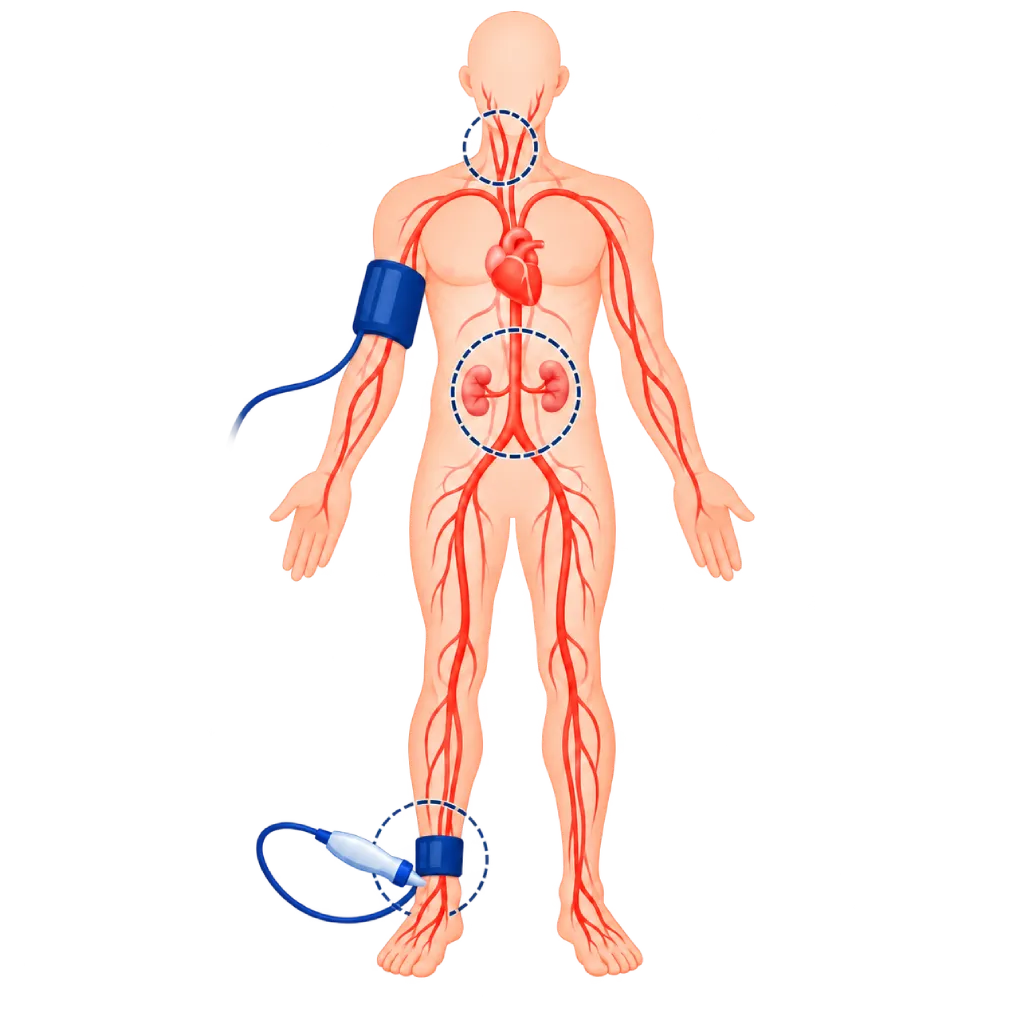
Vascular disease screening checks the blood vessels outside the heart to find problems before they cause serious symptoms. The main conditions it looks for are narrowing of the leg arteries, widening of the aorta in the abdomen (called an aneurysm), and plaque in the neck arteries. All three often cause no symptoms, yet they can lead to slow-healing foot wounds, a ruptured aorta, or stroke.
How It Works in Brief
For the ankle-brachial index, the blood pressure at the ankle is compared with the blood pressure in the arm using a cuff and a small Doppler device. In healthy arteries, the pressure at the ankle is the same as or slightly higher than in the arm. If the leg arteries are narrowed, the pressure at the ankle drops. Ultrasound uses sound waves to see the size of the aorta, plaque in the artery walls, and the speed of blood flow.
Tests Included
- Ankle-brachial index (ABI): looks for peripheral artery disease. A value of 0.90 or lower indicates narrowing. This is covered on the Ankle-Brachial Index (ABI) Test page.
- Abdominal aortic ultrasound: measures the width of the aorta to look for an aneurysm. A one-time scan is recommended for men aged 65 and older, especially those who have ever smoked, and for siblings of people with an aortic aneurysm.
- Neck artery ultrasound: looks for plaque and narrowing. This test is not recommended routinely for everyone without symptoms, but it may be chosen for certain people. The blood vessel ultrasound technique is covered on the Duplex Ultrasound page.
Who Should Be Screened
ABI is mainly recommended for people aged 65 and older, people aged 50 to 64 with risk factors such as smoking, diabetes, high cholesterol, or high blood pressure, and people who already have coronary artery disease or chronic kidney disease. If you already have calf pain when walking, a slow-healing foot wound, or symptoms of a mild stroke, the test becomes diagnostic and is done more thoroughly.
02 / Understanding the procedure
When Is This Procedure Considered?
A doctor may consider this procedure in the situations below. The decision is always made after a thorough assessment.
- Age 65 and OlderThe risk of peripheral artery disease and aortic aneurysm increases.
- Current or Former SmokersA strong risk factor for narrowed arteries and aortic aneurysm.
- Diabetes or Chronic Kidney DiseaseOften accompanied by leg artery disease without symptoms.
- Coronary Artery Disease or StrokeAtherosclerosis is rarely limited to one blood vessel.
- Sibling with an Aortic AneurysmThe risk of aneurysm is higher in close family members.
- Calf Pain When WalkingA typical symptom of narrowed leg arteries that needs to be checked.
Situations to Consider First
- Wounds or Severe Swelling in the LegThe cuff may not fit in the usual place; another method is chosen.
- Very Stiff Leg ArteriesIn diabetes or kidney failure, the ABI can be falsely high, so a toe test is needed.
- Recent Blood Clot in a Leg VeinPlacing a cuff on the leg may be postponed; let the staff know.
- Sudden SymptomsA leg that suddenly becomes cold and painful, or stroke symptoms, require emergency care.
03 / Before the procedure
How Should You Prepare?
This test is simple and usually needs no special preparation.
Clothing. Wear loose clothing so your arms, ankles, and abdomen can be easily uncovered.
Smoking and coffee. Avoid smoking and drinking coffee for at least 1 hour beforehand, because they can affect blood pressure and blood vessels.
Fasting. If the abdominal aorta is also checked, you are usually asked to fast for a few hours so gas in the intestines does not block the image.
Medications and history. Keep taking your regular medications. Bring a list of your medications and any previous blood vessel test results.
Unsure about the preparation instructions? Ask our team before the procedure.
04 / During the procedure
How Is the Procedure Done?
The combination of ABI, abdominal aortic ultrasound, and, if needed, neck artery ultrasound is usually completed in about 1 hour. ABI alone takes about 15 minutes.
Resting While Lying Down
You lie on your back and rest for about 5 to 10 minutes so your blood pressure stabilizes.
ABI Measurement
Cuffs are placed on both arms and both ankles. The staff listen to blood flow with a small Doppler device while the cuffs are inflated and deflated in turn.
Aortic and Neck Artery Ultrasound
Gel is applied to your abdomen and, if needed, your neck. The ultrasound probe is moved to measure the width of the aorta and look for plaque in the neck arteries. You only feel slight pressure.
Discussing the Results
The doctor explains the results and decides whether you need preventive treatment, further tests, or regular monitoring.
05 / Benefits and risks
Benefits and Risks Should Be Discussed Together.
Every medical procedure has benefits and risks. Your doctor will explain both for your situation before the procedure.
Benefits You Can Expect
- No Needles and No RadiationUses cuffs, Doppler, and sound waves.
- QuickABI takes only about 15 minutes.
- Finds Disease Before It Becomes SevereBefore a foot wound, a ruptured aneurysm, or a stroke occurs.
- Clarifies Your Heart RiskA low ABI indicates a higher risk of heart attack and stroke.
- A Basis for Prevention and MonitoringThe results guide preventive medication and the schedule for repeat tests.
The benefits of a procedure are not a promise of a cure. Ask how the results will affect your care plan.
Risks You Should Know
- Pressure When the Cuff InflatesMild and only brief.
- Inaccurate Results in Stiff ArteriesCan occur in diabetes or kidney failure; other tests help.
- Findings That Need MonitoringFor example, small plaque or a slightly widened aorta that needs regular follow-up visits.
- Less Clear ImagesIntestinal gas or excess body weight can block the aortic ultrasound.
Risks can differ from person to person. A full explanation and consent are given after an individual assessment.
06 / After the procedure
What Is Recovery Like?
There is no recovery period. You can return to your activities and eat as usual right away.
If the results are abnormal. Peripheral artery disease signals a higher risk of heart attack and stroke, so the doctor usually tightens control of cholesterol, blood pressure, and blood sugar, and recommends quitting smoking and walking exercise.
Small aneurysm. Usually just monitored with regular ultrasound based on its size.
Warning signs. Go to the emergency room right away if you have:
- A leg that suddenly becomes cold, pale, very painful, or numb
- Sudden, severe abdominal or back pain
- A drooping face, arm weakness, or slurred speech
- A foot wound that turns black or gets worse quickly
Know the Signs That Need Prompt Care.
Follow the team's guidance on warning signs. If severe or sudden symptoms appear after the procedure, go to the nearest emergency department right away or call Heart Attack Center 1500 258.
07 / Team and support
Doctors and Procedure Support
The doctors below are listed for this procedure. Listed by name, not by ranking.

Dr. med. dr. Denio A. Ridjab, Sp.JP(K)
Interventional Cardiology
Coronary Intervention Procedures +2 centers
Clinical focusInterventional Cardiology · Coronary Artery Disease
View Profile
dr. Emanoel Oepangat, Sp.JP(K)
Interventional Cardiology
Vascular Diagnostic and Therapeutic Center +1 center
Clinical focusCoronary Intervention · Peripheral Vascular Intervention
View Profile
dr. Suko Adiarto, Sp.JP(K), Ph.D.
Interventional Cardiology
Vascular Diagnostic and Therapeutic Center +1 center
Clinical focusCoronary Intervention · Peripheral Vascular Intervention
View ProfileDoppler Vascular Ultrasound
An ultrasound test of the blood vessels that shows the vessel wall and the blood flow at the same time. Doctors use it to look…
Ankle-Brachial Index (ABI) Testing System
A needle-free test that compares blood pressure at the ankles and arms. The result is an index number that helps doctors detect…
The availability of technology and test support is confirmed with the team. Technology is chosen according to clinical need.
08 / Common questions
Before You Plan the Procedure.
Questions people often ask about vascular disease screening. Your doctor will explain what the results mean for your condition.
What is peripheral artery disease?
Peripheral artery disease is a narrowing of the arteries, mainly in the legs, caused by plaque buildup. The typical symptom is pain or aching in the calf when walking that goes away when you stop. Many people with it have no symptoms but still have a higher risk of heart attack and stroke, so it needs to be found and treated.
What does my ABI value mean?
A value between 1.00 and 1.40 is usually normal. A value of 0.90 or lower indicates narrowing of the leg arteries, and the lower the value, the more severe the narrowing. Values of 0.91 to 0.99 are borderline. A value above 1.40 means the arteries are too stiff to be compressed by the cuff, so the doctor may request a toe pressure test.
Who needs screening for an abdominal aortic aneurysm?
A one-time ultrasound is recommended for men aged 65 and older, especially those who have ever smoked, and for siblings of people with an aortic aneurysm. In women, screening is considered if there are risk factors such as a history of smoking. An aneurysm often causes no symptoms until it ruptures, so finding it early is very important.
Does everyone need a neck artery ultrasound?
No. In people without symptoms and at low risk, routine neck artery ultrasound is not recommended because it rarely changes treatment and can lead to unnecessary procedures. This test is chosen for certain people, for example those with other blood vessel disease or several risk factors, or if there are symptoms that suggest a mild stroke.
What happens if a narrowing or an aneurysm is found?
The majority of findings are managed with prevention: quitting smoking, cholesterol-lowering medication, control of blood pressure and blood sugar, and walking exercise. A small aneurysm is monitored with regular ultrasound. Procedures such as widening the blood vessel, stent placement, or aortic repair are considered when the narrowing or widening is already severe.
How often does screening need to be repeated?
It depends on your results and risk factors. If the results are normal, the ABI does not need to be repeated every year unless you have symptoms or your risk changes. A normal aortic ultrasound at age 65 is usually needed only once. If an abnormality is found, the doctor will set a suitable monitoring schedule.
Sources and Medical Review
Translated from the Indonesian edition medically reviewed by dr. Emanoel Oepangat, Sp.JP(K).
Sources as cited in the Indonesian edition.
- Mazzolai L, Teixido-Tura G, Lanzi S, et al. 2024 ESC Guidelines for the management of peripheral arterial and aortic diseases. Eur Heart J. 2024;45(36):3538-3700.
- Gornik HL, Aronow HD, Goodney PP, et al. 2024 ACC/AHA/AACVPR/APMA/ABC/SCAI/SVM/SVN/SVS/SIR/VESS Guideline for the Management of Lower Extremity Peripheral Artery Disease. Circulation. 2024;149(24):e1313-e1410.
- Owens DK, Davidson KW, Krist AH, et al. Screening for abdominal aortic aneurysm: US Preventive Services Task Force recommendation statement. JAMA. 2019;322(22):2211-2218.
- US Preventive Services Task Force, Krist AH, Davidson KW, et al. Screening for asymptomatic carotid artery stenosis: US Preventive Services Task Force recommendation statement. JAMA. 2021;325(5):476-481.
- Visseren FLJ, Mach F, Smulders YM, et al. 2021 ESC Guidelines on cardiovascular disease prevention in clinical practice. Eur Heart J. 2021;42(34):3227-3337.