
Quick answer
What Is Abdominal Aortic Aneurysm?
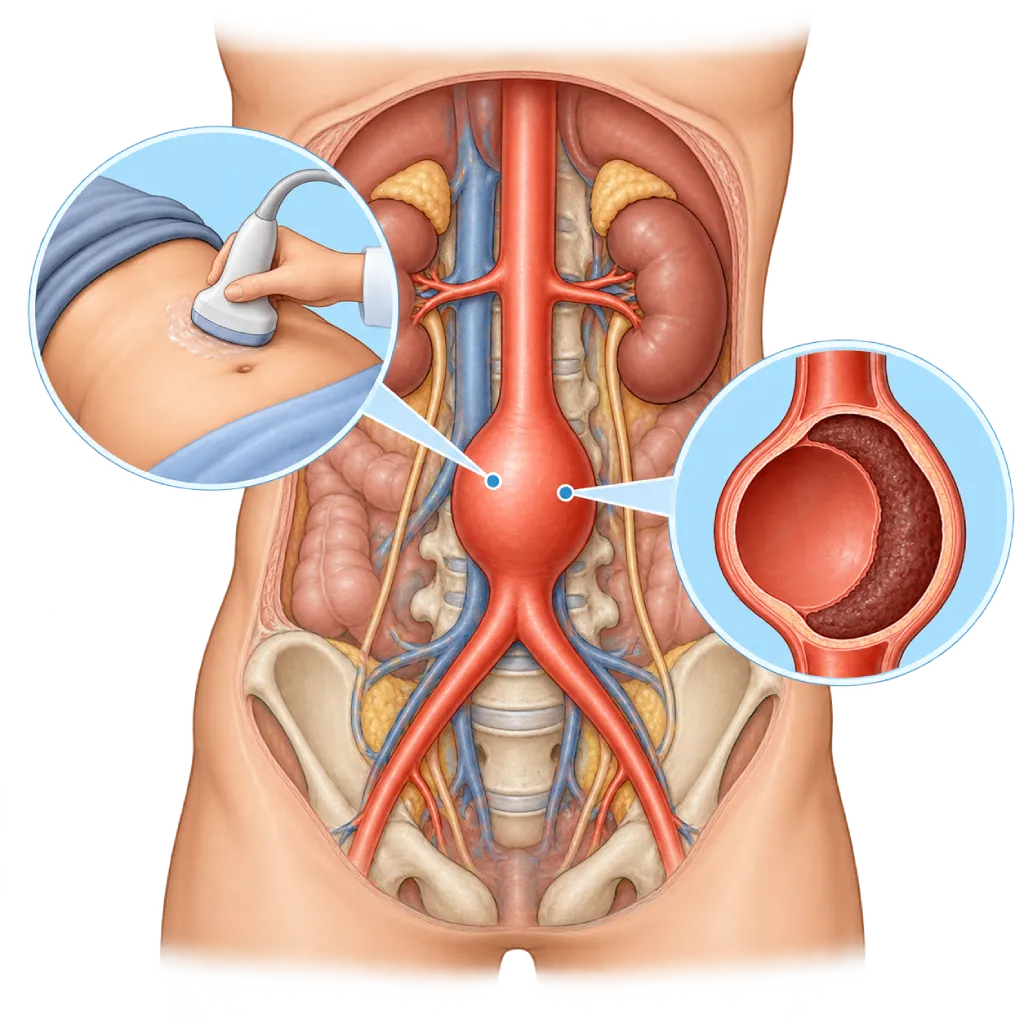
An abdominal aortic aneurysm is a widening of the aorta in the abdomen to a diameter of 3 cm or more. It usually causes no symptoms, is more common in older men who have smoked, and can be found with an abdominal ultrasound.
SourcesSigns That Need Urgent Help
- Sudden, very severe abdominal or back pain
- Pain spreading to the flank, groin, or buttocks
- Severe dizziness, fainting, or appearing confused
- Pale, cold, and sweaty skin with a fast pulse
- A tense, swollen abdomen with weakness
If these signs appear, go to the nearest emergency department right away or call Heart Attack Center 1500 258.
01 / Understanding the condition
About Abdominal Aortic Aneurysm
The abdominal aorta is the part of the aorta that runs through the abdomen, in front of the spine, before it branches into both legs. In adults, its diameter is about 2 cm. An abdominal aortic aneurysm occurs when this section widens permanently to 3 cm or more. The majority lie below the point where the kidney arteries branch off and sometimes extend into the iliac arteries, the branches of the aorta in the pelvis. An overview of aneurysms throughout the aorta is covered on the Aortic Aneurysm page.
How This Aneurysm Forms
An abdominal aortic aneurysm is mainly linked to aging of the vessel wall, accelerated by smoking. Chronic inflammation in the aortic wall breaks down elastic fibers and collagen, so the wall thins and widens little by little. Atherosclerosis, high blood pressure, and family history also play a role. Infection of the aortic wall and inflammation of the blood vessels are less common causes.
How the Condition Progresses
Small aneurysms usually grow a few millimeters per year, and the larger they are, the faster they grow. The risk of rupture is low for small aneurysms and rises markedly when the diameter exceeds 5.5 cm. In women, aneurysms tend to rupture at a smaller size. A layer of blood clot often forms inside the aneurysm sac, and pieces of it occasionally break off into the leg arteries. Because they cause no symptoms, many aneurysms are only discovered during an abdominal ultrasound or CT scan for another complaint, for example when checking for kidney stones or back pain.
Screening and Treatment
An abdominal aortic aneurysm is easy to see on ultrasound, so some guidelines recommend a one-time ultrasound screening for men aged 65 and older, especially those who have smoked. Small aneurysms are monitored regularly while you stop smoking and control your heart and blood vessel risk factors. When the diameter reaches about 5.5 cm in men or 5.0 cm in women, grows by 1 cm or more in a year, or causes pain, your doctor will consider repair with a stent graft or open surgery.
Repair aims to prevent rupture, not to relieve symptoms. For this reason, the decision weighs the risk of rupture against the risk of the procedure, based on your age, your heart and lung health, and your preferences. After repair, follow-up checks are still needed to monitor the result.
02 / Understanding the condition
Symptoms to Recognize.
Common Symptoms
In most cases, an abdominal aortic aneurysm causes no symptoms. The following complaints may appear when the aneurysm grows or stretches.
- A pulsing feeling in the abdomen, especially around or above the belly button
- Persistent dull pain in the middle of the abdomen
- Lower back or flank pain that is not related to movement
- Bluish or painful toes caused by bits of clot from the aneurysm
03 / Understanding the condition
What Causes This Condition?
- Aging of the aortic wall, accelerated by smoking
- Chronic inflammation that breaks down elastic fibers and collagen in the aortic wall
- Atherosclerosis, the buildup of plaque and hardening of the artery walls
- An inherited tendency that runs in families
- Infection of the aortic wall (mycotic aneurysm), although this is rare
- Inflammation of the blood vessels, or the remains of an aortic tear that extends down into the abdomen
04 / Understanding the condition
Who Is at Higher Risk?
Lifestyle
Smoking is the main risk factor: the longer and the more you smoke, the higher the risk, and aneurysms grow faster in active smokers.
Medical
High blood pressure, high cholesterol, coronary artery disease, peripheral artery disease, and chronic obstructive pulmonary disease often occur together with an abdominal aortic aneurysm.
Genetic
The risk is higher if a parent or sibling has had an abdominal aortic aneurysm.
Age
Rarely found before age 60, and the risk increases gradually after age 65.
Other
Men are affected more often, but in women aneurysms tend to grow faster and rupture at a smaller size.
Groups at Higher Risk
- Men Aged 65 and Older Who Have Smoked: A group with a higher risk of abdominal aortic aneurysm; European and American guidelines recommend a one-time abdominal ultrasound screening.
- Siblings of People with an Abdominal Aortic Aneurysm: A family tendency increases the risk, so screening may be considered at a time your doctor recommends.
- People with Coronary or Peripheral Artery Disease: Atherosclerosis in other arteries often occurs together with widening of the abdominal aorta.
- People with an Aneurysm Behind the Knee: Some people with a popliteal artery aneurysm also have an abdominal aortic aneurysm, so both should be checked.
05 / Understanding the condition
How Is It Diagnosed?
An abdominal aortic aneurysm is usually found in one of two ways: by chance during an abdominal ultrasound or CT scan for another complaint, or through screening in people at risk. Abdominal ultrasound is the first test because it is quick, uses no radiation, and is accurate enough to measure the diameter of the aorta. The result also serves as the baseline for later monitoring.
If the aneurysm is fairly large or repair is planned, your doctor will request a CT angiography to look at the length and shape of the aneurysm neck, whether the kidney and pelvic arteries are involved, and the access route through the groin. This information determines whether a stent graft can be placed or open surgery is more suitable. Because an abdominal aortic aneurysm often occurs together with coronary artery disease, your doctor will also assess your heart and lungs before the procedure and look for other aneurysms, for example behind the knee.
Physical Examination
Your doctor feels your abdomen for a pulsating mass; this method is not very sensitive, especially in a large abdomen, so it needs to be confirmed with ultrasound.
Vascular Ultrasound
A radiation-free abdominal ultrasound to measure the diameter of the aorta; used to confirm the diagnosis and for regular monitoring.
Vascular Disease Screening
A needle-free, radiation-free test to look for widening of the abdominal aorta in people at risk.
Aortic CT angiography: a CT scan with contrast dye to measure the aneurysm, see its relationship to the kidney and pelvic arteries, and plan the repair.
Aortic MRI: an option without X-rays when contrast CT is less suitable, for example in certain kidney problems.
Kidney Function Test
A blood test to assess kidney function before a test or procedure that uses contrast dye.
06 / Understanding the condition
Treatment Options.
Treatment is decided by a doctor after an assessment. The categories below can help you follow the conversation with your doctor.
Ultrasound Monitoring
Aneurysms of 3 to 3.9 cm are usually rechecked every three years, 4 to 4.9 cm every year, and 5 cm or more every three to six months.
Quitting Smoking
Smoking speeds up aneurysm growth and increases the risk of rupture, so quitting smoking is the first step. Your doctor can help with counseling and medication.
Medications for Risk Factors
Blood pressure medicines, statins, and antiplatelets may be prescribed to lower the risk of heart attack and stroke. These medicines have not been proven to shrink an aneurysm.
Endovascular Repair (EVAR)
A stent graft is placed through an artery in the groin if the shape of the aorta is suitable. Recovery is shorter, with regular follow-up imaging for life.
Open Surgery
The widened section of the aorta is replaced with an artificial tube through an incision in the abdomen. Recovery takes longer, but repeat procedures are rarely needed.
07 / Understanding the condition
Complications to Watch For.
Aneurysm Rupture
Severe bleeding inside the abdomen that requires emergency surgery or a stent graft. Many ruptures occur in aneurysms that were never known about.
Embolism to the Legs
Bits of clot from inside the aneurysm can break off and block small arteries in the leg, covered on the Arterial Embolism page.
Sudden Blockage of the Aorta
An aneurysm filled with clot can become blocked and stop blood flow to both legs, although this is rare.
Fistula to the Bowel or a Vein
A large aneurysm can break through into the nearby bowel or a large vein, causing bleeding in the digestive tract or an excess load on the heart, although this is rare.
Leakage After a Stent Graft
Blood can flow back into the aneurysm sac around the stent graft (endoleak), so follow-up imaging is still needed.
08 / Understanding the condition
What Can You Do?
- Stop smoking, and do not start if you have never smoked
- Men aged 65 and older who have smoked should have a one-time abdominal ultrasound screening
- Siblings of people with an abdominal aortic aneurysm can ask whether they need screening
- Control your blood pressure and cholesterol according to your doctor's targets
- Stay active regularly, for example by walking for 30 minutes almost every day
- Keep your follow-up ultrasound appointments if you already know you have a small aneurysm
09 / Understanding the condition
When Should You See a Doctor?
An abdominal aortic aneurysm rarely causes symptoms, so screening is helpful for people at risk. Sudden, very severe abdominal or back pain, especially with dizziness or fainting, is an emergency sign: go to the nearest emergency room right away and tell the staff if you are known to have an aneurysm. Make an appointment if you:
- Are a man aged 65 or older who has smoked and has never been screened
- Have a parent or sibling with an abdominal aortic aneurysm
- Feel a pulsing in your abdomen or have persistent abdominal and lower back pain
- Have been told your aorta is widened based on an abdominal ultrasound or CT scan
- Already have a stent graft and have not had follow-up imaging as scheduled
Don't Wait in an Emergency.
If symptoms are severe or come on suddenly, go to the nearest emergency department right away or call Heart Attack Center 1500 258, rather than waiting for an appointment.
10 / Common questions
Questions You May Have.
Frequently asked questions about abdominal aortic aneurysm.
Can you feel an abdominal aortic aneurysm yourself?
A large aneurysm can sometimes be felt as a pulsing in the abdomen, especially in thin people. However, a normal aortic pulse can also be felt in thin people, and many aneurysms cannot be felt at all. For this reason, feeling the abdomen cannot confirm or rule out an aneurysm. An abdominal ultrasound is a simple way to measure the width of the aorta. If you notice a pulsing that bothers you, talk to your doctor.
Who should be screened for an abdominal aortic aneurysm?
American guidelines recommend a one-time ultrasound screening for men aged 65 to 75 who have ever smoked. European guidelines recommend screening for men aged 65 and older, and it may be considered for older women who have smoked and for siblings of people with an aneurysm. If the result is normal, it usually does not need to be repeated. Discuss with your doctor whether screening is right for you.
Is a small abdominal aortic aneurysm dangerous?
The risk of rupture in a small aneurysm, below about 5 cm, is generally low, so monitoring is safer than early surgery. Studies show that repairing a small aneurysm early offers no added benefit compared with regular monitoring. What matters is having follow-up ultrasounds as scheduled, quitting smoking, and controlling your blood pressure, because the aneurysm can keep growing.
Which is more suitable, a stent graft or open surgery?
Both are effective at preventing rupture, and each has its own advantages. A stent graft requires small incisions, a shorter hospital stay, and carries a lower early risk, but it needs lifelong follow-up imaging and more often requires additional procedures. Open surgery has a longer recovery, but its results are durable. In the long term, life expectancy is similar with both approaches. The choice depends on the shape of your aorta, your age, and your health.
What should you do after a stent graft is placed?
Lifelong monitoring is still needed, usually with a CT scan or ultrasound in the first month, then at regular intervals depending on the results. The goal is to make sure the stent graft has not shifted and no blood is flowing back into the aneurysm sac. Most people can return to light activities within a few days to weeks. Stay smoke-free, take your medicines as prescribed, and contact your doctor right away if new abdominal or back pain appears.
Can you lift heavy objects if you have an abdominal aortic aneurysm?
Daily activities and light to moderate exercise are generally safe and recommended. Avoid lifting very heavy loads or straining hard while holding your breath, because your blood pressure can rise suddenly. Ask your doctor what weight limit is safe for you, especially if your aneurysm is close to the size for repair or if you have recently had a procedure.
Sources and Medical Review
Translated from the Indonesian edition medically reviewed by dr. Suko Adiarto, Sp.JP(K), Ph.D..
Sources as cited in the Indonesian edition.
- Wanhainen A, Van Herzeele I, Bastos Goncalves F, et al. European Society for Vascular Surgery (ESVS) 2024 Clinical Practice Guidelines on the Management of Abdominal Aorto-Iliac Artery Aneurysms. Eur J Vasc Endovasc Surg. 2024;67(2):192-331.
- Chaikof EL, Dalman RL, Eskandari MK, et al. The Society for Vascular Surgery practice guidelines on the care of patients with an abdominal aortic aneurysm. J Vasc Surg. 2018;67(1):2-77.e2.
- Mazzolai L, Teixido-Tura G, Lanzi S, et al. 2024 ESC Guidelines for the management of peripheral arterial and aortic diseases. Eur Heart J. 2024;45(36):3538-3700.
- US Preventive Services Task Force, Owens DK, Davidson KW, et al. Screening for Abdominal Aortic Aneurysm: US Preventive Services Task Force Recommendation Statement. JAMA. 2019;322(22):2211-2218.
- Patel R, Sweeting MJ, Powell JT, Greenhalgh RM. Endovascular versus open repair of abdominal aortic aneurysm in 15-years' follow-up of the UK endovascular aneurysm repair trial 1 (EVAR trial 1): a randomised controlled trial. Lancet. 2016;388(10058):2366-2374.
- Lederle FA, Kyriakides TC, Stroupe KT, et al. Open versus Endovascular Repair of Abdominal Aortic Aneurysm. N Engl J Med. 2019;380(22):2126-2135.
Doctors Who Treat This Condition

dr. Suko Adiarto, Sp.JP(K), Ph.D.
Interventional Cardiology
Vascular Diagnostic and Therapeutic Center +1 center
Clinical focusCoronary Intervention · Peripheral Vascular Intervention
View Profile
dr. Emanoel Oepangat, Sp.JP(K)
Interventional Cardiology
Vascular Diagnostic and Therapeutic Center +1 center
Clinical focusCoronary Intervention · Peripheral Vascular Intervention
View Profile
dr. Widya T. Suwatri, Sp.BTKV, Subsp. JD(K)
Adult Cardiac Surgery
Advanced Cardiovascular Surgical Care +1 center
Clinical focusMinimally Invasive Cardiac Surgery · Coronary Artery Bypass Surgery
View Profile