
Quick answer
What Is Brugada Syndrome?
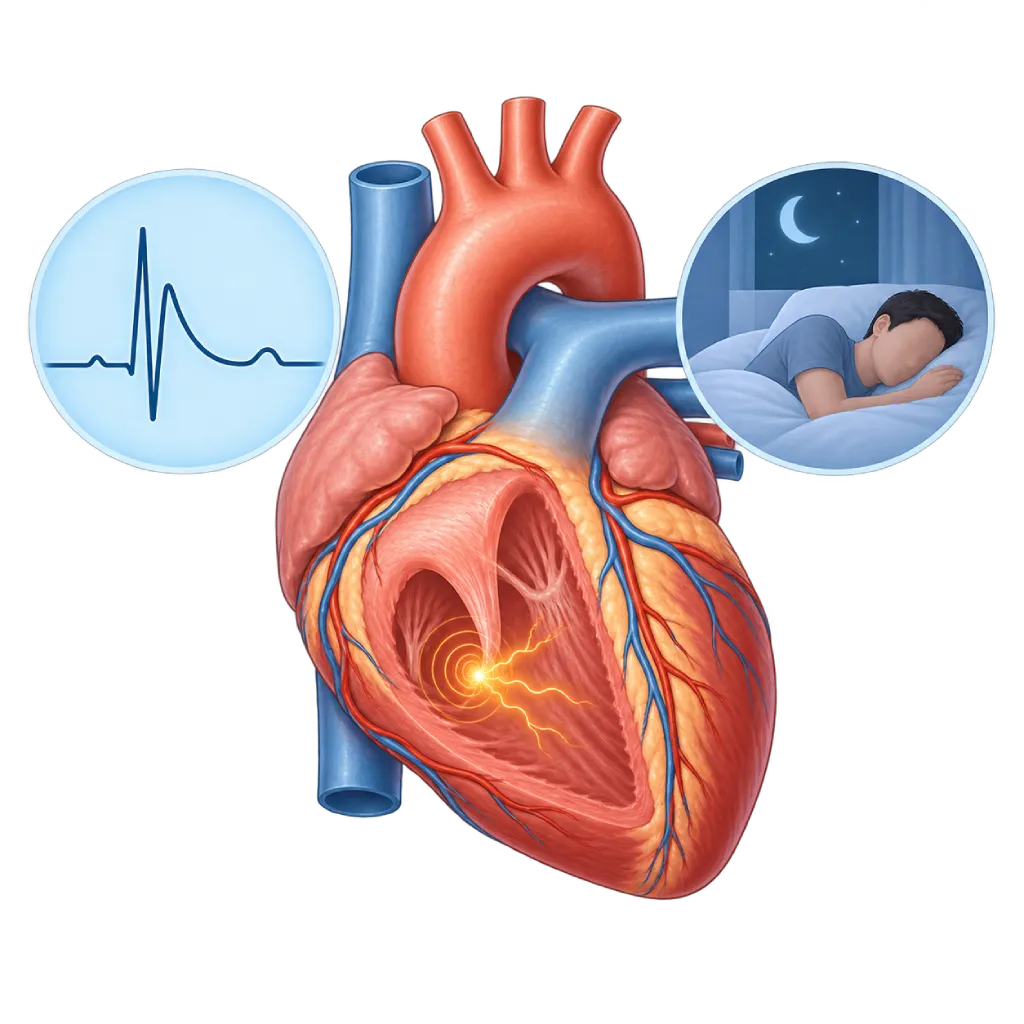
Brugada syndrome is an electrical disorder of the heart, often inherited, that can trigger dangerous rhythms from the lower chambers (ventricles) during rest, sleep, or fever. Many people with it have no symptoms, but some are at risk of sudden cardiac arrest.
SourcesSigns That Need Urgent Help
- Fainting without a clear cause, especially during sleep or a fever
- A brief seizure with loss of consciousness
- Suddenly becoming unresponsive and not breathing normally
- A very fast heartbeat with severe dizziness
- The ICD delivers a shock more than once within a short time
If these signs appear, go to the nearest emergency department right away or call Heart Attack Center 1500 258.
01 / Understanding the condition
About Brugada Syndrome
Brugada syndrome is a disorder of the heart's electrical system, while the structure and muscle of the heart usually look normal. The problem lies in the ion channels, tiny gates in the walls of heart muscle cells that control the movement of sodium and other substances in and out. In people with Brugada syndrome, these channels do not work as well, especially in the right ventricular outflow tract. As a result, the lower chambers of the heart are more prone to fast, chaotic rhythms, namely polymorphic ventricular tachycardia or ventricular fibrillation.
The Typical ECG Pattern
Brugada syndrome is recognized by a typical pattern on the ECG: a dome-shaped (coved) ST-segment elevation in the right chest leads (V1 and V2), called the type 1 Brugada pattern. This pattern can come and go. It is often clearer during a fever, after a large meal, after drinking alcohol, or when the ECG is recorded with electrodes placed higher on the chest. If the pattern is not visible, the doctor may perform a provocation test with a specific medicine under supervision.
Who Is Affected
This disorder is found more often in Southeast Asia than in Europe and the Americas. Serious events are much more common in men, usually between the ages of 30 and 50. About one in five people with the syndrome has a change in the SCN5A gene that can be inherited, but in many people with the syndrome the genetic cause is not yet known. Dangerous rhythms often occur at rest or during sleep at night, when the influence of the nerves that slow the heart increases.
Triggers to Avoid
High fever, large amounts of alcohol, overeating, cocaine, and a number of medicines can strengthen the Brugada pattern and trigger arrhythmias. Medicines to avoid include some antiarrhythmic drugs, certain anesthetics, and some medicines for depression or mental health conditions. Ask your doctor for the full list, and always tell health care providers about your diagnosis before using any new medicine.
Treatment Based on Risk
Not everyone with the syndrome needs a procedure. Those without symptoms usually only need to avoid triggers, bring down a fever promptly with fever-reducing medicine, and have regular checkups. An ICD is recommended for cardiac arrest survivors and considered for people who have fainted because of an arrhythmia. Certain antiarrhythmic medicines or catheter ablation can help if arrhythmias keep coming back. Ventricular fibrillation and how to respond to it are covered on the Ventricular Fibrillation page.
02 / Understanding the condition
Symptoms to Recognize.
Common Symptoms
Many people with the syndrome have no symptoms and only find out from an ECG or family screening.
- Sudden fainting, often at rest or during sleep
- A fast, pounding heartbeat that comes on suddenly
- Dizziness or nearly fainting
- Gasping or unusual breathing sounds during sleep at night
- Symptoms that appear or get worse during a fever
- No symptoms, found during a routine ECG
03 / Understanding the condition
What Causes This Condition?
- A sodium channel disorder in heart muscle cells, especially in the right ventricular outflow tract
- An inherited change in the SCN5A gene, found in about one in five people with the syndrome
- Changes in other genes, or causes not yet known, in the majority of the other people with the syndrome
- Triggers that strengthen the disorder: fever, excessive alcohol, overeating, and cocaine
- Certain medicines, such as some antiarrhythmic drugs, anesthetics, and medicines for depression or mental health conditions
- Electrolyte disorders, for example a blood potassium level that is too high
04 / Understanding the condition
Who Is at Higher Risk?
Genetic
A family history of Brugada syndrome or sudden death at a young age, especially during sleep. It is usually inherited in an autosomal dominant pattern, so children of a person with the syndrome have a chance of inheriting the same disorder.
Age
Arrhythmia events usually occur between the ages of 30 and 50, but they can occur in children, especially during a fever.
Medical
A previous cardiac arrest, previous fainting from a suspected arrhythmia, and a type 1 Brugada pattern that appears on its own without medicine indicate a higher risk.
Lifestyle
Drinking large amounts of alcohol, overeating (especially at night), and using cocaine or cannabis can trigger arrhythmias.
Other
Men have serious events more often than women. This disorder is found more often in people of Southeast Asian descent.
Groups at Higher Risk
- Young and Middle-Aged Adult Men: Serious arrhythmia events are much more common in men, usually between the ages of 30 and 50.
- Family Members of People with Brugada Syndrome: Close relatives can carry the same disorder without symptoms and need to be checked.
- People with the Syndrome Who Have Fainted: Fainting from an arrhythmia indicates a higher risk of cardiac arrest and needs prompt assessment.
- Children with High Fever: In children with the syndrome, fever can trigger arrhythmias, so fever needs to be brought down promptly.
05 / Understanding the condition
How Is It Diagnosed?
The diagnosis is made when the ECG shows a type 1 Brugada pattern, either appearing on its own or after a drug provocation test, taking symptoms and family history into account. Because the pattern can come and go, the doctor may repeat the ECG, record it with the chest electrodes placed higher, or record it while you have a fever.
Other tests aim to rule out conditions that look similar, such as electrolyte disorders, inflammation, or heart muscle disease, for example with blood tests, echocardiography, or cardiac MRI. For fainting with no clear cause, a rhythm recorder implanted under the skin can help. After diagnosis, the doctor assesses your risk based on any history of cardiac arrest or fainting, an ECG pattern that appears spontaneously, and sometimes an electrophysiology study. Genetic testing and ECGs for close family members are also recommended.
Electrocardiogram (ECG)
Looking for a type 1 Brugada pattern; the right chest electrodes can be placed one to two rib spaces higher to make the pattern more visible.
Drug provocation test: a sodium channel blocking medicine is given by IV infusion with ECG monitoring to bring out a suspected pattern that is not visible.
Implantable Loop Recorder (ILR)
A small recording device under the skin that captures the heart rhythm during fainting episodes with no clear cause.
Echocardiography
Confirming that the heart structure is normal and ruling out other diseases that can give a similar ECG picture.
Genetic testing for the person with the syndrome, followed by ECGs and targeted testing for family members.
Electrophysiology Study
May be considered in people without symptoms who have a spontaneous type 1 pattern, to help assess risk.
06 / Understanding the condition
Treatment Options.
Treatment is decided by a doctor after an assessment. The categories below can help you follow the conversation with your doctor.
Avoiding Triggers
Avoid medicines that can bring out the Brugada pattern, excessive alcohol, overeating, and cocaine. Ask your doctor before using any new medicine.
Prompt Fever Control
Take fever-reducing medicine as soon as a fever starts and see a doctor if the fever is high, because fever can trigger arrhythmias.
Implantable Cardioverter Defibrillator (ICD)
Recommended for survivors of cardiac arrest or sustained ventricular tachycardia, and considered for those who have fainted from an arrhythmia and have a spontaneous type 1 pattern.
Certain Antiarrhythmic Medicines
For recurrent arrhythmias, or when an ICD is not yet possible, your doctor may prescribe certain antiarrhythmic medicines that are useful in Brugada syndrome.
Catheter Ablation
Ablation on the outer surface of the right ventricular outflow tract can reduce recurrent arrhythmias and ICD shocks in selected patients.
Family Screening
An ECG, a provocation test if needed, and targeted genetic testing for the parents, siblings, and children of a person with the syndrome.
07 / Understanding the condition
Complications to Watch For.
Cardiac Arrest and Sudden Death
Ventricular fibrillation can stop the heart from pumping, often during sleep. Chest compressions and an AED are needed right away.
Recurrent Fainting
Brief arrhythmias that stop on their own can cause fainting and indicate a higher risk.
Atrial Fibrillation
Some people with the syndrome also have an irregular rhythm from the upper chambers, which can trigger unnecessary ICD shocks.
08 / Understanding the condition
What Can You Do?
- Bring down a fever promptly with fever-reducing medicine and see a doctor if the fever is high
- Ask your doctor or pharmacist before using any new medicine, including anesthesia for surgery
- Limit alcohol and avoid overeating, especially at night
- Stay away from cocaine and other illegal drugs
- Carry a card or note stating your Brugada syndrome diagnosis when you seek medical care
- Encourage close family members to have an ECG and genetic counseling
- Encourage your family to learn chest compressions and how to use an AED
09 / Understanding the condition
When Should You See a Doctor?
Brugada syndrome needs to be assessed by a cardiologist even without symptoms, because the risk differs from person to person. If someone is unresponsive and not breathing normally, call emergency services at 119 right away and start chest compressions. Make an appointment with a doctor if:
- Your ECG report mentions a Brugada pattern or suspected Brugada syndrome
- You have fainted without a clear cause, especially during sleep or a fever
- Your partner has noticed unusual gasping while you sleep
- A family member has been diagnosed with Brugada syndrome or died suddenly at a young age
- You are going to have surgery or start a new medicine and have not told your doctor about your diagnosis
Don't Wait in an Emergency.
If symptoms are severe or come on suddenly, go to the nearest emergency department right away or call Heart Attack Center 1500 258, rather than waiting for an appointment.
10 / Common questions
Questions You May Have.
Common questions about Brugada syndrome.
Does everyone with Brugada syndrome need an ICD?
No. Many people without symptoms, especially those whose pattern only appears during a drug test, have a low risk and only need to avoid triggers and have regular checkups. An ICD is recommended for cardiac arrest survivors and considered for those who have fainted from an arrhythmia and have a spontaneous type 1 pattern. Your doctor will weigh the benefits and risks of the device with you, including unnecessary shocks.
Why is fever dangerous for people with Brugada syndrome?
A high body temperature worsens the function of sodium channels that are already impaired, so the Brugada pattern becomes stronger and arrhythmias occur more easily. That is why you should bring down a fever as quickly as possible with fever-reducing medicine, cool compresses, and enough fluids, then see a doctor if the fever is high or comes with dizziness or palpitations. In children with the syndrome, fever needs to be treated even sooner.
Which medicines should be avoided?
A number of medicines can trigger arrhythmias in Brugada syndrome, including some antiarrhythmic drugs, certain anesthetics, some medicines for depression and mental health conditions, and several other drugs. This list is fairly long and is updated regularly. Ask your doctor or pharmacist every time you are about to use a new medicine, and tell the anesthesiologist before any surgery or procedure.
Is Brugada syndrome inherited?
Often, yes. It is usually inherited in an autosomal dominant pattern, so children of a person with the syndrome have a chance of inheriting it. However, a gene change is found in only some people with the syndrome, mainly in the SCN5A gene. That is why parents, siblings, and children of a person with the syndrome are advised to have an ECG and, if the gene is known, targeted genetic testing. Testing may be repeated because the pattern can change with age.
Can people with Brugada syndrome exercise?
In general, yes. Unlike some other heart conditions, arrhythmias in Brugada syndrome occur more often at rest or during sleep, not during exercise. However, avoid letting your body temperature get too high when exercising in hot weather, drink enough fluids, and discuss the type of exercise with your doctor, especially if you have an ICD or have fainted before.
Does a Brugada pattern on my ECG mean I definitely have the condition?
Not always. A type 2 or type 3 Brugada pattern is not enough for a diagnosis and can be found in healthy people. The diagnosis is made when a type 1 pattern is seen, either on its own or after a drug test, taking symptoms and family history into account. If your ECG report mentions a Brugada pattern, ask a cardiologist to assess it and decide on the next steps.
Sources and Medical Review
Translated from the Indonesian edition medically reviewed by Dr. dr. Faris Basalamah, Sp.JP(K).
Sources as cited in the Indonesian edition.
- Zeppenfeld K, Tfelt-Hansen J, de Riva M, et al. 2022 ESC Guidelines for the management of patients with ventricular arrhythmias and the prevention of sudden cardiac death. Eur Heart J. 2022;43(40):3997-4126.
- Brugada J, Campuzano O, Arbelo E, et al. Present Status of Brugada Syndrome: JACC State-of-the-Art Review. J Am Coll Cardiol. 2018;72(9):1046-1059.
- Krahn AD, Behr ER, Hamilton R, et al. Brugada Syndrome. JACC Clin Electrophysiol. 2022;8(3):386-405.
- Antzelevitch C, Yan GX, Ackerman MJ, et al. J-Wave syndromes expert consensus conference report: Emerging concepts and gaps in knowledge. Heart Rhythm. 2016;13(10):e295-e324.
- Postema PG, Wolpert C, Amin AS, et al. Drugs and Brugada syndrome patients: review of the literature, recommendations, and an up-to-date website (www.brugadadrugs.org). Heart Rhythm. 2009;6(9):1335-1341.
- Wilde AAM, Semsarian C, Márquez MF, et al. European Heart Rhythm Association (EHRA)/Heart Rhythm Society (HRS)/Asia Pacific Heart Rhythm Society (APHRS)/Latin American Heart Rhythm Society (LAHRS) Expert Consensus Statement on the state of genetic testing for cardiac diseases. Europace. 2022;24(8):1307-1367.
Doctors Who Treat This Condition

Dr. dr. Dicky A. Hanafy, Sp.JP(K)
Arrhythmia and Electrophysiology
Arrhythmia and Device Center +1 center
Clinical focusElectrophysiology and Arrhythmia Ablation · Pacemaker and ICD Implantation
View Profile
dr. Sunu B. Raharjo, Sp.JP(K), Ph.D.
Arrhythmia and Electrophysiology
Arrhythmia and Device Center
Clinical focusClinical and Interventional Electrophysiology · Cardiac Arrhythmia Ablation
View Profile
Dr. dr. Faris Basalamah, Sp.JP(K)
Interventional Cardiology
Coronary Intervention Procedures +1 center
Clinical focusComplex Coronary Intervention · Cardiac Electrophysiology
View Profile