
Quick answer
What Is Cardiac Ablation?
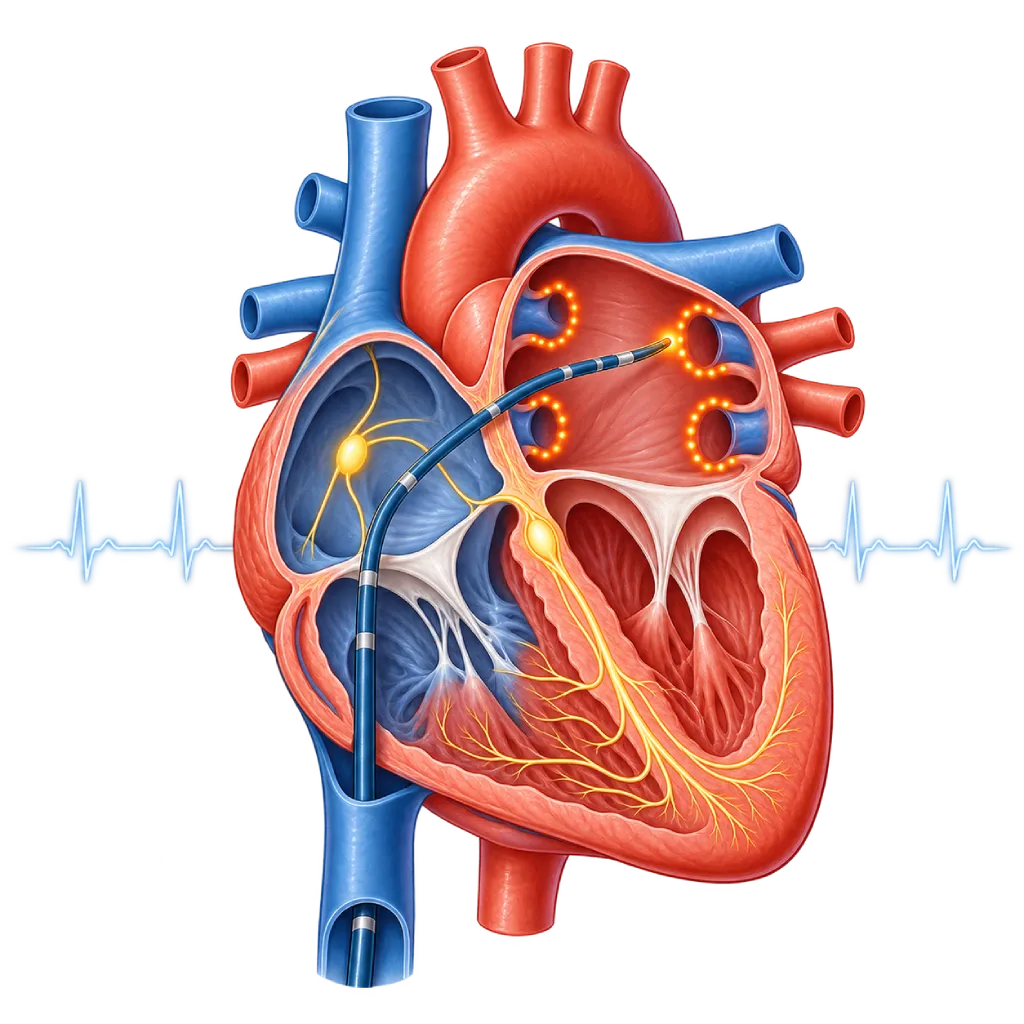
Cardiac ablation is a catheter procedure to treat heart rhythm disorders. A thin catheter is passed from a blood vessel in the groin to the heart, then the electrical spot or pathway that triggers the arrhythmia is deactivated with heat, cold, or an electric field. The procedure usually takes 1 to 4 hours, and patients usually stay one night.
Sources01 / Understanding the procedure
About Cardiac Ablation
What Is Cardiac Ablation
Every heartbeat is triggered by an electrical signal that travels in a specific order. In some heart rhythm disorders (arrhythmias), the signal arises from the wrong spot or circles around an extra electrical pathway, so the heart races or beats irregularly. Cardiac ablation is a catheter procedure that creates very small scars at that spot or pathway, so the faulty signal can no longer form or spread.
How It Works in Brief
A thin catheter is passed from a vein in the groin to the heart under X-ray guidance. The doctor records electrical signals from inside the heart and often uses a three-dimensional computer map to find the source of the arrhythmia. Once the target is found, energy is delivered through the tip of the catheter until the faulty signal stops.
Types of Energy
Three types of energy are commonly used. Radiofrequency heats the tissue at the catheter tip. Cryoablation freezes the tissue, often with a balloon placed against the openings of the pulmonary veins. Pulsed field ablation uses a high-voltage electric field for a very short time, designed to be more selective for heart muscle cells than for the surrounding tissue. The doctor chooses the energy according to the type of arrhythmia, the location of its source, and the team's experience.
Arrhythmias That Can Be Ablated
In supraventricular tachycardia, including Wolff-Parkinson-White syndrome, and typical atrial flutter, ablation is often an initial treatment option because in the majority of patients the episodes do not come back. In atrial fibrillation, ablation isolates the openings of the pulmonary veins, where most of its triggers originate, and is considered if symptoms remain bothersome despite medicines, or as an initial option in some patients. Ablation is also used for very frequent extra beats from the ventricles and for certain ventricular tachycardias.
In some patients with atrial fibrillation whose heart rate is hard to control, the doctor may deactivate the AV node and then implant a pacemaker. This is covered on the Pacemaker Implantation page.
Often Done Together with an Electrophysiology Study
Before ablation, the type and source of the arrhythmia need to be confirmed with an electrophysiology study. This test uses the same catheters and is often done in the same session, right before ablation. It is covered on the Electrophysiology Study page.
What You Should Know
One ablation is not always enough. In atrial fibrillation, some patients need a repeat ablation or rhythm medicines. The decision to take long-term blood thinners is based on the risk of stroke, not on whether the ablation succeeded, which is covered on the Anticoagulation Therapy and Stroke Prevention page. Comprehensive arrhythmia treatment is covered on the Arrhythmia Management page.
02 / Understanding the procedure
When Is This Procedure Considered?
A doctor may consider this procedure in the situations below. The decision is always made after a thorough assessment.
- Supraventricular TachycardiaA very fast heartbeat that starts and stops suddenly, often at a young age.
- Wolff-Parkinson-White SyndromeAn extra electrical pathway that can trigger a very fast heartbeat, especially if it causes symptoms.
- Atrial FlutterA fast, regular rhythm from the right atrium that can usually be stopped with ablation.
- Bothersome Atrial FibrillationSymptoms persist despite medicines, or ablation is chosen as an initial option in some patients.
- Atrial Fibrillation with a Weak Heart PumpIn selected patients, ablation can reduce the risk of death and hospital stays due to heart failure.
- Ventricular Tachycardia or Ventricular Extra BeatsA fast rhythm from the ventricles, or very frequent extra beats that cause symptoms.
Situations to Consider First
- Blood Clot in the Left AtriumAtrial fibrillation ablation is postponed until the clot resolves with blood thinners.
- Unable to Take Blood ThinnersAblation in the left atrium requires blood thinners before, during, and after the procedure.
- Active Infection or FeverThe procedure is postponed until the infection is treated so that germs do not spread to the heart.
- PregnancyUsually postponed because of X-ray exposure, unless there is a severe arrhythmia that does not respond to medicines.
- Unstable General ConditionFor example, worsening heart failure; this condition is stabilized first.
03 / Before the procedure
How Should You Prepare?
Preparation is discussed at a visit before the procedure. Instructions may differ depending on the type of arrhythmia, so follow the team's guidance.
Fasting. Usually no food or drink for about 6 hours before the procedure, except permitted medicines with a little water.
Heart rhythm medicines. You may be asked to stop some heart rhythm medicines a few days beforehand so the arrhythmia can be triggered and mapped during the procedure.
Blood thinners. For atrial fibrillation ablation, these medicines are usually continued without interruption, or only one dose is skipped as instructed by your doctor. Do not stop them on your own.
Tests before the procedure. Blood tests, an ECG, and echocardiography. For atrial fibrillation ablation, the doctor may check that there is no clot in the left atrium with echocardiography through the esophagus or a cardiac CT, which are covered on the Echocardiography and Cardiac CT Scan pages.
Information for the team. Tell the team about all your medicines, any allergies (especially to contrast or anesthetics), and whether you might be pregnant. Bring ECG recordings taken when your symptoms appeared.
Companion. Bring a family member to accompany you and take you home.
Unsure about the preparation instructions? Ask our team before the procedure.
04 / During the procedure
How Is the Procedure Done?
Ablation is done in the electrophysiology laboratory and usually takes 1 to 4 hours, depending on the type of arrhythmia. The groin is numbed with local anesthesia and you are given a sedative; for some procedures, such as atrial fibrillation ablation, general anesthesia may be used.
Inserting the Catheters
The doctor places a small tube in the groin vein, then advances several catheters to the heart under X-ray guidance. To reach the left atrium, the thin wall between the two atria is crossed with a special needle.
Recording and Mapping the Signals
The catheters record electrical signals from inside the heart. The doctor may pace the heart with small electrical stimuli to trigger the arrhythmia, then map its source, often with a three-dimensional map. You may feel palpitations similar to your usual symptoms.
Delivering Energy
Heat, cold, or an electric field is delivered at the target spot. While the energy is delivered, you may feel discomfort in your chest; tell the team so they can give you more pain relief.
Confirming the Result and Closing the Access
The doctor tests again whether the arrhythmia can still be triggered or whether the pathway has been cut off. The catheters are removed, then the puncture site is pressed or temporarily stitched to prevent bleeding.
05 / Benefits and risks
Benefits and Risks Should Be Discussed Together.
Every medical procedure has benefits and risks. Your doctor will explain both for your situation before the procedure.
Benefits You Can Expect
- Fewer PalpitationsEpisodes of palpitations, dizziness, or shortness of breath caused by the arrhythmia decrease or go away.
- Less Need for Rhythm MedicinesIn supraventricular tachycardia and atrial flutter, many patients no longer need rhythm medicines.
- Normal Rhythm Maintained More OftenIn atrial fibrillation, ablation maintains a normal rhythm more often than rhythm medicines alone.
- No Surgical IncisionThe catheter enters through a small puncture in the groin, so recovery is relatively short.
The benefits of a procedure are not a promise of a cure. Ask how the results will affect your care plan.
Risks You Should Know
- Bruising or Bleeding in the GroinUsually mild and improves on its own within a few days.
- Fluid or Blood Around the HeartRare; if there is a lot of fluid, the team promptly drains it with a needle.
- Stroke or Transient Ischemic AttackRare; prevented with blood thinners before, during, and after the procedure.
- Electrical Conduction ProblemsRare; if the normal pathway is also affected, a pacemaker may be needed.
- Esophageal or Diaphragm Nerve InjuryVery rare, mainly in atrial fibrillation ablation; the team takes preventive measures.
- Arrhythmia RecurrenceSome patients, especially those with atrial fibrillation, need medicines again or a repeat ablation.
Risks can differ from person to person. A full explanation and consent are given after an individual assessment.
06 / After the procedure
What Is Recovery Like?
Patients usually stay one night. Some patients with simpler ablations can go home the same day.
Lying down after the procedure. The leg used for the puncture is kept straight for several hours to prevent bleeding in the groin.
Expected symptoms. Bruising in the groin, tiredness, and chest discomfort for a few days usually improve on their own.
Activity. Light activities can be resumed within a few days. Avoid heavy lifting and strenuous exercise for about 1 week, or as advised by your doctor.
After atrial fibrillation ablation. Palpitations or an irregular rhythm in the 3 months after the procedure can occur while the tissue heals and do not necessarily mean the ablation has failed. Blood thinners are continued for at least 2 months, then long term depending on your risk of stroke.
Follow-up visit. The doctor checks your ECG and may ask for a rhythm recording over several days, which is covered on the Long-Term Heart Rhythm Monitoring page.
Warning signs to watch for. Go to the emergency room right away if you experience:
- Bleeding or swelling in the groin that keeps getting bigger
- Worsening chest pain, shortness of breath, or fainting
- A drooping face, weakness on one side of the body, or slurred speech
- Fever, pain when swallowing, or vomiting blood within a few weeks after atrial fibrillation ablation
- A cold, pale, or painful leg
Know the Signs That Need Prompt Care.
Follow the team's guidance on warning signs. If severe or sudden symptoms appear after the procedure, go to the nearest emergency department right away or call Heart Attack Center 1500 258.
07 / Team and support
Doctors and Procedure Support
The doctors below are listed for this procedure. Listed by name, not by ranking.

Dr. dr. Dicky A. Hanafy, Sp.JP(K)
Arrhythmia and Electrophysiology
Arrhythmia and Device Center +1 center
Clinical focusElectrophysiology and Arrhythmia Ablation · Pacemaker and ICD Implantation
View Profile
Dr. dr. Faris Basalamah, Sp.JP(K)
Interventional Cardiology
Coronary Intervention Procedures +1 center
Clinical focusComplex Coronary Intervention · Cardiac Electrophysiology
View Profile
dr. Sunu B. Raharjo, Sp.JP(K), Ph.D.
Arrhythmia and Electrophysiology
Arrhythmia and Device Center
Clinical focusClinical and Interventional Electrophysiology · Cardiac Arrhythmia Ablation
View ProfileHolter Monitoring System
A small ECG recorder that you wear during daily activities to monitor your heart rhythm continuously for 24 to 48 hours or…
HD Grid 3D Mapping System
A mapping catheter made by Abbott with electrodes arranged in a grid, recording the heart's electrical signals from many points…
FARAPULSE Pulsed Field Ablation (PFA)
A catheter ablation system made by Boston Scientific that uses pulsed electrical fields, rather than heat or cold, to isolate the…
EnSite X EP System
A 3D mapping system made by Abbott that maps the shape and electrical activity of the heart chambers during electrophysiology…
The availability of technology and test support is confirmed with the team. Technology is chosen according to clinical need.
08 / Common questions
Before You Plan the Procedure.
Frequently asked questions about cardiac ablation.
Is cardiac ablation painful?
The puncture site in the groin is numbed with local anesthesia, and you are given a sedative or general anesthesia, so in most cases the procedure is not painful. When energy is delivered, some patients briefly feel heat or discomfort in the chest; tell the team so they can give you more medicine. After the procedure, the groin may feel bruised and the chest slightly uncomfortable for a few days.
What is the difference between cardiac ablation and an electrophysiology study?
An electrophysiology study is a test that records electrical signals from inside the heart to find the type and source of the arrhythmia. Ablation is a procedure to deactivate that source or pathway. Both use the same catheters and are often done in one session: the test first, then ablation if the source is found and safe to ablate. The test is covered on the Electrophysiology Study page.
Can the arrhythmia come back after ablation?
Yes. In supraventricular tachycardia and typical atrial flutter, recurrence is rare. In atrial fibrillation, some patients have a recurrence, especially if the fibrillation has been present for a long time, and may need medicines or a repeat ablation. Controlling blood pressure, body weight, sleep-disordered breathing, and alcohol intake helps maintain the results of ablation.
Do I still need to take blood thinners after ablation?
After atrial fibrillation ablation, blood thinners are continued for at least 2 months after the procedure. After that, the decision to continue is based on your risk of stroke, for example age, high blood pressure, diabetes, and a history of stroke, not on whether the ablation succeeded. After supraventricular tachycardia ablation, these medicines are usually not needed long term. Do not stop the medicine without consulting your doctor.
When can I return to work and my usual activities?
Many patients return to light work within a few days to 1 week. Avoid heavy lifting and strenuous exercise for about 1 week so the puncture site in the groin can heal. You may feel tired for a few days. Ask your doctor when you can drive, especially if you have fainted because of an arrhythmia.
What is the difference between heat, cold, and pulsed field energy?
All three have the same goal: creating small scars that stop the faulty signals. Radiofrequency uses heat, cryoablation uses very cold temperatures, and pulsed field uses a brief electric field designed to be more selective for heart muscle. In atrial fibrillation, studies show that the results of all three are comparable. The doctor chooses according to the type of arrhythmia, the shape of the heart, and the team's experience.
Sources and Medical Review
Translated from the Indonesian edition medically reviewed by dr. Sunu B. Raharjo, Sp.JP(K), Ph.D..
Sources as cited in the Indonesian edition.
- Van Gelder IC, Rienstra M, Bunting KV, et al. 2024 ESC Guidelines for the management of atrial fibrillation developed in collaboration with the European Association for Cardio-Thoracic Surgery (EACTS). Eur Heart J. 2024;45(36):3314-3414.
- Tzeis S, Gerstenfeld EP, Kalman J, et al. 2024 European Heart Rhythm Association/Heart Rhythm Society/Asia Pacific Heart Rhythm Society/Latin American Heart Rhythm Society expert consensus statement on catheter and surgical ablation of atrial fibrillation. Europace. 2024;26(4):euae043.
- Brugada J, Katritsis DG, Arbelo E, et al. 2019 ESC Guidelines for the management of patients with supraventricular tachycardia. Eur Heart J. 2020;41(5):655-720.
- Zeppenfeld K, Tfelt-Hansen J, de Riva M, et al. 2022 ESC Guidelines for the management of patients with ventricular arrhythmias and the prevention of sudden cardiac death. Eur Heart J. 2022;43(40):3997-4126.
- Marrouche NF, Brachmann J, Andresen D, et al. Catheter Ablation for Atrial Fibrillation with Heart Failure. N Engl J Med. 2018;378(5):417-427.
- Kuck KH, Brugada J, Fürnkranz A, et al. Cryoballoon or Radiofrequency Ablation for Paroxysmal Atrial Fibrillation. N Engl J Med. 2016;374(23):2235-2245.
- Reddy VY, Gerstenfeld EP, Natale A, et al. Pulsed Field or Conventional Thermal Ablation for Paroxysmal Atrial Fibrillation. N Engl J Med. 2023;389(18):1660-1671.