
Quick answer
What Is Remote Heart Monitoring?
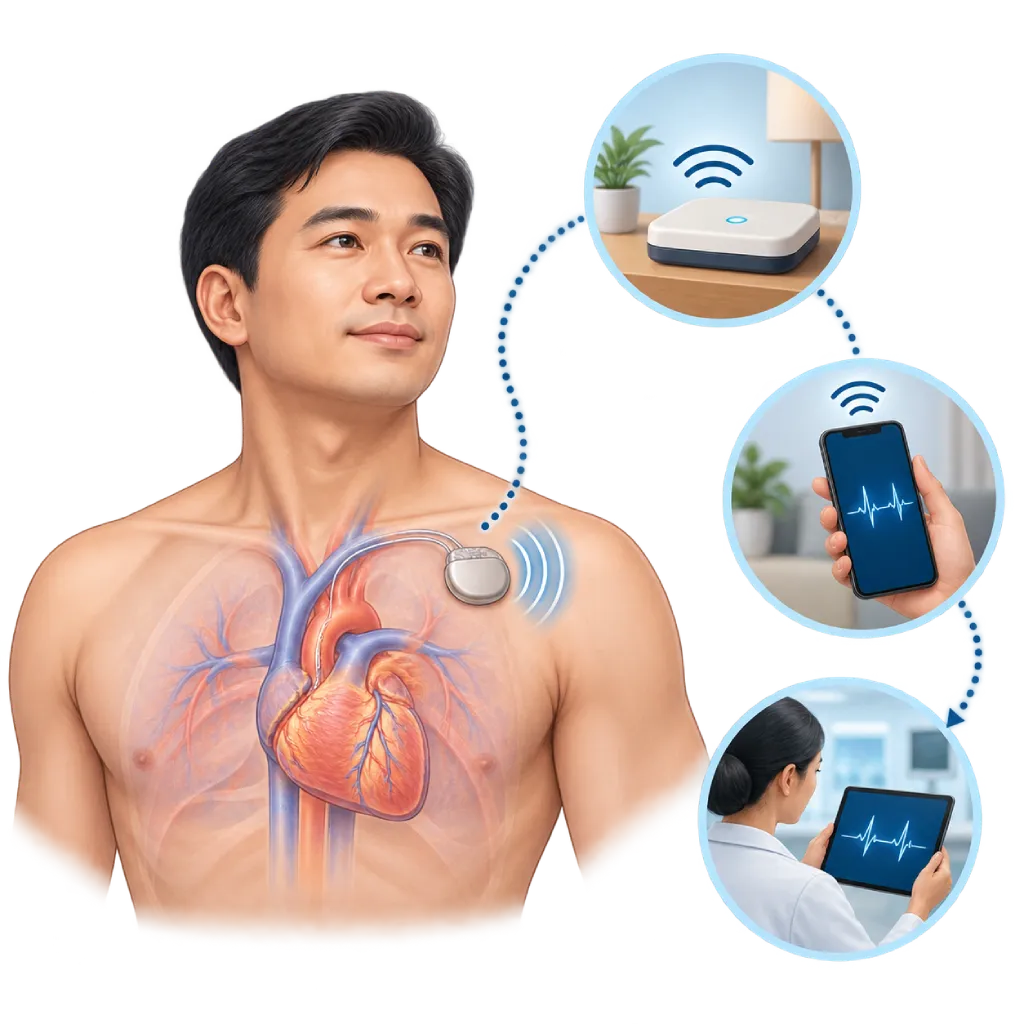
Remote heart monitoring means regularly checking implanted heart devices, such as a pacemaker, ICD, CRT, or rhythm recorder, without coming to the hospital. A home transmitter automatically sends device and heart rhythm data to the clinic. The team reviews the data on schedule and after alerts, then contacts you if needed. This is not an emergency service.
Sources01 / Understanding the procedure
About Remote Heart Monitoring
What Is Remote Heart Monitoring
Implanted heart devices such as pacemakers, ICDs, CRT devices, and implantable loop recorders need to be checked regularly to make sure the battery, leads (wires), and settings are working properly, and to review the recorded heart rhythm. With remote monitoring, the majority of these routine checks can be done from home. Cardiology guidelines recommend remote monitoring as part of routine care for people with these devices.
How It Works in Brief
The device inside your body communicates wirelessly with a transmitter beside your bed or an app on your phone. The data is sent over the internet or a cellular network to the device manufacturer's secure system, then reviewed by the clinic team. Transmissions happen automatically on a schedule, and the device also sends an alert when it detects something important, for example atrial fibrillation, a very fast rhythm, an ICD shock, a lead problem, or a battery that is nearly depleted.
What Is Monitored
- Device status: remaining battery, lead function, and settings. These are covered on the Pacemaker Implantation, Implantable Cardioverter Defibrillator (ICD), and Cardiac Resynchronization Therapy (CRT) pages.
- Heart rhythm: atrial fibrillation that you cannot feel, rhythms that are too slow or too fast, and therapy delivered by the device. This is covered on the Arrhythmia Management page.
- Recordings during symptoms: with an implantable loop recorder, automatic recordings and recordings you mark when you have palpitations or nearly faint. These are covered on the Implantable Loop Recorder (ILR) and Long-Term Heart Rhythm Monitoring pages.
- Signs of heart failure: some devices record daily activity, resting heart rate, and changes in fluid in the lungs that can be an early sign of worsening. This is covered on the Heart Failure Management page.
What You Should Know
Remote monitoring is not an emergency service. Data is generally reviewed on working days and during working hours, so severe symptoms still need to be taken to the emergency room right away. Recordings from a smartwatch or a personal ECG device can be an early clue, but the results need to be confirmed with an ECG or a test at the hospital.
02 / Understanding the procedure
When Is This Procedure Considered?
A doctor may consider this procedure in the situations below. The decision is always made after a thorough assessment.
- People with a PacemakerRegular checks of device function and heart rhythm.
- People with an ICD or CRT DeviceIncluding monitoring of shock therapy and signs of heart failure.
- People with an Implantable Loop RecorderTo capture the rhythm during fainting or palpitations, or to look for atrial fibrillation.
- Heart Failure with an Implanted DeviceTo recognize signs of worsening earlier.
- Leads or Devices That Need Close MonitoringFor example, because of a safety notice from the device manufacturer.
- Living Far from the HospitalReduces travel for routine follow-up visits.
Situations to Consider First
- Fainting, Chest Pain, or Severe BreathlessnessThis is an emergency; go to the emergency room right away and do not wait for data to be sent.
- Repeated ICD ShocksTwo or more shocks, or one shock with symptoms, mean you need to go to the emergency room right away.
- No Internet or Cellular SignalData transmission may be delayed; ask about a suitable transmitter option.
- Device Does Not Yet Support Remote MonitoringSome older devices can only be checked in person at the clinic.
- Traveling AbroadThe transmitter may not work in other countries; tell the clinic before you leave.
03 / Before the procedure
How Should You Prepare?
Preparation takes place at activation, usually shortly after the device is implanted.
Device ID card. Bring the device card you were given after implantation.
Phone or transmitter. If your device connects through an app, bring the phone you will use. Make sure there is a cellular or internet signal at home.
Contact details. Have your phone number and your family's ready so the team can reach you if there are findings.
Medication list. Bring a list of the medications you are taking, especially heart rhythm medications and blood thinners.
Unsure about the preparation instructions? Ask our team before the procedure.
04 / During the procedure
How Is the Procedure Done?
The activation and education session generally takes about 30 minutes. After that, the majority of monitoring runs automatically from home.
Activation
The team registers your device in the monitoring system and connects it to the transmitter or app.
Education
You learn where to place the transmitter, how to send data manually when asked, and what to do if you have symptoms.
Scheduled Transmissions and Alerts
Data is sent automatically on schedule and when the device detects something important. The team reviews the data and contacts you if a medication change, device adjustment, or in-person visit is needed.
In-Person Visits
In-person checks are still done regularly, usually once a year, and when there is a problem that cannot be resolved remotely.
05 / Benefits and risks
Benefits and Risks Should Be Discussed Together.
Every medical procedure has benefits and risks. Your doctor will explain both for your situation before the procedure.
Benefits You Can Expect
- Problems Recognized EarlierDevice or rhythm problems can be detected before the next scheduled follow-up visit.
- Fewer Routine VisitsThe majority of regular checks can be done from home.
- Silent Atrial Fibrillation DetectedSo the risk of stroke can be assessed and treated.
- Lead Problems Detected SoonerHelps prevent unnecessary ICD shocks.
- Heart Failure SupportIn some patients, signs of worsening can be recognized earlier.
The benefits of a procedure are not a promise of a cure. Ask how the results will affect your care plan.
Risks You Should Know
- Not Round-the-Clock MonitoringData is not reviewed every second; severe symptoms still require a trip to the emergency room.
- Failed TransmissionsWhen the transmitter is off, the phone is far from your body, or there is no signal.
- Data PrivacyData is sent through a secure system; ask if you have any concerns.
- AnxietyThe team explains when and how you will be contacted.
Risks can differ from person to person. A full explanation and consent are given after an individual assessment.
06 / After the procedure
What Is Recovery Like?
There is no recovery period. Monitoring runs while you go about your usual activities.
Keep the transmitter on. Place it near your bed and keep it plugged in.
Keep the app active. If you use a phone app, turn on Bluetooth and keep the app running.
Keep the clinic informed. Let them know if you change your phone number, move house, or plan to travel for a long time.
Do not wait for a call. If you feel unwell, contact your doctor or come to the hospital without waiting for monitoring results.
Warning signs to watch for. Go to the emergency room right away if you experience:
- Fainting or nearly fainting
- Chest pain or severe shortness of breath
- Two or more ICD shocks, or one shock with symptoms
- A very fast, pounding heartbeat with dizziness
Know the Signs That Need Prompt Care.
Follow the team's guidance on warning signs. If severe or sudden symptoms appear after the procedure, go to the nearest emergency department right away or call Heart Attack Center 1500 258.
07 / Team and support
Doctors and Procedure Support
The doctors below are listed for this procedure. Listed by name, not by ranking.

Dr. dr. Dicky A. Hanafy, Sp.JP(K)
Arrhythmia and Electrophysiology
Arrhythmia and Device Center +1 center
Clinical focusElectrophysiology and Arrhythmia Ablation · Pacemaker and ICD Implantation
View Profile
Dr. dr. Faris Basalamah, Sp.JP(K)
Interventional Cardiology
Coronary Intervention Procedures +1 center
Clinical focusComplex Coronary Intervention · Cardiac Electrophysiology
View Profile
dr. Sunu B. Raharjo, Sp.JP(K), Ph.D.
Arrhythmia and Electrophysiology
Arrhythmia and Device Center
Clinical focusClinical and Interventional Electrophysiology · Cardiac Arrhythmia Ablation
View Profile08 / Common questions
Before You Plan the Procedure.
Frequently asked questions about remote heart monitoring. Your monitoring schedule is set together with your doctor.
Does the doctor monitor my heart all the time?
No. The device sends data on schedule and when it detects something important, and the team reviews it on working days and during working hours. Remote monitoring is not an emergency service. If you faint, have chest pain or severe breathlessness, or receive repeated shocks, go to the emergency room right away without waiting to be contacted.
Do I still need follow-up visits at the hospital?
Yes, but less often. The majority of routine device checks can be done from home, while in-person visits are still recommended regularly, usually once a year, and when there is a problem that cannot be resolved remotely. Your doctor also continues to assess your symptoms, medications, and heart condition in person.
What happens if something is found in my data?
The clinic team will call you to ask about your symptoms and explain the next steps. Depending on the findings, the doctor may change your medications, schedule an in-person check to adjust the device settings, or ask you to come in right away. Make sure your registered phone number is always active and reachable.
Can a smartwatch replace this monitoring?
No. A smartwatch can record a single-lead ECG and flag possible atrial fibrillation, so it is useful as an early clue. However, the results need to be confirmed with an ECG or a test at the hospital, and a smartwatch cannot check the battery, leads, or settings of an implanted heart device.
Is the transmitter safe for my heart device?
Yes. The transmitter is designed specifically for your device and works by reading data, not by changing the device settings. The signals it uses are weak and safe. Place the transmitter near your bed, keep it plugged in, and do not move it to another home without telling the clinic.
What if I travel?
When traveling within the country, bring your transmitter or make sure the app on your phone stays active. Abroad, some transmitters cannot connect, so ask the clinic before you leave. Bring your device ID card and tell airport security staff that you have an implanted heart device.
Sources and Medical Review
Translated from the Indonesian edition medically reviewed by Dr. dr. Faris Basalamah, Sp.JP(K).
Sources as cited in the Indonesian edition.
- Ferrick AM, Raj SR, Deneke T, et al. 2023 HRS/EHRA/APHRS/LAHRS expert consensus statement on practical management of the remote device clinic. Heart Rhythm. 2023;20(9):e92-e144.
- Slotwiner D, Varma N, Akar JG, et al. HRS Expert Consensus Statement on remote interrogation and monitoring for cardiovascular implantable electronic devices. Heart Rhythm. 2015;12(7):e69-e100.
- Glikson M, Nielsen JC, Kronborg MB, et al. 2021 ESC Guidelines on cardiac pacing and cardiac resynchronization therapy. Eur Heart J. 2021;42(35):3427-3520.
- Varma N, Epstein AE, Irimpen A, et al. Efficacy and Safety of Automatic Remote Monitoring for Implantable Cardioverter-Defibrillator Follow-Up: The Lumos-T Safely Reduces Routine Office Device Follow-Up (TRUST) Trial. Circulation. 2010;122(4):325-332.
- Hindricks G, Taborsky M, Glikson M, et al. Implant-based multiparameter telemonitoring of patients with heart failure (IN-TIME): a randomised controlled trial. Lancet. 2014;384(9943):583-590.
- Perez MV, Mahaffey KW, Hedlin H, et al. Large-Scale Assessment of a Smartwatch to Identify Atrial Fibrillation. N Engl J Med. 2019;381(20):1909-1917.