
Quick answer
What Is Patent Ductus Arteriosus (PDA) Closure?
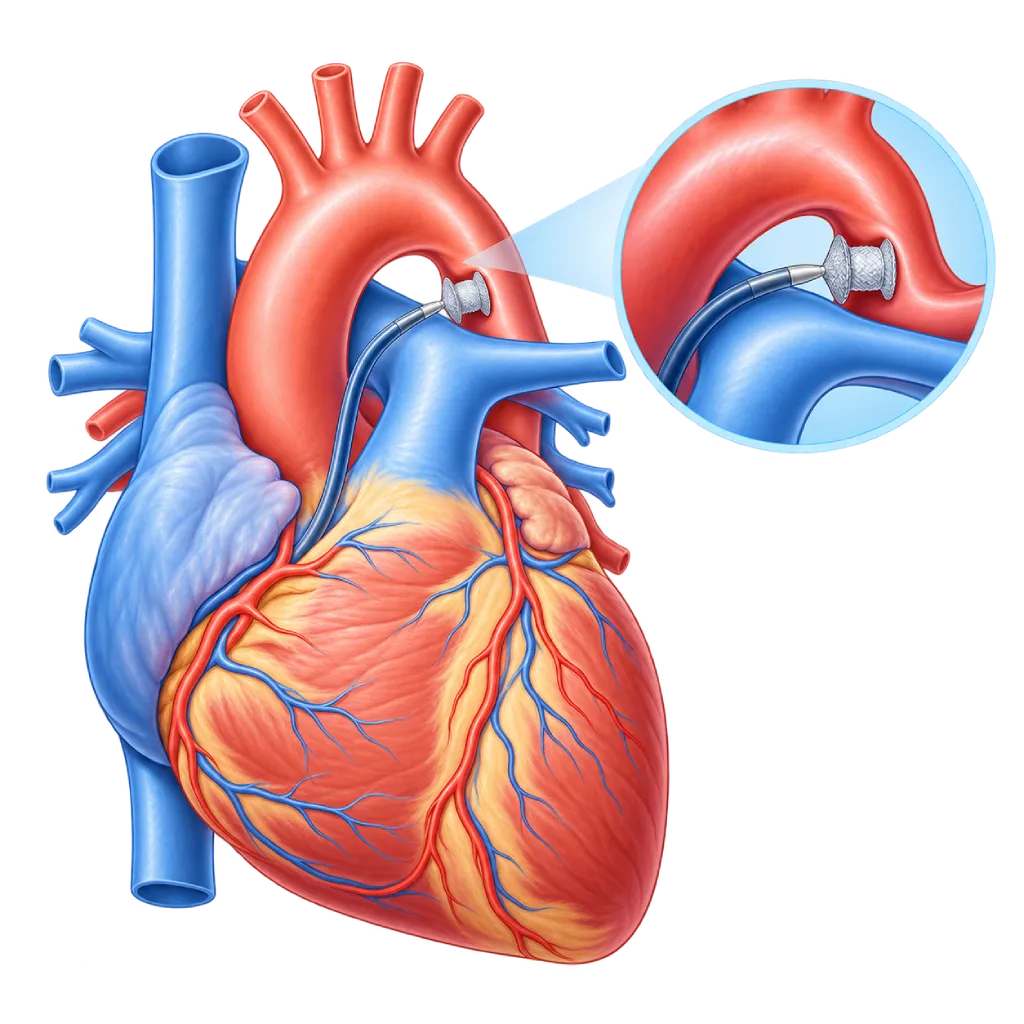
Patent ductus arteriosus (PDA) closure is a procedure to close the channel between the aorta and pulmonary artery that should close on its own after birth. If it stays open, excess blood flows to the lungs and strains the left heart. The channel is usually closed through a catheter with a coil or closure device in about 1 hour.
Sources01 / Understanding the procedure
About Patent Ductus Arteriosus (PDA) Closure
What Is Patent Ductus Arteriosus Closure
In the womb, a baby has a blood vessel channel called the ductus arteriosus that connects the pulmonary artery to the aorta. This channel lets blood bypass the lungs, which are not yet used for breathing. After birth, the channel normally closes on its own within a few days. If it stays open, the condition is called patent ductus arteriosus (PDA). PDA closure is a procedure to close this channel. An overview of closing other holes in the heart is covered on the Heart Defect Closure page.
Why a PDA Strains the Heart
After birth, the pressure in the aorta is higher than in the pulmonary artery. As a result, blood from the aorta flows through the channel to the lungs, then returns to the left atrium and left ventricle. In a large PDA, this excess flow makes the left side of the heart enlarge, and the baby breathes fast, sweats during feeding, and has trouble gaining weight. If left for years, the pressure in the lung blood vessels can rise. The open channel can also become a site of infection.
PDA in Premature Babies
PDA is found more often in babies born prematurely. In some of these babies, the channel can still close on its own or with medicines such as ibuprofen or paracetamol given in the neonatal intensive care unit. If a large channel does not close and affects the baby's breathing, it can be closed with minor surgery or through a catheter using a special device for small babies.
Catheter Closure
In older babies, children, and adults, a PDA is usually closed through a catheter from a blood vessel in the groin. A small channel is closed with a coil, a roll of flexible wire that triggers clotting and plugs the channel. A larger channel is closed with a plug-shaped closure device made of metal mesh. Surgery through a cut on the left side of the chest is chosen when the channel is too large or its shape is not suitable for a catheter.
When a PDA Needs to Be Closed
Closure is recommended when a PDA makes the left side of the heart enlarge, causes symptoms, or affects growth. A small PDA that can be heard as a heart murmur is also often closed to prevent infection. A very small PDA that is only visible on echocardiography, with no murmur, usually does not need to be closed. In adults, closure is not done if the lung pressure is already very high, so the doctor may measure it first with right heart catheterization, covered on the Right Heart Catheterization page.
02 / Understanding the procedure
When Is This Procedure Considered?
A doctor may consider this procedure in the situations below. The decision is always made after a thorough assessment.
- Enlarged Left HeartExcess flow through the channel makes the left atrium and left ventricle enlarge.
- Breathlessness and Poor Growth in BabiesFast breathing, sweating during feeding, and trouble gaining weight.
- PDA Heard as a MurmurA small to moderate PDA that causes a heart murmur, closed to prevent infection.
- Large PDA in Premature BabiesA large channel that does not close with medicines and affects the baby's breathing.
- History of Infection in the ChannelA previous infection of the PDA wall (endarteritis).
Situations to Consider First
- Very High Lung PressureWhen blood has already reversed to flow from the pulmonary artery to the aorta, closure can be harmful.
- Very Small PDA Without a MurmurIt is only visible on echocardiography and does not strain the heart, so monitoring is enough.
- Heart Defects That Depend on the PDAIn certain heart defects, this channel is actually a blood pathway the baby needs.
- Active InfectionA planned procedure is postponed until the infection is resolved.
03 / Before the procedure
How Should You Prepare?
Preparation depends on age and the closure method. For premature babies, decisions and preparation are made together with the neonatal intensive care team.
Tests before the procedure. Echocardiography to measure the channel, ECG, chest X-ray, and blood tests.
Fasting. Follow the fasting schedule from the anesthesia team. The time limits for breast milk, formula, and water are explained separately.
General health. Tell the team if your child has a fever, cough, or cold, because a planned procedure may be postponed.
Medicines and allergies. Bring a list of medicines. Tell the team about any allergy to medicines, contrast dye, or nickel.
Preparing your child. Explain what will happen in simple words. Parents can stay with their child until the anesthesia takes effect, and the child may bring a favorite item.
Unsure about the preparation instructions? Ask our team before the procedure.
04 / During the procedure
How Is the Procedure Done?
Catheter closure of a PDA is done in the catheterization lab and takes about 1 to 2 hours. Children usually receive general anesthesia or deep sedation; adults often only need local anesthesia and a sedative.
Inserting the Catheter
The catheter is inserted through a vein, and sometimes also an artery, in the groin.
Mapping the Channel
Contrast dye is injected into the aorta to see the shape and size of the channel, then the doctor chooses a suitable coil or closure device.
Placing the Coil or Device
The coil or device is pushed through the catheter into the channel and then opened. Before it is released, its position is checked with contrast dye or echocardiography.
Completing the Procedure
The catheter is removed and the puncture site is pressed until the bleeding stops. If surgery is chosen, for example in premature babies, the surgeon ties off or clips the channel through a small cut on the left side of the chest.
05 / Benefits and risks
Benefits and Risks Should Be Discussed Together.
Every medical procedure has benefits and risks. Your doctor will explain both for your situation before the procedure.
Benefits You Can Expect
- No Cut in the ChestIn the majority of children and adults, the channel is closed through a catheter from the groin.
- Short ProcedureUsually about 1 hour, and most children go home the next day.
- Less Strain on the HeartAn enlarged left heart can return to normal after the excess flow stops.
- Preventing Infection and Lung DamageLowers the risk of infection in the channel and of high pressure in the lung blood vessels.
The benefits of a procedure are not a promise of a cure. Ask how the results will affect your care plan.
Risks You Should Know
- Coil or Device Moving Out of PlaceRare; it can usually be retrieved through a catheter.
- Residual LeakA small flow may remain and often closes on its own within a few weeks.
- Narrowing of the Pulmonary Artery or AortaIn small babies, the device may protrude and narrow the nearby blood vessels.
- Problems at the Puncture SiteBruising, bleeding, or reduced blood flow to the leg, more likely in babies.
- Hoarse Voice After SurgeryThe vocal cord nerve near the channel can become irritated; it usually improves gradually.
Risks can differ from person to person. A full explanation and consent are given after an individual assessment.
06 / After the procedure
What Is Recovery Like?
After catheter closure, most children go home the next day. Premature babies stay in the neonatal intensive care unit for as long as they need.
First day. Your child lies with the legs straight for a few hours. The team monitors the puncture site, the pulse in the feet, and the color and warmth of the legs.
Check before going home. An echocardiogram confirms the device position and that there is no significant residual leak.
Activity. Your child can return to light play and school within a few days. Rough play is postponed for about one week or as advised.
Follow-up visits. Echocardiography is done regularly, for example within 1 to 6 months. For the first 6 months, tell your dentist before any dental procedure, because preventive antibiotics may be needed.
Warning signs. Contact the medical team right away or go to the emergency room if your child has:
- Growing swelling or bleeding at the puncture site
- A cold, pale, or bluish leg
- Fast breathing or shortness of breath
- High fever with no clear cause
- Dark, tea-colored urine
Know the Signs That Need Prompt Care.
Follow the team's guidance on warning signs. If severe or sudden symptoms appear after the procedure, go to the nearest emergency department right away or call Heart Attack Center 1500 258.
07 / Team and support
Doctors and Procedure Support
The doctors below are listed for this procedure. Listed by name, not by ranking.

dr. Radityo Prakoso, Sp.JP(K)
Pediatrics & Congenital Heart Disease
Congenital and Structural Heart Center
Clinical focusPediatric Cardiology Consultation · Congenital Heart Disease Care
View Profile
dr. Salomo Purba, Sp.BTKV, Subsp.JPK(K)
Pediatric and Congenital Heart Surgery
Congenital and Structural Heart Center +2 centers
Clinical focusPediatric Heart Surgery · Congenital Heart Defect Surgery
View Profile
dr. Tartila, Sp.A, Subsp.ETIA(K)
Pediatric Emergency and Intensive Care
Congenital and Structural Heart Center
Clinical focusPediatric Intensive Care · Pediatric Emergency Care
View ProfileCatheterization Laboratory (Cath Lab)
A dedicated procedure room for cardiac catheterization, coronary angiography, stent placement, and other catheter-based heart…
The availability of technology and test support is confirmed with the team. Technology is chosen according to clinical need.
08 / Common questions
Before You Plan the Procedure.
Questions parents and patients often ask about patent ductus arteriosus (PDA) closure.
Why does a PDA not close on its own after birth?
In full-term babies, the channel usually closes within a few days after birth as oxygen levels rise. In premature babies, the channel wall is not yet mature, so it more often stays open. Other factors include rubella infection during pregnancy and certain genetic conditions. Often the exact cause is unknown, and it is not the parents' fault.
Can a PDA close on its own?
In premature babies, a PDA often closes on its own or with medicines within a few weeks. In full-term babies, a PDA that is still open after about 3 months of age rarely closes on its own. For this reason, a PDA that strains the heart or can be heard as a murmur is usually planned for closure, while a very small PDA without a murmur only needs monitoring.
Will the coil or closure device stay in the body?
Yes. The coil or device is left in the channel and is gradually covered by tissue, so the channel becomes tightly sealed. It does not need to be replaced and usually does not affect your child's growth. Keep the device card you receive after the procedure, and show it to health workers if your child is going to have a test such as an MRI.
At what age can a PDA be closed through a catheter?
Catheter closure is usually done in older babies, children, and adults. Special devices also make catheter closure possible in some small babies, including premature babies of a certain weight. The team decides between a catheter, surgery, or waiting based on the baby's weight, the size of the channel, and the baby's condition.
Is this procedure painful for my child?
During the procedure, your child is given anesthesia and does not feel pain. Afterward, the groin may feel sore or bruised for a few days, which can be eased with mild pain relievers. Once the anesthesia wears off, children can usually eat, drink, and play gently on the same day.
Do adults with a PDA need closure?
Yes, if the PDA makes the left side of the heart enlarge or causes symptoms, and the lung pressure is not yet too high. In adults, the channel wall may harden, so the device must be chosen carefully. If the lung pressure is suspected to be high, the doctor measures it first with cardiac catheterization. A very small PDA without a murmur and without heart enlargement usually only needs monitoring.
Sources and Medical Review
Translated from the Indonesian edition medically reviewed by dr. Radityo Prakoso, Sp.JP(K).
Sources as cited in the Indonesian edition.
- Baumgartner H, De Backer J, Babu-Narayan SV, et al. 2020 ESC Guidelines for the management of adult congenital heart disease. Eur Heart J. 2021;42(6):563-645.
- Feltes TF, Bacha E, Beekman RH, et al. Indications for Cardiac Catheterization and Intervention in Pediatric Cardiac Disease: A Scientific Statement From the American Heart Association. Circulation. 2011;123(22):2607-2652.
- Schneider DJ, Moore JW. Patent ductus arteriosus. Circulation. 2006;114(17):1873-1882.
- Hamrick SEG, Sallmon H, Rose AT, et al. Patent Ductus Arteriosus of the Preterm Infant. Pediatrics. 2020;146(5):e20201209.
- Backes CH, Rivera BK, Bridge JA, et al. Percutaneous Patent Ductus Arteriosus (PDA) Closure During Infancy: A Meta-analysis. Pediatrics. 2017;139(2):e20162927.
- Sathanandam SK, Gutfinger D, O'Brien L, et al. Amplatzer Piccolo Occluder clinical trial for percutaneous closure of the patent ductus arteriosus in patients ≥700 grams. Catheter Cardiovasc Interv. 2020;96(6):1266-1276.