
Quick answer
What Is Congenital Heart Disease?
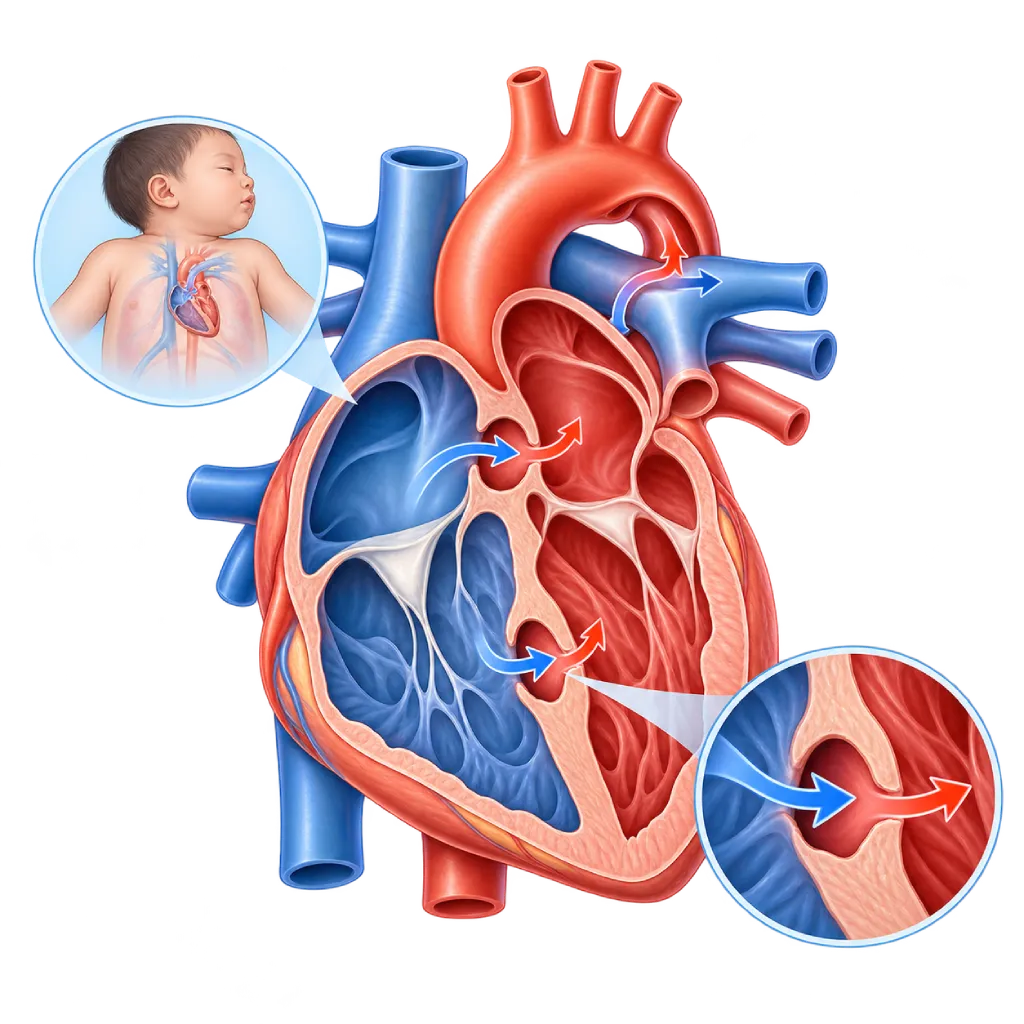
Congenital heart disease is an abnormality in the structure of the heart or the large blood vessels that is present from birth. Its effects vary, from a small hole without symptoms to complex defects that need treatment from infancy.
SourcesSigns That Need Urgent Help
- Very blue lips and skin, or bluish color that keeps getting worse
- Severe shortness of breath, gasping, or the chest pulling inward when breathing
- A baby who refuses to feed at all or is very limp
- Fainting, especially during or after activity
- A very fast heartbeat that does not settle
- Cold hands and feet, pale grayish skin, and a weak pulse
If these signs appear, go to the nearest emergency department right away or call Heart Attack Center 1500 258.
01 / Understanding the condition
About Congenital Heart Disease
Congenital heart disease (CHD) is an abnormality in the structure of the heart or the large blood vessels near it that forms while the baby develops in the womb. The heart forms around the third to eighth week of pregnancy. If this process is disrupted, there may be a hole in the wall between the heart chambers, a valve that is narrowed or leaky, blood vessels connected to the wrong place, or a heart chamber that does not develop. CHD is one of the common birth defects: about 9 out of every 1,000 babies are born with a heart defect.
Types of Congenital Heart Disease
Put simply, CHD is divided into two groups. The first group is acyanotic CHD, defects that at first do not make the skin bluish. Examples include a hole in the wall between the upper chambers (atrial septal defect), a hole in the wall between the lower chambers (ventricular septal defect), a fetal blood vessel that stays open (patent ductus arteriosus), and narrowing of the aorta (coarctation of the aorta). The second group is cyanotic CHD, defects that send low-oxygen blood around the body so that the lips and skin look bluish. Examples include tetralogy of Fallot, transposition of the great arteries, total anomalous pulmonary venous return, truncus arteriosus, hypoplastic left heart syndrome, double outlet right ventricle, and some cases of Ebstein anomaly. Patent foramen ovale, a small opening left over from fetal circulation, also belongs to this family. Each type is covered on its own page.
From Infancy to Adulthood
Critical defects usually show up in the first days or weeks of life, for example when a baby looks blue, is short of breath, or has trouble feeding. Moderate defects are often recognized only in childhood, because of poor weight gain or a heart murmur heard during an examination. Some mild defects, such as an atrial septal defect, are not found until adulthood. In countries with adequate pediatric heart care, more than 90 percent of children with CHD now grow into adulthood, so the number of adults with CHD keeps increasing.
Why Lifelong Follow-Up Matters
Surgery or catheter procedures improve blood flow, but they do not always make the heart fully normal. In some people, later problems can appear years afterward, such as rhythm disorders, leaky valves, high lung pressure, or a weakening heart pump. The 2020 ESC and 2018 AHA/ACC guidelines recommend regular follow-up with a doctor who understands CHD, with visit intervals adjusted to the complexity of the defect. Plans for pregnancy and sports should also be discussed with a doctor in advance.
02 / Understanding the condition
Types and Related Conditions
The following conditions belong to the Congenital Heart Disease group. Open each one for a full explanation.
03 / Understanding the condition
Symptoms to Recognize.
Common Symptoms
- Shortness of breath or tiring quickly during activity
- Bluish lips, tongue, or nails
- Palpitations or a heartbeat that feels irregular
- A heart murmur heard when the doctor examines you
- Swelling in the legs, abdomen, or around the eyes
- Lower exercise ability than peers of the same age
Symptoms in Infants
In babies, symptoms often show during feeding, because feeding is hard physical work for a baby.
- Fast or labored breathing, especially during feeding
- Often stopping, tiring, or sweating during feeding
- Poor weight gain
- Bluish skin or lips, especially when crying
- Looking pale, limp, or easily fussy
Symptoms in Children
- Tiring quickly and often stopping to rest while playing
- Growth that lags behind other children of the same age
- Frequent colds or repeated lung infections
- Often squatting to rest after running
- Rounded tips of the fingers and toes (clubbing)
04 / Understanding the condition
What Causes This Condition?
- Disrupted heart formation in the early weeks of pregnancy, with no known trigger in most cases
- Chromosomal abnormalities, such as Down syndrome, Turner syndrome, or 22q11.2 deletion (DiGeorge syndrome)
- Single-gene changes that can be passed down in families
- Rubella (German measles) infection in the mother early in pregnancy
- Diabetes or phenylketonuria in the mother that is uncontrolled in early pregnancy
- Exposure to alcohol or certain medicines during pregnancy, such as isotretinoin and some anti-seizure medicines
05 / Understanding the condition
Who Is at Higher Risk?
Genetic
A history of CHD in the father, mother, or a sibling increases the chance of CHD in the next child. Genetic syndromes such as Down syndrome are also often accompanied by heart defects.
Medical
Uncontrolled diabetes before and early in pregnancy, obesity, phenylketonuria, and rubella infection in the mother can disrupt the formation of the baby's heart.
Lifestyle
Smoking, drinking alcohol, and using medicines without a prescription during pregnancy are linked to a risk of birth defects, including heart defects.
Other
Babies born prematurely more often have a ductus arteriosus that stays open. In many cases, no risk factor at all is found in the parents.
Groups at Higher Risk
- Babies of Parents with CHD: The risk of CHD in a child rises if the father, mother, or a sibling has CHD, so fetal echocardiography may be considered.
- Children with Genetic Syndromes: Children with Down syndrome, Turner syndrome, or DiGeorge syndrome need their hearts checked because heart defects often come with these conditions.
- Premature Babies: Babies born early more often have a ductus arteriosus that stays open after birth.
- Pregnant Women with Diabetes: Uncontrolled blood sugar in early pregnancy increases the risk of heart defects in the baby.
- Adults with CHD: Adults who had CHD surgery as children still need follow-up because rhythm disorders or valve problems can develop.
06 / Understanding the condition
How Is It Diagnosed?
Some types of CHD can already be suspected before birth on a pregnancy ultrasound and then confirmed with fetal echocardiography. After birth, the doctor checks skin color, breathing, and the pulses in the arms and legs, and listens for a heart murmur. Pulse oximetry screening in newborns helps find critical defects before the baby looks ill.
Echocardiography is the key test for almost all types of CHD. It is safe, uses no radiation, and can be repeated to monitor progress. An ECG and a chest X-ray complete the picture. In teenagers and adults, or when the anatomy is complex, the doctor may request a cardiac MRI or CT scan. Cardiac catheterization is done when lung pressure needs to be measured directly, or when a defect will be closed through a catheter. In adults with CHD, a cardiac exercise test helps assess physical capacity objectively.
Echocardiography
The main test to see holes, valves, and the large blood vessels. Fetal echocardiography can be done at around 18 to 22 weeks of pregnancy.
Pulse oximetry screening in newborns, which measures oxygen levels with a sensor on the hand and foot after 24 hours of age, to find critical CHD.
Electrocardiogram (ECG)
Assesses heart rhythm and signs of enlarged heart chambers.
Chest X-Ray
Shows the size of the heart and the amount of blood flow to the lungs.
Cardiac MRI
Assesses complex anatomy and the size and function of the right ventricle, especially in teenagers and adults, without X-rays.
Cardiac CT Scan
Maps the large blood vessels and coronary arteries when MRI is not possible or before a procedure.
Cardiac Catheterization
Measures pressure and oxygen levels in the heart chambers and lung vessels, and can also serve as the route for a closure procedure.
07 / Understanding the condition
Treatment Options.
Treatment is decided by a doctor after an assessment. The categories below can help you follow the conversation with your doctor.
Regular Monitoring
Many small holes close on their own or do not disrupt blood flow, so monitoring with echocardiography on the doctor's schedule is enough.
Medicines
Diuretics and other heart medicines can ease symptoms of heart failure or rhythm disorders while waiting for a procedure. The type and dose are decided by your doctor.
Catheter Procedures
Holes in the heart wall, a vessel that stays open, or a narrowed vessel can be closed or widened through a catheter from a blood vessel in the groin, without opening the chest.
Heart Surgery
Complex defects or those not suitable for a catheter are repaired through surgery, some already in infancy. Covered on the Congenital Heart Surgery page.
Lifelong Follow-Up
People with CHD, including those who have had surgery, are advised to have regular follow-up with a doctor who understands CHD so that later problems are detected early.
Pregnancy Planning
Women with CHD should have a consultation before pregnancy to assess the risk, review medicines, and plan monitoring during pregnancy.
08 / Understanding the condition
Complications to Watch For.
Heart Failure
An excess workload tires the heart muscle, causing shortness of breath, swelling, and fatigue. In babies, the signs are fast breathing and poor weight gain.
Heart Rhythm Disorders
Enlarged heart chambers and surgical scars can trigger rhythms that are too fast or too slow, especially in adults. Covered on the Heart Rhythm Disorders / Arrhythmia page.
Pulmonary Hypertension
Too much blood flow to the lungs over a long time can damage the lung vessels. Its advanced form is called Eisenmenger syndrome, when the flow reverses and the body turns bluish.
Infective Endocarditis
An infection of the inner lining of the heart or the valves, more likely in cyanotic CHD and after artificial material has been implanted. Dental hygiene plays an important role.
Stroke and Brain Abscess
In CHD with a shunt from the right to the left side of the heart, blood clots or germs can slip into the blood circulation of the brain.
Growth and Development Problems
Babies with severe CHD may have growth problems and developmental delays, so monitoring of growth and development is recommended.
09 / Understanding the condition
What Can You Do?
- Have regular prenatal checkups, including an ultrasound that assesses the baby's heart
- Make sure you are immune to rubella, for example through the MMR vaccine, before planning a pregnancy
- Control your blood sugar before and during pregnancy if you have diabetes
- Take folic acid as recommended by your doctor, starting before pregnancy
- Avoid smoking, alcohol, and medicines without a prescription during pregnancy
- Discuss your regular medicines with your doctor before pregnancy, without stopping them on your own
- If you have CHD, take care of your teeth and mouth to lower the risk of heart infection
10 / Understanding the condition
When Should You See a Doctor?
Many cases of CHD are found only because parents notice small changes in their baby or child. See a doctor if you notice the following signs. Go to the emergency room right away if a baby looks very blue, has severe shortness of breath, or is very limp.
- A baby breathes fast, sweats, or often stops during feeding
- A baby or child has poor weight gain
- Lips or nails look bluish, even if only when crying
- A doctor hears a heart murmur during a routine checkup
- A child or adult tires quickly, is short of breath, has palpitations, or has fainted during activity
- Someone with CHD has not had a checkup for a long time or is planning a pregnancy
Don't Wait in an Emergency.
If symptoms are severe or come on suddenly, go to the nearest emergency department right away or call Heart Attack Center 1500 258, rather than waiting for an appointment.
11 / Common questions
Questions You May Have.
Frequently asked questions from parents and people living with congenital heart disease.
Can congenital heart disease be cured?
Some types can. A small hole in the heart wall, for example, can close on its own in the first years of life. Other defects can be repaired through a catheter or surgery so that children grow and stay active well. However, a repaired heart is not always the same as a normal heart. That is why international guidelines recommend lifelong regular follow-up to find later problems, such as rhythm disorders or leaky valves, as early as possible.
Is CHD caused by something the parents did during pregnancy?
In most cases, the cause of CHD is unknown and is not the parents' fault. The heart forms very early, often before a woman knows she is pregnant. Some factors can indeed add to the risk, such as rubella infection, uncontrolled diabetes, or certain medicines. What matters more now is making sure the child gets the right tests and treatment, along with family support.
Is our next child also at risk of CHD?
The risk is slightly higher than in families without a history of CHD, but the majority of younger siblings of a child with CHD are born with a normal heart. The size of the risk depends on the type of defect and whether there is a genetic syndrome. In the next pregnancy, the obstetrician may recommend fetal echocardiography at around 18 to 22 weeks of pregnancy. Genetic counseling can also help if CHD comes with other abnormalities.
Can children with CHD play sports?
Most children with mild CHD, or whose defect has been well repaired, can play sports, and physical activity is actually good for their health. The type and intensity of exercise are adjusted to the defect, heart function, lung pressure, and whether there are rhythm disorders. The doctor may request a cardiac exercise test before giving advice. Excessive restrictions without a basis in testing can actually hinder the child's growth and development.
Can women with CHD become pregnant?
Many women with CHD can become pregnant and give birth safely, but pregnancy increases the heart's workload. The risk varies, from low with a small hole that has already been closed to high with severe pulmonary hypertension. That is why ESC guidelines recommend a consultation before pregnancy to assess heart function, review which medicines are safe, and plan monitoring together with an obstetrician and a cardiologist.
Why do adults who had surgery as children still need follow-up?
Surgery in childhood improves blood flow, but scars, patches, and valves can change over time. Later problems such as rhythm disorders, leaky valves, or a weakening heart pump often develop slowly without clear symptoms. Regular follow-up with echocardiography, an ECG, and, if needed, cardiac MRI helps find these changes early so that treatment can be planned calmly.
Sources and Medical Review
Translated from the Indonesian edition medically reviewed by dr. Radityo Prakoso, Sp.JP(K).
Sources as cited in the Indonesian edition.
- Baumgartner H, De Backer J, Babu-Narayan SV, et al. 2020 ESC Guidelines for the management of adult congenital heart disease. Eur Heart J. 2021;42(6):563-645.
- Stout KK, Daniels CJ, Aboulhosn JA, et al. 2018 AHA/ACC Guideline for the Management of Adults With Congenital Heart Disease: A Report of the American College of Cardiology/American Heart Association Task Force on Clinical Practice Guidelines. Circulation. 2019;139(14):e698-e800.
- Liu Y, Chen S, Zühlke L, et al. Global birth prevalence of congenital heart defects 1970-2017: updated systematic review and meta-analysis of 260 studies. Int J Epidemiol. 2019;48(2):455-63.
- Pierpont ME, Brueckner M, Chung WK, et al. Genetic basis for congenital heart disease: revisited: a scientific statement from the American Heart Association. Circulation. 2018;138(21):e653-e711.
- Martin GR, Ewer AK, Gaviglio A, et al. Updated strategies for pulse oximetry screening for critical congenital heart disease. Pediatrics. 2020;146(1):e20191650.
- Regitz-Zagrosek V, Roos-Hesselink JW, Bauersachs J, et al. 2018 ESC Guidelines for the management of cardiovascular diseases during pregnancy. Eur Heart J. 2018;39(34):3165-241.
Doctors Who Treat This Condition

dr. Radityo Prakoso, Sp.JP(K)
Pediatrics & Congenital Heart Disease
Congenital and Structural Heart Center
Clinical focusPediatric Cardiology Consultation · Congenital Heart Disease Care
View Profile
dr. Salomo Purba, Sp.BTKV, Subsp.JPK(K)
Pediatric and Congenital Heart Surgery
Congenital and Structural Heart Center +2 centers
Clinical focusPediatric Heart Surgery · Congenital Heart Defect Surgery
View Profile
dr. BRM Ario S. Kuncoro, Sp.JP(K)
Echocardiography & Cardiovascular Imaging
Cardiovascular Diagnostic Center +2 centers
Clinical focusAdvanced and 3D Echocardiography · Transesophageal Echocardiography
View Profile