
Quick answer
What Is Transcatheter Aortic Valve Implantation?
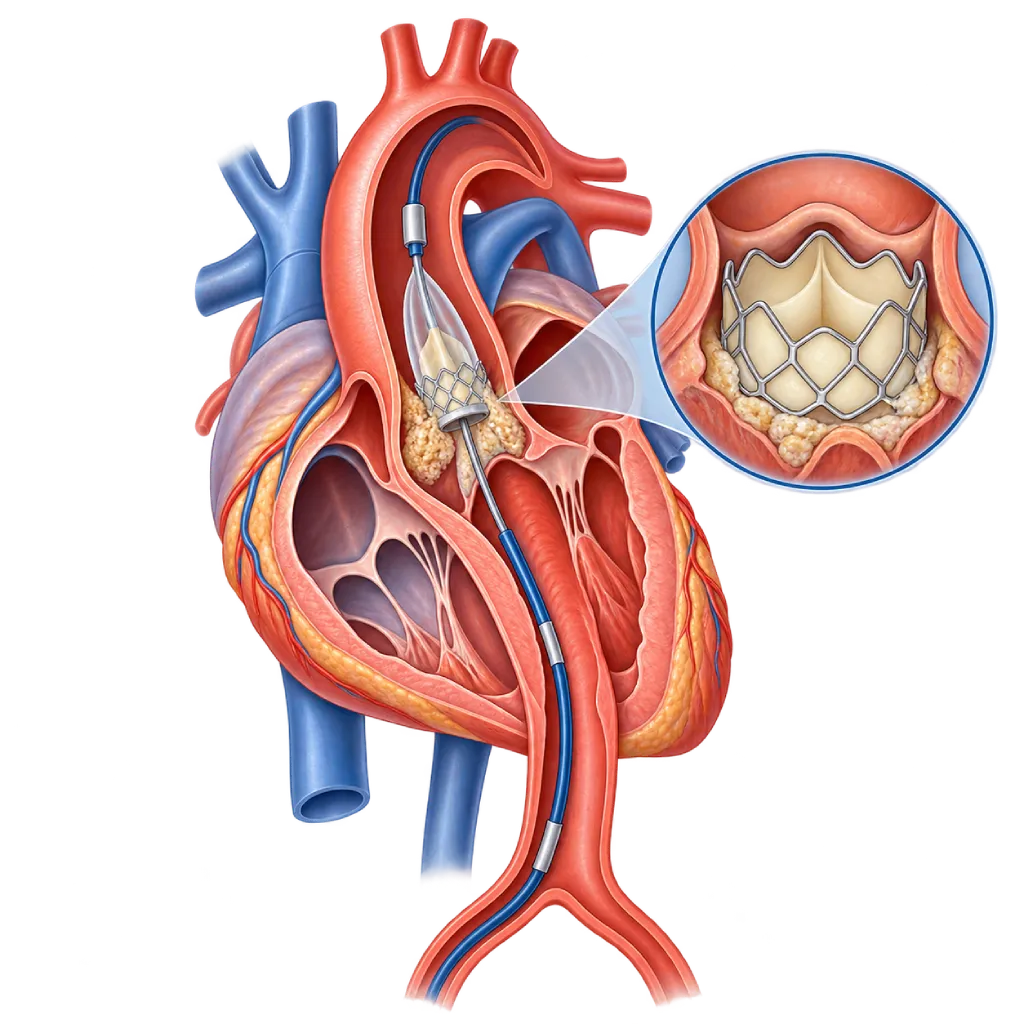
Transcatheter aortic valve implantation (TAVI) is a procedure to place an artificial aortic valve through a catheter, usually from an artery in the groin, without opening the chest. It treats severe narrowing of the aortic valve. The new valve is expanded inside the old valve so blood flows freely again. The procedure takes about 1 to 2 hours.
Sources01 / Understanding the procedure
About Transcatheter Aortic Valve Implantation
What Is Transcatheter Aortic Valve Implantation
The aortic valve is a one-way door between the left ventricle of the heart and the aorta, the main blood vessel that carries blood to the whole body. With age, the valve leaflets can thicken and calcify so they cannot open wide. This condition is called aortic stenosis. The heart has to pump harder, and over time shortness of breath, chest pain, dizziness, or fainting appear during activity.
Transcatheter aortic valve implantation, known as TAVI or TAVR, is a way to replace the function of that valve without open-heart surgery. An artificial valve made from animal tissue mounted on a metal frame is folded small at the tip of a catheter, carried to the heart through a blood vessel, and then expanded inside the old valve.
How It Works in Brief
The new valve pushes the old valve leaflets aside and starts working as soon as it is in place, while the old valve is not removed. The commonly used route is the artery in the groin (transfemoral). If the blood vessels in the groin are too small, too winding, or heavily calcified, the doctor may consider another route, for example through the artery below the collarbone.
TAVI or Valve Replacement Surgery
Severe aortic stenosis can be treated with TAVI or with valve replacement surgery, covered on the Heart Valve Surgery page. The choice is made by the heart team, made up of an interventional cardiologist, a cardiac surgeon, a cardiac imaging specialist, and an anesthesiologist, together with you and your family.
The team weighs your age and estimated life expectancy, surgical risk, the shape of the valve and blood vessels, other heart conditions that need surgery at the same time, and your preferences. In general, TAVI is chosen more often in older age. In younger people with low surgical risk, surgery is often considered because data on the very long-term durability of TAVI valves are still being collected, and mechanical valves can only be placed through surgery.
Tests to Assess Suitability
Echocardiography confirms how severe the narrowing is and assesses the heart's pumping function. A CT scan of the heart and blood vessels measures the valve ring, the distance from the valve to the coronary arteries, and the size and winding of the blood vessels from the groin to the heart, covered on the Cardiac CT Scan page. Coronary angiography is usually also done to look for narrowing of the coronary arteries. The results of these tests determine the valve size and the route used.
An Option for Worn-Out Biological Valves
TAVI can also be used when a biological aortic valve from previous surgery has worn out, narrowed, or started leaking. The new valve is placed inside the old artificial valve (valve-in-valve), so repeat heart surgery can be avoided in suitable patients.
02 / Understanding the procedure
When Is This Procedure Considered?
A doctor may consider this procedure in the situations below. The decision is always made after a thorough assessment.
- Severe Aortic Stenosis with SymptomsShortness of breath, chest pain, dizziness, or fainting caused by a severely narrowed aortic valve.
- Older AgeIn older people, TAVI is generally preferred over surgery after assessment by the heart team.
- High Surgical RiskFor example, because of lung disease, kidney disease, previous chest surgery, or being very frail.
- Reduced Heart Pumping FunctionSevere narrowing that is starting to weaken the heart's pumping, even before symptoms are felt.
- Worn-Out Biological ValveA biological aortic valve from previous surgery that has narrowed or is leaking can be replaced through a catheter.
Situations to Consider First
- Very Little Expected BenefitWhen another serious illness makes it unlikely that TAVI will improve symptoms and quality of life.
- Active Valve InfectionActive endocarditis needs to be treated first with antibiotics and, if needed, surgery.
- Unsuitable AnatomyThe size of the valve ring, the position of the coronary arteries, or the blood vessels do not allow safe placement.
- Need for Other Heart Surgery at the Same TimeFor example, coronary bypass or repair of another valve, making a combined operation more suitable.
- Blood Clot in the Left VentricleA clot inside the heart needs to be treated first because it can break loose during the procedure.
03 / Before the procedure
How Should You Prepare?
TAVI is usually a planned procedure. The heart team assesses you through several tests and consultations before scheduling the procedure.
Tests. Echocardiography, a CT scan of the heart and blood vessels, coronary angiography, an ECG, a chest X-ray, and blood tests including kidney function. The team may also assess your physical strength and your ability to carry out daily activities.
Teeth and sources of infection. Infections of the teeth, gums, skin, or urinary tract should be treated first, because germs can attach to the new valve.
Medications. Bring a complete list of your medications and supplements. Blood thinners and certain diabetes medications may need to be adjusted before the procedure. Do not stop any medication without your doctor's guidance.
Fasting. Follow the fasting instructions from the team, which usually means no food or drink for several hours before the procedure.
Consent and a companion. Your doctor explains the benefits, risks, and other options before you sign the consent form. Arrange for a family member who can accompany you during your hospital stay and in the early days of recovery at home.
Unsure about the preparation instructions? Ask our team before the procedure.
04 / During the procedure
How Is the Procedure Done?
TAVI is performed by the heart team in a cardiac catheterization lab or a hybrid operating room. Local anesthesia in the groin with sedation is usually used, while some patients need general anesthesia. The procedure takes about 1 to 2 hours.
Preparing the Access Route
The doctor punctures the artery in the groin and places a sheath as an entry path for the devices. A temporary pacing wire is inserted through another blood vessel to control the heart rate during the procedure.
Bringing the Valve to the Heart
Guided by X-rays and contrast dye, a guidewire and catheter are advanced across the narrowed aortic valve. If needed, the old valve is first widened with a balloon.
Expanding the New Valve
The artificial valve is positioned precisely inside the old valve, then expanded with a balloon or allowed to expand on its own. At that moment, the heart may be paced rapidly for a short time so the valve does not shift.
Checking the Result and Closing the Puncture
Valve function and any leakage around it are assessed with angiography or echocardiography. The catheters are then removed, and the puncture hole in the artery is closed with a special closure device.
05 / Benefits and risks
Benefits and Risks Should Be Discussed Together.
Every medical procedure has benefits and risks. Your doctor will explain both for your situation before the procedure.
Benefits You Can Expect
- No Need to Open the ChestThe valve is placed through a blood vessel, so the breastbone does not need to be cut.
- Shorter RecoveryMany patients can walk within one to two days and go home within a few days.
- Symptoms Can ImproveShortness of breath and tiring easily can ease because blood flows freely out of the heart again.
- An Option for High-Risk PatientsOffers a way forward for patients who are at too high a risk for open-heart surgery.
- An Option for Worn-Out Biological ValvesA worn-out biological aortic valve can be treated without repeat surgery in suitable patients.
The benefits of a procedure are not a promise of a cure. Ask how the results will affect your care plan.
Risks You Should Know
- Heart Electrical Conduction ProblemsThe heart rate can slow down, so some patients need an implanted pacemaker.
- Problems with the Groin Blood VesselsBleeding, a tear, or narrowing at the puncture site; some cases need an additional procedure.
- StrokeFragments of calcium or clots can travel to the brain during the procedure; the team takes preventive measures.
- Leakage Around the ValveA gap between the new valve and the aortic wall can cause a leak that sometimes needs further treatment.
- Kidney ProblemsContrast dye and changes in blood pressure during the procedure can temporarily reduce kidney function.
- Rare Serious ComplicationsA tear in the valve ring, blockage of a coronary artery, or death; your doctor explains the risks before the procedure.
Risks can differ from person to person. A full explanation and consent are given after an individual assessment.
06 / After the procedure
What Is Recovery Like?
After TAVI through the groin, many patients stay in the hospital for about 1 to 3 days. The length of stay depends on your condition before the procedure and whether there are any complications.
Heart rhythm monitoring. Your heart rhythm is recorded continuously during your stay, because some patients develop a disturbance in the heart's electrical conduction that requires an implanted pacemaker.
Groin. Lie down as advised for the first few hours. A small bruise in the groin is normal and will fade.
Activity. Walking starts on the first or second day. Light activities at home can be resumed gradually. Avoid lifting heavy objects for about one week or as advised by your doctor.
Medications and follow-up visits. Patients with no other reason for a blood thinner usually take a single antiplatelet medication, such as aspirin, long term. A follow-up echocardiogram is done about one month after the procedure, then periodically.
Protecting the valve from infection. Keep your teeth clean and tell your dentist that you have an artificial valve, because certain dental procedures require preventive antibiotics.
Warning signs. Go to the emergency room right away if you have:
- Fainting, severe dizziness, or a heartbeat that feels very slow
- Shortness of breath, chest pain, or leg swelling that gets worse
- Facial drooping, weakness on one side of the body, or slurred speech
- Bleeding, swelling that grows larger, or severe pain in the groin
- Fever with no clear cause
Know the Signs That Need Prompt Care.
Follow the team's guidance on warning signs. If severe or sudden symptoms appear after the procedure, go to the nearest emergency department right away or call Heart Attack Center 1500 258.
07 / Team and support
Doctors and Procedure Support
The doctors below are listed for this procedure. Listed by name, not by ranking.

dr. BRM Ario S. Kuncoro, Sp.JP(K)
Echocardiography & Cardiovascular Imaging
Cardiovascular Diagnostic Center +2 centers
Clinical focusAdvanced and 3D Echocardiography · Transesophageal Echocardiography
View Profile
Dr. dr. Dafsah A. Juzar, Sp.JP(K)
Interventional Cardiology
Coronary Intervention Procedures +1 center
Clinical focusComplex Coronary Intervention · Cardiac Catheterization
View Profile
Dr. med. dr. Denio A. Ridjab, Sp.JP(K)
Interventional Cardiology
Coronary Intervention Procedures +2 centers
Clinical focusInterventional Cardiology · Coronary Artery Disease
View ProfileCardiovascular Intensive Care Unit (ICU)
An intensive care unit for heart and blood vessel patients who need close monitoring and prompt treatment, for example after…
CT Scan 512 Slices
A CT scanner that produces up to 512 image slices in a single rotation to show the coronary arteries, calcium in the artery…
Catheterization Laboratory (Cath Lab)
A dedicated procedure room for cardiac catheterization, coronary angiography, stent placement, and other catheter-based heart…
4D Echocardiography
An ultrasound scan of the heart that records three-dimensional images in real time to assess pumping function, the valves, and…
The availability of technology and test support is confirmed with the team. Technology is chosen according to clinical need.
08 / Common questions
Before You Plan the Procedure.
Questions patients and families often ask about transcatheter aortic valve implantation (TAVI).
Is TAVI painful?
Usually not much. The groin is numbed with local anesthesia and you are given sedation so you feel comfortable, or general anesthesia if needed. During the procedure, you may only feel pressure in the groin. Afterward, mild pain or bruising in the groin may be felt for a few days and is usually relieved with ordinary pain medication.
What is the difference between TAVI and aortic valve replacement surgery?
In surgery, the chest is opened, the heart is temporarily stopped with the help of a heart-lung machine, and the old valve is removed and replaced. In TAVI, the new valve is inserted through a catheter and expanded inside the old valve without opening the chest. Recovery from TAVI is usually shorter, but surgery is still more suitable for some patients. The surgery is covered on the Heart Valve Surgery page.
Am I too old for TAVI?
Older age is not automatically a barrier, and many patients over 80 years old undergo TAVI. The heart team assesses your overall physical condition, your ability to carry out activities, other illnesses, and whether the procedure is expected to improve your symptoms and quality of life. If the expected benefit is small, your doctor will discuss other options with you and your family.
How long can a TAVI valve last?
TAVI valves are made from animal tissue, so they can wear out over time, like biological valves used in surgery. Studies with about 5 to 10 years of follow-up show that valve function generally remains good, while longer-term data are still being collected. That is why follow-up echocardiograms are done periodically. If the valve wears out, some patients can receive another new valve through a catheter.
When can I return to my usual activities?
Many patients are already walking the day after the procedure and go home within a few days. Light activities at home can be resumed gradually. Avoid heavy lifting and activities that put pressure on the groin for about one week or as advised by your doctor. Driving is usually postponed until your doctor allows it at a follow-up visit. A cardiac rehabilitation program can help restore your fitness.
Do I need to take long-term medication after TAVI?
Usually yes, although the type varies. Patients with no other reason for a blood thinner usually take a single antiplatelet medication, such as aspirin, long term. Patients who already need a blood thinner, for example because of atrial fibrillation, continue that medication. Your doctor adjusts the type and duration to your bleeding risk. Do not stop any medication without consulting your doctor.
Sources and Medical Review
Translated from the Indonesian edition medically reviewed by Dr. dr. Dafsah A. Juzar, Sp.JP(K).
Sources as cited in the Indonesian edition.
- Praz F, Borger MA, Lanz J, et al. 2025 ESC/EACTS Guidelines for the management of valvular heart disease. Eur Heart J. 2025;46(44):4635-4736.
- Vahanian A, Beyersdorf F, Praz F, et al. 2021 ESC/EACTS Guidelines for the management of valvular heart disease. Eur Heart J. 2022;43(7):561-632.
- Otto CM, Nishimura RA, Bonow RO, et al. 2020 ACC/AHA Guideline for the Management of Patients With Valvular Heart Disease: A Report of the American College of Cardiology/American Heart Association Joint Committee on Clinical Practice Guidelines. Circulation. 2021;143(5):e72-e227.
- Leon MB, Smith CR, Mack M, et al. Transcatheter aortic-valve implantation for aortic stenosis in patients who cannot undergo surgery. N Engl J Med. 2010;363(17):1597-1607.
- Mack MJ, Leon MB, Thourani VH, et al. Transcatheter aortic-valve replacement with a balloon-expandable valve in low-risk patients. N Engl J Med. 2019;380(18):1695-1705.
- Popma JJ, Deeb GM, Yakubov SJ, et al. Transcatheter aortic-valve replacement with a self-expanding valve in low-risk patients. N Engl J Med. 2019;380(18):1706-1715.
- Mack MJ, Leon MB, Thourani VH, et al. Transcatheter aortic-valve replacement in low-risk patients at five years. N Engl J Med. 2023;389(21):1949-1960.