
Quick answer
What Is Thoracoabdominal Aortic Aneurysm?
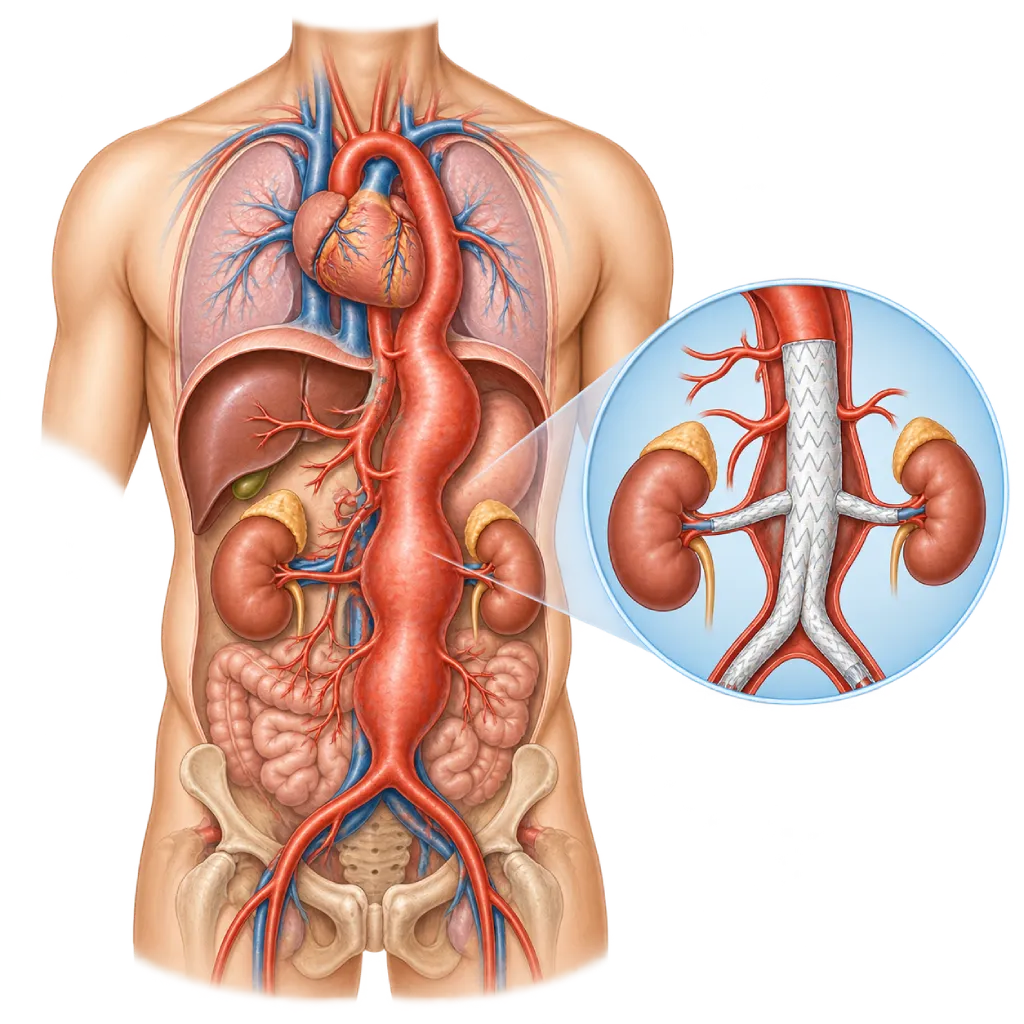
A thoracoabdominal aortic aneurysm is a widening of the aorta that extends from the chest to the abdomen and involves the branches to the intestines, kidneys, and spinal cord. This condition is rare, often causes no symptoms, and its treatment requires special planning.
SourcesSigns That Need Urgent Help
- Sudden, very severe pain in the back, chest, or abdomen
- Fainting, severe dizziness, or appearing confused
- Pale, cold, sweaty skin with a fast pulse
- Sudden weakness or numbness in both legs
- Severe shortness of breath that comes on suddenly
If these signs appear, go to the nearest emergency department right away or call Heart Attack Center 1500 258.
01 / Understanding the condition
About Thoracoabdominal Aortic Aneurysm
A thoracoabdominal aortic aneurysm is an aortic aneurysm that is not limited to one body cavity. Instead, it extends from the descending aorta in the chest, past the muscle that separates the chest from the abdomen (the diaphragm), to the aorta in the abdomen. Along this section, important arteries branch off to the liver, stomach, intestines, and both kidneys, along with small arteries that supply blood to the spinal cord. This is what makes treatment more complex than for an aneurysm that is only in the chest or only in the abdomen. This type of aneurysm is also less common than an abdominal aortic aneurysm. This condition belongs to the aortic aneurysm family, which is covered in general on the Aortic Aneurysm page.
Types by Length
Doctors divide thoracoabdominal aortic aneurysms into several types (the Crawford classification) according to the length of aorta involved, ranging from those that involve only the lower part of the chest aorta and the upper part of the abdominal aorta to those that cover almost the entire chest and abdominal aorta. These types help estimate the risk of treatment and choose the repair method.
Main Causes
The majority of thoracoabdominal aortic aneurysms are degenerative, meaning they are related to age, smoking, high blood pressure, and atherosclerosis. Others develop from an old tear in the aorta (chronic dissection) that gradually widens, so aortic dissection survivors need lifelong monitoring. Connective tissue disorders such as Marfan syndrome and Loeys-Dietz syndrome cause aneurysms to appear at a younger age.
Course and Treatment
Like other aortic aneurysms, this aneurysm usually grows slowly and is often found on a CT scan done for another reason. Small aneurysms are monitored with CT or MRI while controlling blood pressure and quitting smoking. Repair is generally considered when the diameter reaches about 5.5 to 6 cm, when it grows quickly, or when it causes symptoms. The options are open surgery through an incision in the chest and abdomen, a special stent graft made with branches or openings to maintain blood flow to the intestines and kidneys, or a combination of both.
Because the procedure is major, the decision is made by weighing the risk of rupture against the risk of the procedure, taking into account your age, the health of your heart, lungs, and kidneys, and your wishes. For some people, continued monitoring is the more appropriate choice.
02 / Understanding the condition
Symptoms to Recognize.
Common Symptoms
Many thoracoabdominal aortic aneurysms cause no symptoms. The following symptoms appear when the aneurysm enlarges or presses on the surrounding tissue.
- Deep, persistent pain in the back or flank
- Upper abdominal pain or a pulsing sensation in the abdomen
- Chest pain or pain between the shoulder blades
- Hoarseness, coughing, or shortness of breath from pressure in the chest
- Difficulty swallowing or feeling full quickly from pressure on the esophagus and stomach
03 / Understanding the condition
What Causes This Condition?
- Aging of the aortic wall, accelerated by smoking and high blood pressure
- Atherosclerosis along the chest and abdominal aorta
- An old tear in the aorta (chronic dissection) that gradually widens
- Inherited connective tissue disorders, such as Marfan syndrome or Loeys-Dietz syndrome
- Inflammation of the aortic wall, such as Takayasu arteritis
- Infection of the aortic wall, although this is rare
04 / Understanding the condition
Who Is at Higher Risk?
Lifestyle
Smoking, including a history of smoking for many years, damages the aortic wall and is associated with faster aneurysm growth.
Medical
High blood pressure, a history of aortic dissection, an aortic aneurysm elsewhere, chronic obstructive pulmonary disease, and chronic kidney disease.
Genetic
Marfan syndrome, Loeys-Dietz syndrome, vascular Ehlers-Danlos syndrome, and a history of aortic aneurysm or dissection in close family members.
Age
Degenerative aneurysms usually appear after age 60, while those related to inherited disorders or dissection can appear at a younger age.
Groups at Higher Risk
- Aortic Dissection Survivors: The part of the aorta that has torn can widen years later, so lifelong repeat imaging is needed.
- People with Marfan or Loeys-Dietz Syndrome: The aortic wall is more fragile from a young age, and aneurysms can form in several parts of the aorta.
- Older Smokers with Hypertension: The combination of age, smoking, and high blood pressure speeds up aging of the aortic wall.
- People with an Aortic Aneurysm Elsewhere: People with a chest or abdominal aortic aneurysm need an examination of the entire aorta, because the aneurysm can extend or appear in another part.
05 / Understanding the condition
How Is It Diagnosed?
A thoracoabdominal aortic aneurysm is usually found on a chest or abdominal CT scan done for another complaint, or during monitoring of a known aortic aneurysm or aortic dissection. CT angiography from the chest to the pelvis is the basis of the assessment: the doctor measures the width of the aneurysm, determines its type based on the length of aorta involved, and looks at where the branches to the intestines and kidneys are located. MRI can be used for periodic monitoring without X-rays.
If repair is being considered, the assessment is extended to the heart, lungs, and kidneys, because this procedure is major and places a strain on these organs. The results of all tests are discussed with the surgical team and the endovascular team to choose the approach that suits your condition.
Aortic CT angiography: a CT scan with contrast dye from the chest to the pelvis to measure the aneurysm, determine its type, and look at the branches to the intestines, kidneys, and spinal cord.
Aortic MRI or MR angiography: an option without X-rays for periodic monitoring, or when CT contrast is less suitable.
Aortic Angiography
Examination of the aorta and its branches using a catheter and contrast dye, usually during planning or placement of a stent graft.
Kidney Function Test
A blood test to assess kidney function before contrast is given and before repair, because this procedure can strain the kidneys.
Echocardiography
An ultrasound of the heart to assess pumping strength and the heart valves as part of assessing readiness for a major procedure.
Lung Function Test (Spirometry)
Assessing lung readiness, especially if open surgery through a chest incision is planned.
06 / Understanding the condition
Treatment Options.
Treatment is decided by a doctor after an assessment. The categories below can help you follow the conversation with your doctor.
Monitoring and Risk Control
Aneurysms that have not reached the size threshold are monitored with CT or MRI, along with blood pressure control and quitting smoking.
Open Surgery
The widened aorta is replaced with an artificial tube (graft) through an incision in the chest and abdomen, and the branches to the intestines, kidneys, and spinal cord are then reattached.
Branched or Fenestrated Stent Graft
A special stent graft with branches or openings (fenestrations) is placed from inside the blood vessel to maintain blood flow to the abdominal organs, if the shape of the aorta is suitable.
Hybrid Repair
A combination of surgery to reroute blood flow to the aortic branches and stent graft placement, for patients considered less suitable for full open surgery.
Spinal Cord Protection
Measures such as draining the fluid around the brain and spinal cord (cerebrospinal fluid) through a small tube and maintaining blood pressure are used to lower the risk of leg weakness.
07 / Understanding the condition
Complications to Watch For.
Aneurysm Rupture
Severe bleeding inside the chest or abdomen that requires emergency treatment.
Aortic Dissection
A new tear in the wall of the already widened aorta. Covered on the Aortic Dissection page.
Impaired Blood Flow to the Intestines and Kidneys
A clot or expansion of the aneurysm can disrupt the branches to the intestines and kidneys, reducing the function of these organs.
Leg Weakness After Repair
Blood flow to the spinal cord can decrease during or after repair, causing leg weakness. The team uses special protective measures to lower this risk.
Reduced Kidney Function After Repair
The kidneys can be affected by contrast dye or by reduced blood flow during the procedure, so their function is closely monitored.
08 / Understanding the condition
What Can You Do?
- Quit smoking and avoid cigarette smoke
- Control your blood pressure to the target set by your doctor
- Have regular CT or MRI scans if you have had an aortic dissection
- Close family members of people with an aortic aneurysm or dissection can ask about screening
- Avoid lifting very heavy weights and straining while holding your breath
09 / Understanding the condition
When Should You See a Doctor?
A thoracoabdominal aortic aneurysm often causes no symptoms, so regular monitoring is important for people with a history of aortic dissection or aortic aneurysm. Sudden, very severe pain in the back, chest, or abdomen, or sudden weakness in both legs, is an emergency sign: go to the nearest emergency room right away. Make an appointment if you:
- Have had an aortic dissection or a previous aortic repair
- Have been told that a CT scan shows a widened aorta in the chest or abdomen
- Have Marfan syndrome or Loeys-Dietz syndrome, or a family history of aneurysm
- Have deep, persistent pain in the back or upper abdomen with no clear cause
- Would like a second opinion about the repair options that have been recommended to you
Don't Wait in an Emergency.
If symptoms are severe or come on suddenly, go to the nearest emergency department right away or call Heart Attack Center 1500 258, rather than waiting for an appointment.
10 / Common questions
Questions You May Have.
Frequently asked questions about thoracoabdominal aortic aneurysm.
What is the difference between a thoracoabdominal aortic aneurysm and an abdominal aortic aneurysm?
An abdominal aortic aneurysm is usually limited to the abdomen, below the kidney arteries, so it can be repaired without disturbing the branches to the organs. A thoracoabdominal aortic aneurysm extends from the chest to the abdomen and involves the branches to the intestines, kidneys, and spinal cord. As a result, its repair is more extensive and requires additional steps to maintain blood flow to these organs. Abdominal aortic aneurysm is covered on the Abdominal Aortic Aneurysm page.
Why can repair of this aneurysm cause leg weakness?
Some of the small arteries that supply blood to the spinal cord branch off the aorta in the chest and abdomen. When this section is replaced or covered by a stent graft, blood flow to the spinal cord can decrease, causing the legs to become weak. To lower this risk, the team may place a small tube to drain the fluid around the brain and spinal cord, maintain blood pressure, and carry out the repair in stages. This risk is explained before the procedure.
At what size is a thoracoabdominal aortic aneurysm repaired?
Repair is generally considered when the diameter reaches about 5.5 to 6 cm, when it grows quickly, or when it causes symptoms. In connective tissue disorders or aneurysms caused by dissection, the threshold may be different. Because the procedure is major, the doctor also weighs your age, the function of your heart, lungs, and kidneys, and your wishes. For some people, continued monitoring is more appropriate than a procedure.
Can a stent graft be used for a thoracoabdominal aortic aneurysm?
Yes, in some patients. A special stent graft is made with branches or openings matched to the location of the arteries to the intestines and kidneys, then connected to each branch with small stents. This approach avoids large incisions in the chest and abdomen, but it requires a suitable aortic shape, planning time, and lifelong CT monitoring. The team will compare it with open surgery based on your condition.
What is recovery like after open surgery?
Open surgery for a thoracoabdominal aortic aneurysm is a major procedure. Patients usually stay in the intensive care unit for several days, then in a regular ward until they can walk and eat well. Full recovery at home can take several weeks to months, with gradual exercise. A rehabilitation program helps restore strength. After that, CT scans are still needed to monitor the rest of the aorta.
Do aortic dissection survivors need regular checkups?
Yes. The part of the aorta that has torn can slowly widen and become an aneurysm, including a thoracoabdominal aortic aneurysm. For this reason, dissection survivors have regular CT or MRI scans, usually more often in the first year and less often once stable. Strict blood pressure control also helps reduce the strain on the aortic wall. Your doctor will set your examination schedule based on your condition.
Sources and Medical Review
Translated from the Indonesian edition medically reviewed by dr. Suko Adiarto, Sp.JP(K), Ph.D..
Sources as cited in the Indonesian edition.
- Isselbacher EM, Preventza O, Hamilton Black J, et al. 2022 ACC/AHA Guideline for the Diagnosis and Management of Aortic Disease: A Report of the American Heart Association/American College of Cardiology Joint Committee on Clinical Practice Guidelines. Circulation. 2022;146(24):e334-e482.
- Czerny M, Grabenwöger M, Berger T, et al. EACTS/STS Guidelines for diagnosing and treating acute and chronic syndromes of the aortic organ. Eur J Cardiothorac Surg. 2024;65(2):ezad426.
- Mazzolai L, Teixido-Tura G, Lanzi S, et al. 2024 ESC Guidelines for the management of peripheral arterial and aortic diseases. Eur Heart J. 2024;45(36):3538-3700.
- Riambau V, Böckler D, Brunkwall J, et al. Management of Descending Thoracic Aorta Diseases: Clinical Practice Guidelines of the European Society for Vascular Surgery (ESVS). Eur J Vasc Endovasc Surg. 2017;53(1):4-52.
- Coselli JS, LeMaire SA, Preventza O, et al. Outcomes of 3309 thoracoabdominal aortic aneurysm repairs. J Thorac Cardiovasc Surg. 2016;151(5):1323-1338.
Doctors Who Treat This Condition

dr. Widya T. Suwatri, Sp.BTKV, Subsp. JD(K)
Adult Cardiac Surgery
Advanced Cardiovascular Surgical Care +1 center
Clinical focusMinimally Invasive Cardiac Surgery · Coronary Artery Bypass Surgery
View Profile
dr. Suko Adiarto, Sp.JP(K), Ph.D.
Interventional Cardiology
Vascular Diagnostic and Therapeutic Center +1 center
Clinical focusCoronary Intervention · Peripheral Vascular Intervention
View Profile
dr. Emanoel Oepangat, Sp.JP(K)
Interventional Cardiology
Vascular Diagnostic and Therapeutic Center +1 center
Clinical focusCoronary Intervention · Peripheral Vascular Intervention
View Profile