
Quick answer
What Is Unstable Angina?
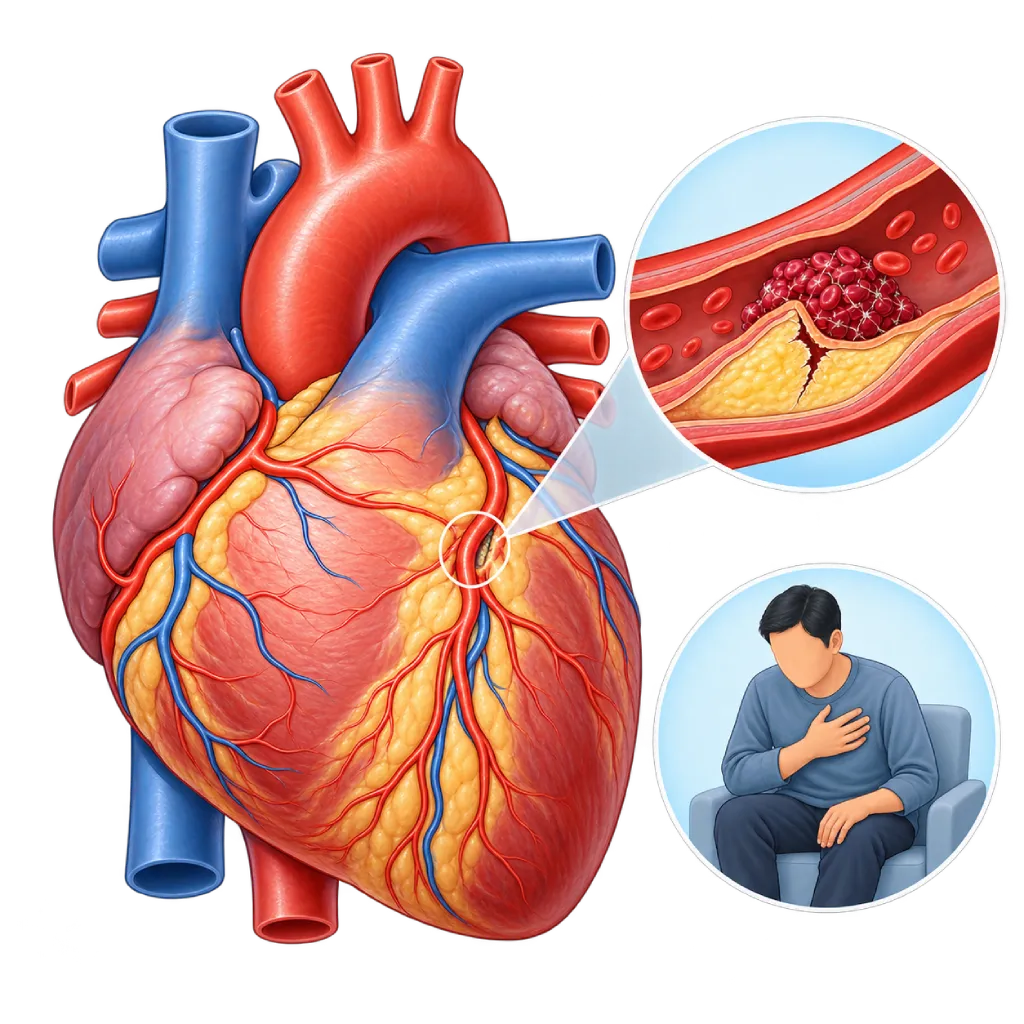
Unstable angina is chest pain that is new, becoming more frequent or severe, or occurring at rest, because blood flow in the coronary arteries suddenly decreases. It is a type of acute coronary syndrome and needs to be treated right away in the emergency room.
Sources01 / Understanding the condition
About Unstable Angina
Unstable angina is angina pectoris that appears without a clear trigger, feels new and severe, or changes pattern quickly. Doctors classify it as an acute coronary syndrome (ACS), together with heart attack. The difference is that in unstable angina, the troponin test shows no heart muscle damage, even though blood flow is being disrupted.
What Happens in the Coronary Arteries
Usually, a fatty plaque in the wall of a coronary artery cracks or wears away. The body responds by forming a blood clot on top of it. This clot narrows the flow but does not yet block it completely, or blocks it only briefly. If the clot grows, the blockage can become complete and turn into a heart attack. In a small number of people, the cause is a coronary artery spasm or a sharp rise in oxygen demand when a narrowing is already severe.
Three Patterns to Recognize
First, prolonged angina at rest. Second, angina that appears for the first time and immediately feels severe or limits light activity. Third, previously stable angina that becomes more frequent, lasts longer, or is triggered by lighter activity. Angina that returns within a few weeks after a heart attack also falls into this pattern. Angina with a fixed pattern is explained on the Stable Angina page.
Why Go to the Emergency Room
At home, unstable angina cannot be told apart from a heart attack. An ECG and repeated troponin tests in the emergency room determine whether the heart muscle has been damaged. With high-sensitivity troponin tests, more and more cases that used to be called unstable angina now turn out to be small heart attacks without ST-segment elevation, covered on the Non-ST-Elevation Myocardial Infarction (NSTEMI) page. Early treatment with clot-preventing medicines and, if needed, opening the coronary artery lowers the risk of a heart attack.
After the Acute Phase
Unstable angina is a sign that coronary disease is active. After you go home, long-term medicines, risk factor control, and cardiac rehabilitation help lower the risk of a repeat event. Many people can return to work and their usual activities after a period of recovery.
02 / Understanding the condition
Symptoms to Recognize.
Common Symptoms
- Pain, pressure, or heaviness in the chest at rest
- Chest pain that lasts longer than your usual angina
- Angina that is more frequent, lasts longer, or comes on with lighter activity
- New chest pain that feels severe right away
- Pain spreading to the arm, shoulder, neck, jaw, or back
- Shortness of breath, cold sweats, or nausea
- Pain that does not ease with rest or nitrate medicine
Symptoms in Adult Women
Chest pain is still the main complaint, but the following accompanying symptoms are more common and sometimes more prominent.
- Shortness of breath that comes on suddenly
- Nausea, vomiting, or discomfort in the pit of the stomach
- Unusual, severe tiredness
- Pain in the upper back, neck, jaw, or arm
- Palpitations or dizziness
Symptoms in Older Adults
In older adults, especially those who also have diabetes, symptoms can be vague, without clear chest pain.
- Sudden shortness of breath
- Severe weakness or fatigue that comes on suddenly
- Fainting or nearly fainting
- Sudden confusion or change in consciousness
- Discomfort in the upper abdomen
03 / Understanding the condition
What Causes This Condition?
- A plaque in a coronary artery that cracks or wears away and then triggers a blood clot
- A clot that suddenly narrows a coronary artery but has not fully blocked it
- Coronary artery spasm around a plaque that makes the narrowing worse
- Renarrowing or a clot inside a stent, covered on the Stent Thrombosis page.
- A sharp rise in oxygen demand when a narrowing is severe, for example from severe anemia, fever, or a very fast heart rate
04 / Understanding the condition
Who Is at Higher Risk?
Lifestyle
Smoking plays a major role in plaque rupture and clot formation. Physical inactivity, a diet high in saturated fat, and obesity add to the risk.
Medical
Known coronary artery disease, a history of stents or bypass surgery, diabetes, hypertension, high cholesterol, and chronic kidney disease.
Age
Risk rises after age 45 in men and after menopause in women. Older adults also more often come in with vague symptoms.
Other
Stopping antiplatelet medicines or statins without your doctor's advice, severe infection, severe emotional stress, and cocaine or amphetamine use can trigger an acute event.
Groups at Higher Risk
- People with Stable Angina: Angina that has been stable can become unstable, so any change in the pattern of symptoms needs attention.
- Patients After a Stent or Bypass: A clot or new narrowing can form in a stent, a graft, or other arteries, especially if antiplatelet medicines are stopped.
- People with Diabetes: Plaque tends to be more widespread and symptoms are sometimes vague, so help often comes late.
- Smokers: Smoking makes blood clot more easily and plaque crack more easily, which raises the risk of acute coronary syndrome.
05 / Understanding the condition
How Is It Diagnosed?
In the emergency room, an ECG is recorded within the first 10 minutes after you arrive and repeated if symptoms continue. Blood is drawn for a high-sensitivity cardiac troponin test on arrival and repeated 1 to 2 hours later, following the protocol recommended by the 2023 ESC guidelines. If the symptoms are typical of ischemia but troponin does not rise, the diagnosis is unstable angina. If troponin rises, the diagnosis is a heart attack without ST-segment elevation.
Echocardiography assesses wall motion and the heart's pumping, and also helps rule out other urgent causes of chest pain, such as a tear in the aorta or a blockage in the blood vessels of the lungs. The doctor then assesses your risk level based on your symptoms, ECG, troponin, and general condition. This assessment determines when coronary angiography is done: immediately at very high risk, within 24 hours at high risk, or based on the results of further tests at low risk. At low risk without recurring symptoms, CT coronary angiography or a stress test may be used first.
Electrocardiogram (ECG)
Recorded within 10 minutes of arriving at the emergency room and repeated, to look for ST-segment or T-wave changes and to tell it apart from STEMI.
Cardiac Troponin Test
Measured on arrival and repeated 1 to 2 hours later. Troponin that does not rise distinguishes unstable angina from a heart attack.
Echocardiography
Assesses wall motion and the heart's pumping, and helps rule out other causes of chest pain such as a tear in the aorta or fluid in the sac around the heart.
Coronary Angiography
Shows narrowed or clotted arteries and determines whether a stent or bypass is needed; its timing is based on the risk level.
CT Coronary Angiography
Can be used in low-risk patients with normal troponin to rule out severe narrowing without a catheter.
06 / Understanding the condition
Treatment Options.
Treatment is decided by a doctor after an assessment. The categories below can help you follow the conversation with your doctor.
Initial Care in the Emergency Room
Continuous heart rhythm monitoring, oxygen if your blood oxygen level is low, and medicines to relieve chest pain such as nitrates, as your doctor judges appropriate.
Antithrombotic Medicines
A combination of two antiplatelet medicines, aspirin and a P2Y12 inhibitor, plus an anticoagulant during the hospital stay to stop the clot from growing. Your doctor decides how long you take them, usually about 12 months.
Antianginal Medicines
Beta blockers and nitrates lower the heart's oxygen demand and relieve pain, adjusted to your blood pressure and heart rate.
Cholesterol-Lowering Medicines
Statins are started as early as possible during the hospital stay to lower LDL cholesterol and help stabilize plaque, with additional medicines if the target is not yet reached.
Angiography and Opening the Coronary Arteries
Most patients undergo coronary angiography, followed by stent placement (PCI) or bypass surgery if a narrowing that needs to be opened is found.
Secondary Prevention and Rehabilitation
After you go home, long-term medicines, quitting smoking, risk factor control, and cardiac rehabilitation lower the risk of a repeat event.
07 / Understanding the condition
Complications to Watch For.
Heart Attack
A growing clot can fully block the artery and damage the heart muscle. Covered on the Myocardial Infarction / Heart Attack page.
Heart Rhythm Disorders
Acute ischemia can trigger fast, irregular rhythms in the ventricles, so patients are watched on a monitor during their hospital stay.
Acute Heart Failure
A heart pump that is short of blood can weaken suddenly, so fluid builds up in the lungs. Covered on the Acute Heart Failure page.
Medicine-Related Bleeding
The clot-preventing medicines you need can cause bleeding. Your doctor weighs the benefits and risks, and you should report any unusual bleeding.
08 / Understanding the condition
What Can You Do?
- Know the signs of unstable angina and go to the emergency room right away if they appear
- Take antiplatelet medicines and statins as prescribed, and do not stop them without your doctor's advice
- Quit smoking completely, including e-cigarettes
- Keep your blood pressure, LDL cholesterol, and blood sugar at target
- Join a cardiac rehabilitation program after your hospital stay
- See your cardiologist regularly, especially if you have stable angina or a stent
- Get a flu vaccine every year as your doctor recommends
09 / Understanding the condition
When Should You See a Doctor?
Unstable angina is an emergency. Do not wait for symptoms to ease on their own, and do not wait for your next checkup. Call emergency services right away or have someone take you to the nearest emergency room if you have any of the following, and do not drive yourself. After you leave the hospital, see your cardiologist as scheduled to review your medicines and start rehabilitation.
- Pain, pressure, or heaviness in the chest at rest.
- Angina that is usually stable becomes more frequent, lasts longer, or is triggered by lighter activity.
- Severe new chest pain, especially with cold sweats, nausea, or shortness of breath.
- Pain that does not ease with rest or with your prescribed nitrate medicine.
10 / Common questions
Questions You May Have.
Frequently asked questions about unstable angina.
What is the difference between unstable angina and a heart attack?
Both are acute coronary syndromes, and both are caused by a sudden drop in coronary blood flow. In a heart attack, part of the heart muscle is already damaged, so troponin in the blood rises. In unstable angina, troponin does not rise. This difference can only be confirmed at the hospital, so both are treated as emergencies from the start.
Can I take aspirin on my own when I have chest pain?
The first step is to call emergency services or go to the emergency room right away, not to treat yourself. Aspirin should be given as directed by a health professional, because chest pain can be caused by other conditions such as a tear in the aorta, and aspirin is not suitable for people with certain allergies or bleeding problems. If your doctor has given you instructions beforehand, follow them.
Do all patients with unstable angina need a stent?
Not all of them. Most patients undergo coronary angiography to look for narrowing. If a narrowing that needs to be opened is found, the doctor may place a stent or recommend bypass surgery. In some low-risk patients, a test without a catheter or a stress test is done first. The decision is based on your risk level, test results, and overall condition.
How long does a hospital stay usually last?
The length of stay differs from person to person. Many patients stay a few days for heart rhythm monitoring, repeated troponin tests, coronary angiography, and medicine adjustments. If bypass surgery is needed or complications arise, the stay can be longer. Your doctor will explain the care plan and when you can safely go home.
Can unstable angina happen again?
Yes, because the underlying coronary disease is still there. You can lower the risk of a repeat event by taking antiplatelet medicines and statins as prescribed, quitting smoking, controlling blood pressure, cholesterol, and blood sugar, and joining cardiac rehabilitation. Know the warning signs and go to the emergency room right away if similar symptoms come back.
When can I return to my usual activities after unstable angina?
When you can return to work, driving, and exercise depends on your test results, the procedures you had, and your recovery. Many people can start light activity within a few days to weeks after going home. A cardiac rehabilitation program helps you increase activity gradually and safely. Ask your doctor about the right timeline for you.
Sources and Medical Review
Translated from the Indonesian edition medically reviewed by dr. Puti S. Saus, Sp.JP(K).
Sources as cited in the Indonesian edition.
- Byrne RA, Rossello X, Coughlan JJ, Barbato E, Berry C, Chieffo A, et al. 2023 ESC Guidelines for the management of acute coronary syndromes. Eur Heart J. 2023;44(38):3720-826.
- Rao SV, O'Donoghue ML, Ruel M, Rab T, Tamis-Holland JE, Alexander JH, et al. 2025 ACC/AHA/ACEP/NAEMSP/SCAI Guideline for the Management of Patients With Acute Coronary Syndromes: A Report of the American College of Cardiology/American Heart Association Joint Committee on Clinical Practice Guidelines. Circulation. 2025;151(13):e771-862.
- Thygesen K, Alpert JS, Jaffe AS, Chaitman BR, Bax JJ, Morrow DA, et al. Fourth Universal Definition of Myocardial Infarction (2018). Circulation. 2018;138(20):e618-51.
- Collet JP, Thiele H, Barbato E, Barthelemy O, Bauersachs J, Bhatt DL, et al. 2020 ESC Guidelines for the management of acute coronary syndromes in patients presenting without persistent ST-segment elevation. Eur Heart J. 2021;42(14):1289-367.
- Gulati M, Levy PD, Mukherjee D, Amsterdam E, Bhatt DL, Birtcher KK, et al. 2021 AHA/ACC/ASE/CHEST/SAEM/SCCT/SCMR Guideline for the Evaluation and Diagnosis of Chest Pain: A Report of the American College of Cardiology/American Heart Association Joint Committee on Clinical Practice Guidelines. Circulation. 2021;144(22):e368-454.
Doctors Who Treat This Condition

Dr. dr. Jajang Sinardja, Sp.JP(K)
Interventional Cardiology
Coronary Intervention Procedures
Clinical focusAcute Coronary Syndrome · Primary Coronary Intervention
View Profile
dr. Puti S. Saus, Sp.JP(K)
Interventional Cardiology
Coronary Intervention Procedures
Clinical focusAcute Coronary Syndrome · Primary Coronary Intervention
View Profile
dr. Siska S. Danny, Sp.JP(K)
Interventional Cardiology
Coronary Intervention Procedures
Clinical focusPCI for Acute Coronary Syndrome · Primary Coronary Intervention
View Profile