
Quick answer
What Is Cardiac Rehabilitation Phase I?
Cardiac rehabilitation Phase I is the initial stage of rehabilitation that starts while you are still hospitalized, once your condition is stable after a heart attack, stent placement, or heart surgery. It includes gradual exercises monitored by the team, from sitting to walking, education on medicines and warning signs, and preparation for discharge with referral to Phase II.
Sources01 / Understanding the procedure
About Cardiac Rehabilitation Phase I
What Is Cardiac Rehabilitation Phase I
Cardiac rehabilitation Phase I is the initial stage of a cardiac rehabilitation program, carried out while you are still in the hospital. This phase starts once your condition is stable, often within one to two days after a heart attack or stent placement, and after heart surgery as soon as your doctor allows. Its goal is to help you move again safely, understand your condition and its treatment, and be ready to continue your recovery after going home. This is covered on the Structured Cardiac Rehabilitation Program page.
How It Works in Brief
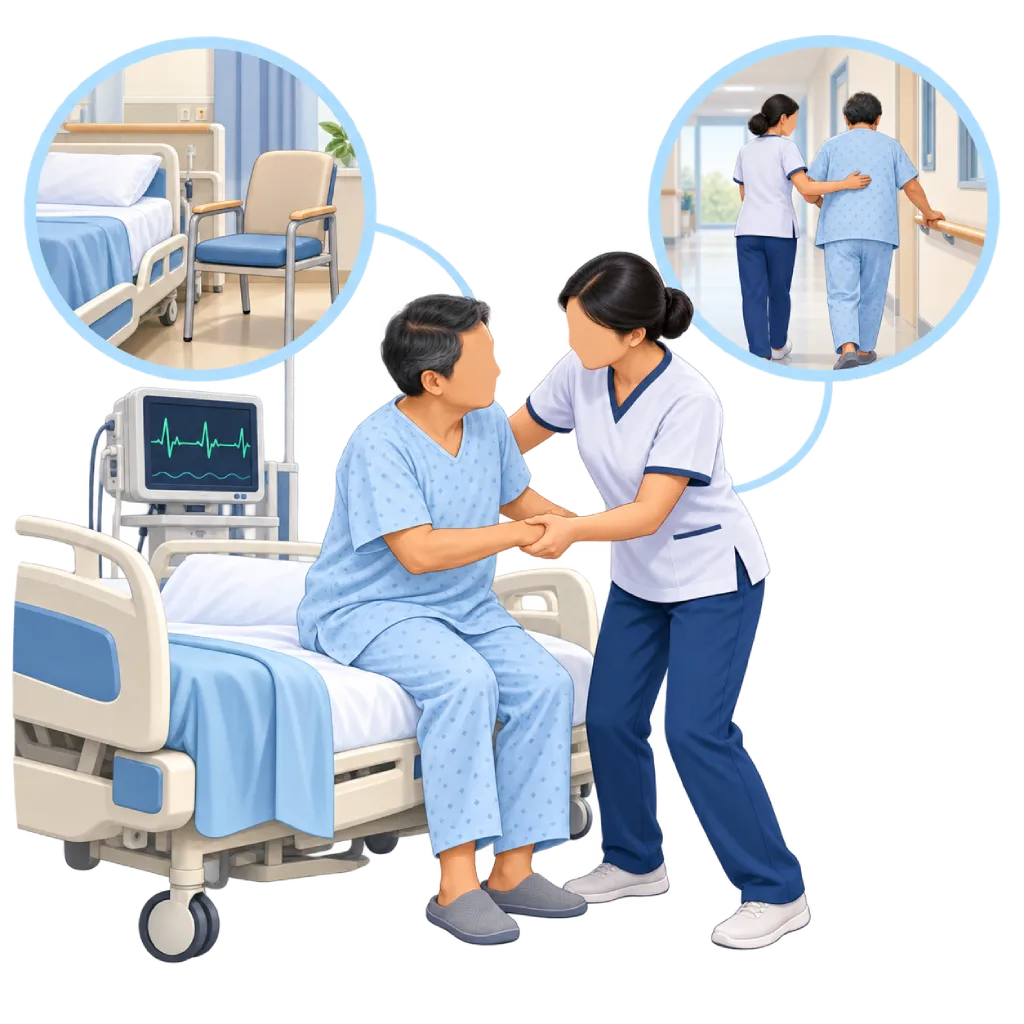
Lying in bed too long after a heart event can weaken the muscles, reduce fitness, and increase the risk of blood clots and lung problems. Early mobilization trains the body to become active again little by little: from sitting, standing, and walking in the room to walking in the hallway and climbing stairs. Each stage is increased if your pulse, blood pressure, heart rhythm, and symptoms remain good during and after exercise.
Components of Phase I
- Gradual mobilization: practice sitting, standing, and walking with monitoring, plus breathing exercises after heart surgery.
- Education: understanding your condition, how to take new medicines, warning signs, and how to use nitrates if prescribed.
- Risk factors: quitting smoking starts while you are in the hospital, along with an introduction to a heart-healthy diet. This is covered on the Lifestyle Counseling and Risk Management page.
- Preparing to go home: guidance on activities at home, for example bathing on your own, climbing stairs, and light housework, as well as a follow-up plan.
- Referral to Phase II: you are referred to an outpatient exercise program before going home. This is covered on the Cardiac Rehabilitation Phase II page.
After Heart Surgery
After open-heart surgery, breathing exercises and effective coughing help prevent lung problems. Arm movements and lifting are limited as advised by your doctor so the breastbone heals well.
02 / Understanding the procedure
When Is This Procedure Considered?
A doctor may consider this procedure in the situations below. The decision is always made after a thorough assessment.
- After a Heart AttackOnce your condition is stable, often within one to two days.
- After Stent PlacementMobilization can start sooner if the procedure went smoothly.
- After Bypass or Valve SurgeryStarted gradually once the surgeon allows it.
- Acute Heart Failure That Has StabilizedOnce breathlessness and fluid buildup are under control.
- Unstable Angina That Has Been TreatedOnce symptoms are under control and the procedure is complete.
- After a Heart Device ImplantSuch as a pacemaker or ICD, with temporary limits on arm movement.
Situations to Consider First
- Recurring Chest PainMobilization is postponed until symptoms are under control.
- Heart Failure That Is Not Yet StableFor example, shortness of breath at rest.
- Uncontrolled Rhythm DisturbancesThe heart rhythm needs to be stabilized beforehand.
- Blood Pressure Drop on StandingThe exercise stages are slowed down and done with assistance.
- Fever or New ComplicationsExercise is adjusted or postponed.
03 / Before the procedure
How Should You Prepare?
The care team on the ward helps you prepare.
Clothing and footwear. Wear comfortable clothing and non-slip footwear when you start walking.
Report symptoms. Tell the staff if you feel chest pain, shortness of breath, dizziness, or very tired before exercise.
Wound pain. After surgery, tell the staff if wound pain is bothering you so the exercise can be done comfortably.
Involve your family. Invite family members to join the education sessions so they can help you at home.
Unsure about the preparation instructions? Ask our team before the procedure.
04 / During the procedure
How Is the Procedure Done?
Each session usually lasts 15 to 30 minutes, once or twice a day during your hospital stay.
Initial Assessment
The team assesses your heart condition, test results, and ability to move to determine the starting stage of exercise.
Gradual Exercise
Exercise starts with light movements in bed and sitting, then standing, walking in the room, and walking in the hallway. Your pulse, blood pressure, and symptoms are checked before, during, and after exercise.
Education
Doctors, nurses, and the rehabilitation team explain your medicines, warning signs, diet, and activities that are safe at home.
Preparing to Go Home
Before you go home, the team assesses your ability to walk and, if needed, to climb stairs, gives you an activity plan for home, and schedules Phase II.
05 / Benefits and risks
Benefits and Risks Should Be Discussed Together.
Every medical procedure has benefits and risks. Your doctor will explain both for your situation before the procedure.
Benefits You Can Expect
- Moving Again SoonerPrevents muscle weakness from lying in bed too long.
- Better Prepared to Go HomeYou and your family know what you can and need to do.
- Understanding Medicines and Warning SignsHelps you act quickly if symptoms appear.
- Fewer Complications from Prolonged Bed RestSuch as blood clots and lung problems.
- A Bridge to Phase IIReferral before discharge helps rehabilitation continue.
The benefits of a procedure are not a promise of a cure. Ask how the results will affect your care plan.
Risks You Should Know
- Dizziness on StandingCaused by a drop in blood pressure; exercise is done slowly and with assistance.
- Heart Symptoms During MovementRare; exercise is stopped and you are assessed if warning signs appear.
- Surgical Wound PainManaged with pain relievers so exercise stays comfortable.
- Risk of FallingReduced with assistance and safe footwear.
Risks can differ from person to person. A full explanation and consent are given after an individual assessment.
06 / After the procedure
What Is Recovery Like?
After going home, continue your activities according to the team's plan until Phase II begins.
Light walking. Walk for a few minutes several times a day, then increase gradually.
Get enough rest. Balance activity with rest, and avoid strenuous activity until you are allowed.
Take your medicines on schedule. Do not stop any medicine without your doctor's approval.
After open-heart surgery. Avoid lifting heavy objects and driving until your doctor allows it.
Warning signs. Go to the emergency room right away if you have:
- Chest pain that does not ease with rest or nitrates
- Severe shortness of breath or breathlessness when lying down
- Fainting or a very fast heartbeat
- A surgical wound with pus, swelling, or fever
Know the Signs That Need Prompt Care.
Follow the team's guidance on warning signs. If severe or sudden symptoms appear after the procedure, go to the nearest emergency department right away or call Heart Attack Center 1500 258.
07 / Team and support
Doctors and Procedure Support
The doctors below are listed for this procedure. Listed by name, not by ranking.

dr. Ayu Amalia U. Putri, Sp.KFR
Physical Medicine & Rehabilitation
Clinical focusCardiac Rehabilitation · Postoperative Rehabilitation
View Profile
Dr. dr. Dafsah A. Juzar, Sp.JP(K)
Interventional Cardiology
Coronary Intervention Procedures +1 center
Clinical focusComplex Coronary Intervention · Cardiac Catheterization
View Profile
Dr. med. dr. Denio A. Ridjab, Sp.JP(K)
Interventional Cardiology
Coronary Intervention Procedures +2 centers
Clinical focusInterventional Cardiology · Coronary Artery Disease
View ProfileCardiovascular Intensive Care Unit (ICU)
An intensive care unit for heart and blood vessel patients who need close monitoring and prompt treatment, for example after…
The availability of technology and test support is confirmed with the team. Technology is chosen according to clinical need.
08 / Common questions
Before You Plan the Procedure.
Frequently asked questions about cardiac rehabilitation Phase I. Your exercise stages are decided together with your care team.
Why am I asked to move when I have only just been admitted?
Lying in bed too long actually weakens the muscles, makes you tire quickly, and increases the risk of blood clots and lung problems. Once your condition is stable, moving gradually under supervision is safe and helps your recovery. The team will assess your readiness before each exercise stage is increased.
What is the difference between Phase I and Phase II?
Phase I takes place while you are still in the hospital and focuses on moving again, education, and preparing to go home. Phase II starts after you go home as supervised outpatient exercise, usually two to three times a week for 8 to 12 weeks, to improve fitness gradually.
What can I do after going home?
In general, you can take light walks several times a day, bathe on your own, and do light housework, then increase your activity gradually. Strenuous activity, lifting, driving, and returning to work wait for your doctor's approval based on your condition and procedure. The team will give you an activity plan before you go home.
When can I resume sexual activity?
Usually once you can do light to moderate activity, such as brisk walking or climbing two flights of stairs, without symptoms. After an uncomplicated heart attack, this is often reached within a few weeks. After open-heart surgery, wait until your breastbone has healed enough. Erectile dysfunction medicines must not be combined with nitrates, so discuss this with your doctor beforehand.
Should my family be involved?
This is strongly recommended. Your family can help you move safely at home, manage your medicines, prepare heart-healthy meals, and recognize warning signs. Invite family members to join the education sessions during your hospital stay and at your next follow-up visit, so everyone at home understands your recovery plan.
Do I have to join Phase II?
It is strongly recommended. Cardiology guidelines recommend cardiac rehabilitation for patients after a heart attack, stent placement, or heart surgery, and with stable heart failure, because it has been shown to help lower the risk of recurrent events and hospital admissions. A referral is usually given before discharge so the program can start within a few weeks.
Sources and Medical Review
Translated from the Indonesian edition medically reviewed by dr. Ayu Amalia U. Putri, Sp.KFR.
Sources as cited in the Indonesian edition.
- Ambrosetti M, Abreu A, Corrà U, et al. Secondary prevention through comprehensive cardiovascular rehabilitation: From knowledge to implementation. 2020 update. A position paper from the Secondary Prevention and Rehabilitation Section of the European Association of Preventive Cardiology. Eur J Prev Cardiol. 2021;28(5):460-495.
- Byrne RA, Rossello X, Coughlan JJ, et al. 2023 ESC Guidelines for the management of acute coronary syndromes. Eur Heart J. 2023;44(38):3720-3826.
- Thomas RJ, Balady G, Banka G, et al. 2018 ACC/AHA Clinical Performance and Quality Measures for Cardiac Rehabilitation. J Am Coll Cardiol. 2018;71(16):1814-1837.
- Dibben G, Faulkner J, Oldridge N, et al. Exercise-based cardiac rehabilitation for coronary heart disease. Cochrane Database Syst Rev. 2021;11:CD001800.
- Levine GN, Steinke EE, Bakaeen FG, et al. Sexual Activity and Cardiovascular Disease: A Scientific Statement From the American Heart Association. Circulation. 2012;125(8):1058-1072.