
Quick answer
What Is Infiltrative Cardiomyopathy?
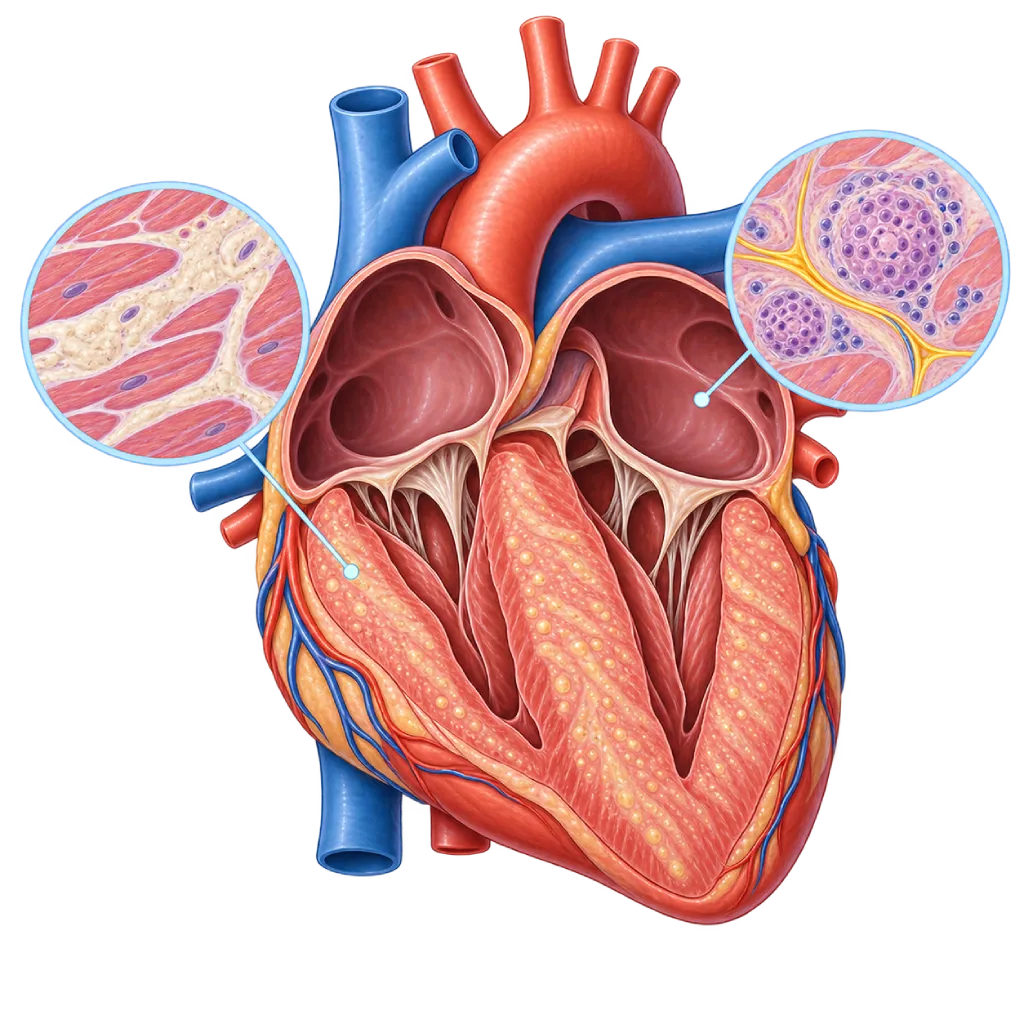
Infiltrative cardiomyopathy is a heart muscle disease caused by a buildup of abnormal substances or cells in the heart wall, such as amyloid, inflammatory cells in sarcoidosis, or iron, so the heart becomes thick or stiff and its electrical rhythm is disrupted.
SourcesSigns That Need Urgent Help
- Fainting or nearly fainting
- A very slow heartbeat with weakness or severe dizziness
- A very fast, pounding heartbeat with chest pain or shortness of breath
- Severe shortness of breath at rest or being unable to lie down
- Swelling that increases quickly all over the body
If these signs appear, go to the nearest emergency department right away or call Heart Attack Center 1500 258.
01 / Understanding the condition
About Infiltrative Cardiomyopathy
Infiltrative cardiomyopathy is a group of diseases in which substances or cells that do not belong there build up in the heart muscle. This buildup makes the heart walls look thickened, become stiff, and have difficulty relaxing to fill with blood. The heart's electrical system is often affected as well, so the heartbeat becomes slow or irregular. In the 2023 European Society of Cardiology (ESC) guidelines, this group is not a separate type of cardiomyopathy but is seen as a cause that can show the features of hypertrophic, restrictive, dilated, or non-dilated left ventricular cardiomyopathy.
Main Causes
Cardiac amyloidosis is caused by a buildup of amyloid protein. Its two main types are AL type, which comes from plasma cells in the bone marrow, and ATTR type, which comes from the protein transthyretin, either due to age or inheritance. Covered on the Cardiac Amyloidosis page. Cardiac sarcoidosis is caused by clusters of inflammatory cells (granulomas) in the heart muscle and often leads to heart block or ventricular rhythm disorders. Covered on the Cardiac Sarcoidosis page. Cardiac hemochromatosis is caused by iron overload, either from a gene defect or from repeated blood transfusions, as in thalassemia. Covered on the Cardiac Hemochromatosis page. Storage diseases such as Fabry disease and Danon disease are often discussed alongside them because they look similar, although the substance builds up inside the heart muscle cells.
Why It Is Often Recognized Late
The symptoms resemble ordinary heart failure: shortness of breath, swelling, and tiring easily. Several clues help doctors suspect this disease, for example thick heart walls in someone without severe hypertension, blood pressure that falls in someone who used to have hypertension, low ECG voltage that does not match the wall thickness, heart block without a clear cause before age 60, or carpal tunnel syndrome in both hands. Problems in other organs, such as the kidneys, nerves, skin, lungs, or liver, are also clues.
Treatment Based on the Cause
Treatment of infiltrative cardiomyopathy has two parts: addressing the cause and managing its effects on the heart. Examples include transthyretin stabilizers for ATTR amyloidosis, chemotherapy by a hematologist for AL amyloidosis, medicines that suppress inflammation for sarcoidosis, and regular blood removal (phlebotomy) or iron-binding medicines for iron overload. At the same time, your doctor treats heart failure, atrial fibrillation, and electrical conduction problems. Infiltrative cardiomyopathy belongs to the cardiomyopathy family covered on the Cardiomyopathy page.
02 / Understanding the condition
Symptoms to Recognize.
Common Symptoms
- Shortness of breath with less and less exertion over time
- Swelling in the feet, legs, or abdomen
- Tiring easily and a reduced ability to be active
- Dizziness or nearly fainting when standing up
- A heartbeat that feels slow, pounding, or irregular
- Falling blood pressure in someone who previously had hypertension
- Tingling or numbness in the hands and feet
Symptoms in Older Adults
Age-related (wild-type) ATTR amyloidosis is often found in men over 65 and is often mistaken for heart failure due to aging.
- Shortness of breath and swelling that do not improve with standard heart failure medicines
- A history of carpal tunnel syndrome in both hands
- Lower back and leg pain due to narrowing of the spinal canal
- Getting dizzy easily after taking blood pressure medicines
- A slow heartbeat or frequent near-fainting due to heart block
03 / Understanding the condition
What Causes This Condition?
- ATTR amyloidosis due to aging (wild-type) or an inherited change in the transthyretin gene
- AL amyloidosis due to a plasma cell disorder in the bone marrow
- Sarcoidosis, meaning clusters of inflammatory cells (granulomas) in the heart muscle
- Iron overload due to genetic hemochromatosis or repeated blood transfusions
- Storage diseases such as Fabry disease or Danon disease, which can look similar
- Less common causes, such as AA amyloidosis due to long-term inflammation or a buildup of eosinophil cells
04 / Understanding the condition
Who Is at Higher Risk?
Age
Age-related ATTR amyloidosis increases after age 65 and is more common in men. AL amyloidosis generally appears after age 50.
Genetic
Changes in the transthyretin gene can be inherited, as can hemochromatosis and Fabry disease. A family history of heart failure, peripheral nerve problems, or heart thickening should be shared with your doctor.
Medical
Plasma cell disorders such as monoclonal gammopathy or multiple myeloma, sarcoidosis of the lungs or skin, thalassemia with repeated transfusions, and long-term inflammatory diseases.
Groups at Higher Risk
- Older Men: Age-related ATTR amyloidosis is found more often in men over 65, often together with heart failure with preserved ejection fraction.
- People with Plasma Cell Disorders: Monoclonal gammopathy and multiple myeloma can produce proteins that deposit as AL amyloid in the heart.
- People with Thalassemia: Repeated blood transfusions build up iron in the heart, so regular iron level checks and T2* MRI are needed.
- People with Sarcoidosis: Sarcoidosis of the lungs or other organs can also affect the heart without symptoms, so heart screening is recommended.
- Family Members Carrying a Gene Change: Close relatives of people with hereditary ATTR amyloidosis, hemochromatosis, or Fabry disease can have genetic testing and monitoring.
05 / Understanding the condition
How Is It Diagnosed?
Diagnosis begins with suspicion. Your doctor connects heart symptoms with clues from other organs, family history, and the results of an ECG and echocardiography. Cardiac MRI helps assess the pattern of buildup and distinguish between causes. If amyloidosis is suspected, the first step is blood and urine tests to look for a monoclonal protein that marks AL type, followed by bone scintigraphy for ATTR type. When sarcoidosis is suspected, cardiac PET and a biopsy from a more easily reached organ, such as the lymph nodes in the chest, are often used. When iron overload is suspected, your doctor checks ferritin, transferrin saturation, and T2* MRI. A heart muscle biopsy is considered if other tests have not confirmed the diagnosis. Genetic testing is done when hereditary ATTR amyloidosis, hemochromatosis, or a storage disease is suspected.
Echocardiography
Shows thickened walls, enlarged atria, and impaired filling. Muscle deformation imaging (strain) can reveal a pattern typical of amyloidosis.
Cardiac MRI
Assesses the pattern of scar tissue and buildup. Certain patterns point to amyloidosis or sarcoidosis, and the T2* technique is used to measure iron levels in the heart muscle.
Bone Scintigraphy (Bone Scan)
A nuclear medicine test that can confirm ATTR amyloidosis without a biopsy, if blood and urine tests show no monoclonal protein.
Cardiac PET Scan
FDG PET assesses active inflammation in cardiac sarcoidosis and is used to monitor the response to treatment.
Laboratory Tests
Free light chain tests, blood and urine protein electrophoresis, ferritin and transferrin saturation, as well as NT-proBNP and troponin.
Endomyocardial Biopsy
Taking a small sample of heart muscle through a catheter when the diagnosis is not certain from tests that do not require an incision.
Electrocardiogram (ECG)
Looks for low voltage, conduction problems, heart block, and rhythm disorders that often accompany this disease.
06 / Understanding the condition
Treatment Options.
Treatment is decided by a doctor after an assessment. The categories below can help you follow the conversation with your doctor.
Specific Treatment for Amyloidosis
Transthyretin stabilizers or medicines that suppress transthyretin production for ATTR type, and chemotherapy by a hematologist for AL type.
Anti-Inflammatory Medicines for Sarcoidosis
Corticosteroids and other immunosuppressive medicines are used to calm the inflammation, with regular PET monitoring.
Reducing Iron Overload
Regular phlebotomy in genetic hemochromatosis, or iron-binding medicines (chelation) for iron overload caused by transfusions.
Heart Failure Treatment
Diuretics to reduce shortness of breath and swelling. Some common heart failure medicines need to be adjusted by your doctor because they can lower blood pressure too much in amyloidosis.
Pacemakers and ICDs
A pacemaker for heart block, and an ICD for patients at risk of dangerous ventricular rhythm disorders, for example in sarcoidosis.
Blood Thinners
Recommended in cardiac amyloidosis with atrial fibrillation, regardless of the usual stroke risk scores.
Heart Transplant
Considered in selected patients with advanced heart failure once the underlying disease is under control.
07 / Understanding the condition
Complications to Watch For.
Heart Failure
Stiff walls make it hard for the heart to fill with blood, so fluid builds up. This type of heart failure often occurs with a preserved ejection fraction.
Heart Block and Conduction Disorders
Buildup in the heart's electrical system can slow or interrupt conduction, so the heartbeat becomes too slow and sometimes needs a pacemaker.
Ventricular Rhythm Disorders
Especially in sarcoidosis, inflamed and scarred tissue can trigger ventricular tachycardia, so an ICD is sometimes needed.
Atrial Fibrillation and Blood Clots
Enlarged, stiff atria make atrial fibrillation and clot formation more likely. In amyloidosis, clots can form in the atria even when the rhythm appears regular.
Problems in Other Organs
The underlying disease often also affects the kidneys, nerves, liver, or lungs, so treatment involves several specialists.
08 / Understanding the condition
What Can You Do?
- Tell your doctor about any family history of amyloidosis, hemochromatosis, or Fabry disease
- If you are diagnosed with monoclonal gammopathy, have routine monitoring with a hematologist
- If you have thalassemia with repeated transfusions, have iron level checks and cardiac MRI as scheduled
- If you have sarcoidosis in another organ, ask whether you need heart tests
- Weigh yourself every day to spot fluid buildup early
- Tell your doctor about your diagnosis before starting any new heart or blood pressure medicine
- Do not take iron supplements if you have iron overload, unless your doctor advises it
09 / Understanding the condition
When Should You See a Doctor?
See a cardiologist if the following symptoms appear, especially if they come with problems in other organs. If you faint, your heartbeat feels very slow, or you have severe shortness of breath at rest, go to the emergency room right away.
- Shortness of breath, swelling, or tiredness that does not improve with heart failure treatment
- Dizziness when standing up or a drop in blood pressure without a clear cause
- A slow heartbeat, palpitations, or nearly fainting
- Carpal tunnel syndrome in both hands along with heart symptoms
- A diagnosis of monoclonal gammopathy, myeloma, sarcoidosis, or thalassemia
- Family members with ATTR amyloidosis, hemochromatosis, or Fabry disease
Don't Wait in an Emergency.
If symptoms are severe or come on suddenly, go to the nearest emergency department right away or call Heart Attack Center 1500 258, rather than waiting for an appointment.
10 / Common questions
Questions You May Have.
Frequently asked questions about infiltrative cardiomyopathy.
What is the difference between infiltrative cardiomyopathy and cardiac amyloidosis?
Infiltrative cardiomyopathy is the name of a group, while cardiac amyloidosis is one of the causes within it, along with cardiac sarcoidosis and cardiac hemochromatosis. Each cause has a different approach to diagnosis and treatment. For this reason, once infiltrative cardiomyopathy is suspected, the next step is to confirm the cause. Cardiac amyloidosis is covered in more detail on the Cardiac Amyloidosis page.
Can infiltrative cardiomyopathy be treated?
It can be controlled, and some causes have specific treatments. A transthyretin stabilizer was shown to reduce deaths and hospital stays in ATTR amyloidosis in the ATTR-ACT study. AL amyloidosis is treated with chemotherapy by a hematologist. Sarcoidosis is treated with medicines that suppress inflammation, and iron overload with phlebotomy or chelation medicines. Results tend to be better when treatment starts before the heart damage is advanced.
Why is my doctor also checking my kidneys, nerves, or skin?
The causes of infiltrative cardiomyopathy often affect several organs at once. Amyloidosis can affect the kidneys and nerves, sarcoidosis often affects the lungs, skin, and eyes, and iron overload can affect the liver and hormone glands. Findings in other organs help your doctor confirm the cause, and sometimes a biopsy of those organs is easier than a heart biopsy. For this reason, care often involves several specialists.
Does this disease run in families?
Some forms do. Hereditary ATTR amyloidosis, genetic hemochromatosis, and Fabry disease are passed down through genes. In contrast, age-related ATTR amyloidosis, AL amyloidosis, and sarcoidosis are generally not directly inherited. If the cause in your case is genetic, your doctor may recommend genetic counseling and testing for close relatives so monitoring can start earlier.
Why are some heart medicines used with caution?
In cardiac amyloidosis, the stiff heart chambers make blood flow depend heavily on heart rate and filling pressure. Some medicines commonly used for heart failure or blood pressure can lower blood pressure too much or slow the heart rate. For this reason, your doctor chooses and adjusts medicines carefully. Do not stop or add medicines on your own, and tell your doctor if you often feel dizzy after taking your medicines.
Do I need a pacemaker?
Not every patient needs one. A pacemaker is implanted when the buildup damages the heart's electrical system, causing heart block or a heartbeat that is too slow. In cardiac sarcoidosis with a risk of ventricular rhythm disorders, your doctor may choose an ICD, which also works as a pacemaker. This need is assessed from the ECG, rhythm recordings, and heart imaging results.
Sources and Medical Review
Translated from the Indonesian edition medically reviewed by Dr. med. dr. Denio A. Ridjab, Sp.JP(K).
Sources as cited in the Indonesian edition.
- Arbelo E, Protonotarios A, Gimeno JR, Arbustini E, Barriales-Villa R, Basso C, et al. 2023 ESC Guidelines for the management of cardiomyopathies. Eur Heart J. 2023;44(37):3503-626.
- Pereira NL, Grogan M, Dec GW. Spectrum of Restrictive and Infiltrative Cardiomyopathies: Part 1 of a 2-Part Series. J Am Coll Cardiol. 2018;71(10):1130-48.
- Garcia-Pavia P, Rapezzi C, Adler Y, Arad M, Basso C, Brucato A, et al. Diagnosis and treatment of cardiac amyloidosis: a position statement of the ESC Working Group on Myocardial and Pericardial Diseases. Eur Heart J. 2021;42(16):1554-68.
- Kittleson MM, Ruberg FL, Ambardekar AV, Brannagan TH, Cheng RK, Clarke JO, et al. 2023 ACC Expert Consensus Decision Pathway on Comprehensive Multidisciplinary Care for the Patient With Cardiac Amyloidosis: A Report of the American College of Cardiology Solution Set Oversight Committee. J Am Coll Cardiol. 2023;81(11):1076-126.
- Cheng RK, Kittleson MM, Beavers CJ, Birnie DH, Blankstein R, Bravo PE, et al. Diagnosis and Management of Cardiac Sarcoidosis: A Scientific Statement From the American Heart Association. Circulation. 2024;149(21):e1197-216.
- Kremastinos DT, Farmakis D. Iron overload cardiomyopathy in clinical practice. Circulation. 2011;124(20):2253-63.
- Maurer MS, Schwartz JH, Gundapaneni B, Elliott PM, Merlini G, Waddington-Cruz M, et al. Tafamidis Treatment for Patients with Transthyretin Amyloid Cardiomyopathy. N Engl J Med. 2018;379(11):1007-16.
Doctors Who Treat This Condition

dr. BRM Ario S. Kuncoro, Sp.JP(K)
Echocardiography & Cardiovascular Imaging
Cardiovascular Diagnostic Center +2 centers
Clinical focusAdvanced and 3D Echocardiography · Transesophageal Echocardiography
View Profile
Dr. med. dr. Denio A. Ridjab, Sp.JP(K)
Interventional Cardiology
Coronary Intervention Procedures +2 centers
Clinical focusInterventional Cardiology · Coronary Artery Disease
View Profile
dr. Sunu B. Raharjo, Sp.JP(K), Ph.D.
Arrhythmia and Electrophysiology
Arrhythmia and Device Center
Clinical focusClinical and Interventional Electrophysiology · Cardiac Arrhythmia Ablation
View Profile