
Quick answer
What Is Takotsubo Cardiomyopathy?
Takotsubo cardiomyopathy is a sudden weakening of part of the muscle of the heart's left ventricle, often after severe emotional or physical stress. Its symptoms resemble a heart attack, so it needs to be checked in the emergency room right away.
Sources01 / Understanding the condition
About Takotsubo Cardiomyopathy
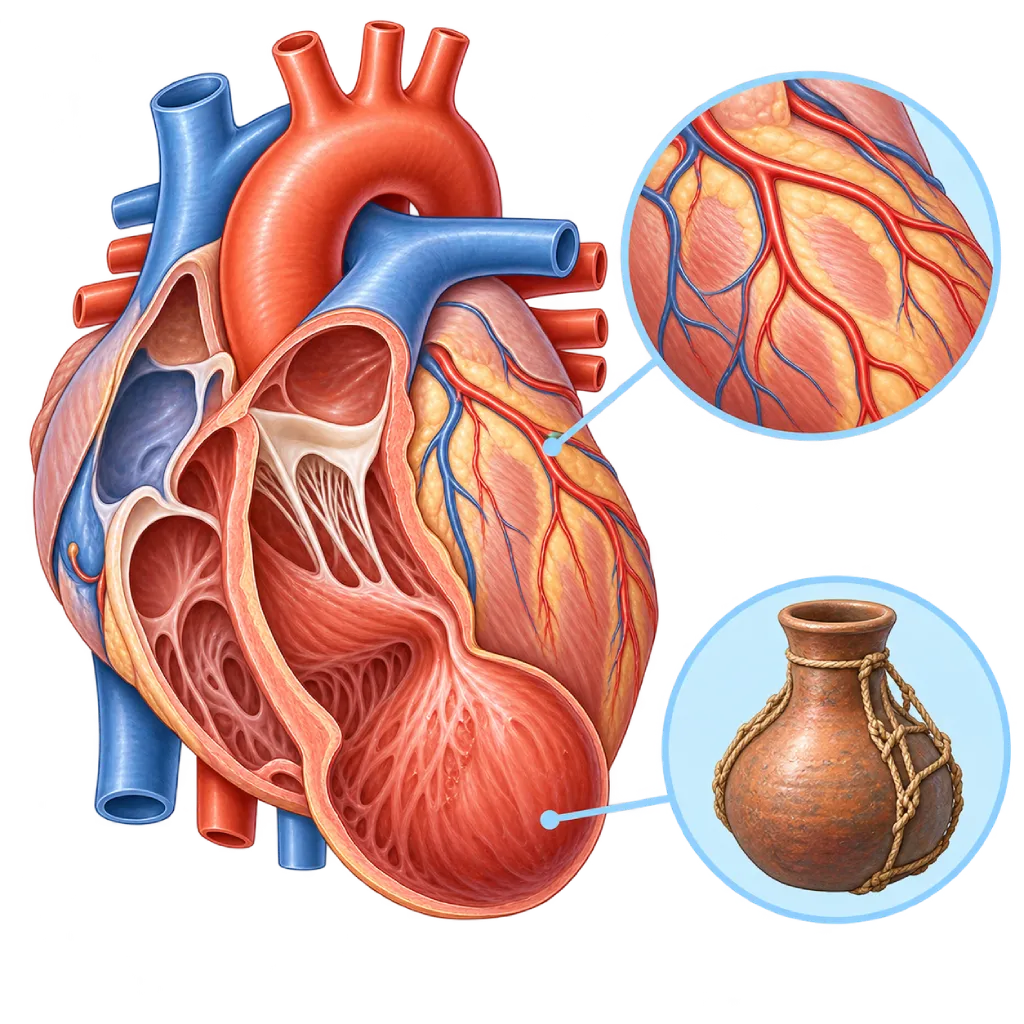
Takotsubo cardiomyopathy, also called takotsubo syndrome, stress cardiomyopathy, or broken heart syndrome, is a temporary problem with the muscle of the heart's left ventricle. Part of the ventricle wall suddenly stops contracting, while other parts work harder. In the usual pattern, the tip of the left ventricle balloons out so that its shape resembles a takotsubo, a traditional Japanese pot used to catch octopus.
Similar to a Heart Attack
The main symptoms are chest pain and shortness of breath that come on suddenly. ECG recordings and troponin blood tests often show changes like those of a heart attack. The difference is that the coronary arteries are not blocked to an extent that matches the area of affected muscle. Therefore, any sudden chest pain is still treated as a possible heart attack until a doctor confirms the cause. Heart attacks are covered on the Myocardial Infarction / Heart Attack page.
Triggers and Who Is Affected
About 90 percent of patients are women, most of them after menopause. The trigger can be emotional stress, such as losing a loved one, an argument, or shocking news, or physical stress, such as a severe infection, surgery, an asthma attack, a stroke, or a broken bone. In men, physical triggers are more common. In more than a quarter of patients, no trigger is found.
The mechanism is thought to involve a surge of stress hormones (catecholamines) that disrupts the heart muscle and its small blood vessels. This condition does not mean your symptoms are only in your mind: the heart muscle truly weakens and needs treatment.
Treatment Approach
There is no specific medicine that cures this condition. Treatment aims to keep you stable until the heart muscle recovers: monitoring heart rhythm and blood pressure, relieving fluid buildup, preventing or treating blood clots, and managing shock with carefully chosen medicines. After you go home, follow-up visits and cardiac rehabilitation help you return to your activities.
Usually Recovers, but Needs Monitoring
Pumping function usually recovers within a few days to a few weeks. Even so, acute heart failure, rhythm disturbances, a blood clot in the left ventricle, or cardiogenic shock can occur in the early phase, with in-hospital complication rates similar to those of a heart attack. The condition can also come back in a small number of patients, so follow-up after you go home remains important. An overview of this family of diseases is covered on the Cardiomyopathy page.
02 / Understanding the condition
Symptoms to Recognize.
Common Symptoms
Symptoms come on suddenly, often within minutes to hours after a highly stressful event.
- Sudden chest pain that feels like pressure or squeezing
- Pain spreading to the arm, neck, jaw, or back
- Shortness of breath that comes on suddenly
- Cold sweats, nausea, or vomiting
- Palpitations (a pounding or racing heartbeat)
- Dizziness, weakness, or nearly fainting
03 / Understanding the condition
What Causes This Condition?
- A surge of stress hormones (catecholamines) that temporarily disrupts the heart muscle
- Problems in the heart's small blood vessels and blood vessel spasm
- Severe emotional stress, such as grief, an argument, fear, or shocking news
- Physical stress, such as a severe infection, surgery, an asthma attack, severe pain, or injury
- Acute neurological illness, such as stroke, bleeding in the brain, or seizures
- Medicines or substances that raise stress hormones, including illicit stimulant drugs
04 / Understanding the condition
Who Is at Higher Risk?
Age
Most patients are over 50 years old, especially women after menopause. The condition is rare in young people and children, but it can occur.
Medical
Anxiety disorders, depression, neurological diseases such as stroke or epilepsy, lung disease, and severe acute illness are found more often in people with takotsubo cardiomyopathy.
Other
A severe emotional or physical event can be a trigger, although more than a quarter of patients have no clear trigger. Men more often develop it after physical stress.
Groups at Higher Risk
- Women After Menopause: About nine in ten patients are women, most of them after menopause, which is thought to be due to reduced protection from the hormone estrogen.
- People with Anxiety Disorders or Depression: Mental health disorders and prolonged stress are found more often in patients, so mental health support is part of recovery.
- Patients with Severe Acute Illness: A severe infection, major surgery, an asthma attack, or a stroke can trigger this condition during a hospital stay.
- People Who Have Had Takotsubo: A small number of patients can have a recurrence, sometimes years after the first episode.
05 / Understanding the condition
How Is It Diagnosed?
Because the symptoms are the same as those of a heart attack, testing begins as it would for a heart attack: an immediate ECG, a troponin test, and a check of vital signs. Echocardiography shows the typical pattern of abnormal left ventricular wall motion and also looks for blood clots, mitral valve leakage, and obstruction of the left ventricular outflow.
Coronary angiography is generally needed to confirm that no coronary artery blockage explains the symptoms. During this procedure, the doctor can take images of the left ventricle to see its characteristic shape. Cardiac MRI helps distinguish takotsubo cardiomyopathy from myocarditis and heart attack, because this condition usually shows muscle swelling without scar tissue. A repeat test showing that left ventricular function has recovered strengthens the diagnosis. Other conditions with similar symptoms but no coronary blockage are covered on the Myocardial Infarction with Non-Obstructive Coronary Arteries (MINOCA) page.
Electrocardiogram (ECG)
Done immediately on arrival. The changes often resemble a heart attack, including QT interval prolongation that needs to be monitored.
Cardiac Troponin Test
Usually mildly to moderately raised, often not in proportion to the area of heart muscle affected.
Echocardiography
Shows the pattern of abnormal left ventricular movement, pumping strength, blood clots, mitral valve leakage, and left ventricular outflow obstruction.
Coronary Angiography
Confirms there is no coronary blockage that explains the symptoms. Images of the left ventricle taken during the procedure can show its characteristic shape.
Cardiac MRI
Distinguishes it from myocarditis and heart attack by assessing swelling of the heart muscle and whether scar tissue is present.
NT-proBNP and BNP Test
Levels are often quite high and help assess how much strain the heart is under.
06 / Understanding the condition
Treatment Options.
Treatment is decided by a doctor after an assessment. The categories below can help you follow the conversation with your doctor.
Hospital Care and Monitoring
In the early phase, patients are cared for with heart rhythm and blood pressure monitoring until their condition is stable and complications have been ruled out.
Heart Failure Medicines
Diuretics and other heart failure medicines are given if there is fluid buildup. ACE inhibitors or ARBs may be continued after you go home, based on your doctor's assessment.
Treatment of Shock and Outflow Obstruction
Doctors choose medicines and fluids carefully, avoid catecholamine-type heart-strengthening drugs if there is an obstruction, and, if needed, use a temporary circulatory support device.
Blood Thinners
Given if a clot is found in the left ventricle, and may be considered if the motionless part of the ventricle is fairly large.
Avoiding QT-Prolonging Medicines
While the QT interval is still long, doctors avoid medicines that can lengthen it further, to prevent rhythm disturbances.
Recovery and Psychological Support
Gradual cardiac rehabilitation and mental health support help you return to your activities and manage stress that may have been a trigger.
07 / Understanding the condition
Complications to Watch For.
Acute Heart Failure
A suddenly weakened pump can cause fluid to build up in the lungs and severe shortness of breath. Covered on the Acute Heart Failure page.
Cardiogenic Shock
Blood pressure drops because the heart does not pump enough blood. Treatment needs care because some heart-strengthening medicines can make things worse.
Rhythm Disturbances and QT Prolongation
QT interval prolongation and fast rhythms from the heart's lower chambers can occur in the early phase, so the heart rhythm is monitored continuously during the hospital stay.
Blood Clot in the Left Ventricle
The motionless tip of the ventricle can form a clot that may travel to the brain and cause a stroke.
Left Ventricular Outflow Obstruction
The base of the ventricle, contracting strongly, can narrow the path blood takes out of the heart, lower blood pressure, and require specific treatment.
Recurrence
A small number of patients experience this condition again, sometimes years later, with the same or a different trigger.
08 / Understanding the condition
What Can You Do?
- Treat sudden chest pain as an emergency and go to the emergency room right away
- Attend follow-up echocardiography to make sure pumping function has recovered
- Manage stress with support from family, a counselor, or a psychologist
- Talk to a mental health professional about anxiety or depression
- Take your medicines as prescribed and ask your doctor before stopping them
- Return to your activities gradually as your doctor advises
- Tell your doctor about your history of takotsubo before surgery or when you are given a new medicine
09 / Understanding the condition
When Should You See a Doctor?
Sudden chest pain should be treated as an emergency until a doctor confirms the cause, even if you suspect it is due to stress. After your hospital stay, keep your follow-up appointments to make sure your heart function recovers. Call emergency services or go to the emergency room right away if you notice the following signs, and do not drive yourself:
- Chest pain that lasts more than a few minutes, feels like pressure, or spreads to the arm, neck, or jaw
- Sudden shortness of breath or a cough with frothy sputum
- Fainting, severe dizziness, or cold sweats
- A very fast or irregular heartbeat
- Shortness of breath, swelling, or chest pain that returns after you leave the hospital
10 / Common questions
Questions You May Have.
Frequently asked questions about takotsubo cardiomyopathy.
Is takotsubo cardiomyopathy the same as a heart attack?
No, but the two are hard to tell apart at first. In a heart attack, a coronary artery is blocked, so part of the heart muscle is permanently damaged. In takotsubo cardiomyopathy, the muscle weakens temporarily without a matching coronary blockage. Both cause chest pain, ECG changes, and a rise in troponin, so tests in the hospital, including coronary angiography, are needed to confirm which it is.
Why is it called broken heart syndrome?
Many reported cases appeared after deep grief, such as losing a spouse or family member, which gave rise to the name broken heart syndrome. However, the trigger is not only sadness. Physical stress such as a severe infection or surgery is also a common trigger, and even surprising happy news has been reported as a trigger. Some patients have no clear trigger.
Can my heart recover completely?
In most patients, pumping strength returns to normal within a few days to a few weeks. However, some patients still tire easily, feel short of breath, or have chest pain for months, and research shows the long-term risk is not as low as once thought. That is why follow-up echocardiography and control of heart risk factors remain important even after the pump has recovered.
Can this condition come back?
Yes, although it is uncommon. A small number of patients have a recurrence, sometimes years after the first episode. No medicine has yet been proven to prevent recurrence. Managing stress, treating anxiety or depression, and regular follow-up are the recommended steps. If chest pain or shortness of breath returns, still go to the emergency room right away, because the cause needs to be checked again.
What should I do after leaving the hospital?
Take your medicines as prescribed, keep your follow-up appointments, and have a repeat echocardiogram to make sure your pump has recovered. Return to activity gradually, ideally through a cardiac rehabilitation program. Also talk about any stress or difficult events you have been through with your family or a mental health professional. Go to the emergency room right away if chest pain, severe shortness of breath, fainting, or signs of stroke appear.
Can men get it too?
Yes. About one in ten patients is a man. In men, this condition is more often triggered by physical stress such as serious illness or surgery, and in-hospital complication rates tend to be higher. That is why sudden chest pain in men and women alike, with or without a stressful trigger, still needs to be checked right away.
Sources and Medical Review
Translated from the Indonesian edition medically reviewed by dr. BRM Ario S. Kuncoro, Sp.JP(K).
Sources as cited in the Indonesian edition.
- Ghadri JR, Wittstein IS, Prasad A, Sharkey S, Dote K, Akashi YJ, et al. International expert consensus document on Takotsubo syndrome (part I): clinical characteristics, diagnostic criteria, and pathophysiology. Eur Heart J. 2018;39(22):2032-2046.
- Ghadri JR, Wittstein IS, Prasad A, Sharkey S, Dote K, Akashi YJ, et al. International expert consensus document on Takotsubo syndrome (part II): diagnostic workup, outcome, and management. Eur Heart J. 2018;39(22):2047-2062.
- Templin C, Ghadri JR, Diekmann J, Napp LC, Bataiosu DR, Jaguszewski M, et al. Clinical features and outcomes of Takotsubo (stress) cardiomyopathy. N Engl J Med. 2015;373(10):929-938.
- Lyon AR, Bossone E, Schneider B, Sechtem U, Citro R, Underwood SR, et al. Current state of knowledge on Takotsubo syndrome: a position statement from the Taskforce on Takotsubo Syndrome of the Heart Failure Association of the European Society of Cardiology. Eur J Heart Fail. 2016;18(1):8-27.
- Byrne RA, Rossello X, Coughlan JJ, Barbato E, Berry C, Chieffo A, et al. 2023 ESC Guidelines for the management of acute coronary syndromes. Eur Heart J. 2023;44(38):3720-3826.
- Singh T, Khan H, Gamble DT, Scally C, Newby DE, Dawson D. Takotsubo syndrome: pathophysiology, emerging concepts, and clinical implications. Circulation. 2022;145(13):1002-1019.
Doctors Who Treat This Condition

Dr. dr. Dafsah A. Juzar, Sp.JP(K)
Interventional Cardiology
Coronary Intervention Procedures +1 center
Clinical focusComplex Coronary Intervention · Cardiac Catheterization
View Profile
Dr. med. dr. Denio A. Ridjab, Sp.JP(K)
Interventional Cardiology
Coronary Intervention Procedures +2 centers
Clinical focusInterventional Cardiology · Coronary Artery Disease
View Profile
dr. BRM Ario S. Kuncoro, Sp.JP(K)
Echocardiography & Cardiovascular Imaging
Cardiovascular Diagnostic Center +2 centers
Clinical focusAdvanced and 3D Echocardiography · Transesophageal Echocardiography
View Profile