
Quick answer
What Is Patent Foramen Ovale?
A patent foramen ovale is a small, flap-like opening in the wall between the heart's upper chambers that does not close after birth. About one in four people have it, and it is usually harmless.
SourcesSigns That Need Urgent Help
- Sudden facial drooping or unevenness
- Weakness or numbness of an arm or leg on one side of the body
- Slurred speech, difficulty speaking, or difficulty understanding speech
- Sudden blurred or lost vision
- Severe spinning dizziness with difficulty walking or poor balance
- Severe shortness of breath and bluish lips that worsen when sitting or standing
If these signs appear, go to the nearest emergency department right away or call Heart Attack Center 1500 258.
01 / Understanding the condition
About Patent Foramen Ovale
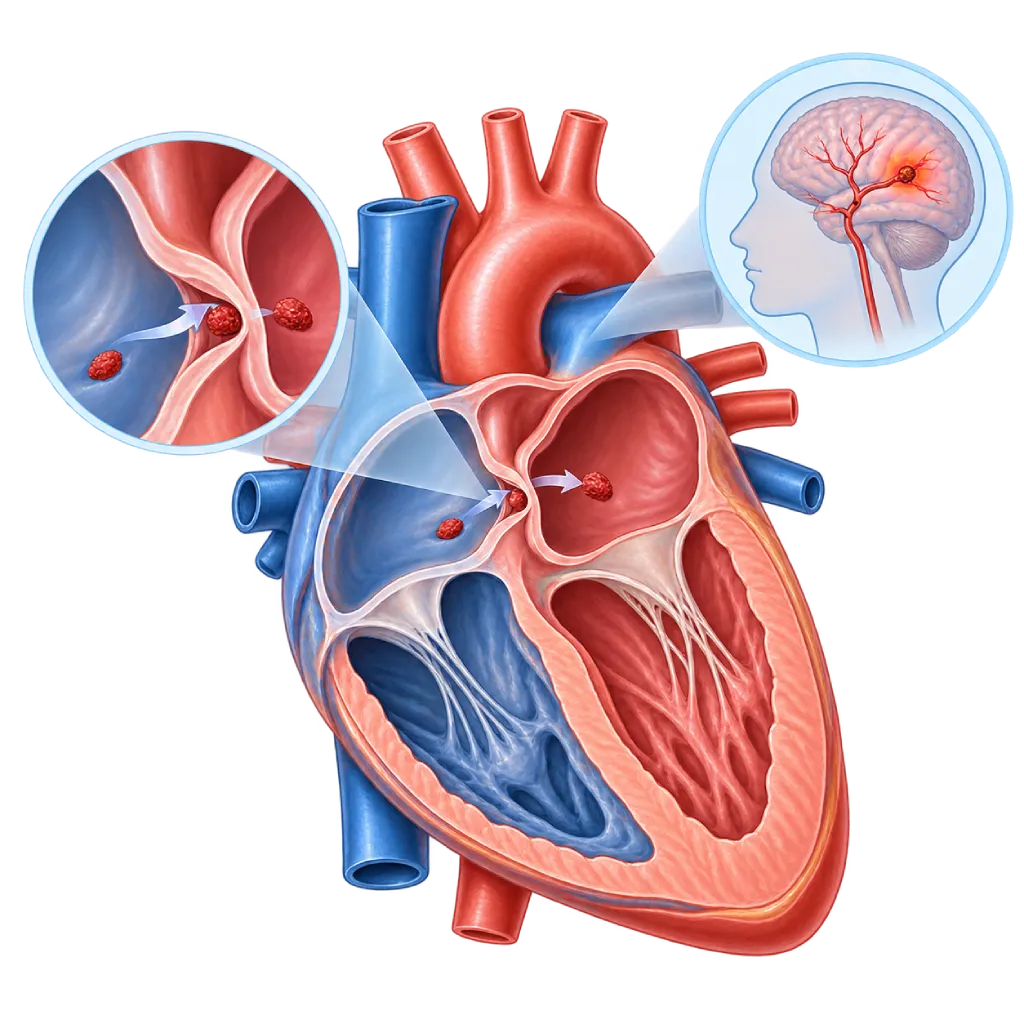
In the womb, a baby's blood does not need to pass through the lungs. Some blood from the right atrium crosses to the left atrium through a natural opening in the atrial septum called the foramen ovale. After the baby is born and starts breathing, the pressure in the left atrium rises and pushes a flap of tissue to close the opening. In about three quarters of people, this flap seals permanently. In the rest, the flap does not seal, leaving a flap-like opening called a patent foramen ovale (PFO).
A PFO is different from an atrial septal defect. No septal tissue is missing, and the opening is usually tightly closed because the pressure in the left atrium is higher. The opening only opens briefly when the pressure in the right atrium rises, for example when coughing, sneezing, straining, or lifting heavy objects.
When a PFO Becomes Important
Most people with a PFO never have symptoms and do not need treatment. A PFO becomes relevant when a small blood clot from a vein in the leg or pelvis crosses through the opening to the left side of the heart and is then carried to the brain. This is called a paradoxical embolism and can cause a stroke. This possibility is considered mainly in an ischemic stroke with no other clear cause in people under 60.
A PFO is also linked to some rare conditions: decompression sickness in divers and oxygen levels that drop when sitting or standing (platypnea-orthodeoxia syndrome). Its link with migraine is still uncertain, so PFO closure is not recommended to treat migraine outside of research studies.
Management Based on Context
Because PFO is very common, finding a PFO does not automatically mean it is the cause of symptoms. In stroke patients, the cardiologist and neurologist assess together whether other causes have been ruled out, how much blood flows through the opening, and whether the atrial septum is floppy and billows back and forth (atrial septal aneurysm). Assessment tools, such as the RoPE score and the PASCAL classification, help estimate how likely the stroke is related to the PFO. The results determine whether catheter closure of the PFO offers additional benefit compared with medicines alone. In people with a PFO and no history of stroke, further testing or treatment is generally not needed.
02 / Understanding the condition
Symptoms to Recognize.
Common Symptoms
A PFO by itself almost never causes symptoms. It is usually found in the following situations.
- No symptoms at all
- Found by chance during echocardiography done for another reason
- Found while looking for the cause of a stroke or a transient ischemic attack (TIA)
- In a small number of people, shortness of breath or low oxygen levels when sitting or standing
- In divers, symptoms of decompression sickness after diving
03 / Understanding the condition
What Causes This Condition?
- The flap of tissue in the atrial septum does not seal after birth
- The exact cause is unknown; a PFO is considered a normal variation in many people
- Hereditary factors are thought to play a role in some families
- The opening opens briefly when the pressure in the right atrium rises, for example when coughing or straining
- The opening opens more often when the pressure on the right side of the heart increases, for example with pulmonary embolism or lung disease
04 / Understanding the condition
Who Is at Higher Risk?
Medical
Blood clots in the veins of the legs or pelvis, blood clotting disorders, and high pressure on the right side of the heart increase the chance that a PFO leads to a paradoxical embolism.
Genetic
PFO appears to be more common in certain families, but no genetic test is used to assess it yet.
Lifestyle
Diving with an air tank (scuba) increases the chance of gas bubbles crossing a PFO and causing decompression sickness. Sitting still for a long time on long trips increases the risk of clots in the veins.
Age
PFO is found more often at younger ages because some openings close with age. The link between PFO and stroke is stronger in people under 60.
Groups at Higher Risk
- Stroke Survivors Under Age 60: If an ischemic stroke has no other clear cause, a PFO should be looked for and its role assessed together with a neurologist.
- Divers: Divers with a history of decompression sickness that does not fit their diving profile should be evaluated for a possible PFO.
- People with Vein Clots or Pulmonary Embolism: Clots in the veins and raised pressure on the right side of the heart can push a clot across a PFO into the arterial circulation.
- People with Blood Clotting Disorders: A tendency to form clots increases the chance of paradoxical embolism, so the choice of medicine needs careful evaluation.
05 / Understanding the condition
How Is It Diagnosed?
Testing for a PFO is usually done in two situations: looking for the cause of a stroke or TIA at a young age, or following up a finding made by chance. In stroke patients, the first step is to confirm the type of stroke and rule out other causes, such as narrowing of the blood vessels of the brain and neck, atrial fibrillation, or other heart disease.
A PFO is detected with echocardiography and a bubble test. Salt water shaken until it contains tiny bubbles is injected into a vein in the arm. If bubbles appear in the left atrium within a few heartbeats, especially after you strain and then release, an opening is present. Transesophageal echocardiography shows the shape of the opening and the septum in more detail. Long-term rhythm recording and an ultrasound of the leg veins help complete the evaluation. The final results are discussed with a neurologist to assess how likely it is that the PFO played a role.
Echocardiography
Echocardiography through the chest wall with a bubble test: salt water containing tiny bubbles is injected through an IV line, and the doctor watches whether the bubbles cross into the left atrium as you strain.
Transesophageal echocardiography, with a small probe passed through the esophagus, shows the shape of the opening, the length of its tunnel, and any atrial septal aneurysm before a decision on closure.
Transcranial Doppler, an ultrasound of the blood vessels of the brain while bubbles are injected, detects a shunt as a screening test.
Duplex Ultrasound
Looks for clots in the leg veins when a paradoxical embolism is suspected.
Long-Term Heart Rhythm Monitoring
Rhythm recording over several days to several weeks to rule out atrial fibrillation as the cause of a stroke.
MRI or CT of the head plus tests of the blood vessels of the brain and neck to confirm the type of stroke and rule out other causes.
06 / Understanding the condition
Treatment Options.
Treatment is decided by a doctor after an assessment. The categories below can help you follow the conversation with your doctor.
No Specific Treatment
A PFO found by chance, with no history of stroke or related symptoms, does not need to be closed or treated.
Antiplatelet Medicines
After a stroke linked to a PFO, antiplatelet medicines are used to prevent another stroke. Your doctor determines the type.
Anticoagulant Medicines
Given when there is another reason, for example deep vein thrombosis, pulmonary embolism, or a blood clotting disorder. Your doctor weighs the benefits against the risk of bleeding.
Catheter Closure of PFO
A double-disc closure device is placed through a vein in the groin. In selected patients aged 18 to 60 with a stroke judged to be related to the PFO, closure lowers the risk of another stroke compared with medicines alone.
Stroke Risk Factor Control
Blood pressure, blood sugar, cholesterol, and smoking still need to be controlled, whatever PFO management is chosen.
07 / Understanding the condition
Complications to Watch For.
Ischemic Stroke
A clot from a vein can cross through the opening and travel to the brain. This link is considered when there is no other clear cause. Covered on the Ischemic Stroke page.
Transient Ischemic Attack (TIA)
Stroke symptoms that improve on their own within a short time, but are still a warning sign and need to be checked right away.
Embolism to Other Organs
Although rare, a clot that crosses over can block blood vessels in the kidneys, intestines, legs, or heart.
Decompression Sickness
In divers, gas bubbles in the veins can cross a PFO and cause symptoms in the skin, nerves, or brain.
Platypnea-Orthodeoxia Syndrome
A rare condition in which you become short of breath and oxygen levels drop when sitting or standing, then improve when lying down.
08 / Understanding the condition
What Can You Do?
- Move around and drink enough fluids on long trips to reduce the risk of clots in the veins
- Control your blood pressure, blood sugar, and cholesterol, and quit smoking
- Take stroke prevention medicines as your doctor advises and do not stop them on your own
- If you are a diver with a PFO, talk with your doctor about safer diving rules
- Learn the signs of stroke and go to the emergency room right away if they appear
09 / Understanding the condition
When Should You See a Doctor?
A PFO found by chance without symptoms generally does not need specific follow-up. See a cardiologist if any of the following apply to you. If signs of stroke appear, go to the emergency room right away without waiting.
- You have had a stroke or TIA with no clear cause, especially under age 60
- You have had a clot in a leg vein or a pulmonary embolism and are known to have a PFO
- You have had decompression sickness after diving
- Shortness of breath or low oxygen levels when sitting or standing
- You want to discuss closure options for a PFO found during a checkup
Don't Wait in an Emergency.
If symptoms are severe or come on suddenly, go to the nearest emergency department right away or call Heart Attack Center 1500 258, rather than waiting for an appointment.
10 / Common questions
Questions You May Have.
Frequently asked questions about patent foramen ovale.
I have a PFO. Is it dangerous?
For most people, no. About one in four adults has a PFO and lives a normal life without symptoms. A PFO found by chance, with no history of stroke or related symptoms, generally does not need to be treated or closed. You are still encouraged to manage your stroke risk factors, such as blood pressure and cholesterol, and to learn the signs of stroke.
Who is advised to have a PFO closed?
The 2021 AHA/ASA guideline and European consensus recommend considering closure in patients aged 18 to 60 who have had an ischemic stroke with no other cause that is judged to be related to the PFO. The decision is made together with a neurologist and a cardiologist. The size of the shunt, the presence of an atrial septal aneurysm, and the risks of the procedure are also taken into account.
Can closing a PFO cure migraine?
There is not enough evidence yet. Several randomized studies did not show a clear benefit for their main study goal. For this reason, guidelines do not recommend PFO closure solely to treat migraine outside of research. Migraine should be managed by a neurologist with treatment options that have been proven to work.
Does PFO closure carry any risks?
As with other procedures, there are risks, although they are rare, such as bleeding in the groin or problems with the device. A more common effect is atrial fibrillation, an irregular rhythm that usually appears within a few weeks after the procedure and often improves on its own. After closure, your doctor usually prescribes antiplatelet medicine for several months and performs a follow-up echocardiogram.
Can people with a PFO go diving?
Divers with a PFO have a higher risk of decompression sickness, especially if the opening is large. If you have had decompression sickness, talk with your doctor before diving again. Options may include diving with more conservative rules, stopping diving, or in certain cases PFO closure after a careful evaluation.
Sources and Medical Review
Translated from the Indonesian edition medically reviewed by dr. Salomo Purba, Sp.BTKV, Subsp.JPK(K).
Sources as cited in the Indonesian edition.
- Pristipino C, Sievert H, D'Ascenzo F, et al. European position paper on the management of patients with patent foramen ovale. General approach and left circulation thromboembolism. Eur Heart J. 2019;40(38):3182-95.
- Pristipino C, Germonpré P, Toni D, et al. European position paper on the management of patients with patent foramen ovale. Part II: decompression sickness, migraine, arterial deoxygenation syndromes and select high-risk clinical conditions. Eur Heart J. 2021;42(16):1545-53.
- Kleindorfer DO, Towfighi A, Chaturvedi S, et al. 2021 Guideline for the Prevention of Stroke in Patients With Stroke and Transient Ischemic Attack: A Guideline From the American Heart Association/American Stroke Association. Stroke. 2021;52(7):e364-e467.
- Saver JL, Carroll JD, Thaler DE, et al. Long-term outcomes of patent foramen ovale closure or medical therapy after stroke. N Engl J Med. 2017;377(11):1022-32.
- Kent DM, Saver JL, Kasner SE, et al. Heterogeneity of treatment effects in an analysis of pooled individual patient data from randomized trials of device closure of patent foramen ovale after stroke. JAMA. 2021;326(22):2277-86.
- Silvestry FE, Cohen MS, Armsby LB, et al. Guidelines for the Echocardiographic Assessment of Atrial Septal Defect and Patent Foramen Ovale: From the American Society of Echocardiography and Society for Cardiac Angiography and Interventions. J Am Soc Echocardiogr. 2015;28(8):910-58.
Doctors Who Treat This Condition

dr. BRM Ario S. Kuncoro, Sp.JP(K)
Echocardiography & Cardiovascular Imaging
Cardiovascular Diagnostic Center +2 centers
Clinical focusAdvanced and 3D Echocardiography · Transesophageal Echocardiography
View Profile
dr. Salomo Purba, Sp.BTKV, Subsp.JPK(K)
Pediatric and Congenital Heart Surgery
Congenital and Structural Heart Center +2 centers
Clinical focusPediatric Heart Surgery · Congenital Heart Defect Surgery
View Profile
dr. Radityo Prakoso, Sp.JP(K)
Pediatrics & Congenital Heart Disease
Congenital and Structural Heart Center
Clinical focusPediatric Cardiology Consultation · Congenital Heart Disease Care
View Profile