
Quick answer
What Is Heart Valve Regurgitation?
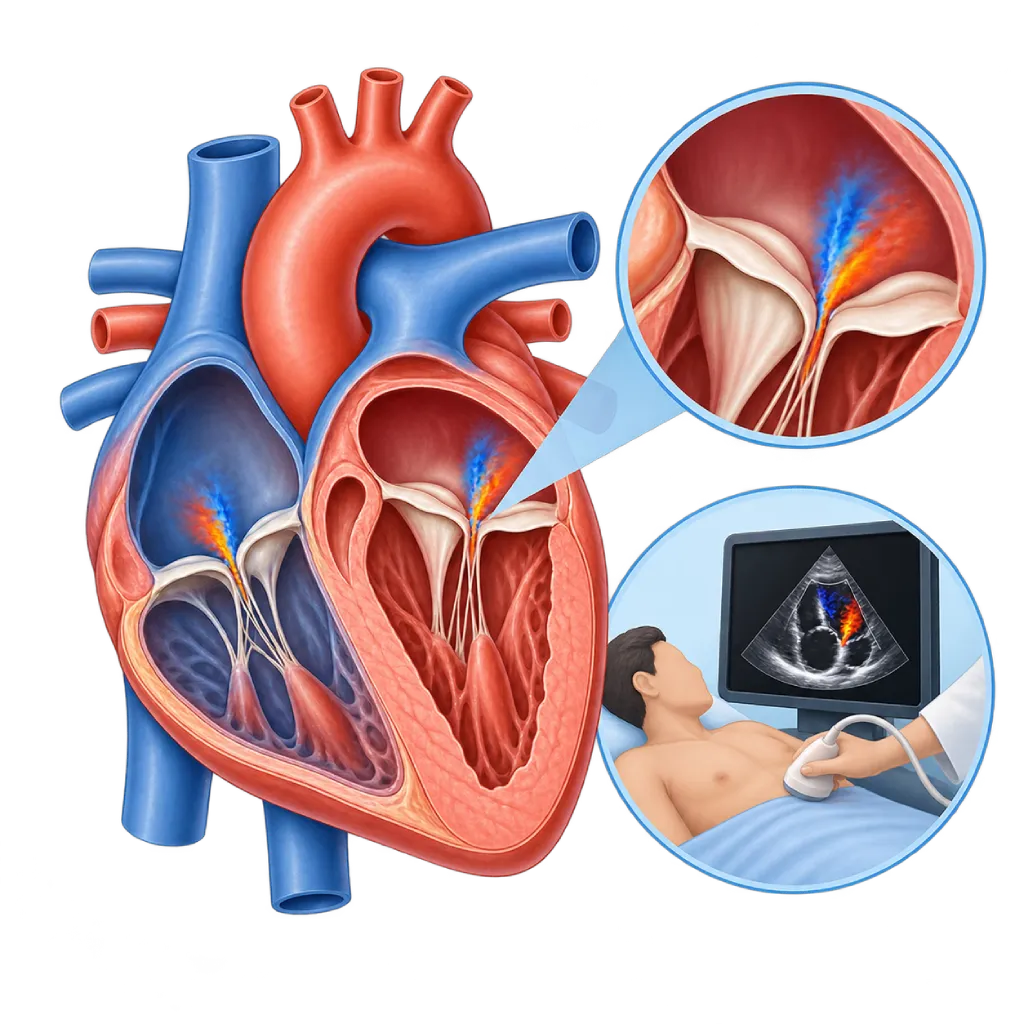
Heart valve regurgitation is a leak in a heart valve that lets some blood flow backward. Its degree, from very mild to severe, determines whether monitoring is enough or a procedure is needed, so your echocardiography results should be reviewed with your doctor.
SourcesSigns That Need Urgent Help
- Severe shortness of breath that comes on suddenly
- Being unable to lie down because of breathlessness, or coughing up pink, frothy sputum
- Severe chest pain that spreads to the back
- Fainting or nearly fainting
- Cold, pale, clammy skin with weakness
- High fever with rapidly worsening shortness of breath in people with an artificial valve
If these signs appear, go to the nearest emergency department right away or call Heart Attack Center 1500 258.
01 / Understanding the condition
About Heart Valve Regurgitation
Many people first hear the term regurgitation from an echocardiography report, for example one that says mild mitral regurgitation or trivial tricuspid regurgitation. Regurgitation means a valve does not close tightly, so some blood flows back into the previous chamber of the heart. Other terms often used are insufficiency or a leaky valve. The types of leakage in each valve and how they happen are covered on the Valve Regurgitation / Insufficiency page.
Understanding the Degree of Leakage
Doctors assess the leak using several measurements at once, such as the width and direction of the backward jet, the volume of blood that leaks, and the size of the heart chambers. The results are grouped as trivial (very mild), mild, moderate, and severe. Trivial to mild leakage in the tricuspid and pulmonary valves is often found in healthy people and is considered normal (physiological). The Framingham study found small leaks like these in many adults without heart disease.
What Determines the Next Step
A single word describing the degree is not enough. Your doctor also looks at which valve is leaking, its cause, whether the ventricle or atrium is starting to enlarge, the strength of the heart's pumping, the pressure in the lung blood vessels, and your symptoms. This is why two people with the same degree of leakage may need different plans. For example, a moderate leak that has been stable for years means something different from a moderate leak with a left ventricle that keeps enlarging.
Monitoring and Timing of Treatment
The 2020 ACC/AHA guidelines suggest echocardiography intervals according to the degree: roughly every 3 to 5 years for mild leakage, every 1 to 2 years for moderate leakage, and every 6 to 12 months for severe leakage without symptoms. The goal is to find the right time for valve repair or replacement, before the ventricle becomes permanently damaged. If new symptoms appear, you do not need to wait for your scheduled checkup.
Living with a Leaky Valve
Most people with mild to moderate leakage can go about their activities, work, and exercise as usual. The things to look after are well-controlled blood pressure, clean teeth and mouth, and a planned pregnancy. Keep your old echocardiography reports, because changes over time help your doctor assess how the leak is progressing.
02 / Understanding the condition
Symptoms to Recognize.
Common Symptoms
Mild to moderate leakage often causes no symptoms. The following symptoms usually appear once the leakage is more severe.
- Getting out of breath quickly when climbing stairs or walking fast
- Tiring quickly and a lower ability to exercise than before
- A heartbeat that feels strong or pounding, especially when lying on your left side
- Needing to sleep with your head raised higher on pillows because of breathlessness
- Swelling in the ankles or a feeling of fullness in the abdomen
- A heart murmur heard by a doctor during an examination
Symptoms in Older Adults
In older adults, mitral and tricuspid leakage is found more often, and its symptoms are easily put down to age.
- Doing less in daily life because of tiring quickly
- Shortness of breath when walking short distances or while bathing
- Palpitations with an irregular rhythm that is new
- Leg swelling and an enlarging abdomen
03 / Understanding the condition
What Causes This Condition?
- Age-related changes in valve tissue, including mitral valve prolapse
- Damage left by rheumatic fever in childhood or adolescence
- Valve infection (endocarditis) that damages the valve leaflets
- An enlarged ventricle or atrium that stretches the valve ring
- Widening of the aortic root or a bicuspid (two-leaflet) aortic valve
- High pressure in the lung blood vessels that makes the tricuspid valve leak
- Pacemaker leads that pass through the tricuspid valve
04 / Understanding the condition
Who Is at Higher Risk?
Age
Mitral and tricuspid valve leakage becomes increasingly common after age 60, along with changes in valve tissue and enlargement of the atria.
Medical
Uncontrolled high blood pressure, atrial fibrillation, heart failure, coronary artery disease, and pulmonary hypertension make leakage more likely to appear or get worse.
Genetic
A bicuspid aortic valve, mitral valve prolapse, and Marfan syndrome can be found in several members of the same family.
Other
A history of rheumatic fever, endocarditis, chest radiation therapy, congenital heart surgery, or a pacemaker with a lead in the right ventricle.
Groups at Higher Risk
- Older Adults: Mitral and tricuspid leakage is found more often in older age, often together with atrial fibrillation.
- People with Atrial Fibrillation: An enlarged atrium can stretch the ring of the mitral and tricuspid valves, causing the valves to leak.
- People with a Pacemaker: A lead that passes through the tricuspid valve sometimes interferes with valve closure, so the leakage needs to be monitored.
- Survivors of Rheumatic Fever or Endocarditis: Valve damage from a previous illness can slowly increase over the years.
- Women Planning a Pregnancy: Pregnancy increases blood volume, so moderate or severe leakage needs to be assessed before pregnancy.
05 / Understanding the condition
How Is It Diagnosed?
An echocardiography report usually lists the name of the valve and the degree of leakage. To confirm the degree, the doctor does not rely on a single measurement but combines several measurements, following the 2017 recommendations of the American Society of Echocardiography. The size and strength of the left ventricle and the lung pressure are also recorded, because both determine the timing of treatment.
If the result is on the border between moderate and severe, or the images are unclear, the doctor may add echocardiography through the esophagus or a cardiac MRI. Stress echocardiography helps if you feel short of breath but the leak at rest does not appear severe. Bring your previous test reports to every checkup, because changes over time are often more meaningful than a single result.
Echocardiography
Determines which valve is leaking, the degree of leakage using several measurements, and the size and function of the ventricles; also used for regular follow-up.
Physical Examination
The doctor listens for a heart murmur, checks your pulse and blood pressure, and looks for swelling or bulging neck veins.
Transesophageal echocardiography (through the esophagus) is used when images through the chest wall are unclear, or to plan valve repair.
Cardiac MRI
Precisely measures the volume of leaking blood and the size of the ventricles when the degree of leakage cannot yet be confirmed.
Stress Echocardiography
Assesses symptoms, changes in leakage, and lung pressure while the heart is under stress, when symptoms do not match the results at rest.
NT-proBNP and BNP Test
A blood test for markers of strain on the heart that helps assess disease progression and the timing of treatment.
Electrocardiogram (ECG)
Looks for atrial fibrillation and signs of enlarged heart chambers.
06 / Understanding the condition
Treatment Options.
Treatment is decided by a doctor after an assessment. The categories below can help you follow the conversation with your doctor.
Scheduled Checkups
Echocardiography intervals are adjusted to the degree of leakage, from once every few years for mild leakage to once every 6 to 12 months for severe leakage.
Blood Pressure Control
Well-controlled blood pressure reduces the load on the mitral and aortic valves. Your doctor chooses the appropriate class of medicine.
Medicines for Symptoms and Coexisting Conditions
Diuretics for fluid buildup, guideline-based heart failure medicines if the ventricle is weakened, and rhythm control medicines or blood thinners if atrial fibrillation is present.
Valve Repair or Replacement
Through surgery or a catheter, when severe leakage causes symptoms or starts to damage the ventricle even before symptoms appear.
Cardiac Rehabilitation After a Procedure
Gradual, supervised exercise helps restore your ability to be active after valve surgery.
07 / Understanding the condition
Complications to Watch For.
Enlargement and Weakening of the Ventricle
A ventricle that keeps receiving extra blood will enlarge, then its pumping strength declines and does not always recover after treatment.
Heart Failure
Shortness of breath, swelling, and tiring quickly appear when the heart can no longer keep up with the leak. Covered on the Heart Failure page.
Atrial Fibrillation
An enlarged atrium easily develops an irregular rhythm, which adds to the risk of stroke. Covered on the Atrial Fibrillation page.
Pulmonary Hypertension
Severe mitral leakage raises the pressure in the lung blood vessels and strains the right side of the heart. Covered on the Pulmonary Hypertension page.
Infective Endocarditis
A leaking valve is more easily infected if germs enter the bloodstream. Covered on the Infective Endocarditis page.
08 / Understanding the condition
What Can You Do?
- Keep your previous echocardiography reports and bring them to every checkup
- Control your blood pressure according to the target set by your doctor
- Keep your teeth and mouth clean and have regular dental checkups
- Stay physically active as advised by your doctor
- Limit salt if there are already signs of fluid buildup
- Plan pregnancy together with a cardiologist if the leakage is moderate or severe
- Do not delay a checkup if new shortness of breath or palpitations appear
09 / Understanding the condition
When Should You See a Doctor?
Discuss your echocardiography results with a cardiologist, especially if they state moderate or severe leakage, or if you do not yet know when your next checkup should be. Trivial or mild leakage without symptoms is usually nothing to worry about, but still ask whether a repeat test is needed. Go to the emergency room right away if severe shortness of breath comes on suddenly or you faint.
- Your echocardiography report mentions moderate or severe leakage
- Shortness of breath or tiring quickly during activities that used to feel easy
- Palpitations with an irregular rhythm
- Leg swelling or rapid weight gain
- You are past the checkup date your doctor recommended
Don't Wait in an Emergency.
If symptoms are severe or come on suddenly, go to the nearest emergency department right away or call Heart Attack Center 1500 258, rather than waiting for an appointment.
10 / Common questions
Questions You May Have.
Frequently asked questions about heart valve regurgitation and echocardiography results.
What does trivial or physiological regurgitation mean on an echocardiography result?
It means there is a very small backward flow, often seen in the tricuspid, pulmonary, or mitral valves of healthy people. This finding is considered normal and does not strain the heart. It usually needs no medicine, does not limit your activities, and does not require antibiotics before a tooth extraction. If there are no other abnormalities, your doctor usually does not schedule a separate repeat echocardiography just for this finding.
Can a valve leak get worse?
Yes, but the speed differs from person to person. Leakage caused by changes in valve tissue or enlargement of the heart chambers tends to increase slowly over the years, while trivial leakage in healthy people usually stays the same. Leakage can also increase quickly if a valve cord breaks or the valve becomes infected. Regular checkups help your doctor see the direction of change.
Why does my doctor recommend a procedure even though I have no symptoms?
With severe leakage, the heart can adapt for years so that symptoms have not yet appeared, even though the ventricle is starting to enlarge or weaken. If damage to the ventricle is allowed to go past a certain point, its function may not fully recover after the valve is repaired. This is why guidelines recommend a procedure for some patients without symptoms, based on the size and function of the ventricle on echocardiography.
Can I exercise if my valve leaks?
With mild to moderate leakage and a normal ventricle, exercise is generally allowed, including regular recreational sports. With severe leakage, the type and intensity of training need to be assessed first, sometimes with an exercise test, especially if the ventricle is already enlarged or there is a rhythm disturbance. The 2020 ESC guidelines on sports cardiology guide your doctor in giving advice that suits you.
Do I need antibiotics before going to the dentist?
Generally not, if your valve is still your own and has never been infected. Preventive antibiotics are only recommended for high-risk groups, such as people with an artificial valve, people who have had endocarditis, and some people with congenital heart disease. What matters more for everyone with a leaky valve is brushing your teeth regularly and having regular dental checkups.
What should I prepare for a checkup?
Bring your echocardiography reports and previous test results, a list of the medicines you are taking, and notes on any new symptoms, such as shortness of breath when climbing stairs or palpitations. Records of your weight and blood pressure from home also help. By comparing results over time, your doctor can assess whether the leak is stable or getting worse and set the date of your next checkup.
Sources and Medical Review
Translated from the Indonesian edition medically reviewed by dr. BRM Ario S. Kuncoro, Sp.JP(K).
Sources as cited in the Indonesian edition.
- Otto CM, Nishimura RA, Bonow RO, Carabello BA, Erwin JP 3rd, Gentile F, et al. 2020 ACC/AHA Guideline for the Management of Patients With Valvular Heart Disease: A Report of the American College of Cardiology/American Heart Association Joint Committee on Clinical Practice Guidelines. Circulation. 2021;143(5):e72-e227.
- Vahanian A, Beyersdorf F, Praz F, Milojevic M, Baldus S, Bauersachs J, et al. 2021 ESC/EACTS Guidelines for the management of valvular heart disease. Eur Heart J. 2022;43(7):561-632.
- Zoghbi WA, Adams D, Bonow RO, Enriquez-Sarano M, Foster E, Grayburn PA, et al. Recommendations for Noninvasive Evaluation of Native Valvular Regurgitation: A Report from the American Society of Echocardiography Developed in Collaboration with the Society for Cardiovascular Magnetic Resonance. J Am Soc Echocardiogr. 2017;30(4):303-371.
- Singh JP, Evans JC, Levy D, Larson MG, Freed LA, Fuller DL, et al. Prevalence and clinical determinants of mitral, tricuspid, and aortic regurgitation (the Framingham Heart Study). Am J Cardiol. 1999;83(6):897-902.
- Pelliccia A, Sharma S, Gati S, Back M, Borjesson M, Caselli S, et al. 2020 ESC Guidelines on sports cardiology and exercise in patients with cardiovascular disease. Eur Heart J. 2021;42(1):17-96.
- Regitz-Zagrosek V, Roos-Hesselink JW, Bauersachs J, Blomstrom-Lundqvist C, Cifkova R, De Bonis M, et al. 2018 ESC Guidelines for the management of cardiovascular diseases during pregnancy. Eur Heart J. 2018;39(34):3165-3241.
- Delgado V, Ajmone Marsan N, de Waha S, Bonaros N, Brida M, Burri H, et al. 2023 ESC Guidelines for the management of endocarditis. Eur Heart J. 2023;44(39):3948-4042.
Doctors Who Treat This Condition

dr. BRM Ario S. Kuncoro, Sp.JP(K)
Echocardiography & Cardiovascular Imaging
Cardiovascular Diagnostic Center +2 centers
Clinical focusAdvanced and 3D Echocardiography · Transesophageal Echocardiography
View Profile
Dr. dr. Dudy A. Hanafy, Sp.BTKV, Subsp. JD(K), MARS
Adult Cardiac Surgery
Advanced Cardiovascular Surgical Care +1 center
Clinical focusMinimally Invasive Cardiac Surgery · Coronary Artery Bypass Surgery
View Profile
Dr. dr. Dafsah A. Juzar, Sp.JP(K)
Interventional Cardiology
Coronary Intervention Procedures +1 center
Clinical focusComplex Coronary Intervention · Cardiac Catheterization
View Profile