
Quick answer
What Is Minimally Invasive Heart Surgery?
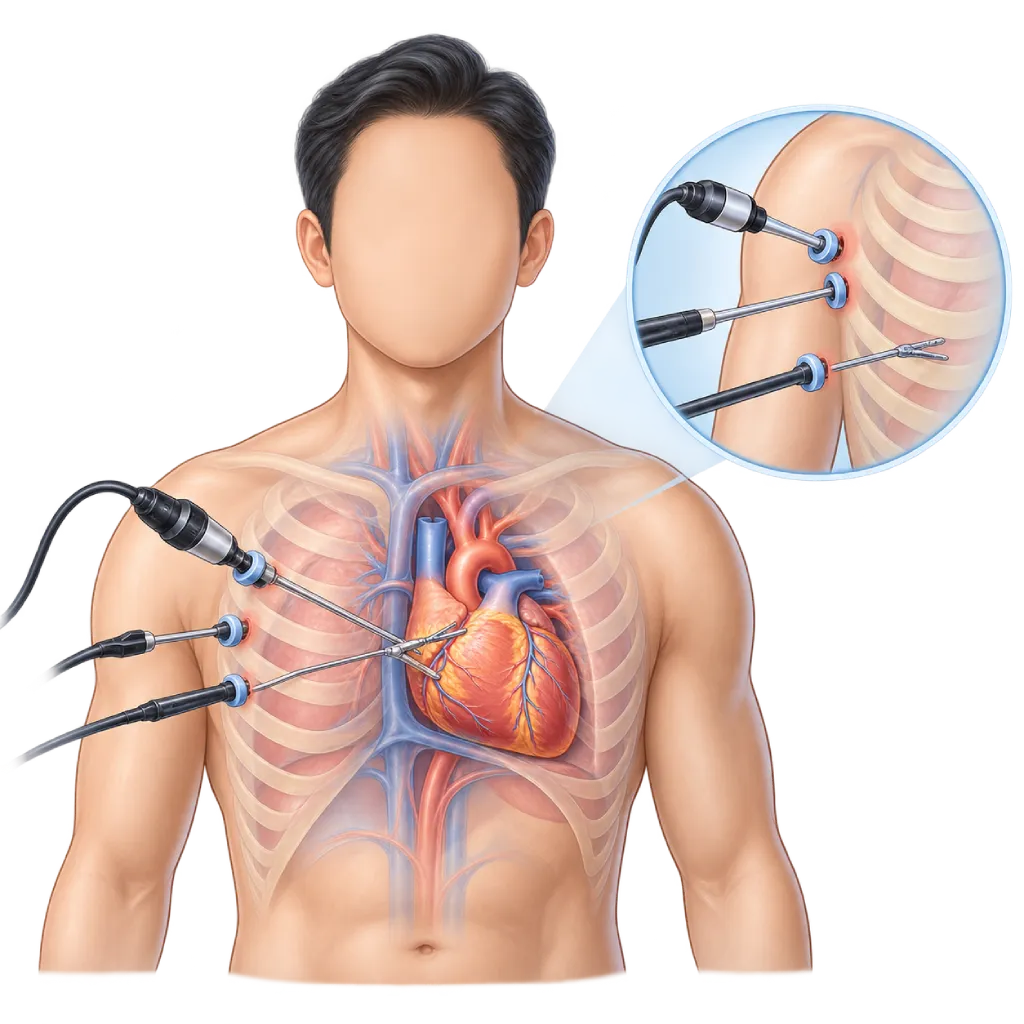
Minimally invasive heart surgery is heart surgery through a small incision between the ribs or through part of the breastbone, without dividing the whole breastbone. It is used for mitral valve repair, valve replacement, closing a hole between the heart chambers, and single-artery bypass, among others. The operation takes about 3 to 5 hours under general anesthesia.
Sources01 / Understanding the procedure
About Minimally Invasive Heart Surgery
What Is Minimally Invasive Heart Surgery
Minimally invasive heart surgery is heart surgery performed through a small incision, without dividing the whole breastbone. The incision can be made between the right ribs, about 5 to 8 cm long, between the left ribs, or through the upper part of the breastbone. The surgeon uses long-handled instruments and a small camera to see inside the heart. The repair inside the heart is in principle the same as in conventional surgery; what differs is the way in.
Operations That Can Be Performed
This technique is widely used for mitral valve repair or replacement, which is covered on the Mitral Valve Repair page. A similar technique is used for aortic valve replacement, closing a hole in the wall between the upper heart chambers (atrial septal defect, ASD) in adults, and removing certain heart tumors. In coronary bypass, the artery behind the breastbone can be connected to the left anterior descending artery through a small incision between the left ribs, a procedure called MIDCAB.
The Role of the Heart-Lung Machine
In valve and ASD surgery, the heart needs to be stopped temporarily. The heart-lung machine tubes are usually inserted through vessels in the groin or neck via small incisions, so the chest incision stays small. In MIDCAB, the graft is usually sewn onto a beating heart without a heart-lung machine.
Who Is Suitable
Not every patient is suitable. The surgical team assesses the shape of the chest, the condition of the aorta and groin vessels with a CT scan, lung function, any history of surgery or adhesions in the chest cavity, and the type of heart disease. When several operations need to be done at once, for example valve surgery and bypass of multiple vessels, an incision in the middle of the chest is often safer. Valve surgery options in general are covered on the Heart Valve Surgery page, and coronary bypass on the Coronary Artery Bypass Grafting (CABG) page.
Benefits and Limitations
Because the breastbone stays intact, the scar is smaller, there is no breastbone that needs to heal, and in some studies bleeding and the need for transfusion were lower. However, the operation usually takes longer. The UK Mini Mitral randomized trial in mitral valve repair showed that the quality of repair and safety were comparable to surgery through the middle of the chest, while recovery of physical function within 12 weeks was not very different. During the operation, the surgeon can enlarge the incision if needed for safety.
Other Options Through a Catheter
Some valve diseases and heart holes can be treated through a catheter without a chest incision, for example aortic valve implantation, covered on the Transcatheter Aortic Valve Implantation (TAVI) page, or ASD closure with a device, covered on the Atrial Septal Defect (ASD) Closure page. The combination of small-incision surgery and catheter procedures is covered on the Hybrid Heart Procedure page.
02 / Understanding the procedure
When Is This Procedure Considered?
A doctor may consider this procedure in the situations below. The decision is always made after a thorough assessment.
- Leaking Mitral ValveA leaking mitral valve, for example due to prolapse, can be repaired or replaced through an incision between the right ribs.
- Aortic Valve DiseaseAortic valve replacement can be performed through part of the breastbone or between the right ribs in selected patients.
- Atrial Septal Defect (ASD)An ASD in adults that is not suitable for closure with a device through a catheter.
- Narrowing of the Left Anterior Descending ArteryWhen only this artery needs a graft, or as part of a hybrid procedure.
- Certain Heart TumorsFor example, a myxoma in the left atrium that can be removed through a small incision.
Situations to Consider First
- Severe Adhesions in the Chest CavityFor example, from lung surgery, infection of the lung lining, or chest radiation, which make access between the ribs difficult.
- Severe Calcification of the Aorta or Groin VesselsThis makes connecting the heart-lung machine through the groin difficult and can increase the risk of stroke.
- Several Major Operations at OnceCombined valve surgery and bypass of multiple vessels is usually safer through the middle of the chest.
- Severely Reduced Lung FunctionSurgery between the ribs often requires one lung to be deflated temporarily during the operation.
03 / Before the procedure
How Should You Prepare?
A planned operation is preceded by tests to make sure you are suitable for a small incision. The surgical team, cardiologist, and anesthesia team give instructions based on your condition.
Imaging. Echocardiography, including through the esophagus (TEE), to assess the valves. A CT scan of the chest, abdomen, and pelvis is often done to assess the aorta and groin vessels. Coronary artery testing is done for certain ages or risk factors.
Other tests. Blood tests, an ECG, a chest X-ray, and lung function tests.
Medications. Blood thinners and some antiplatelet medications may need to be stopped or replaced a few days beforehand. Do not stop any medication on your own.
Teeth and smoking. Treat any dental infection first, especially before valve surgery, and stop smoking as early as possible.
Consent to the procedure. The doctor explains the benefits, risks, and the possibility that the incision is extended to the middle of the chest if needed during the operation.
Unsure about the preparation instructions? Ask our team before the procedure.
04 / During the procedure
How Is the Procedure Done?
The operation is performed in the operating room by the cardiac surgery team under general anesthesia and usually takes 3 to 5 hours, slightly longer than surgery through the middle of the chest. Afterward, you are cared for in the intensive care unit (ICU).
Anesthesia and Monitoring
A special breathing tube is placed so that one lung can be deflated temporarily. Echocardiography through the esophagus (TEE) is used to monitor the heart and valves.
Making a Small Incision
An incision of about 5 to 8 cm is made between the ribs, often below the right breast fold, or in the upper part of the breastbone.
Connecting the Heart-Lung Machine
For valve or ASD surgery, the heart-lung machine tubes are inserted through vessels in the groin or neck, and the heart is then stopped temporarily. In MIDCAB, the heart keeps beating.
Repairing the Valve or Hole
Using long-handled instruments and a camera, the surgeon repairs or replaces the valve, closes the hole, or connects the graft.
Closing the Wound
The heart is restarted, valve function is checked with TEE, drainage tubes are placed, and the wound is then stitched.
05 / Benefits and risks
Benefits and Risks Should Be Discussed Together.
Every medical procedure has benefits and risks. Your doctor will explain both for your situation before the procedure.
Benefits You Can Expect
- Breastbone Stays IntactWith an incision between the ribs, there is no breastbone that needs to heal after surgery.
- Smaller ScarThe incision is about 5 to 8 cm, and in women it is often hidden below the breast fold.
- Bleeding Tends to Be LowerSome studies show a lower need for transfusion compared with an incision in the middle of the chest.
- Comparable Repair QualityIn suitable patients, mitral valve repair results are equivalent to surgery through the middle of the chest.
The benefits of a procedure are not a promise of a cure. Ask how the results will affect your care plan.
Risks You Should Know
- Bleeding and Rhythm DisturbancesAs with other heart surgery, these may require a transfusion, rhythm medication, or further procedures.
- Problems in the GroinThe heart-lung machine tubes can cause vessel injury, swelling, or infection in the groin.
- StrokeA clot or air can travel to the brain; the risk is reduced by assessing the aorta first.
- Fluid Buildup in One LungRare; it occurs after the lung has been temporarily deflated and is treated with breathing support.
- Incision Needs to Be EnlargedIf access is limited or bleeding occurs, the surgeon can switch to an incision in the middle of the chest for safety.
- Prolonged Pain Between the RibsA small number of patients feel pain or numbness around the wound for several months.
Risks can differ from person to person. A full explanation and consent are given after an individual assessment.
06 / After the procedure
What Is Recovery Like?
Recovery time differs from person to person, depending on the type of operation and your condition beforehand.
In the ICU. Usually about one day, after which you are moved to the ward.
On the ward. You start sitting up, walking, and practicing deep breathing. The total hospital stay is usually about 4 to 7 days.
Pain and wounds. Pain between the ribs can be felt for a few weeks and is controlled with medication. Keep the wounds on your chest and groin clean and dry.
Activity. Because the breastbone is not divided, lifting restrictions are shorter for some patients, but follow your doctor's instructions. Ask when you can drive and return to work.
Medications and follow-up visits. After valve surgery, blood thinners may be needed temporarily or for life, depending on the type of valve. Keep to your echocardiography schedule and cardiac rehabilitation program.
Warning signs to watch for. Contact the medical team or go to the emergency room right away if you experience:
- Fever, or a wound on the chest or groin that is red, swollen, or filled with pus
- Shortness of breath that gets worse, or new chest pain
- An irregular pounding heartbeat or fainting
- Swelling, coldness, or pain in the leg on the side of the groin incision
- Facial drooping, weakness on one side of the body, or slurred speech
Know the Signs That Need Prompt Care.
Follow the team's guidance on warning signs. If severe or sudden symptoms appear after the procedure, go to the nearest emergency department right away or call Heart Attack Center 1500 258.
07 / Team and support
Doctors and Procedure Support
The doctors below are listed for this procedure. Listed by name, not by ranking.

Dr. dr. Dudy A. Hanafy, Sp.BTKV, Subsp. JD(K), MARS
Adult Cardiac Surgery
Advanced Cardiovascular Surgical Care +1 center
Clinical focusMinimally Invasive Cardiac Surgery · Coronary Artery Bypass Surgery
View Profile
dr. Salomo Purba, Sp.BTKV, Subsp.JPK(K)
Pediatric and Congenital Heart Surgery
Congenital and Structural Heart Center +2 centers
Clinical focusPediatric Heart Surgery · Congenital Heart Defect Surgery
View Profile
dr. Widya T. Suwatri, Sp.BTKV, Subsp. JD(K)
Adult Cardiac Surgery
Advanced Cardiovascular Surgical Care +1 center
Clinical focusMinimally Invasive Cardiac Surgery · Coronary Artery Bypass Surgery
View ProfileOperating Theatre (Cardiac Operating Room)
An operating room dedicated to heart and blood vessel surgery, where the surgical, anesthesia, perfusion, and nursing teams work…
Minimally Invasive Cardiac Surgery (MICS) Technology
A way of performing heart surgery through a small incision between the ribs or through part of the breastbone, using long-shafted…
Live Surgery Facility
Cameras and an audio-video link in the operating room that allow an operation to be broadcast for education and discussion among…
The availability of technology and test support is confirmed with the team. Technology is chosen according to clinical need.
08 / Common questions
Before You Plan the Procedure.
Questions patients and families often ask about minimally invasive heart surgery.
Are the results the same as with conventional heart surgery?
In suitable patients, yes. The repair inside the heart is in principle the same; what differs is the way in. A randomized trial in mitral valve repair showed that the quality of repair and safety were comparable to surgery through the middle of the chest. The key to a good result is choosing the right patients and a surgical team trained in this technique.
Can everyone have minimally invasive heart surgery?
No. The surgical team assesses the type of heart disease, the shape of the chest, the condition of the aorta and groin vessels, lung function, and any previous surgery. If several major operations need to be done at once or there are severe adhesions in the chest cavity, surgery through the middle of the chest is often safer. The decision is made after a complete evaluation.
Is the pain milder?
Many patients feel more comfortable because the breastbone is not divided, but an incision between the ribs still causes pain that can last a few weeks. Pain is controlled with medication and breathing exercises. Research shows that the difference in recovery of physical function within three months after surgery is not very large compared with conventional surgery.
Is a heart-lung machine still used?
For valve surgery and closing a hole between the heart chambers, yes. The machine tubes are usually inserted through vessels in the groin or neck, so the heart can be stopped temporarily and safely. In single-artery bypass between the left ribs (MIDCAB), the graft is usually sewn onto a beating heart without a heart-lung machine.
How long will I stay in the hospital, and when can I return to my usual activities?
The hospital stay is usually about 4 to 7 days, including about one day in the ICU. Because the breastbone is not divided, some patients can return to lifting light loads and driving earlier, but the timing is still decided by the doctor. Full recovery can take several weeks to months, supported by a cardiac rehabilitation program.
How is it different from catheter procedures such as TAVI?
Minimally invasive surgery is still an operation, with a small incision, general anesthesia, and usually a heart-lung machine. Catheter procedures, such as transcatheter aortic valve implantation (TAVI), are performed through a blood vessel without opening the chest. The choice between them depends on age, surgical risk, and the type of valve disease, which is covered on the Transcatheter Aortic Valve Implantation (TAVI) page.
Sources and Medical Review
Translated from the Indonesian edition medically reviewed by Dr. dr. Dudy A. Hanafy, Sp.BTKV, Subsp. JD(K), MARS.
Sources as cited in the Indonesian edition.
- Vahanian A, Beyersdorf F, Praz F, et al. 2021 ESC/EACTS Guidelines for the management of valvular heart disease. Eur Heart J. 2022;43(7):561-632.
- Otto CM, Nishimura RA, Bonow RO, et al. 2020 ACC/AHA Guideline for the Management of Patients With Valvular Heart Disease: A Report of the American College of Cardiology/American Heart Association Joint Committee on Clinical Practice Guidelines. Circulation. 2021;143(5):e72-e227.
- Akowuah EF, Maier RH, Hancock HC, et al. Minithoracotomy vs Conventional Sternotomy for Mitral Valve Repair: A Randomized Clinical Trial. JAMA. 2023;329(22):1957-1966.
- Falk V, Cheng DC, Martin J, et al. Minimally Invasive versus Open Mitral Valve Surgery: A Consensus Statement of the International Society of Minimally Invasive Coronary Surgery (ISMICS) 2010. Innovations (Phila). 2011;6(2):66-76.
- Sündermann SH, Sromicki J, Rodriguez Cetina Biefer H, et al. Mitral valve surgery: right lateral minithoracotomy or sternotomy? A systematic review and meta-analysis. J Thorac Cardiovasc Surg. 2014;148(5):1989-1995.
- Doenst T, Diab M, Sponholz C, Bauer M, Färber G. The Opportunities and Limitations of Minimally Invasive Cardiac Surgery. Dtsch Arztebl Int. 2017;114(46):777-784.