
Quick answer
What Is Fractional Flow Reserve?
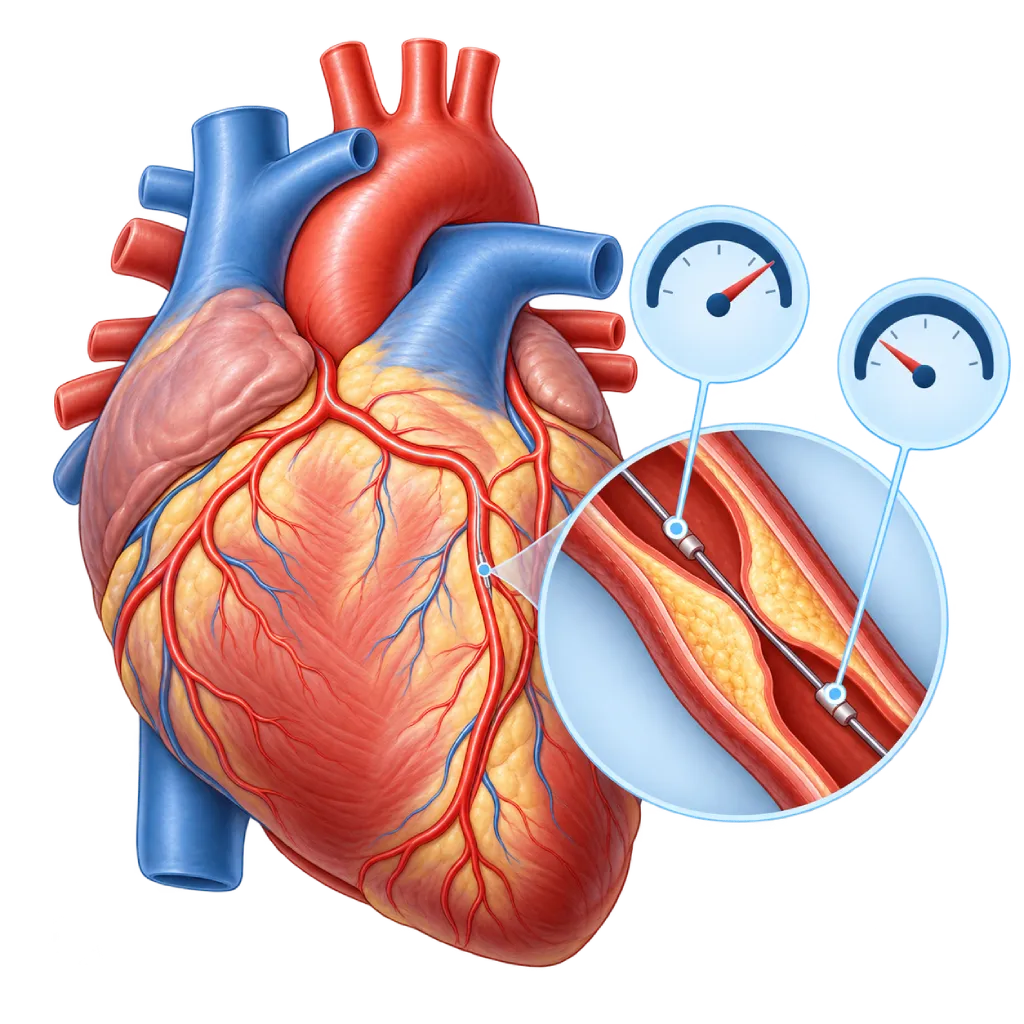
Fractional flow reserve (FFR) is a measurement of pressure inside a coronary artery using a sensor-tipped wire during cardiac catheterization. The result shows whether a narrowing truly reduces blood flow to the heart muscle, so your doctor can decide whether a stent is needed. The measurement adds about 10 to 15 minutes to the catheterization.
Sources01 / Understanding the procedure
About Fractional Flow Reserve
What Is Fractional Flow Reserve
Coronary angiography shows how narrow an artery is, but it does not always show whether that narrowing actually reduces blood flow to the heart muscle. A narrowing that looks moderate, for example 50 to 70 percent, may disrupt blood flow in one person but not in another. Fractional flow reserve (FFR) answers this question by measuring blood pressure directly inside the coronary artery.
How It Works in Brief
A very thin wire with a pressure sensor at its tip is passed across the narrowing. The medication adenosine is given to bring blood flow to the heart muscle to its peak, as when the heart is working hard. The device then compares the pressure beyond the narrowing with the pressure before it. An artery without any obstruction has a value of about 1.0, while a value of 0.80 or less shows that the narrowing significantly reduces blood flow.
What the Results Mean
If the FFR value is 0.80 or less, opening the narrowing with a stent or bypass surgery is usually beneficial, mainly to relieve symptoms and reduce the need for emergency procedures later on. If the value is above 0.80, the narrowing can usually be managed with medication and lifestyle changes. Long-term studies show that deferring a stent in narrowings like these is safe.
Measurement Without Adenosine
There are also similar measurements that do not use adenosine, such as iFR (instantaneous wave-free ratio), which reads the pressure at a specific moment within each heartbeat, with a cutoff value of 0.89. Two large studies in 2017 showed one-year results equivalent to FFR, with fewer symptoms during the measurement. The 2024 ESC guidelines recommend FFR or iFR to assess moderate narrowings before deciding on treatment.
FFR in Cardiac Catheterization
FFR is performed during cardiac catheterization, usually right after angiography finds an uncertain narrowing; angiography is covered on the Coronary Angiography page. If the result shows a significant narrowing, a stent is often placed in the same procedure, which is covered on the Coronary Angioplasty page. During a heart attack, the artery causing the attack is opened right away without FFR; for the other arteries, the doctor may use FFR or rely on angiography alone, depending on the situation.
02 / Understanding the procedure
When Is This Procedure Considered?
A doctor may consider this procedure in the situations below. The decision is always made after a thorough assessment.
- Uncertain Moderate NarrowingA narrowing of about 40 to 90 percent without evidence of reduced blood flow from other tests.
- Narrowings in Multiple VesselsHelps choose which vessels need to be opened, whether with stents or bypass surgery.
- Symptoms That Do Not Match the AngiogramFor example, typical chest pain but a narrowing that looks mild, or the other way around.
- Other Arteries After a Heart AttackTo assess narrowings in arteries that did not cause the attack, based on the doctor's judgment.
- Narrowing of the Left Main Coronary ArteryHelps assess a moderate narrowing of the left main coronary artery, sometimes together with IVUS.
Situations to Consider First
- Severe Asthma or Airway NarrowingAdenosine can trigger breathlessness, so a measurement without adenosine, such as iFR, may be chosen.
- Severe Electrical Conduction Disorders of the HeartAdenosine can slow the heartbeat; a measurement without adenosine may be considered.
- Very Low Blood PressureIn an unstable condition, the main treatment comes first, and the measurement results are less reliable.
- Artery Causing a Heart AttackThe artery blocked during a heart attack is opened right away without waiting for an FFR measurement.
- Very Severe NarrowingA narrowing above 90 percent is generally considered significant without the need for measurement.
03 / Before the procedure
How Should You Prepare?
FFR is performed as part of cardiac catheterization, so the preparation follows that procedure. The team will give you written instructions.
Avoid caffeine. If adenosine is planned, you will usually be asked not to have coffee, tea, chocolate, or other caffeinated drinks for 12 to 24 hours beforehand, because caffeine blocks the action of this medication.
Medications you are taking. Bring a list of all your medications. Antiplatelet medications are usually continued, while other blood thinners, some diabetes medications, and medications containing dipyridamole or theophylline may need to be adjusted. Do not change any medication without your doctor's instructions.
History of asthma. Tell the team if you have asthma or chronic obstructive pulmonary disease, because this affects the choice of medication during the measurement.
Tests before the procedure. Blood tests, including kidney function and blood clotting, as well as an ECG.
Fasting and a companion. Follow the fasting instructions from the team, and arrange for someone to take you home.
Unsure about the preparation instructions? Ask our team before the procedure.
04 / During the procedure
How Is the Procedure Done?
FFR measurement is performed in the catheterization laboratory by an interventional cardiologist under local anesthesia. The whole catheterization with FFR usually takes about 1 hour, while the FFR measurement itself adds about 10 to 15 minutes.
Coronary Angiography
A catheter is inserted through the wrist or groin, and the coronary arteries are imaged with contrast dye to find the narrowing that needs to be assessed. Blood thinners and medications that widen the blood vessels are given.
Placing the Pressure Wire
The wire sensor is set to match the pressure at the opening of the coronary artery, and then the wire is advanced across the narrowing until the sensor sits in the segment beyond it.
Giving Adenosine and Measuring
Adenosine is given through an IV line or injected into the coronary artery. For about one to two minutes, you may feel short of breath, a heavy chest, or a warm face; these sensations go away soon after the medication is stopped. The device then displays the FFR value.
Deciding the Next Step
If the value shows a significant narrowing and the treatment has been discussed beforehand, a stent can be placed right away. If not, the wire is withdrawn and treatment continues with medication.
05 / Benefits and risks
Benefits and Risks Should Be Discussed Together.
Every medical procedure has benefits and risks. Your doctor will explain both for your situation before the procedure.
Benefits You Can Expect
- Decisions Based on Blood FlowStents are placed in narrowings shown to reduce blood flow, not just in those that look narrow.
- Avoiding Unnecessary StentsNarrowings that are not significant can be treated with medication, and this deferral has been shown to be safe.
- Fewer Emergency ProceduresFor significant narrowings, FFR-guided stent placement reduces emergency procedures compared with medication alone.
- Immediate Results in the Same ProcedureThe value appears on the screen within minutes, so a decision can be made on the spot.
The benefits of a procedure are not a promise of a cure. Ask how the results will affect your care plan.
Risks You Should Know
- Brief Effects of AdenosineShortness of breath, a heavy chest, a warm face, or a slowed heartbeat, which go away once the medication is stopped.
- General Catheterization RisksBruising or bleeding at the puncture site, which is usually mild and treatable.
- Coronary Artery SpasmThe artery can narrow briefly as the wire enters; this is prevented with medication that widens the blood vessels.
- Coronary Artery Wall InjuryVery rare, such as a tear caused by the wire, which can be treated with a stent.
- Contrast Reaction and Kidney ProblemsFrom the contrast dye used for angiography, especially if kidney function is already reduced.
Risks can differ from person to person. A full explanation and consent are given after an individual assessment.
06 / After the procedure
What Is Recovery Like?
Recovery follows the catheterization or stent placement done at the same time. The FFR measurement itself does not add to the recovery time.
After the procedure. If the wrist was used for access, a compression band is worn for a few hours. If the groin was used, you lie down for a few hours with your leg straight.
Hospital stay. If a stent is placed, patients usually stay in the hospital for one night. If only the measurement was done without a stent, some patients can go home on the same day.
Results and treatment. If the narrowing is not significant, your doctor adjusts your medications and lifestyle advice. The plaque still needs to be controlled with cholesterol-lowering medication and regular follow-up visits.
Warning signs to watch for. Go to the emergency room right away if you have:
- Chest pain, shortness of breath, or cold sweats
- Growing swelling or bleeding at the puncture site
- A hand or leg that feels cold, pale, numb, or painful
- A rash, itching, or shortness of breath after receiving contrast dye
Know the Signs That Need Prompt Care.
Follow the team's guidance on warning signs. If severe or sudden symptoms appear after the procedure, go to the nearest emergency department right away or call Heart Attack Center 1500 258.
07 / Team and support
Doctors and Procedure Support
The doctors below are listed for this procedure. Listed by name, not by ranking.

Dr. dr. Dafsah A. Juzar, Sp.JP(K)
Interventional Cardiology
Coronary Intervention Procedures +1 center
Clinical focusComplex Coronary Intervention · Cardiac Catheterization
View Profile
Dr. med. dr. Denio A. Ridjab, Sp.JP(K)
Interventional Cardiology
Coronary Intervention Procedures +2 centers
Clinical focusInterventional Cardiology · Coronary Artery Disease
View Profile
dr. Puti S. Saus, Sp.JP(K)
Interventional Cardiology
Coronary Intervention Procedures
Clinical focusAcute Coronary Syndrome · Primary Coronary Intervention
View ProfilePhysiologic Testing System (FFR / iFR)
Measurement of blood pressure inside the coronary artery during catheterization, using a wire with a pressure sensor, to assess…
The availability of technology and test support is confirmed with the team. Technology is chosen according to clinical need.
08 / Common questions
Before You Plan the Procedure.
Frequently asked questions about FFR and what the measured numbers mean.
What does my FFR number mean?
The FFR number compares the pressure beyond a narrowing with the pressure before it while blood flow is at its peak. A healthy artery has a value of about 1.0. A value of 0.80 or less means the narrowing significantly reduces blood flow and usually needs to be opened. A value above 0.80 means the narrowing can usually be managed with medication and lifestyle changes.
Can I feel the FFR measurement?
You cannot feel the sensor wire. When adenosine is given, most patients feel short of breath, a heavy chest, a warm face, or a pounding heart for one to two minutes. These sensations are normal, reflect how the medication works, and go away soon after the medication is stopped. Tell the team if the symptoms feel severe or do not go away quickly.
If my FFR is normal, do I really not need a stent?
Long-term studies show that deferring a stent for a narrowing with a normal FFR value is safe, with a low risk of heart attack. However, the plaque is still there and can grow. That is why medications such as cholesterol-lowering drugs and antiplatelets, quitting smoking, and controlling blood pressure and blood sugar remain important, along with regular follow-up visits.
What is the difference between FFR and iFR?
Both measure the pressure inside a coronary artery with the same wire. FFR requires adenosine to bring blood flow to its peak, with a cutoff value of 0.80. iFR reads the pressure at a specific moment within each heartbeat without adenosine, with a cutoff of 0.89. Large studies have shown equivalent results, and iFR causes fewer symptoms during the measurement.
Why do I have to avoid coffee before the procedure?
Caffeine in coffee, tea, chocolate, and some soft drinks blocks the action of adenosine, so blood flow does not reach its peak and the FFR value may look better than it really is. For this reason, if adenosine is planned, you will usually be asked to avoid caffeine for 12 to 24 hours beforehand. Follow the timing set by the team.
What is the difference between FFR and IVUS?
FFR assesses function, meaning whether a narrowing reduces blood flow. IVUS assesses structure, meaning the vessel size, plaque, and the result of stent placement from inside the vessel. The two complement each other and can be done during the same catheterization. Your doctor chooses based on the question that needs answering, such as whether a stent is needed or what stent size is suitable.
Sources and Medical Review
Translated from the Indonesian edition medically reviewed by dr. Siska S. Danny, Sp.JP(K).
Sources as cited in the Indonesian edition.
- Vrints C, Andreotti F, Koskinas KC, et al. 2024 ESC Guidelines for the management of chronic coronary syndromes. Eur Heart J. 2024;45(36):3415-3537.
- Lawton JS, Tamis-Holland JE, Bangalore S, et al. 2021 ACC/AHA/SCAI Guideline for Coronary Artery Revascularization: A Report of the American College of Cardiology/American Heart Association Joint Committee on Clinical Practice Guidelines. Circulation. 2022;145(3):e18-e114.
- Tonino PAL, De Bruyne B, Pijls NHJ, et al. Fractional Flow Reserve versus Angiography for Guiding Percutaneous Coronary Intervention. N Engl J Med. 2009;360(3):213-224.
- Xaplanteris P, Fournier S, Pijls NHJ, et al. Five-Year Outcomes with PCI Guided by Fractional Flow Reserve. N Engl J Med. 2018;379(3):250-259.
- Zimmermann FM, Ferrara A, Johnson NP, et al. Deferral vs. performance of percutaneous coronary intervention of functionally non-significant coronary stenosis: 15-year follow-up of the DEFER trial. Eur Heart J. 2015;36(45):3182-3188.
- Davies JE, Sen S, Dehbi HM, et al. Use of the Instantaneous Wave-free Ratio or Fractional Flow Reserve in PCI. N Engl J Med. 2017;376(19):1824-1834.
- Götberg M, Christiansen EH, Gudmundsdottir IJ, et al. Instantaneous Wave-free Ratio versus Fractional Flow Reserve to Guide PCI. N Engl J Med. 2017;376(19):1813-1823.