
Quick answer
What Is Kawasaki Disease?
Kawasaki disease is an inflammation of the blood vessels in children, especially those under 5, marked by a high fever lasting several days, red eyes and lips, a rash, and swelling of the hands and feet. Early treatment protects the heart's coronary arteries.
SourcesSigns That Need Urgent Help
- The child looks very weak or pale, or is hard to wake up
- Cold hands and feet with very little urine
- Fast breathing or shortness of breath
- A very fast or irregular heartbeat
- Chest pain, cold sweats, or vomiting in a child with a history of coronary aneurysm
If these signs appear, go to the nearest emergency department right away or call Heart Attack Center 1500 258.
01 / Understanding the condition
About Kawasaki Disease
Kawasaki disease is an inflammation of the blood vessels (vasculitis) that appears suddenly in children, especially those under 5 years of age. It was first described by Dr. Tomisaku Kawasaki in Japan in 1967. The inflammation affects medium-sized blood vessels throughout the body, especially the coronary arteries that carry blood to the heart muscle. In developed countries, Kawasaki disease is the main cause of acquired heart disease in children, meaning heart disease that is not present from birth.
How the Disease Progresses
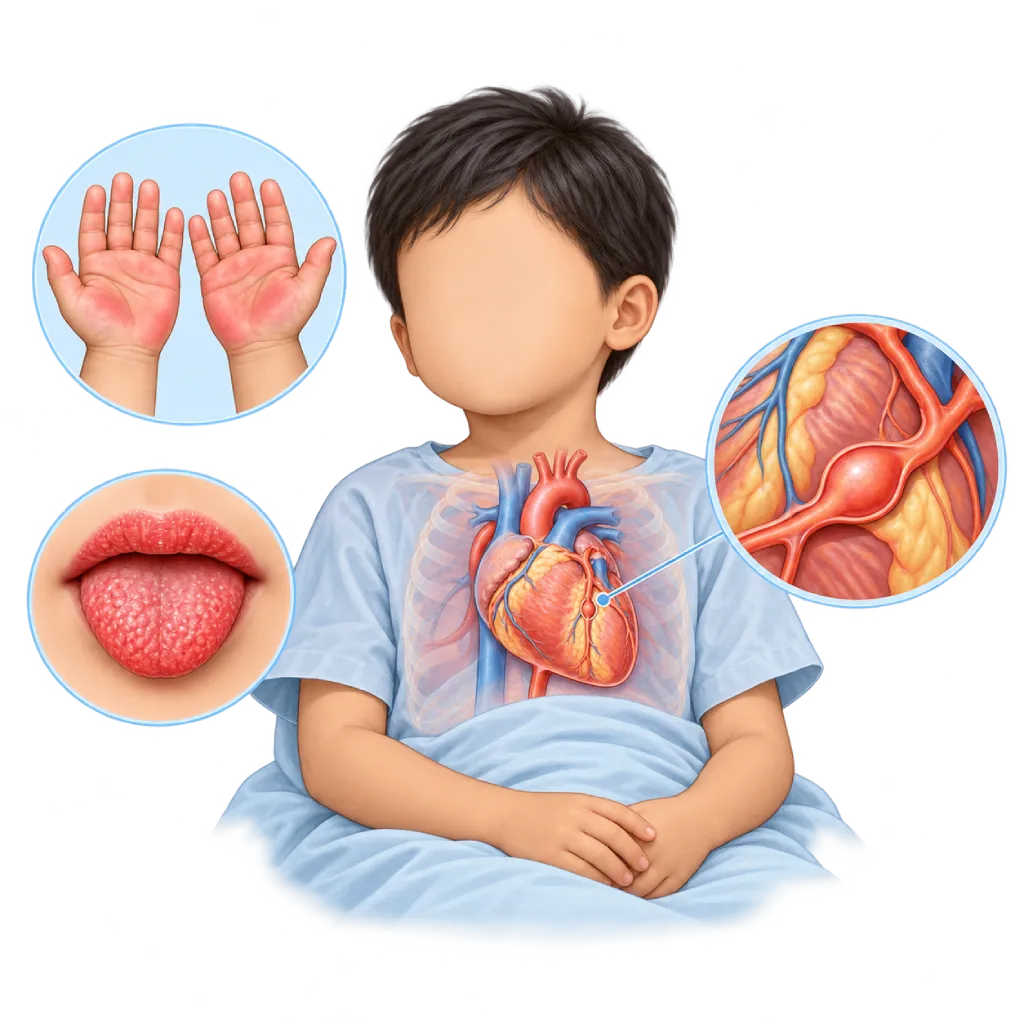
Kawasaki disease begins with a high fever that lasts several days, along with red eyes, red lips and tongue, a rash, swelling of the hands and feet, and a swollen gland in the neck. These signs do not always appear at the same time and may come and go, so parents sometimes notice only some of them. In some children, especially babies, only two or three signs appear. This is called incomplete Kawasaki disease, and it can still affect the coronary arteries. Without treatment, the fever can last about 1 to 2 weeks. In the second to third week, the skin on the fingertips may peel. Widening of the coronary arteries can begin to form during this period, often without symptoms.
Why Early Treatment Matters
Without treatment, about 1 in 4 children develop widening of the coronary arteries, called coronary aneurysms. A 2017 scientific statement from the American Heart Association (AHA) explains that giving intravenous immunoglobulin (IVIG) together with aspirin, ideally within the first 10 days of fever, lowers that number to about 4 in 100 children. That is why a child with a prolonged fever and the signs above needs to be seen by a doctor promptly, even if not all the signs have appeared.
After the Acute Phase
Most children recover without heart problems. Echocardiography is repeated within a few weeks to make sure the coronary arteries are normal, and children with normal results can go back to school and play as usual. Children with coronary aneurysms need medicines to prevent clots and long-term heart monitoring, because aneurysms can lead to clots or narrowing years later, including in adulthood. Kawasaki disease is not contagious and is not caused by mistakes in parenting, food, or hygiene.
02 / Understanding the condition
Symptoms to Recognize.
Common Symptoms
Signs may appear one after another and not always at the same time. Take photos of visible signs so you can show them to the doctor.
- A high fever lasting 5 days or more that is hard to bring down with fever medicine
- Red eyes on both sides without eye discharge
- Red, dry, cracked lips and a red tongue that looks like a strawberry
- A red rash on the body, legs, or diaper area
- Red, swollen palms and soles
- A swollen lymph node on one side of the neck
- Peeling skin on the tips of the fingers and toes in the second to third week
- A child who is very fussy and hard to soothe
Symptoms in Infants
Babies under 6 months often show only some of the signs (incomplete Kawasaki disease), even though their risk to the coronary arteries is higher.
- Fever for 7 days or more without a clear cause
- Only one or two typical signs, such as red eyes or a rash
- The BCG vaccine injection site turning red, swollen, or crusted again
- Being very fussy, feeding poorly, or appearing limp
- Diarrhea, vomiting, or a bloated belly
03 / Understanding the condition
What Causes This Condition?
- The exact cause is not yet known
- Thought to be an excessive immune reaction to a trigger, possibly an infection, in children with a certain genetic tendency
- The inflammation attacks the walls of medium-sized blood vessels, especially the coronary arteries
- Cases sometimes appear in clusters during certain seasons, which supports the idea of an environmental trigger
- It does not spread from child to child and is not caused by food, hygiene, or parenting
04 / Understanding the condition
Who Is at Higher Risk?
Age
Most cases occur in children under 5 years of age. Babies under 6 months and older children are affected less often, but they are more often recognized late and are at higher risk of coronary aneurysms.
Genetic
The disease is more common in children of Asian descent, especially Japanese and Korean. Siblings of affected children have a higher risk, and several variants of genes that regulate the immune system have been linked to the disease.
Other
Boys are affected slightly more often than girls. Children who have had Kawasaki disease can also get it again, although this is rare.
Groups at Higher Risk
- Children Under 5: Most cases occur in children under 5 years of age, so a prolonged fever in young children needs attention.
- Babies Under 6 Months: They often show only some of the signs, even though their risk of coronary aneurysms is higher.
- Siblings of Affected Children: They have a higher risk than other children, so parents need to know the signs.
- Adults with a History of Kawasaki Disease and Aneurysm: They still need heart monitoring because aneurysms can lead to clots or narrowing years later.
05 / Understanding the condition
How Is It Diagnosed?
No single test can confirm Kawasaki disease. Doctors make the diagnosis from a physical examination: a fever lasting 5 days or more along with at least 4 of 5 main signs, namely red eyes, changes in the lips and mouth, a rash, changes in the hands and feet, and a swollen gland in the neck. If fewer signs are present, doctors use the AHA pathway for incomplete Kawasaki disease, which combines markers of inflammation (CRP and ESR), blood counts, albumin, liver enzymes, a urine test, and echocardiography.
Echocardiography measures the coronary arteries and compares them with the child's body size (Z score). This test is done at diagnosis, then repeated 1 to 2 weeks and 4 to 6 weeks after treatment. Doctors also rule out other similar illnesses, such as measles, scarlet fever, viral infections, drug reactions, and multisystem inflammatory syndrome in children (MIS-C) after COVID-19.
Physical Examination
The doctor counts how long the fever has lasted and checks the five main signs: the eyes, lips and mouth, rash, hands and feet, and neck glands.
Echocardiography
Measures the coronary arteries and compares them with the child's body size (Z score), assesses the heart muscle and valves, and is repeated after treatment.
Complete Blood Count (CBC)
Looks for anemia, a high white blood cell count, and a rising platelet count after day seven, which support a diagnosis of incomplete Kawasaki disease.
C-Reactive Protein (CRP) Test
CRP, together with the erythrocyte sedimentation rate (ESR), shows how severe the inflammation is and is an early step when incomplete Kawasaki disease is suspected.
Urinalysis
Looks for white blood cells in the urine without a urinary tract infection, one of the supporting findings of Kawasaki disease.
Electrocardiogram (ECG)
Assesses heart rhythm and signs of heart muscle inflammation in the acute phase, as well as signs of reduced blood flow during follow-up.
CT Coronary Angiography
In older children or adults with aneurysms, CT maps coronary arteries that are hard to see with echocardiography.
06 / Understanding the condition
Treatment Options.
Treatment is decided by a doctor after an assessment. The categories below can help you follow the conversation with your doctor.
Intravenous Immunoglobulin (IVIG)
Antibodies given by infusion in the hospital to calm the inflammation. Ideally given within the first 10 days of fever, and still considered afterward if the inflammation is still active.
Aspirin Under a Doctor's Supervision
Given together with IVIG in the acute phase, then at a low dose for several weeks. Your doctor determines the dose and duration; do not give aspirin to a child without a doctor's instructions.
Corticosteroids and Other Anti-Inflammatory Medicines
Considered for children at high risk of aneurysms or when the fever does not go down after IVIG, including certain biologic medicines.
Long-Term Clot Prevention Medicines
For children with coronary aneurysms, in the form of antiplatelet medicines, with anticoagulant medicines added for large aneurysms.
Long-Term Heart Monitoring
Echocardiography, ECG, stress testing, and coronary artery imaging based on the size of the aneurysm, continuing into adulthood if needed.
Procedures for Coronary Narrowing
If severe narrowing develops later in life, options include a catheter procedure or coronary bypass surgery.
07 / Understanding the condition
Complications to Watch For.
Coronary Artery Aneurysm
Widening of the coronary arteries occurs in about 1 in 4 children who are not treated and about 4 in 100 children who are treated in time. Small aneurysms often return to normal.
Coronary Artery Clots and Narrowing
Large aneurysms can form clots or narrow years later and trigger a heart attack, covered on the Myocardial Infarction / Heart Attack page.
Heart Muscle Inflammation
In the acute phase, inflammation can affect the heart muscle and temporarily weaken its pumping. Inflammation of the heart muscle is covered on the Myocarditis page.
Kawasaki Disease Shock Syndrome
A small number of children develop very low blood pressure in the acute phase and need intensive care.
Leaky Heart Valves
The mitral valve can leak in the acute phase, and the root of the aorta can widen slightly. These usually improve once the inflammation settles.
08 / Understanding the condition
What Can You Do?
- Have your child checked if a fever lasts more than 4 to 5 days, especially with red eyes, a rash, or red lips
- Note the first day of fever and take photos of visible signs so you can show them to the doctor
- Do not give aspirin to a child without a doctor's instructions
- Attend follow-up echocardiography as scheduled after your child leaves the hospital
- Ask your doctor about delaying live vaccines, such as measles and chickenpox, after IVIG
- If your child takes aspirin long term, ask about the flu vaccine and avoid ibuprofen without a doctor's instructions
- For children with coronary aneurysms, build habits of healthy eating, staying active, and not smoking as adults
09 / Understanding the condition
When Should You See a Doctor?
Take your child to the doctor if a fever lasts more than 4 to 5 days, especially if it comes with any of the following signs. Do not wait for all the signs to appear. If your child looks very weak, pale, or short of breath, or has cold hands and feet, go to the emergency room right away.
- Red eyes on both sides without eye discharge
- Red, cracked lips or a red tongue that looks like a strawberry
- A red rash on the body or diaper area
- Red or swollen palms and soles
- A swollen gland in the neck
- A baby with a fever for 7 days or more without a clear cause
- A BCG injection site that turns red and swollen again during a fever
Don't Wait in an Emergency.
If symptoms are severe or come on suddenly, go to the nearest emergency department right away or call Heart Attack Center 1500 258, rather than waiting for an appointment.
10 / Common questions
Questions You May Have.
Questions parents often ask about Kawasaki disease.
Is Kawasaki disease contagious?
No. Kawasaki disease does not spread from child to child, so your child's siblings and friends do not need to be kept away. Its exact cause is not yet known. Experts think it is an excessive immune reaction to a trigger, possibly an infection, in children with a certain genetic tendency. It is also not caused by food, hygiene, or parenting.
Can my child fully recover?
Most children recover fully, especially if treated within the first 10 days of fever. Children whose echocardiogram is still normal after 4 to 6 weeks can generally go about their usual activities and do not need long-term medicines. Children with coronary aneurysms need longer monitoring. Small aneurysms often return to normal size within 1 to 2 years, while large aneurysms need lifelong follow-up.
Why does my child need to be hospitalized and given an IVIG infusion?
IVIG is a solution of antibodies from blood donors that is given by infusion over several hours. It calms the inflammation in the blood vessels and lowers the risk of coronary aneurysms. A hospital stay is needed to monitor infusion reactions, fever, and the heart's condition. If the fever has not gone down about 36 hours after the infusion ends, the doctor may give IVIG again or another anti-inflammatory medicine.
Why is my child given aspirin when aspirin is usually not recommended for children?
Aspirin is generally not given to children, but Kawasaki disease is an exception supervised by a doctor. In the acute phase, aspirin helps calm the inflammation, and then at a low dose it prevents platelets from clumping in the coronary arteries. While your child is taking aspirin, tell the doctor if your child is exposed to flu or chickenpox, and do not give ibuprofen without a doctor's instructions because it can interfere with how aspirin works.
Does my child's immunization schedule change after treatment?
Yes, partly. The antibodies in IVIG can make live vaccines, such as the measles and chickenpox vaccines, work less well. That is why the AHA recommends delaying these vaccines for about 11 months after IVIG. Other vaccines can generally still be given on schedule. Children who take aspirin long term are advised to get the flu vaccine. Discuss the immunization schedule with your child's pediatrician.
Can Kawasaki disease come back?
Yes, but rarely. It comes back in about 1 to 3 in 100 children, usually within a few years after the previous episode. If a child who has had Kawasaki disease again has a prolonged fever with similar signs, take them to the doctor right away and mention their history. Children with a history of Kawasaki disease do not need their activities restricted if their coronary arteries are normal.
Sources and Medical Review
Translated from the Indonesian edition medically reviewed by dr. Tartila, Sp.A, Subsp.ETIA(K).
Sources as cited in the Indonesian edition.
- McCrindle BW, Rowley AH, Newburger JW, Burns JC, Bolger AF, Gewitz M, et al. Diagnosis, Treatment, and Long-Term Management of Kawasaki Disease: A Scientific Statement for Health Professionals From the American Heart Association. Circulation. 2017;135(17):e927-99.
- Jone PN, Tremoulet A, Choueiter N, Dominguez SR, Harahsheh AS, Mitani Y, et al. Update on Diagnosis and Management of Kawasaki Disease: A Scientific Statement From the American Heart Association. Circulation. 2024;150(23):e481-500.
- Fukazawa R, Kobayashi J, Ayusawa M, Hamada H, Miura M, Mitani Y, et al. JCS/JSCS 2020 Guideline on Diagnosis and Management of Cardiovascular Sequelae in Kawasaki Disease. Circ J. 2020;84(8):1348-407.
- de Graeff N, Groot N, Ozen S, Eleftheriou D, Avcin T, Bader-Meunier B, et al. European consensus-based recommendations for the diagnosis and treatment of Kawasaki disease: the SHARE initiative. Rheumatology (Oxford). 2019;58(4):672-82.
- Newburger JW, Takahashi M, Burns JC. Kawasaki Disease. J Am Coll Cardiol. 2016;67(14):1738-49.
- Kobayashi T, Saji T, Otani T, Takeuchi K, Nakamura T, Arakawa H, et al. Efficacy of immunoglobulin plus prednisolone for prevention of coronary artery abnormalities in severe Kawasaki disease (RAISE study): a randomised, open-label, blinded-endpoints trial. Lancet. 2012;379(9826):1613-20.
Doctors Who Treat This Condition

dr. Radityo Prakoso, Sp.JP(K)
Pediatrics & Congenital Heart Disease
Congenital and Structural Heart Center
Clinical focusPediatric Cardiology Consultation · Congenital Heart Disease Care
View Profile
dr. Tartila, Sp.A, Subsp.ETIA(K)
Pediatric Emergency and Intensive Care
Congenital and Structural Heart Center
Clinical focusPediatric Intensive Care · Pediatric Emergency Care
View Profile
dr. Sri Diniharini, Sp.JP(K)
Echocardiography & Cardiovascular Imaging
Cardiovascular Diagnostic Center +1 center
Clinical focusAdvanced Echocardiography · Transesophageal Echocardiography
View Profile