
Quick answer
What Is Acute Pericarditis?
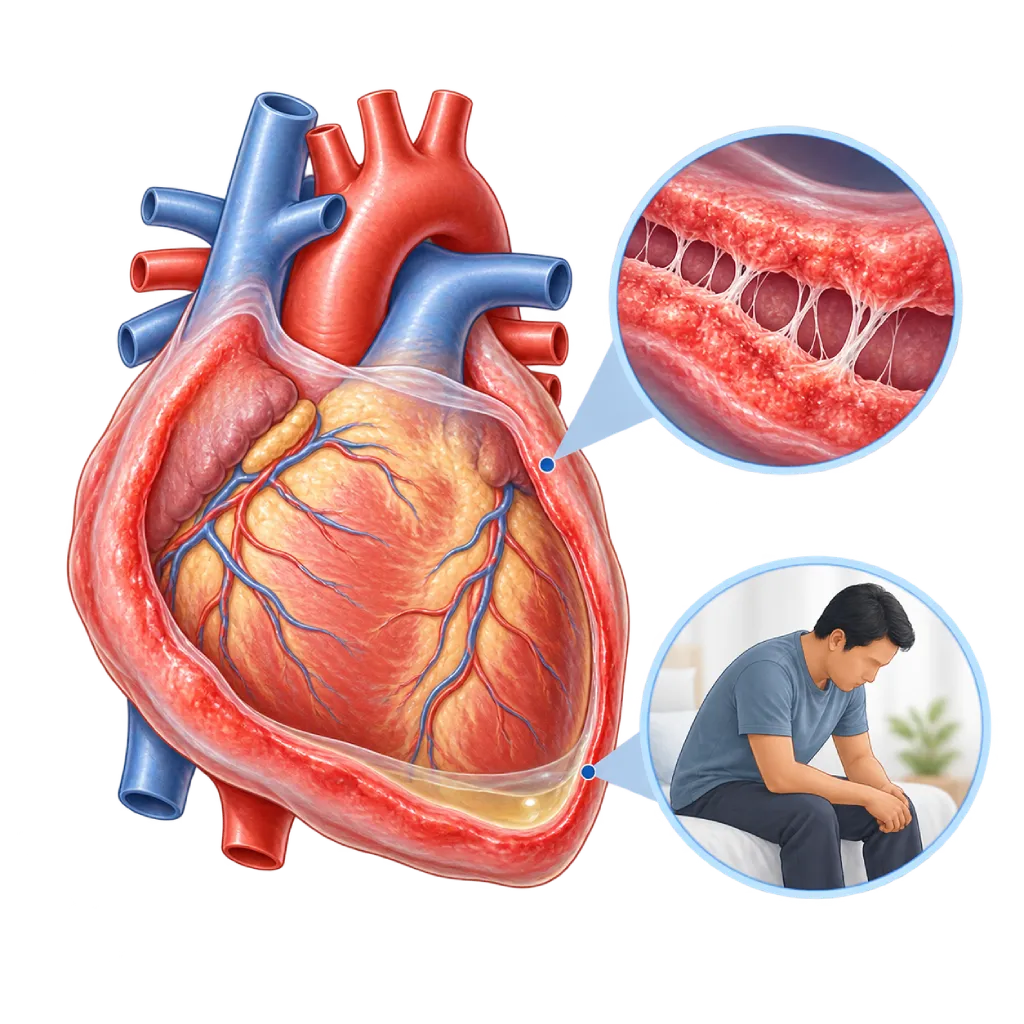
Acute pericarditis is a sudden inflammation of the sac that surrounds the heart, usually caused by a viral infection or occurring with no clear cause. Most cases improve within a few weeks with anti-inflammatory medicine and colchicine.
SourcesSigns That Need Urgent Help
- Severe shortness of breath, or breathlessness that gets worse over a few hours
- Fainting or nearly fainting
- Pale, cold, sweaty skin with a very fast heartbeat
- Severe, pressing chest pain that does not change with body position
- Visibly bulging veins in the neck
- Unusual confusion or drowsiness
If these signs appear, go to the nearest emergency department right away or call Heart Attack Center 1500 258.
01 / Understanding the condition
About Acute Pericarditis
Acute pericarditis is an episode of inflammation of the pericardium, the thin, two-layered sac that surrounds the heart, that develops over hours to a few days. The inflamed layers become rough and rub against each other with every heartbeat. This causes a typical sharp chest pain: it gets worse when you breathe in, cough, or lie down, and eases when you sit up and lean forward.
Acute pericarditis is fairly common among patients who come to the emergency room with chest pain, but its symptoms resemble a heart attack. That is why new chest pain should never be self-diagnosed. An ECG and blood tests are needed to tell the two apart.
Common Causes
In most people, no cause is found and a viral infection is suspected. Acute pericarditis can also develop a few days to weeks after a heart attack, heart surgery, or a catheter procedure, as an inflammatory reaction of the body. Other causes include TB, bacterial infections, autoimmune diseases, kidney failure, and cancer. In Indonesia, TB needs to be considered, especially if symptoms develop gradually with fever, weight loss, or a long-lasting cough.
When a Hospital Stay Is Needed
Your doctor looks for high-risk signs before deciding on outpatient care. These include a fever above 38 degrees Celsius, symptoms that develop gradually over several days to weeks, a large amount of fluid in the heart sac, signs of pressure on the heart, and symptoms that do not improve after about one week of anti-inflammatory medicine. A raised troponin level, a weakened immune system, a chest injury, and the use of blood thinners are also taken into account. If any of these signs are present, a hospital stay and further investigation of the cause are recommended.
Treatment and Recovery
The main treatment is anti-inflammatory medicine, either aspirin or a nonsteroidal anti-inflammatory drug (NSAID), together with colchicine for about three months to lower the risk of recurrence. The anti-inflammatory medicine is tapered gradually based on your symptoms and CRP level. Strenuous exercise is postponed until symptoms are gone and inflammation markers are normal. Most patients recover with no lasting effects. If the inflammation also affects the heart muscle, a condition covered on the Myocarditis page, monitoring and the break from exercise are usually longer. If symptoms return after going away, the condition is covered on the Recurrent Pericarditis page.
02 / Understanding the condition
Symptoms to Recognize.
Common Symptoms
- Sharp or stabbing chest pain that comes on suddenly
- Pain that gets worse when you take a deep breath, cough, swallow, or lie down
- Pain that eases when you sit up and lean forward
- Pain that spreads to the left shoulder, neck, or upper back
- Mild fever, body aches, or having just recovered from the flu
- A pounding heartbeat or feeling short of breath
- Tiring easily
03 / Understanding the condition
What Causes This Condition?
- Viral infections, including flu viruses, gut viruses, and SARS-CoV-2, the virus that causes COVID-19
- Idiopathic, meaning no cause is found despite testing
- An inflammatory reaction after a heart attack, heart surgery, or a catheter procedure (post-cardiac injury syndrome)
- Tuberculosis (TB) or other bacterial infections
- Autoimmune diseases such as lupus and rheumatoid arthritis
- Severe kidney failure (uremia) or cancer that has spread to the sac around the heart
- A reaction to certain medicines or vaccines, including mRNA COVID-19 vaccines, although this is rare
04 / Understanding the condition
Who Is at Higher Risk?
Age
Acute pericarditis is more common in adults aged 16 to 65, especially men.
Medical
A history of a heart attack, heart surgery, or a catheter procedure, autoimmune disease, kidney failure, cancer, and radiation therapy to the chest.
Other
A recent viral infection of the airways or digestive tract, contact with someone who has TB, and a weakened immune system.
Groups at Higher Risk
- Young and Middle-Aged Men: The group more often treated for acute pericarditis, usually after a viral infection.
- Patients After Heart Surgery: The sac around the heart can become inflamed a few days to weeks after heart surgery, a catheter procedure, or a heart attack.
- People with Autoimmune Diseases: Lupus and rheumatoid arthritis can cause acute pericarditis, sometimes as an early sign of the disease.
- People with Severe Kidney Failure: A buildup of waste products or inadequate dialysis can trigger inflammation of the sac around the heart.
05 / Understanding the condition
How Is It Diagnosed?
Acute pericarditis is diagnosed when at least two of four signs are present: typical chest pain, a rubbing sound from the sac around the heart (pericardial friction rub), typical ECG changes, and new or increasing fluid in the heart sac. A raised CRP level or signs of inflammation on MRI or CT support the diagnosis.
The initial tests recommended for all patients are a physical examination, an ECG, echocardiography, a chest X-ray, and blood tests for inflammation markers and troponin. These tests also rule out a heart attack and other conditions that cause chest pain. In patients without high-risk signs who improve with medicine, a broad search for the cause is usually not needed. Tests for TB, autoimmune disease, or cancer are done if there are high-risk signs or clues pointing to a specific cause.
Physical Examination
The doctor listens to your heart with a stethoscope for a rubbing sound from the sac around the heart and checks your blood pressure, pulse, and the blood vessels in your neck.
Electrocardiogram (ECG)
Looks for ST-segment elevation spread across many leads or PR-segment depression, and helps tell the condition apart from a heart attack.
Cardiac Troponin Test
A raised troponin level means the heart muscle is also inflamed, and the test helps rule out a heart attack.
C-Reactive Protein (CRP) Test
Measures the level of inflammation to support the diagnosis and to guide when medicines can be tapered.
Echocardiography
Looks for fluid in the heart sac, assesses how much there is, and confirms there are no signs of pressure on the heart.
Chest X-Ray
Looks for an enlarged heart shadow and for lung abnormalities or fluid in the lining of the lungs.
Cardiac MRI
Used when the diagnosis is uncertain or troponin is raised, to look for inflammation of the sac around the heart and of the heart muscle.
06 / Understanding the condition
Treatment Options.
Treatment is decided by a doctor after an assessment. The categories below can help you follow the conversation with your doctor.
Aspirin or Nonsteroidal Anti-Inflammatory Drugs
The first choice to relieve pain and inflammation, together with a medicine to protect the stomach. After a heart attack, aspirin is preferred. Your doctor decides on the type and how to taper it.
Colchicine
Added from the start, usually for about three months, to speed recovery and lower the risk of recurrence by about half.
Low-Dose Corticosteroids
A second choice when aspirin or NSAIDs cannot be used or do not work, once infection has been ruled out. Their use is limited because they are linked to recurrence.
Rest from Strenuous Exercise
Strenuous exercise is postponed until symptoms are gone and CRP is normal. Competitive athletes and patients with heart muscle inflammation usually wait longer, based on their doctor's assessment.
Treatment of the Underlying Cause
If a specific cause is found, such as TB, a bacterial infection, autoimmune disease, or uremia, treatment is directed at that cause.
07 / Understanding the condition
Complications to Watch For.
Recurrence
About 15 to 30 out of 100 patients have a recurrence. The risk is lower with colchicine and when medicines are not stopped too early.
Incessant Pericarditis
The inflammation continues for more than 4 to 6 weeks without a break. Treatment is usually extended, and the cause is investigated more closely.
Pericardial Effusion and Tamponade
Fluid in the heart sac can increase. If it builds up quickly and presses on the heart, tamponade occurs and needs emergency treatment.
Heart Muscle Inflammation
A rise in troponin means the inflammation also affects the heart muscle. Recovery is usually still good, but monitoring and a longer break from exercise are needed.
Constrictive Pericarditis
Rare after viral or idiopathic pericarditis, in fewer than 1 in 100 patients, but more common after TB or a pus-forming bacterial infection.
08 / Understanding the condition
What Can You Do?
- Take anti-inflammatory medicine and colchicine for as long as your doctor recommends
- Do not stop your medicines on your own, even if the pain has gone
- Postpone strenuous exercise until your doctor says the inflammation has settled
- Come for follow-up CRP tests as scheduled
- Tell your doctor if you take blood thinners or have a stomach condition
- Wash your hands and cover your mouth when coughing to reduce the spread of viral infections
09 / Understanding the condition
When Should You See a Doctor?
See a doctor if you have sharp chest pain that gets worse when you breathe in or lie down, especially after the flu or a digestive tract infection. New chest pain always needs to be checked because it can resemble a heart attack. If you are already being treated, contact your doctor if the pain does not improve after about one week, the fever does not go down, or you have side effects from the medicine such as stomach pain or severe diarrhea.
Go to the emergency room right away if you have:
- Severe or pressing chest pain, or chest pain with cold sweats
- Severe shortness of breath, or breathlessness that gets worse over a few hours
- Fainting or nearly fainting
- Pale, cold skin with a very fast heartbeat
Don't Wait in an Emergency.
If symptoms are severe or come on suddenly, go to the nearest emergency department right away or call Heart Attack Center 1500 258, rather than waiting for an appointment.
10 / Common questions
Questions You May Have.
Frequently asked questions about acute pericarditis.
How long does acute pericarditis take to heal?
In most people, the pain eases within a few days of starting anti-inflammatory medicine, and the inflammation settles within a few weeks. Colchicine is usually continued for about three months to prevent recurrence. If the pain does not improve after about one week of treatment, your doctor will reassess the cause and may recommend a hospital stay.
How can you tell pericarditis pain apart from a heart attack?
Pericarditis pain is usually sharp, gets worse when you breathe in or lie down, and eases when you sit up and lean forward. Heart attack pain more often feels heavy or pressing, does not change with position, and can come with cold sweats. However, these features are not always reliable, so any new chest pain needs to be checked with an ECG and a troponin test at a healthcare facility.
Does acute pericarditis require a hospital stay?
Not always. Patients without high-risk signs can usually be treated as outpatients, with a follow-up visit in about one week. A hospital stay is recommended if there is a fever above 38 degrees Celsius, symptoms that developed gradually, a large amount of fluid in the heart sac, signs of pressure on the heart, a raised troponin level, a weakened immune system, use of blood thinners, or no improvement after about one week of treatment.
Is it safe to take colchicine for months?
Colchicine is generally well tolerated when used for pericarditis. Possible side effects include diarrhea, nausea, or abdominal pain. Your doctor will adjust its use if you have kidney or liver problems or take other medicines that interact with colchicine. Do not stop the medicine or add to it on your own, and report any side effects at your follow-up visits.
When can I exercise again?
Strenuous exercise should be postponed until the pain is gone and inflammation markers such as CRP are back to normal. Light daily activity, such as relaxed walking, is generally still allowed. If troponin is raised because the heart muscle is also inflamed, or if you are a competitive athlete, the break is usually longer, and your doctor needs to reassess you before you return to full training.
Can the COVID-19 vaccine cause pericarditis?
Inflammation of the sac around the heart or of the heart muscle after mRNA COVID-19 vaccines has been reported, but it is rare, more common in young men, and usually mild and improves with treatment. COVID-19 infection itself can also cause pericarditis. If you have chest pain, shortness of breath, or a pounding heartbeat within a few days of vaccination, see a doctor.
Sources and Medical Review
Translated from the Indonesian edition medically reviewed by dr. BRM Ario S. Kuncoro, Sp.JP(K).
Sources as cited in the Indonesian edition.
- Schulz-Menger J, Collini V, Gröschel J, Adler Y, Brucato A, Christian V, et al. 2025 ESC Guidelines for the management of myocarditis and pericarditis. Eur Heart J. 2025;46(40):3952-4041.
- Adler Y, Charron P, Imazio M, Badano L, Barón-Esquivias G, Bogaert J, et al. 2015 ESC Guidelines for the diagnosis and management of pericardial diseases: The Task Force for the Diagnosis and Management of Pericardial Diseases of the European Society of Cardiology (ESC). Eur Heart J. 2015;36(42):2921-2964.
- Imazio M, Brucato A, Cemin R, Ferrua S, Maggiolini S, Beqaraj F, et al. A Randomized Trial of Colchicine for Acute Pericarditis. N Engl J Med. 2013;369(16):1522-1528.
- Imazio M, Cecchi E, Demichelis B, Ierna S, Demarie D, Ghisio A, et al. Indicators of Poor Prognosis of Acute Pericarditis. Circulation. 2007;115(21):2739-2744.
- Imazio M, Brucato A, Barbieri A, Ferroni F, Maestroni S, Ligabue G, et al. Good Prognosis for Pericarditis With and Without Myocardial Involvement: Results From a Multicenter, Prospective Cohort Study. Circulation. 2013;128(1):42-49.
- Imazio M, Gaita F, LeWinter M. Evaluation and Treatment of Pericarditis: A Systematic Review. JAMA. 2015;314(14):1498-1506.
Doctors Who Treat This Condition

dr. Puti S. Saus, Sp.JP(K)
Interventional Cardiology
Coronary Intervention Procedures
Clinical focusAcute Coronary Syndrome · Primary Coronary Intervention
View Profile
dr. BRM Ario S. Kuncoro, Sp.JP(K)
Echocardiography & Cardiovascular Imaging
Cardiovascular Diagnostic Center +2 centers
Clinical focusAdvanced and 3D Echocardiography · Transesophageal Echocardiography
View Profile
dr. Radityo Prakoso, Sp.JP(K)
Pediatrics & Congenital Heart Disease
Congenital and Structural Heart Center
Clinical focusPediatric Cardiology Consultation · Congenital Heart Disease Care
View Profile