
Quick answer
What Is Chronic Pericarditis?
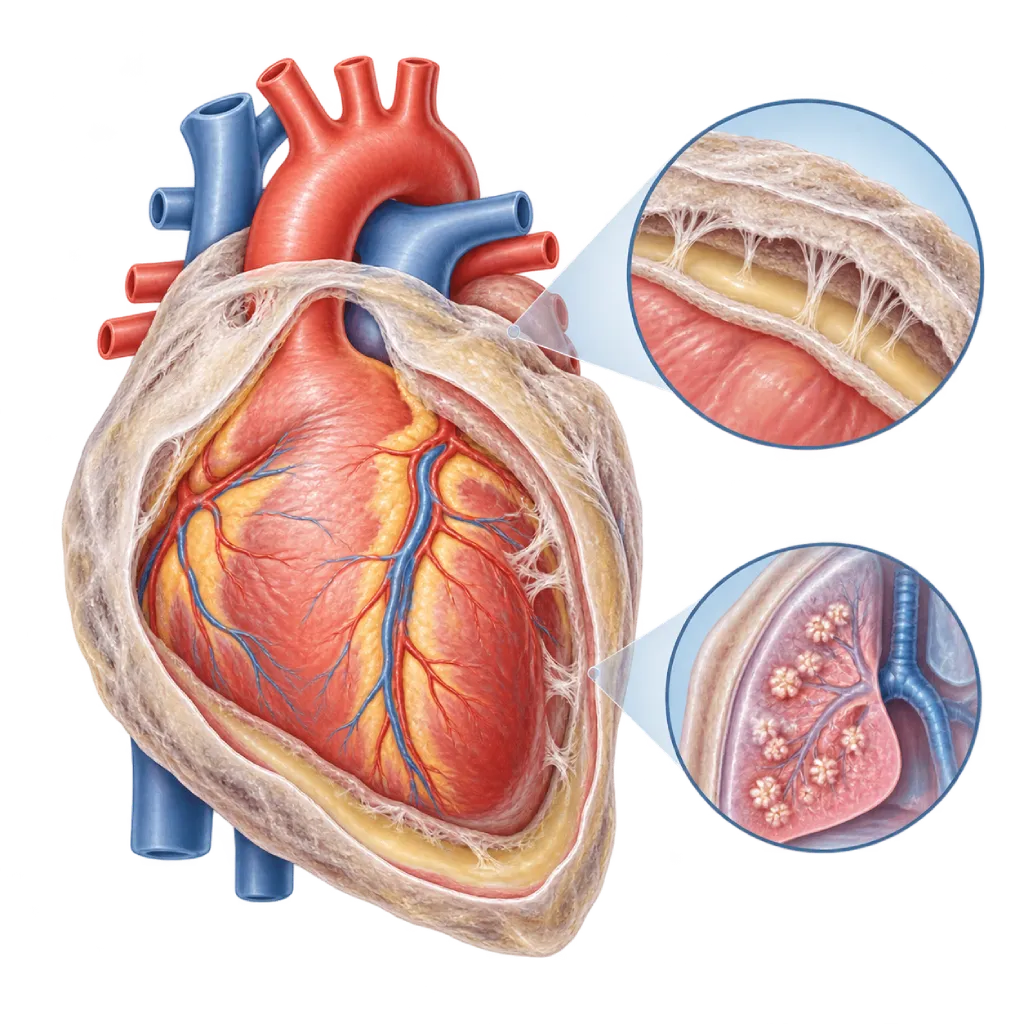
Chronic pericarditis is inflammation of the sac around the heart that lasts longer than three months. It often comes with fluid around the heart, and its cause needs to be found, such as TB, autoimmune disease, or kidney failure.
SourcesSigns That Need Urgent Help
- Severe shortness of breath or breathlessness that worsens quickly
- Fainting or nearly fainting
- Pale, cold, sweaty skin with a very fast heartbeat
- Severe chest pain that does not ease with rest or a change in position
- Swelling and a rapidly enlarging abdomen
If these signs appear, go to the nearest emergency department right away or call Heart Attack Center 1500 258.
01 / Understanding the condition
About Chronic Pericarditis
Most cases of acute pericarditis settle within a few weeks. When inflammation of the sac around the heart lasts longer than three months, doctors call it chronic pericarditis. This term is different from incessant pericarditis, which is inflammation that continues for more than 4 to 6 weeks but less than three months, and from recurrent pericarditis, which is inflammation that returns after a symptom-free period, covered on the Recurrent Pericarditis page.
The symptoms of chronic pericarditis are often vaguer than those of an acute episode. Some people feel mild chest pain that comes and goes, tire easily, or are short of breath during activity. Others feel nothing at all and only find out from an echocardiogram that shows fluid in the heart sac.
Forms of Chronic Pericarditis
Long-lasting inflammation can take several forms. The effusive form is marked by fluid that persists in the heart sac, covered on the Pericardial Effusion page. The adhesive form is marked by adhesions and thickening of the sac without much fluid. When the sac becomes so thick and stiff that it restricts the filling of the heart, the condition has progressed to constriction, covered on the Constrictive Pericarditis page.
Why the Cause Needs to Be Found
Unlike an acute episode, where a cause is often not found, inflammation that lasts for months is more likely to have a specific cause. In Indonesia, TB should always be considered. Other causes include autoimmune diseases such as lupus and rheumatoid arthritis, severe kidney failure, an underactive thyroid gland, cancer, and past radiation to the chest. Treatment directed at the cause is often the key to settling the inflammation and the fluid.
Pericarditis caused by TB usually comes with fever, night sweats, weight loss, and a fairly large amount of fluid. If it is not fully treated, this inflammation can leave scar tissue that binds the heart. For this reason, testing of the pericardial fluid is sometimes needed to confirm the cause.
Living with Chronic Pericarditis
With the cause treated and regular monitoring, many people with chronic pericarditis can go about their usual activities. Strenuous exercise is postponed while the inflammation is still active. Regular checkups are still needed to detect increasing fluid or signs of constriction early, so treatment can be adjusted before symptoms get worse.
02 / Understanding the condition
Symptoms to Recognize.
Common Symptoms
- Chest pain or discomfort that comes and goes
- Tiring easily and reduced ability to stay active
- Shortness of breath during activity or when lying down
- Low-grade fever or night sweats, especially when the cause is TB
- Weight loss with no clear cause
- Swelling in the legs or a feeling of fullness in the abdomen
- No symptoms, found on an echocardiogram or chest X-ray
03 / Understanding the condition
What Causes This Condition?
- Tuberculosis (TB) affecting the sac around the heart
- Autoimmune diseases, such as lupus, rheumatoid arthritis, or scleroderma
- Severe kidney failure with a buildup of metabolic waste, including in patients on dialysis
- An underactive thyroid gland (hypothyroidism) that causes fluid in the heart sac
- Cancer that has spread to the pericardium, or past radiation therapy to the chest
- Acute pericarditis that was not fully treated, or inflammation after heart surgery
- Idiopathic, meaning no cause is found despite a complete evaluation
04 / Understanding the condition
Who Is at Higher Risk?
Medical
Autoimmune disease, severe kidney failure, hypothyroidism, cancer, a history of heart surgery or chest radiation, and previous pericarditis that was not fully treated.
Other
Close contact with people who have TB, living in an area with many TB cases, HIV, and the use of medicines that suppress the immune system.
Groups at Higher Risk
- People with Past TB or TB Contact: Pericardial TB can progress slowly with fever, night sweats, and persistent fluid in the heart sac.
- People with Autoimmune Diseases: Lupus, rheumatoid arthritis, and other connective tissue diseases can cause long-lasting inflammation of the sac around the heart.
- Kidney Failure and Dialysis Patients: A buildup of metabolic waste or inadequate dialysis can trigger inflammation and fluid in the pericardium.
- Cancer Survivors: Cancer that has spread to the pericardium or radiation to the chest can cause persistent inflammation and fluid.
05 / Understanding the condition
How Is It Diagnosed?
The diagnosis of chronic pericarditis rests on how long the inflammation has lasted and on evidence that it is still present, such as pain, a high CRP level, persistent fluid, or signs of inflammation on MRI. Echocardiography is the basic test to assess the fluid and the thickness of the sac, and it is repeated regularly.
The next step is to look for the cause. The doctor chooses tests based on your history and symptoms, such as a chest X-ray and TB tests, an ANA test for autoimmune disease, kidney function tests, and thyroid function tests. Cardiac CT or MRI assesses thickening, calcification, and active inflammation. If the cause is still unclear, the amount of fluid is large, or TB, a bacterial infection, or cancer is suspected, pericardial fluid can be drawn with a needle for testing. A pericardial biopsy is sometimes needed.
Echocardiography
Assesses the amount of fluid, the thickness of the sac, and signs of compression or constriction; repeated regularly to monitor changes.
C-Reactive Protein (CRP) Test
Shows whether the inflammation is still active, as a basis for choosing anti-inflammatory medicines and monitoring the response.
Cardiac MRI
Shows active inflammation and thickening of the pericardium, helping to distinguish inflammation that can still be treated from scar tissue.
Cardiac CT Scan
Assesses thickening and calcification of the pericardium, as well as abnormalities in the lungs and lymph nodes that point to TB or cancer.
Antinuclear Antibody Test (ANA Test)
Screens for autoimmune diseases such as lupus, one of the causes of long-lasting inflammation of the sac around the heart.
Thyroid Function Test
Looks for hypothyroidism, a cause of fluid in the heart sac that can improve with thyroid treatment.
Analysis of pericardial fluid drawn with a needle (pericardiocentesis), or a pericardial biopsy, to look for TB, infection, or cancer cells when the cause is still unclear.
06 / Understanding the condition
Treatment Options.
Treatment is decided by a doctor after an assessment. The categories below can help you follow the conversation with your doctor.
Treatment of the Cause
TB medicines, control of autoimmune disease, more adequate dialysis, or thyroid hormone therapy, depending on the cause found.
Anti-Inflammatory Medicines and Colchicine
Used when the inflammation is still active, as shown by pain or a high CRP. The type, how long they are taken, and how they are tapered are determined by the doctor.
Corticosteroids or Immunosuppressive Medicines
Considered for autoimmune causes or inflammation that does not improve, after infections such as TB have been ruled out.
Pericardial Fluid Drainage
Fluid that is large in amount, causes symptoms, or needs testing is drained with a needle. If it keeps coming back, a pericardial window can be created surgically.
Pericardiectomy
Surgery to remove the pericardium is considered when persistent constriction develops or the inflammation keeps coming back despite adequate medicines.
Regular Monitoring
Regular echocardiography and blood tests to assess the amount of fluid, inflammatory activity, and signs of constriction.
07 / Understanding the condition
Complications to Watch For.
Persistent Pericardial Effusion
Persistent fluid can increase slowly and cause shortness of breath. A large amount of fluid that causes symptoms needs to be drained.
Cardiac Tamponade
If fluid builds up quickly, the heart is compressed and its pumping is impaired. This emergency is covered on the Cardiac Tamponade page.
Constrictive Pericarditis
Long-standing inflammation, especially from TB, can make the sac thick and stiff so the heart has trouble filling with blood.
Repeated Acute Pain Attacks
Sharp chest pain can return when the inflammation flares, especially if medicines are reduced too quickly.
08 / Understanding the condition
What Can You Do?
- Complete your TB treatment fully and on schedule
- Take your pericarditis medicines as directed and do not stop them on your own
- Keep autoimmune, kidney, or thyroid disease under control with regular checkups
- Come in for repeat echocardiography as scheduled even if you feel well
- Write down symptoms such as shortness of breath, swelling, or chest pain to bring to your checkups
09 / Understanding the condition
When Should You See a Doctor?
See a doctor if mild chest pain, tiring easily, or shortness of breath does not go away for months, especially if it comes with fever, night sweats, or weight loss. If you have already been diagnosed with chronic pericarditis, contact your doctor if shortness of breath or swelling increases, the pain becomes sharp again, or side effects from your medicines appear. Do not put off checkups just because your symptoms feel mild, because fluid can increase without many symptoms.
Go to the emergency room right away if you have:
- Severe shortness of breath or breathlessness that worsens quickly
- Fainting or nearly fainting
- Pale, cold, sweaty skin with a very fast heartbeat
- Swelling and a rapidly enlarging abdomen
Don't Wait in an Emergency.
If symptoms are severe or come on suddenly, go to the nearest emergency department right away or call Heart Attack Center 1500 258, rather than waiting for an appointment.
10 / Common questions
Questions You May Have.
Frequently asked questions about chronic pericarditis.
What is the difference between chronic, incessant, and recurrent pericarditis?
The three are distinguished by how long the inflammation lasts and by its pattern. Incessant pericarditis continues for more than 4 to 6 weeks without a break, but for less than three months. Chronic pericarditis lasts longer than three months. Recurrent pericarditis means the inflammation returns after a symptom-free period of at least 4 to 6 weeks. This classification helps the doctor decide which tests to do to find the cause and how long treatment should last.
Is chronic pericarditis always caused by TB?
No. TB is an important cause in Indonesia and needs to be considered, but chronic pericarditis can also be caused by autoimmune disease, kidney failure, hypothyroidism, cancer, or chest radiation, or have no known cause. The doctor chooses tests based on your symptoms and history. If TB is proven or strongly suspected, TB medicines are given for several months and must be taken until the course is complete.
Does fluid around the heart always have to be drained?
Not always. A small to moderate amount of fluid that causes no symptoms can often just be monitored while the cause is treated. Fluid is drained if it presses on the heart, causes shortness of breath, is large in amount and does not decrease, or needs to be tested for TB, infection, or cancer cells. The doctor makes this decision based on the echocardiography results and your condition.
Can chronic pericarditis be cured?
It can improve, especially if the cause is found and treated, such as TB that is fully treated, autoimmune disease that is under control, or hypothyroidism that is treated. In some people with no clear cause, the inflammation and fluid settle slowly over several months. Monitoring is still needed because a small number of people can develop constriction that requires surgery.
Can I keep working and exercising?
Many people with chronic pericarditis can work as usual if their symptoms are mild. Strenuous exercise should be postponed while the inflammation is still active, meaning while there is still pain or a high CRP. Once the inflammation settles, activity is increased gradually as your doctor advises. Tell your doctor if shortness of breath or fatigue gets worse, because it may signal more fluid or the start of constriction.
Sources and Medical Review
Translated from the Indonesian edition medically reviewed by dr. Radityo Prakoso, Sp.JP(K).
Sources as cited in the Indonesian edition.
- Schulz-Menger J, Collini V, Gröschel J, Adler Y, Brucato A, Christian V, et al. 2025 ESC Guidelines for the management of myocarditis and pericarditis. Eur Heart J. 2025;46(40):3952-4041.
- Adler Y, Charron P, Imazio M, Badano L, Barón-Esquivias G, Bogaert J, et al. 2015 ESC Guidelines for the diagnosis and management of pericardial diseases: The Task Force for the Diagnosis and Management of Pericardial Diseases of the European Society of Cardiology (ESC). Eur Heart J. 2015;36(42):2921-2964.
- Imazio M, Adler Y. Management of pericardial effusion. Eur Heart J. 2013;34(16):1186-1197.
- Mayosi BM, Burgess LJ, Doubell AF. Tuberculous Pericarditis. Circulation. 2005;112(23):3608-3616.
- Mayosi BM, Ntsekhe M, Bosch J, Pandie S, Jung H, Gumedze F, et al. Prednisolone and Mycobacterium indicus pranii in Tuberculous Pericarditis. N Engl J Med. 2014;371(12):1121-1130.
- Cremer PC, Kumar A, Kontzias A, Tan CD, Rodriguez ER, Imazio M, et al. Complicated Pericarditis: Understanding Risk Factors and Pathophysiology to Inform Imaging and Treatment. J Am Coll Cardiol. 2016;68(21):2311-2328.
- Imazio M, Brucato A, Maestroni S, Cumetti D, Belli R, Trinchero R, et al. Risk of Constrictive Pericarditis After Acute Pericarditis. Circulation. 2011;124(11):1270-1275.
Doctors Who Treat This Condition

dr. BRM Ario S. Kuncoro, Sp.JP(K)
Echocardiography & Cardiovascular Imaging
Cardiovascular Diagnostic Center +2 centers
Clinical focusAdvanced and 3D Echocardiography · Transesophageal Echocardiography
View Profile
dr. Siska S. Danny, Sp.JP(K)
Interventional Cardiology
Coronary Intervention Procedures
Clinical focusPCI for Acute Coronary Syndrome · Primary Coronary Intervention
View Profile
dr. Radityo Prakoso, Sp.JP(K)
Pediatrics & Congenital Heart Disease
Congenital and Structural Heart Center
Clinical focusPediatric Cardiology Consultation · Congenital Heart Disease Care
View Profile