
Quick answer
What Is Pre-Excitation Syndrome?
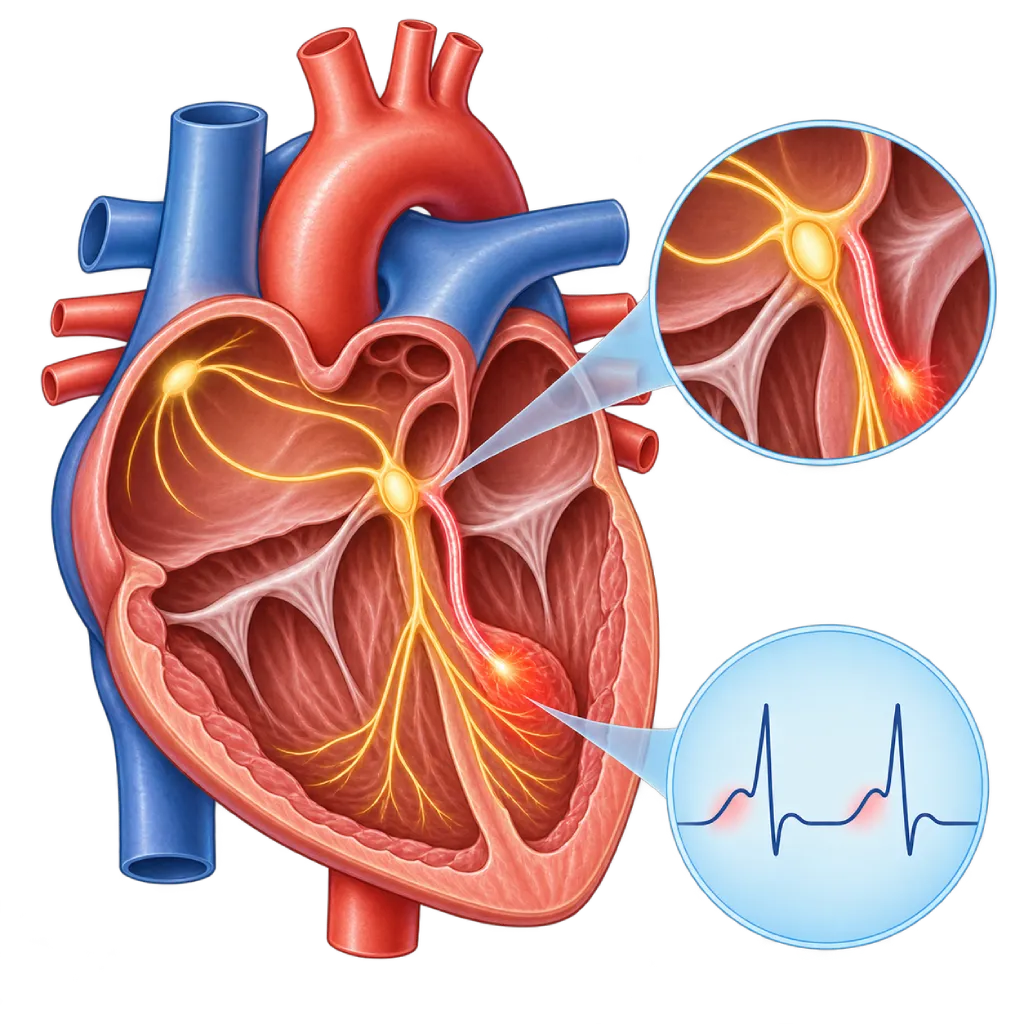
Pre-excitation syndrome is a condition in which part of the heart's lower chambers receives the electrical signal early through an extra pathway present from birth, creating a characteristic pattern on an ECG. Some people with it have episodes of a fast heartbeat that can be treated, including with ablation.
SourcesSigns That Need Urgent Help
- Fainting or nearly losing consciousness
- A very fast, irregular heartbeat with severe dizziness
- Chest pain or severe shortness of breath
- Cold sweats, paleness, and severe weakness during an episode
- An episode that does not stop after the vagal maneuvers your doctor taught you
- A baby who is very limp, pale or grayish, or refuses to feed
If these signs appear, go to the nearest emergency department right away or call Heart Attack Center 1500 258.
01 / Understanding the condition
About Pre-Excitation Syndrome
Normally, the heart's electrical signal starts in the upper chambers and then passes through the AV node, a kind of gate that holds the signal briefly before passing it on to the lower chambers. This short pause gives the lower chambers time to fill with blood before they pump. In pre-excitation, there is an extra electrical pathway (accessory pathway), present from birth, that connects the upper and lower chambers without passing through this gate. As a result, part of the lower chambers receives the signal early. That is what the word pre-excitation means: stimulation that arrives ahead of time.
Pattern and Syndrome
On an ECG, pre-excitation appears as a short PR interval, a slurred start of the lower chamber wave (called a delta wave), and a slightly widened lower chamber wave. When these findings are present without symptoms, doctors call it a pre-excitation pattern. When they come with episodes of tachycardia, a fast heartbeat that starts and stops suddenly, the condition is called pre-excitation syndrome. This pattern is found in about 1 to 3 out of every 1,000 people, and many of them never have symptoms.
Types of Pre-Excitation Syndrome
A commonly seen type is Wolff-Parkinson-White (WPW) syndrome, covered on the Wolff-Parkinson-White Syndrome page. Rarer types are atypical extra pathways, such as Mahaim fibers, which produce a different ECG pattern. There are also concealed extra pathways that only conduct signals from the lower chambers to the upper chambers; these pathways are not visible on a standard ECG but can still trigger tachycardia. Lown-Ganong-Levine syndrome was once included in this group because of its short PR interval, but it has no delta wave and is now rarely used as a separate diagnosis.
Why It Should Be Checked
The extra pathway can form a signal loop with the AV node, causing episodes of tachycardia called AVRT, one type of supraventricular tachycardia. A rarer event, but the main reason for a doctor's assessment, occurs when a person develops atrial fibrillation. Certain extra pathways can pass this chaotic upper chamber rhythm to the lower chambers very rapidly and, in a small number of cases, trigger cardiac arrest.
For this reason, guidelines recommend a risk assessment of the extra pathway, especially for people with symptoms, athletes, and workers for whom fainting on the job would be dangerous. Catheter ablation can disable the extra pathway and, in many patients, stop the episodes over the long term.
02 / Understanding the condition
Types and Related Conditions
The following conditions belong to the Pre-Excitation Syndrome group. Open each one for a full explanation.
03 / Understanding the condition
Symptoms to Recognize.
Common Symptoms
Many people with a pre-excitation pattern have no symptoms. Symptoms usually appear during an episode of tachycardia.
- A fast, regular heartbeat that starts and stops suddenly
- A very fast heartbeat that feels irregular
- Strong heartbeats felt in the chest or neck
- Dizziness or lightheadedness
- Shortness of breath or chest discomfort
- Weakness, anxiety, or sweating during an episode
Symptoms in Infants
Babies cannot tell you that their heart is racing, so tachycardia episodes caused by an extra pathway are recognized by their behavior, skin color, and breathing.
- Constant fussiness, or instead looking very limp and sleepy
- Feeding poorly or stopping feeding
- Fast breathing or looking breathless
- Pale or grayish, sweaty skin
04 / Understanding the condition
What Causes This Condition?
- An extra electrical pathway that connects the upper and lower chambers without passing through the AV node
- Leftover tissue connecting the upper and lower chambers that did not disappear as the heart developed before birth
- Congenital heart defects that often come with extra pathways, especially Ebstein anomaly
- Changes in certain genes, such as PRKAG2, in a small number of cases that run in families
- Rare storage diseases that affect the heart muscle, such as Danon disease
- Triggers for episodes such as caffeine, alcohol, lack of sleep, stress, or strenuous physical activity
05 / Understanding the condition
Who Is at Higher Risk?
Genetic
The extra pathway is present from birth. A small number of cases run in families, for example linked to changes in the PRKAG2 gene, so your doctor may suggest an ECG for family members.
Medical
Ebstein anomaly, hypertrophic cardiomyopathy, and some rare storage diseases are more often accompanied by a pre-excitation pattern.
Age
A pre-excitation pattern can be seen from infancy. Tachycardia episodes often first appear in childhood, adolescence, or young adulthood, while in some babies the extra pathway stops working as they grow older.
Lifestyle
Excess caffeine, energy drinks, alcohol, stimulants, and lack of sleep do not create an extra pathway, but they can trigger episodes in people who already have one.
Groups at Higher Risk
- Children and Teens with a Pre-Excitation Pattern: Tachycardia episodes often first appear at school age or in the teen years. Pediatric guidelines recommend a risk assessment, especially before competitive sports.
- Athletes and High-Risk Workers: Athletes, drivers, pilots, and people who work at heights are advised to have a risk assessment of the extra pathway, because fainting on the job can endanger themselves and others.
- People with Ebstein Anomaly: This congenital defect of the tricuspid valve, covered on the Ebstein Anomaly page, often comes with one or more extra pathways.
- Families with Inherited Pre-Excitation: In families with certain gene changes, a pre-excitation pattern can occur together with thickened heart muscle and conduction problems, so family members should be checked.
06 / Understanding the condition
How Is It Diagnosed?
Pre-excitation is often found by chance on a routine ECG, for example during a health checkup or before surgery. Your doctor will ask whether you have ever had a racing heart, dizziness, or fainting, as well as about any family history of heart disease and sudden cardiac arrest. The ECG is then read carefully to confirm a delta wave and estimate the location of the extra pathway.
The next step is to assess the risk of the extra pathway. A pattern that comes and goes on an ECG or Holter recording, or that suddenly disappears during a treadmill test, usually indicates a low-risk pathway. Echocardiography looks for associated structural abnormalities. If you have symptoms, if tests from outside the body are not conclusive, or if you are an athlete or work in a field where fainting would be dangerous, your doctor may recommend an electrophysiology study. This test measures the capability of the extra pathway from inside the heart and can be followed directly by ablation in the same session.
Electrocardiogram (ECG)
Shows a short PR interval, a delta wave, and a widened lower chamber wave. A recording during an episode helps determine the type of tachycardia.
Holter Monitoring
Records the rhythm for 24 to 48 hours to capture episodes and see whether the pre-excitation pattern is constant or comes and goes.
Treadmill Stress Test
Shows whether the pre-excitation pattern suddenly disappears as the heart rate rises, a sign that the extra pathway is less able to conduct fast signals.
Echocardiography
Looks for associated structural abnormalities, such as Ebstein anomaly or thickened heart muscle, and assesses the strength of the heart's pumping.
Electrophysiology Study
Measures how fast the extra pathway can conduct signals, looks for other pathways, and locates them before ablation.
07 / Understanding the condition
Treatment Options.
Treatment is decided by a doctor after an assessment. The categories below can help you follow the conversation with your doctor.
Regular Monitoring
For people without symptoms who have a low-risk extra pathway, your doctor may suggest regular monitoring. This option is discussed together with you, including the possibility of ablation.
Vagal Maneuvers
Simple techniques that stimulate the vagus nerve and can stop an episode of a fast, regular heartbeat. Your doctor will teach you a technique that suits you.
Treating Episodes in the Emergency Room
Episodes that do not stop are treated with injected medicines or a controlled electrical shock (cardioversion). In atrial fibrillation with pre-excitation, some medicines that slow the AV node are avoided, so your doctor chooses a specific treatment.
Catheter Ablation
The extra pathway is disabled using a catheter inserted through a blood vessel in the groin. Guidelines recommend ablation for pre-excitation syndrome with symptoms and for pathways shown to be high risk.
Antiarrhythmic Medicines
For people who have not yet had or cannot have ablation, certain antiarrhythmic medicines can reduce episodes. The type and dose are determined by your doctor, because not all rhythm medicines are suitable for people with pre-excitation.
08 / Understanding the condition
Complications to Watch For.
Recurrent Tachycardia Episodes
A signal loop through the extra pathway causes episodes of a racing heart (AVRT) that can recur and disrupt daily activities, school, or work.
Atrial Fibrillation with a Very Fast Ventricular Rate
Certain extra pathways can pass the chaotic upper chamber rhythm to the lower chambers without filtering by the AV node, making the heartbeat very fast and irregular.
Sudden Cardiac Arrest
This is rare. Atrial fibrillation passed on very rapidly can turn into ventricular fibrillation. This is the main reason guidelines recommend a risk assessment of the extra pathway.
Weakened Heart Pump
In a small number of children and young people, uncoordinated contraction of the lower chambers due to pre-excitation can weaken the heart's pumping. This usually improves after ablation.
09 / Understanding the condition
What Can You Do?
- Keep a copy of your ECG and show it to every doctor or emergency room staff member who treats you
- Tell your doctor that you have a pre-excitation pattern before you are given any heart medicine
- Recognize and reduce triggers for episodes, such as excess caffeine, energy drinks, or alcohol
- Have a risk assessment before taking part in competitive sports or work where fainting would be dangerous
- Learn vagal maneuvers from your doctor and practice them when you are not having an episode
- Take your medicines as advised and do not stop them on your own
10 / Understanding the condition
When Should You See a Doctor?
A pre-excitation pattern on your ECG results should be discussed with a cardiologist, even if you have no symptoms. Your doctor will assess whether your extra pathway needs further testing or only monitoring. Make an appointment if any of the following applies to you, and go to the emergency room right away if warning signs appear.
- Your ECG results mention pre-excitation, a delta wave, or a WPW pattern
- Episodes of a racing heart that start and stop suddenly
- You are an athlete, plan to take part in competitive sports, or work as a driver or pilot
- A baby or child looks pale or limp, breathes fast, or feeds poorly
- Fainting, chest pain, or a very fast and irregular heartbeat: go to the emergency room right away
Don't Wait in an Emergency.
If symptoms are severe or come on suddenly, go to the nearest emergency department right away or call Heart Attack Center 1500 258, rather than waiting for an appointment.
11 / Common questions
Questions You May Have.
Frequently asked questions about pre-excitation syndrome.
What is the difference between a pre-excitation pattern and pre-excitation syndrome?
A pre-excitation pattern means signs of an extra pathway are seen on an ECG, but you have never had an episode of tachycardia. Pre-excitation syndrome means those signs come with symptoms, such as episodes of a racing heart. This distinction matters because the treatment is different. People with the syndrome are usually advised to have ablation, while people with the pattern and no symptoms first have their risk assessed before monitoring or ablation is decided.
Is pre-excitation without symptoms dangerous?
Most people with a pre-excitation pattern and no symptoms never have serious problems. However, a small number of extra pathways can conduct signals very rapidly and are risky if atrial fibrillation occurs. This risk cannot be judged from a single ECG, so your doctor may suggest Holter monitoring, a treadmill test, or an electrophysiology study depending on your age, work, and activities.
Can pre-excitation go away on its own?
In some people, yes. In babies, the extra pathway sometimes stops working in the first years of life. In adults, the pre-excitation pattern can also come and go or disappear with age, which usually indicates a pathway with low conduction ability. Even so, the decision to stop follow-up visits should be discussed with your cardiologist.
Do I have to have ablation?
Not always. Guidelines recommend ablation for people with pre-excitation syndrome who have symptoms and for pathways shown to be high risk during testing. For people without symptoms who have a low-risk pathway, ablation can be considered after discussing its benefits and risks, for example when work or sports require certainty. The decision is made together with your doctor once all test results are available.
Which medicines should I be careful with if I have pre-excitation?
During atrial fibrillation, some medicines commonly used to slow the heart rate act on the AV node and can let more signals pass through the extra pathway. For this reason, tell every doctor and emergency room staff member that you have a pre-excitation pattern, and bring a copy of your ECG. Do not change or stop heart medicines on your own; your doctor decides which medicines are safe.
Can I exercise?
In general, yes, but preferably after an assessment by your doctor. Guidelines recommend a risk assessment of the extra pathway for athletes in competitive sports, usually with an electrophysiology study. If the pathway is high risk, ablation usually allows you to return to sports. If you have palpitations, dizziness, or fainting during exercise, stop the activity and get checked right away.
Sources and Medical Review
Translated from the Indonesian edition medically reviewed by Dr. dr. Faris Basalamah, Sp.JP(K).
Sources as cited in the Indonesian edition.
- Brugada J, Katritsis DG, Arbelo E, et al. 2019 ESC Guidelines for the management of patients with supraventricular tachycardia. The Task Force for the management of patients with supraventricular tachycardia of the European Society of Cardiology (ESC). Eur Heart J. 2020;41(5):655-720.
- Page RL, Joglar JA, Caldwell MA, et al. 2015 ACC/AHA/HRS Guideline for the Management of Adult Patients With Supraventricular Tachycardia. Circulation. 2016;133(14):e506-e574.
- Cohen MI, Triedman JK, Cannon BC, et al. PACES/HRS Expert Consensus Statement on the Management of the Asymptomatic Young Patient with a Wolff-Parkinson-White (WPW, Ventricular Preexcitation) Electrocardiographic Pattern. Heart Rhythm. 2012;9(6):1006-1024.
- Obeyesekere MN, Leong-Sit P, Massel D, et al. Risk of arrhythmia and sudden death in patients with asymptomatic preexcitation: a meta-analysis. Circulation. 2012;125(19):2308-2315.
- Bagliani G, De Ponti R, Notaristefano F, et al. Ventricular preexcitation. Card Electrophysiol Clin. 2020;12(4):447-464.
- Gollob MH, Green MS, Tang AS, Roberts R. PRKAG2 cardiac syndrome: familial ventricular preexcitation, conduction system disease, and cardiac hypertrophy. Curr Opin Cardiol. 2002;17(3):229-234.
Doctors Who Treat This Condition

dr. Sunu B. Raharjo, Sp.JP(K), Ph.D.
Arrhythmia and Electrophysiology
Arrhythmia and Device Center
Clinical focusClinical and Interventional Electrophysiology · Cardiac Arrhythmia Ablation
View Profile
Dr. dr. Dicky A. Hanafy, Sp.JP(K)
Arrhythmia and Electrophysiology
Arrhythmia and Device Center +1 center
Clinical focusElectrophysiology and Arrhythmia Ablation · Pacemaker and ICD Implantation
View Profile
Dr. dr. Faris Basalamah, Sp.JP(K)
Interventional Cardiology
Coronary Intervention Procedures +1 center
Clinical focusComplex Coronary Intervention · Cardiac Electrophysiology
View Profile