
Quick answer
What Is Lown-Ganong-Levine Syndrome?
Lown-Ganong-Levine (LGL) syndrome is an old term for a short PR interval on the ECG without a delta wave, together with episodes of a fast, pounding heartbeat. Today it is rarely used as a separate diagnosis, and the episodes are treated according to the underlying type of tachycardia.
SourcesSigns That Need Urgent Help
- Fainting or nearly losing consciousness
- Severe chest pain or severe shortness of breath
- Very fast, irregular palpitations with severe dizziness
- An episode that does not stop after the vagal maneuvers your doctor taught you
If these signs appear, go to the nearest emergency department right away or call Heart Attack Center 1500 258.
01 / Understanding the condition
About Lown-Ganong-Levine Syndrome
In 1952, doctors Bernard Lown, William Ganong, and Samuel Levine reported a group of patients with two features: a short PR interval on the ECG and recurring episodes of a fast heartbeat. Unlike Wolff-Parkinson-White syndrome, the ventricular waves on their ECGs were normal, with no delta wave. This combination of findings later became known as Lown-Ganong-Levine syndrome, or LGL, and was once placed in the group of pre-excitation syndromes.
What a Short PR Interval Means
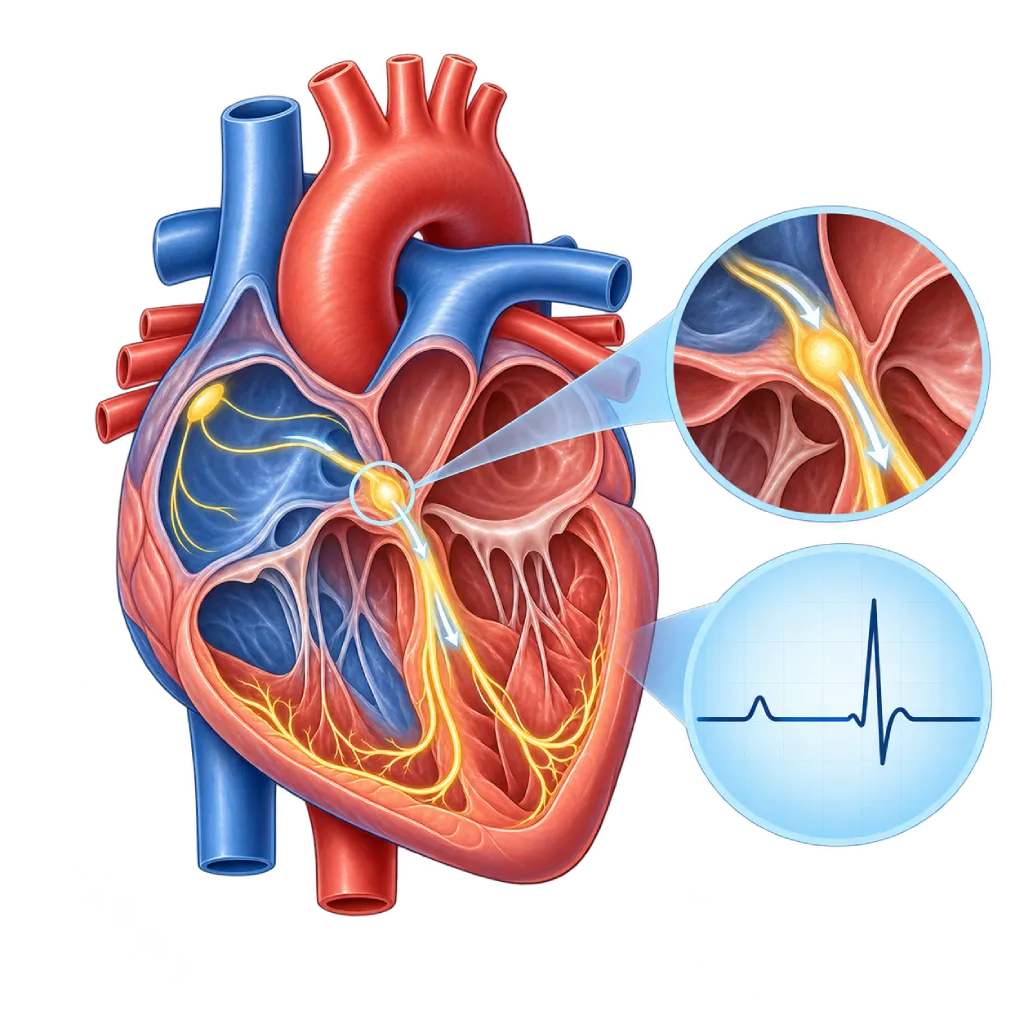
The PR interval on an ECG reflects the time an electrical signal takes to travel from the atria to the ventricles. The majority of that time is spent passing through the AV node, a gateway that briefly holds the signal before passing it on to the ventricles. In adults, the PR interval is considered short if it is less than 120 milliseconds. This means the signal passes through the AV node faster than usual.
Where LGL Stands Today
It was once thought that a small shortcut pathway, called James fibers, allowed the signal to skip part of the AV node. However, research using electrophysiology studies did not find a single pathway or structural abnormality shared by everyone with the condition. In many people, a short PR interval fits better with an AV node that naturally conducts signals faster, a state called enhanced AV nodal conduction. This finding is also fairly common in healthy people who have never had palpitations.
For this reason, many experts no longer regard LGL as a separate disease. The 2019 ESC guidelines on supraventricular tachycardia group episodes by their mechanism, not by the LGL pattern. When a person with a short PR interval has episodes of palpitations, the doctor looks for the type of tachycardia, such as AV nodal reentrant tachycardia, atrial tachycardia, a concealed accessory pathway, or atrial fibrillation, and then treats it according to that type.
Other Conditions to Rule Out
A short PR interval can also appear with a rhythm that starts in the lower part of the atria, in children, whose normal PR interval is naturally shorter, and in some rare storage diseases such as Fabry disease. That is why the doctor assesses this finding together with your symptoms and other test results. If there are no symptoms and no other disease is found, a short PR interval usually does not need treatment.
02 / Understanding the condition
Symptoms to Recognize.
Common Symptoms
A short PR interval by itself does not cause symptoms. The following symptoms appear when an episode of tachycardia occurs.
- A fast, pounding heartbeat that starts and stops suddenly
- A strong heartbeat felt in the chest or neck
- Dizziness or lightheadedness
- Shortness of breath or chest discomfort
- Weakness or tiring easily after an episode
03 / Understanding the condition
What Causes This Condition?
- An AV node that naturally conducts signals faster than usual
- A small shortcut pathway around the AV node (James fibers), an old theory that has not been proven in everyone with the condition
- Two pathways in the AV node that let the signal circle around and trigger an episode of tachycardia
- A rhythm from the lower part of the atria that makes the PR interval look short
- Rare storage diseases, such as Fabry disease, that can shorten the PR interval
- Triggers of episodes such as caffeine, alcohol, lack of sleep, or stress
04 / Understanding the condition
Who Is at Higher Risk?
Age
The normal PR interval is shorter in children and teenagers, so a short PR interval at a young age is often a normal variation and is judged according to age.
Medical
An overactive thyroid can trigger a fast heartbeat, and some rare storage diseases such as Fabry disease can shorten the PR interval.
Lifestyle
Too much caffeine, energy drinks, alcohol, stimulants, and lack of sleep can trigger episodes of palpitations in susceptible people.
Groups at Higher Risk
- Young People with Recurring Palpitations: Episodes of supraventricular tachycardia often start in the teenage years to young adulthood, including in people with a short PR interval.
- People with Atrial Fibrillation: Fast AV node conduction can make the ventricular rate faster during atrial fibrillation, so heart rate control needs to be monitored by a doctor.
- People with Rare Storage Diseases: Some rare storage diseases, such as Fabry disease, can shorten the PR interval, so a short PR finding is sometimes an early clue. Covered on the Fabry Disease page.
05 / Understanding the condition
How Is It Diagnosed?
A short PR interval is usually found on a routine ECG. The doctor first makes sure there is no delta wave, because if there is one, the finding points to Wolff-Parkinson-White syndrome, which is assessed and treated differently. The doctor also checks whether the short PR interval fits your age and whether there are signs of a rhythm from the lower atria or another disease, for example with echocardiography and a thyroid blood test.
If you have never had palpitations, testing usually stops here. If you have episodes, the main step is to record an ECG during an episode, for example with a Holter monitor or a long-term recorder. This recording shows the actual type of tachycardia. If episodes are frequent and bothersome, an electrophysiology study can confirm the mechanism and also serve as the basis for ablation.
Electrocardiogram (ECG)
Shows a PR interval of less than 120 milliseconds with a normal ventricular wave and no delta wave. A recording during an episode helps determine the type of tachycardia.
Holter Monitoring
Records the heart rhythm for 24 to 48 hours to capture episodes that happen often.
Long-Term Heart Rhythm Monitoring
A recorder worn for longer, or activated by you when you feel palpitations, if episodes are infrequent.
Thyroid Function Test
Looks for an overactive thyroid gland, which can trigger or worsen a fast heartbeat.
Echocardiography
Assesses the structure and pumping strength of the heart, including signs of thickened muscle in storage diseases.
Electrophysiology Study
Confirms the mechanism of the episodes and assesses AV node conduction from inside the heart, followed by ablation if a treatable source is found.
06 / Understanding the condition
Treatment Options.
Treatment is decided by a doctor after an assessment. The categories below can help you follow the conversation with your doctor.
Monitoring When There Are No Symptoms
A short PR interval without symptoms and without other disease usually does not need treatment. Your doctor may suggest a checkup if new symptoms appear.
Vagal Maneuvers
Simple techniques to stimulate the vagus nerve that can stop some episodes of a fast, regular heartbeat. Your doctor will teach you a technique that is safe for you.
Medicines to Control Episodes
Beta blockers or calcium channel blockers can reduce episodes or slow the heart rate. The choice of medicine and the dose are decided by your doctor based on the type of tachycardia.
Catheter Ablation
If an electrophysiology study finds the source of the episodes, such as two pathways in the AV node or a concealed accessory pathway, that source can be disabled through a catheter. The short PR interval itself is not a target for ablation.
Treating Episodes in the Emergency Room
Episodes that do not stop are treated with injected medicines or a controlled electric shock under ECG monitoring.
07 / Understanding the condition
Complications to Watch For.
Recurring Tachycardia Episodes
Frequent episodes of palpitations can disrupt daily activities, sleep, and your sense of security, although they usually do not damage the heart.
Fast Ventricular Rate During Atrial Fibrillation
If atrial fibrillation or atrial flutter occurs, an AV node that conducts signals faster can make the ventricular rate faster than usual, so symptoms feel more severe.
Fainting and Injury
In a small number of people, a very fast episode lowers blood pressure, causing fainting and possible injury from a fall.
08 / Understanding the condition
What Can You Do?
- Identify and cut back on triggers, such as too much coffee, energy drinks, or alcohol
- Get enough sleep and manage stress
- Avoid smoking and stimulants
- Keep a copy of your ECG and show it when you see a doctor
- Record an ECG during an episode if possible, and bring the result to your checkup
- Take your medicines as advised and do not stop them on your own
09 / Understanding the condition
When Should You See a Doctor?
A short PR interval without symptoms is usually harmless, but it is a good idea to discuss it with a doctor so that a delta wave and other causes can be ruled out. Make an appointment if you experience any of the following, and go to the emergency room right away if danger signs appear.
- Your ECG report mentions a short PR interval or LGL syndrome
- Episodes of a fast heartbeat that start and stop suddenly
- Episodes that make you dizzy or short of breath, or force you to stop what you are doing
- You plan to take part in competitive sports and want your ECG assessed
- Fainting, chest pain, or a very fast heartbeat that does not stop: go to the emergency room right away
Don't Wait in an Emergency.
If symptoms are severe or come on suddenly, go to the nearest emergency department right away or call Heart Attack Center 1500 258, rather than waiting for an appointment.
10 / Common questions
Questions You May Have.
Frequently asked questions about Lown-Ganong-Levine syndrome.
Is LGL syndrome still considered a disease?
The term LGL still sometimes appears on ECG reports, but many experts no longer regard it as a separate disease. Research has not found a single pathway or abnormality shared by everyone with the condition, and a short PR interval is often seen in healthy people. Today doctors focus more on the type of palpitation episodes you have, because that is what determines the treatment.
What is the difference between LGL and WPW?
Both have a short PR interval. In WPW there is a clear extra electrical pathway, so the ECG shows a delta wave and a widened ventricular wave. In LGL, the ventricular wave is normal with no delta wave, and the signal still passes through the AV node. This difference matters because WPW requires an assessment of the risk from the extra pathway, while a short PR interval without a delta wave usually does not.
Is a short PR interval dangerous?
A short PR interval without a delta wave and without symptoms is usually harmless and does not need treatment. Your doctor still needs to check for other causes, such as a rhythm from the lower atria or a rare storage disease. If you have episodes of palpitations, fainting, or chest pain, it is those symptoms that need further testing, not the PR number alone.
Does LGL need ablation?
The short PR interval itself is not treated with ablation. Ablation is considered if you have frequent or bothersome episodes of tachycardia and an electrophysiology study finds the source, such as two pathways in the AV node or a concealed accessory pathway. Once the source is disabled, the episodes do not come back in many patients. Your doctor will explain the benefits and risks based on the test findings.
Can I exercise if my PR interval is short?
In general, yes. A short PR interval without a delta wave and without symptoms is usually not a reason to stop exercising. If you have a very fast heartbeat, feel dizzy, or nearly faint during exercise, stop the activity and get checked. Competitive athletes should bring their ECG results for a doctor to assess before competing.
What should I do if my ECG report mentions LGL?
Do not panic. Take your ECG results to a cardiologist to make sure there is no delta wave and no other cause. Describe whether you have ever had palpitations, dizziness, or fainting, along with what triggered them. If you have no symptoms, treatment is usually not needed. If you have episodes, your doctor will record your heart rhythm to find out the type of tachycardia.
Sources and Medical Review
Translated from the Indonesian edition medically reviewed by dr. Sunu B. Raharjo, Sp.JP(K), Ph.D..
Sources as cited in the Indonesian edition.
- Lown B, Ganong WF, Levine SA. The syndrome of short P-R interval, normal QRS complex and paroxysmal rapid heart action. Circulation. 1952;5(5):693-706.
- Brugada J, Katritsis DG, Arbelo E, et al. 2019 ESC Guidelines for the management of patients with supraventricular tachycardia. The Task Force for the management of patients with supraventricular tachycardia of the European Society of Cardiology (ESC). Eur Heart J. 2020;41(5):655-720.
- Page RL, Joglar JA, Caldwell MA, et al. 2015 ACC/AHA/HRS Guideline for the Management of Adult Patients With Supraventricular Tachycardia. Circulation. 2016;133(14):e506-e574.
- Scheinman M. Enhanced AV nodal conduction and Brenchenmacher tracts. Pacing Clin Electrophysiol. 2013;36(2):135-136.
- Hunter J, Tsounias E, Cogan J, Young ML. A case of Lown-Ganong-Levine syndrome: due to an accessory pathway of James fibers or enhanced atrioventricular nodal conduction (EAVNC)? Am J Case Rep. 2018;19:309-313.
- Aryana A, Fifer MA, Ruskin JN, Mela T. Short PR interval in the absence of preexcitation: a characteristic finding in a patient with Fabry disease. Pacing Clin Electrophysiol. 2008;31(6):782-783.
Doctors Who Treat This Condition

dr. Sunu B. Raharjo, Sp.JP(K), Ph.D.
Arrhythmia and Electrophysiology
Arrhythmia and Device Center
Clinical focusClinical and Interventional Electrophysiology · Cardiac Arrhythmia Ablation
View Profile
Dr. dr. Faris Basalamah, Sp.JP(K)
Interventional Cardiology
Coronary Intervention Procedures +1 center
Clinical focusComplex Coronary Intervention · Cardiac Electrophysiology
View Profile
Dr. dr. Dicky A. Hanafy, Sp.JP(K)
Arrhythmia and Electrophysiology
Arrhythmia and Device Center +1 center
Clinical focusElectrophysiology and Arrhythmia Ablation · Pacemaker and ICD Implantation
View Profile