
Quick answer
What Is Treadmill Stress Test?
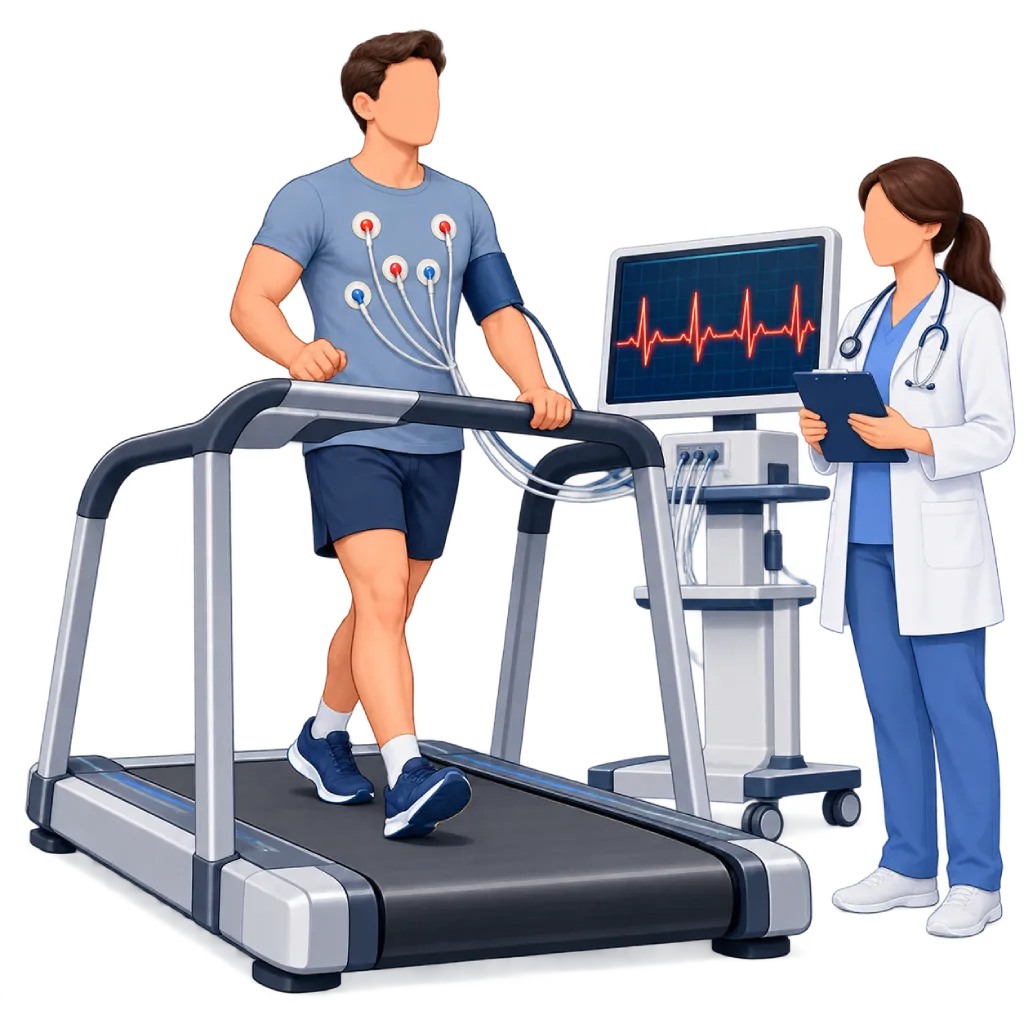
A treadmill stress test, or exercise test, is an ECG recorded while you walk on a treadmill with gradually increasing speed and incline. It assesses your exercise capacity, blood pressure, heart rhythm, and signs of reduced blood flow to the heart muscle during exertion. The whole test takes about 30 to 60 minutes.
Sources01 / Understanding the procedure
About Treadmill Stress Test
What Is a Treadmill Stress Test
A treadmill stress test is a heart stress test using exercise. You walk on a treadmill whose speed and incline are increased every few minutes, while your ECG, blood pressure, and symptoms are continuously monitored. This test is also known as a cardiac exercise test or exercise stress test. Its purpose is to see how the heart responds when it has to work harder than at rest.
How It Works in Brief
During exercise, the heart muscle needs more oxygen. If the coronary arteries are narrowed, blood flow cannot increase enough, so part of the heart muscle does not get enough blood. This can cause chest pain and characteristic changes on the ECG recording that are not seen at rest. In some people, this lack of blood flow causes no symptoms and is only visible as ECG changes. The test usually follows standard stages, such as the Bruce protocol, which increases the workload every 3 minutes.
What Is Assessed
Besides ECG changes, the doctor assesses how long you are able to walk, the rise in your heart rate and blood pressure, any rhythm disturbances, and how quickly your heart rate falls after you stop. Your exercise capacity is itself a strong indicator of heart health, and so are blood pressure that does not rise during exercise and a heart rate that is slow to fall after the test. The test results are also used to set a safe exercise level, for example in a cardiac rehabilitation program.
Uses and Limitations
A treadmill stress test is easy to do and uses no radiation or contrast. However, it is less accurate at finding coronary narrowing than stress tests with imaging. The 2024 European guidelines favor stress testing with imaging or coronary CT to confirm coronary artery disease, while the 2021 American guidelines still accept a treadmill stress test for certain patients whose resting ECG is normal and who are able to exercise. The ECG results are also hard to read if the resting ECG is already abnormal, for example in people with a pacemaker.
Treadmill Stress Test and Other Tests
When a clearer picture is needed, treadmill exercise can be combined with a heart ultrasound, which is covered on the Stress Echocardiography page, or with a radioactive tracer, which is covered on the Myocardial Perfusion Imaging page. For people who cannot walk long enough, the exercise can be replaced with medication in both of these tests.
02 / Understanding the procedure
When Is This Procedure Considered?
A doctor may consider this procedure in the situations below. The decision is always made after a thorough assessment.
- Chest Pain During ActivityLooks for signs of reduced blood flow to the heart muscle that appear during exertion.
- Assessing Exercise Capacity and RiskIn known coronary artery disease, to decide on the next steps.
- Before a Cardiac Rehabilitation ProgramSets a safe exercise level after a heart attack or heart procedure.
- Rhythm Disturbances During ExerciseChecks whether palpitations or rhythm disturbances appear during exertion.
- Shortness of Breath During ActivityHelps assess whether the symptom comes from the heart or from reduced fitness.
- Before Starting Vigorous ExerciseFor certain people at risk of heart disease who want to do vigorous exercise.
Situations to Consider First
- Recent Heart Attack or Unstable AnginaThe test is postponed until your condition is stable, as assessed by the doctor.
- Uncontrolled Dangerous Rhythm DisordersThese need to be treated before the heart is put under stress.
- Severe Aortic Valve Narrowing with SymptomsExercise can trigger fainting or rhythm disturbances.
- Other Acute IllnessesFor example, pulmonary embolism, inflammation of the heart muscle, a tear in the aorta, or fever.
- Unable to Walk on a TreadmillA stress test with medication combined with imaging is more suitable.
03 / Before the procedure
How Should You Prepare?
Follow the instructions the team gives you when your test is scheduled.
Eating and drinking. A light meal is fine, but avoid heavy meals for about 2 to 3 hours beforehand. Avoid coffee, tea, and smoking on the day of the test.
Medications. Your doctor may ask you to temporarily stop medications that slow the heart rate, such as beta blockers, depending on the purpose of the test. Do not stop any medication on your own.
Clothing and shoes. Wear comfortable clothing and sports shoes that are safe for brisk walking.
Bring your records. Bring a list of your medications and any previous ECG or heart test results. Let the team know if you have joint pain or balance problems, or have had chest pain in the past few days.
Unsure about the preparation instructions? Ask our team before the procedure.
04 / During the procedure
How Is the Procedure Done?
A treadmill stress test is done in an exercise testing room under a doctor's supervision, without anesthesia. The whole test takes about 30 to 60 minutes, while walking on the treadmill usually takes 6 to 12 minutes.
Attaching the Electrodes
The skin on your chest is cleaned, then about ten ECG electrodes are attached. A blood pressure cuff is placed on your arm. Your ECG and blood pressure at rest are recorded first.
Walking on the Treadmill
You start walking slowly. Every few minutes, the speed and incline are increased. The staff regularly ask about your symptoms and how tired you feel, while your ECG is continuously monitored on the screen.
When the Test Is Stopped
The test is stopped when you are too tired, your target heart rate is reached, or you develop chest pain, shortness of breath, dizziness, ECG changes, rhythm disturbances, or worrying changes in blood pressure. Speak up right away if you feel uncomfortable.
Recovery Period
After stopping, you walk slowly or sit while your ECG and blood pressure are monitored for about 5 to 10 minutes until they are close to normal again.
05 / Benefits and risks
Benefits and Risks Should Be Discussed Together.
Every medical procedure has benefits and risks. Your doctor will explain both for your situation before the procedure.
Benefits You Can Expect
- No Radiation or ContrastUses only ECG electrodes and a blood pressure device.
- Assesses Exercise CapacityHow long you can exercise and the workload you reach give clues about heart health.
- Symptoms Monitored DirectlySymptoms during activity can be matched with the ECG recording under a doctor's supervision.
- A Basis for Exercise LevelsThe results help set up a safe exercise and cardiac rehabilitation program.
- Easy to DoNo IV, needles, or complicated special preparation is needed.
The benefits of a procedure are not a promise of a cure. Ask how the results will affect your care plan.
Risks You Should Know
- Chest Pain or Shortness of Breath During ExerciseThe test is stopped if symptoms appear, and the team is ready to manage them.
- Heart Rhythm DisturbancesUsually mild and brief; severe rhythm disturbances are rare.
- Blood Pressure ChangesBlood pressure can rise very high or instead drop during exercise.
- Falls or Muscle InjuryPrevented with the treadmill handrails and a gradual increase in workload.
- False Positive or False Negative ResultsThe ECG sometimes changes without any narrowing, or stays normal even when narrowing is present.
- Serious EventsSuch as a heart attack; very rare, and the doctor assesses the risk before the test.
Risks can differ from person to person. A full explanation and consent are given after an individual assessment.
06 / After the procedure
What Is Recovery Like?
You can go home right away and resume your usual activities once your heart rate and blood pressure are back to normal. Feeling tired and achy after the test is normal and goes away with rest.
Test results. The doctor assesses the ECG recording, your exercise capacity, blood pressure, and symptoms during the test, then explains the results during your consultation. If the results are inconclusive or abnormal, the doctor may request further tests.
Medications. If any medication was temporarily stopped, ask when you can start taking it again.
Warning signs to watch for. Go to the emergency room right away if you experience:
- Chest pain that does not go away with rest
- Shortness of breath that gets worse
- A very fast or irregular heartbeat
- Severe dizziness or fainting
Know the Signs That Need Prompt Care.
Follow the team's guidance on warning signs. If severe or sudden symptoms appear after the procedure, go to the nearest emergency department right away or call Heart Attack Center 1500 258.
07 / Team and support
Doctors and Procedure Support
The doctors below are listed for this procedure. Listed by name, not by ranking.

Dr. med. dr. Denio A. Ridjab, Sp.JP(K)
Interventional Cardiology
Coronary Intervention Procedures +2 centers
Clinical focusInterventional Cardiology · Coronary Artery Disease
View Profile
Dr. dr. Jajang Sinardja, Sp.JP(K)
Interventional Cardiology
Coronary Intervention Procedures
Clinical focusAcute Coronary Syndrome · Primary Coronary Intervention
View Profile
dr. Sri Diniharini, Sp.JP(K)
Echocardiography & Cardiovascular Imaging
Cardiovascular Diagnostic Center +1 center
Clinical focusAdvanced Echocardiography · Transesophageal Echocardiography
View ProfileTreadmill Test System
A testing system that records your ECG, heart rate, and blood pressure while you walk on a treadmill as the workload increases in…
The availability of technology and test support is confirmed with the team. Technology is chosen according to clinical need.
08 / Common questions
Before You Plan the Procedure.
Frequently asked questions about the treadmill stress test, from preparation to what the results mean.
How is a treadmill stress test different from stress echocardiography?
Both can stress the heart using a treadmill. A treadmill stress test only assesses the ECG recording, blood pressure, and symptoms. Stress echocardiography adds heart ultrasound images before and after exercise, so the doctor can directly see parts of the heart wall that weaken. Stress echocardiography is more accurate for finding coronary narrowing, especially if your resting ECG is already abnormal.
Do I have to run?
Not always. The test starts with slow walking, then the speed and incline are increased gradually. Many people finish without needing to run. What matters is trying to reach a high enough workload for your ability, because a workload that is too light can make the results hard to interpret. You can ask to stop at any time if you feel unable to continue or uncomfortable.
Is a treadmill stress test safe?
A treadmill stress test is generally safe because it is done under a doctor's supervision, with continuous ECG and blood pressure monitoring and a gradual increase in workload. The doctor first makes sure you do not have a condition that would make the test dangerous, such as a recent heart attack. Serious events are very rare. The test is stopped as soon as symptoms or worrying changes appear.
Do I need to stop taking my medications?
Sometimes. Medications that slow the heart rate, such as beta blockers, can make it hard for your heart rate to reach the target, so the results are harder to interpret. However, if the goal is to assess your capacity while taking your medications, they are kept as usual. Your doctor decides which medications to stop and for how long. Do not stop any medication without your doctor's instructions.
What if the result is positive?
A positive result means there are ECG changes or symptoms that suggest a possible lack of blood flow to the heart muscle during exercise. This does not necessarily mean there is a narrowing, because a treadmill stress test can give false positive results, especially in women. The doctor may follow up with a stress test with imaging, coronary CT, or cardiac catheterization, depending on the findings and your symptoms.
What if I cannot manage walking on the treadmill?
If joint pain, balance problems, or another illness keeps you from walking long enough, a treadmill stress test is less suitable. The doctor may choose a stress test with medication combined with heart ultrasound or nuclear imaging, or coronary CT to look at the coronary arteries directly. Let the team know about your limitations when scheduling your test.
Sources and Medical Review
Translated from the Indonesian edition medically reviewed by dr. Sri Diniharini, Sp.JP(K).
Sources as cited in the Indonesian edition.
- Fletcher GF, Ades PA, Kligfield P, et al. Exercise Standards for Testing and Training: A Scientific Statement From the American Heart Association. Circulation. 2013;128(8):873-934.
- Myers J, Arena R, Franklin B, et al. Recommendations for Clinical Exercise Laboratories: A Scientific Statement From the American Heart Association. Circulation. 2009;119(24):3144-3161.
- Vrints C, Andreotti F, Koskinas KC, et al. 2024 ESC Guidelines for the management of chronic coronary syndromes. Eur Heart J. 2024;45(36):3415-3537.
- Gulati M, Levy PD, Mukherjee D, et al. 2021 AHA/ACC/ASE/CHEST/SAEM/SCCT/SCMR Guideline for the Evaluation and Diagnosis of Chest Pain: A Report of the American College of Cardiology/American Heart Association Joint Committee on Clinical Practice Guidelines. Circulation. 2021;144(22):e368-e454.
- Pelliccia A, Sharma S, Gati S, et al. 2020 ESC Guidelines on sports cardiology and exercise in patients with cardiovascular disease. Eur Heart J. 2021;42(1):17-96.
- Ambrosetti M, Abreu A, Corrà U, et al. Secondary prevention through comprehensive cardiovascular rehabilitation: From knowledge to implementation. 2020 update. A position paper from the Secondary Prevention and Rehabilitation Section of the European Association of Preventive Cardiology. Eur J Prev Cardiol. 2021;28(5):460-495.