
Quick answer
What Is Arrhythmia Screening?
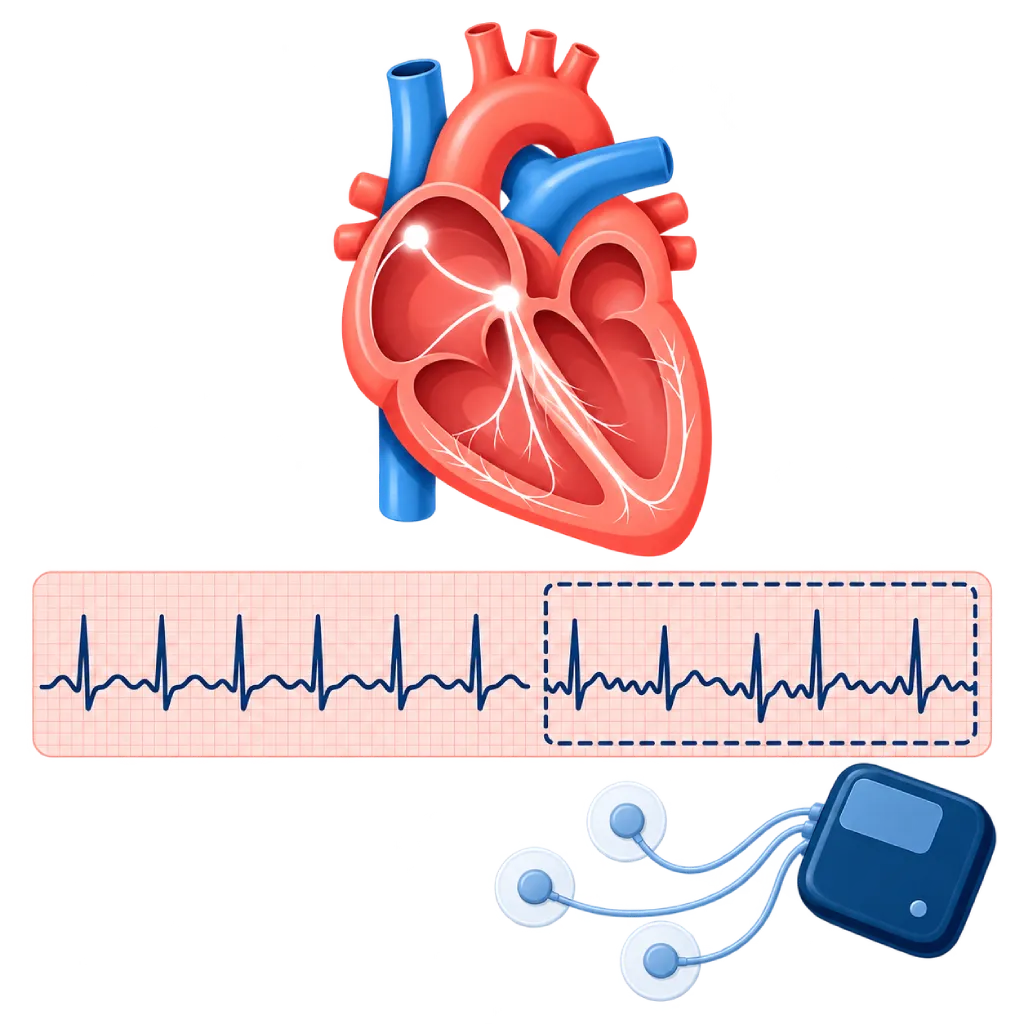
Arrhythmia screening is a check to find heart rhythm disorders that have not yet been diagnosed, especially atrial fibrillation. This disorder often causes no symptoms but increases the risk of stroke. The check involves feeling the pulse and an ECG, sometimes with a multi-day ECG recording, and is mainly recommended for people aged 65 and older.
Sources01 / Understanding the procedure
About Arrhythmia Screening
What Is Arrhythmia Screening
An arrhythmia is a heart rhythm disorder, for example a heartbeat that is too fast, too slow, or irregular. Arrhythmia screening aims to find rhythm disorders in people who do not know they have one. Its main target is atrial fibrillation, an irregular rhythm that often causes no symptoms but can form clots in the heart and cause a stroke.
How It Works in Brief
Each heartbeat is triggered by an electrical signal that can be recorded through electrodes on the skin as an ECG. In a normal rhythm, the intervals between beats are regular. In atrial fibrillation, the upper chambers of the heart quiver irregularly, so the intervals between beats are random. Because rhythm disorders can come and go, a longer recording, for example over several days, gives a better chance of finding them.
Tests Used
- Pulse check and ECG: a quick basic test. This is covered on the Electrocardiogram (ECG) page.
- Longer ECG recording: a Holter monitor or patch recorder worn at home for 1 to several days. This is covered on the Holter Monitoring page.
- Personal devices: a smartwatch or handheld ECG device can flag an irregular rhythm, but a diagnosis still requires an ECG recording reviewed by a doctor.
Who Should Be Screened
Guidelines recommend a pulse check or ECG during clinic visits for people aged 65 and older. Longer recordings may be considered for people aged 75 and older, or 65 and older with stroke risk factors such as hypertension, diabetes, or heart failure. Screening is also recommended for close relatives of people who died suddenly at a young age. If you already have palpitations or dizziness, or have fainted, the test is no longer screening but a test to find the cause.
02 / Understanding the procedure
When Is This Procedure Considered?
A doctor may consider this procedure in the situations below. The decision is always made after a thorough assessment.
- Age 65 and OlderAtrial fibrillation becomes more common with age.
- Hypertension, Diabetes, or Heart FailureFactors that increase the risk of atrial fibrillation and stroke.
- History of Stroke or Transient Ischemic AttackTo look for atrial fibrillation as a preventable cause.
- Family Member Who Died Suddenly at a Young AgeTo look for inherited electrical disorders of the heart.
- Athletes or Starting Strenuous ExerciseAn ECG helps identify abnormalities that pose a risk during strenuous activity.
- Irregular Rhythm Alert from a SmartwatchNeeds to be confirmed with an ECG reviewed by a doctor.
Situations to Consider First
- Severe Symptoms Happening NowChest pain, shortness of breath, or fainting require immediate care, not screening.
- Irritated Chest Skin or Adhesive AllergyTell the staff so suitable electrodes can be chosen.
- Difficulty Keeping the Device in PlaceA long recording may be incomplete; the staff will help choose a device.
- Comparing with Smartwatch ResultsResults from personal devices do not replace a medical ECG.
03 / Before the procedure
How Should You Prepare?
Arrhythmia screening usually needs no special preparation.
Clothing. Wear clothing that is easy to open at the chest. Avoid lotion or oil on your chest skin so the electrodes stick well.
Medications. Keep taking your regular medications. Bring a list of your medications, especially heart, thyroid, and blood-thinning medications.
Symptom notes and device data. If you use a smartwatch or handheld ECG device, bring the recordings or screenshots that show an irregular rhythm.
Family history. Note whether any family members died suddenly, fainted repeatedly, or had a pacemaker at a young age.
Unsure about the preparation instructions? Ask our team before the procedure.
04 / During the procedure
How Is the Procedure Done?
A consultation with a pulse check and ECG usually takes about 30 minutes. If the doctor recommends a longer recording, the device is fitted at the clinic and then worn at home for 1 to several days.
Interview and Pulse Check
The doctor asks about your medical history, medications, and family, then feels your pulse and checks your blood pressure.
ECG Recording
Electrodes are placed on your chest, arms, and legs. You lie still for a few minutes while your heart rhythm is recorded.
Longer Recording If Needed
A small Holter device or patch recorder is fitted, and you go about your usual activities at home while noting the time whenever you have symptoms.
Reading the Results
The doctor reviews the recording and explains whether there is a rhythm disorder, what the risks are, and the next steps.
05 / Benefits and risks
Benefits and Risks Should Be Discussed Together.
Every medical procedure has benefits and risks. Your doctor will explain both for your situation before the procedure.
Benefits You Can Expect
- Finds Atrial Fibrillation EarlierBefore it causes a stroke.
- Prevents StrokeThe right blood-thinning medication lowers the risk of stroke in atrial fibrillation.
- Quick and PainlessAn ECG takes only a few minutes and involves no needles.
- Identifies Inherited DisordersImportant for relatives of people who died suddenly at a young age.
- Confirms Smartwatch AlertsDistinguishes a true arrhythmia from a false result.
The benefits of a procedure are not a promise of a cure. Ask how the results will affect your care plan.
Risks You Should Know
- Itchy or Red SkinCaused by the electrode adhesive; usually goes away on its own.
- A Normal Result Is Not a GuaranteeRhythm disorders that occur rarely may not be recorded.
- Minor, Harmless FindingsSuch as occasional extra beats that usually do not need treatment.
- Further TestsSome findings require echocardiography or a longer recording.
Risks can differ from person to person. A full explanation and consent are given after an individual assessment.
06 / After the procedure
What Is Recovery Like?
There is no recovery period. You can return to your activities right away.
While wearing a Holter. Keep the device dry and do not take a bath. Follow the staff's instructions about showering and sleeping.
If atrial fibrillation is found. The doctor assesses your stroke risk and decides whether you need blood-thinning medication, and also treats triggering factors such as high blood pressure, body weight, and breathing problems during sleep.
Warning signs. Go to the emergency room right away if you have:
- A very fast heartbeat with chest pain or shortness of breath
- Fainting or nearly fainting
- A drooping face, arm weakness, or slurred speech
- A very slow pulse with severe dizziness
Know the Signs That Need Prompt Care.
Follow the team's guidance on warning signs. If severe or sudden symptoms appear after the procedure, go to the nearest emergency department right away or call Heart Attack Center 1500 258.
07 / Team and support
Doctors and Procedure Support
The doctors below are listed for this procedure. Listed by name, not by ranking.

Dr. med. dr. Denio A. Ridjab, Sp.JP(K)
Interventional Cardiology
Coronary Intervention Procedures +2 centers
Clinical focusInterventional Cardiology · Coronary Artery Disease
View Profile
Dr. dr. Faris Basalamah, Sp.JP(K)
Interventional Cardiology
Coronary Intervention Procedures +1 center
Clinical focusComplex Coronary Intervention · Cardiac Electrophysiology
View Profile
dr. Sunu B. Raharjo, Sp.JP(K), Ph.D.
Arrhythmia and Electrophysiology
Arrhythmia and Device Center
Clinical focusClinical and Interventional Electrophysiology · Cardiac Arrhythmia Ablation
View ProfileHolter Monitoring System
A small ECG recorder that you wear during daily activities to monitor your heart rhythm continuously for 24 to 48 hours or…
The availability of technology and test support is confirmed with the team. Technology is chosen according to clinical need.
08 / Common questions
Before You Plan the Procedure.
Questions people often ask about arrhythmia screening. Your doctor will explain what the results mean for your condition.
What is atrial fibrillation, and why should it be looked for?
Atrial fibrillation is a rhythm disorder in which the upper chambers of the heart quiver irregularly. Blood can pool and form clots that travel to the brain, raising the risk of stroke several times over. Many people with it have no symptoms, so screening helps find it before a stroke occurs and allows prevention with medication.
Is a smartwatch enough to detect an arrhythmia?
Smartwatches and handheld ECG devices can flag an irregular rhythm, but they are sometimes wrong. Guidelines state that a diagnosis of atrial fibrillation must be confirmed with an ECG recording reviewed by a doctor. If your device gives you an alert, bring the recording to your consultation, and do not start or stop any medication on your own.
Does everyone need arrhythmia screening?
No. The benefits of screening are clearer in people aged 65 and older, especially those with stroke risk factors, and in relatives of people who died suddenly at a young age. In young people without symptoms or a family history, routine screening is usually not needed. Evidence on the benefits of mass screening is also still being studied.
What if my ECG result is normal?
A normal ECG shows that your heart rhythm was fine while it was being recorded. Because rhythm disorders can come and go, a normal result does not completely rule out an arrhythmia. If you have palpitations that come and go or are at high risk, your doctor may recommend a longer recording, such as a Holter for several days.
What happens if atrial fibrillation is found?
The doctor assesses your stroke risk based on your age and other conditions, then decides whether you need blood-thinning medication. The doctor also looks for causes and triggers, such as hypertension, thyroid problems, or breathing problems during sleep. Treatment to control the heart rhythm or heart rate is discussed based on your symptoms and heart condition.
Why should relatives of someone who died suddenly be checked?
Some sudden deaths at a young age are caused by inherited electrical or muscle disorders of the heart, such as long QT syndrome. These disorders can often be identified with an ECG and other tests before they cause a dangerous event. If one is found, there are preventive steps that can be taken.
Sources and Medical Review
Translated from the Indonesian edition medically reviewed by Dr. dr. Faris Basalamah, Sp.JP(K).
Sources as cited in the Indonesian edition.
- Van Gelder IC, Rienstra M, Bunting KV, et al. 2024 ESC Guidelines for the management of atrial fibrillation developed in collaboration with the European Association for Cardio-Thoracic Surgery (EACTS). Eur Heart J. 2024;45(36):3314-3414.
- US Preventive Services Task Force, Davidson KW, Barry MJ, et al. Screening for atrial fibrillation: US Preventive Services Task Force recommendation statement. JAMA. 2022;327(4):360-367.
- Svennberg E, Friberg L, Frykman V, et al. Clinical outcomes in systematic screening for atrial fibrillation (STROKESTOP): a multicentre, parallel group, unmasked, randomised controlled trial. Lancet. 2021;398(10310):1498-1506.
- Zeppenfeld K, Tfelt-Hansen J, de Riva M, et al. 2022 ESC Guidelines for the management of patients with ventricular arrhythmias and the prevention of sudden cardiac death. Eur Heart J. 2022;43(40):3997-4126.