
Quick answer
What Is Sudden Cardiac Death?
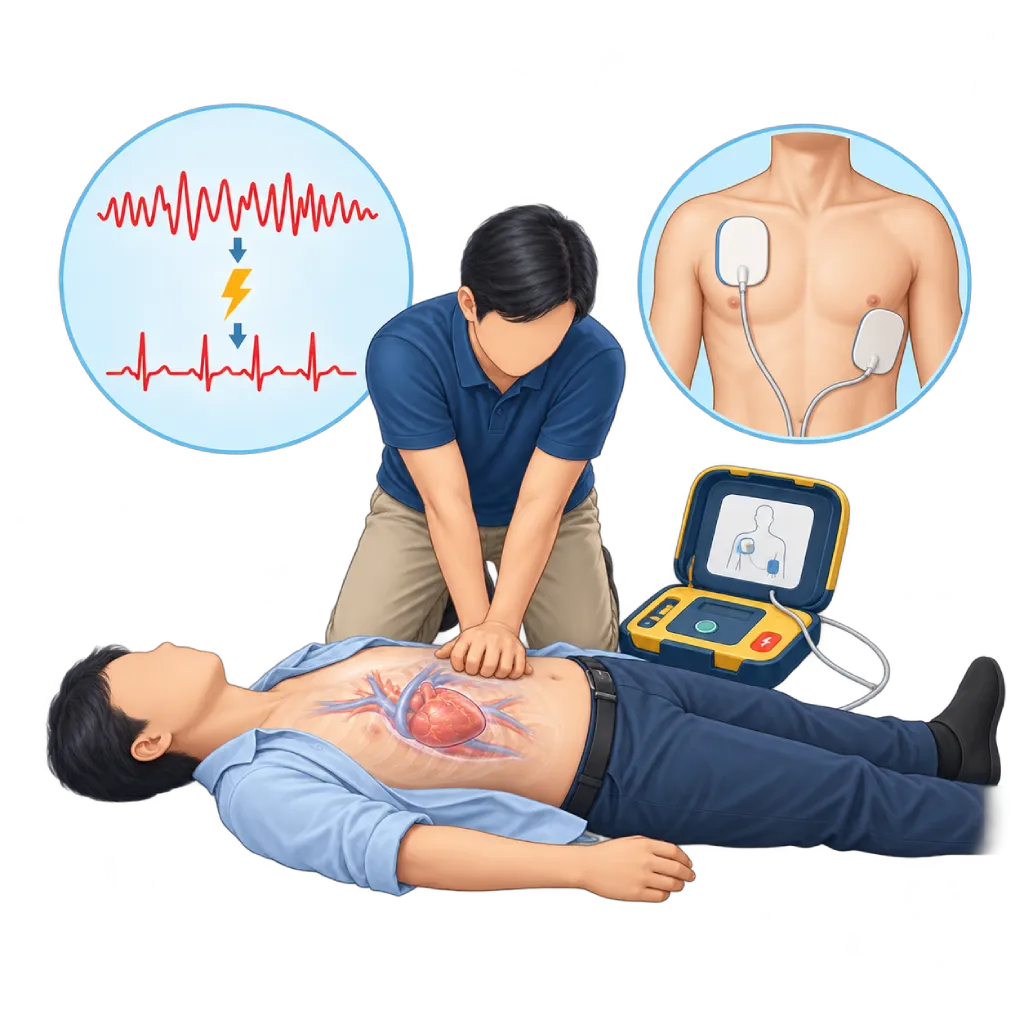
Sudden cardiac death is an unexpected death that occurs because the heart suddenly stops pumping, usually due to a severe rhythm disorder. Cardiac arrest can still be treated: call emergency services, start chest compressions, and use an AED.
Sources01 / Understanding the condition
About Sudden Cardiac Death
Sudden cardiac death is a death that happens suddenly from a heart cause, usually within one hour of symptoms starting, or in a person found dead after being seen healthy within the previous 24 hours. The event that comes before it is called sudden cardiac arrest: the heart suddenly stops pumping blood, so the person collapses, becomes unconscious, and does not breathe normally. Cardiac arrest does not always end in death. If help is given within a few minutes, some people can be saved.
How the Heart Suddenly Stops
In the majority of cases, cardiac arrest is caused by a dangerous rhythm disorder starting in the heart's lower chambers, either a very fast ventricular tachycardia or ventricular fibrillation, in which the lower chambers only quiver without pumping. These rhythms and how to help are covered on the Ventricular Fibrillation page. Less often, the heart stops because of a very slow heartbeat or because electrical activity no longer produces a pumping action.
Causes Differ by Age
In adults over 35, a common cause is coronary artery disease, including a heart attack in progress or scar tissue from an old heart attack. Heart failure with a weak pump also increases the risk. In children, teenagers, and young adults, the cause is more often an inherited cardiomyopathy, inflammation of the heart muscle, a congenital electrical disorder such as long QT syndrome and Brugada syndrome, or a congenital abnormality of the coronary arteries.
Often Preceded by Warning Signs
Cardiac arrest often seems to come without warning. However, some people have symptoms in the days or weeks before, such as chest pain, shortness of breath, palpitations, or fainting during activity. Symptoms like these, as well as a family history of sudden death at a young age, need to be checked.
Preventing and Helping
Prevention follows two paths. The first is controlling coronary artery disease and assessing the risk of people who already have heart disease; some are advised to have an implantable cardioverter defibrillator (ICD). The second is preparing the community: the more people who can give chest compressions and use an AED, the greater the chance that a victim survives. If someone dies suddenly at a young age, investigating the cause and screening the family help protect their relatives.
02 / Understanding the condition
Symptoms to Recognize.
Common Symptoms
Cardiac arrest often comes suddenly. Some people have the following signs in the minutes, days, or weeks before.
- Chest pain, pressure, or discomfort
- Unusual shortness of breath
- A very fast or irregular heartbeat
- Severe dizziness or nearly fainting
- Fainting during exercise, when startled, or without a clear cause
- Sudden weakness, nausea, or cold sweats
03 / Understanding the condition
What Causes This Condition?
- Ventricular fibrillation or ventricular tachycardia that stops the heart from pumping
- A heart attack or scar tissue from an old heart attack
- Heart failure with a weak pump
- Cardiomyopathy, such as hypertrophic, dilated, and arrhythmogenic cardiomyopathy
- Congenital electrical disorders, such as long QT syndrome and Brugada syndrome
- Inflammation of the heart muscle (myocarditis)
- Congenital abnormalities of the coronary arteries or severe valve disease
- Severe potassium or magnesium imbalance, certain medicines, or stimulant drugs
04 / Understanding the condition
Who Is at Higher Risk?
Medical
Coronary artery disease, a previous heart attack, heart failure with a low ejection fraction, cardiomyopathy, fainting caused by arrhythmia, and a previous cardiac arrest.
Genetic
A family history of sudden death before age 50 without a clear cause, or cardiomyopathy and heart electrical disorders that run in the family.
Lifestyle
Smoking, high blood pressure and cholesterol, uncontrolled diabetes, obesity, lack of physical activity, and stimulant drugs increase the risk, mainly through coronary artery disease.
Age
The risk rises with age and is higher in men, but sudden death can occur at a young age if there is a congenital or inherited heart condition.
Groups at Higher Risk
- People with Coronary Artery Disease: Especially during a heart attack and after a large heart attack that leaves scar tissue.
- People with Heart Failure and a Weak Pump: A low ejection fraction increases the risk of ventricular arrhythmias; some people are advised to have an ICD.
- People with Cardiomyopathy or Inherited Electrical Disorders: Hypertrophic and arrhythmogenic cardiomyopathy, long QT syndrome, and Brugada syndrome can cause cardiac arrest at a young age.
- Families of Young Sudden Death Victims: Some causes are inherited, so close relatives need to be checked even if they have no symptoms.
- Cardiac Arrest Survivors: The risk of recurrence is high if the cause was not temporary, so an ICD is generally recommended.
05 / Understanding the condition
How Is It Diagnosed?
Cardiac arrest is recognized from clinical signs: the person is unconscious, unresponsive, and not breathing normally. Rescuers do not need to wait for any tests. An AED will read the heart rhythm and give instructions.
In survivors, testing looks for the cause and the risk of recurrence, as explained on the Ventricular Fibrillation page: an ECG, blood tests including troponin and electrolytes, coronary angiography, echocardiography, and cardiac MRI. In people who have never had a cardiac arrest but are at risk, the doctor assesses the heart's pumping strength, arrhythmias recorded on a Holter monitor, any history of fainting, and family history. If someone dies suddenly at a young age, guidelines recommend an autopsy with a careful examination of the heart and, if needed, genetic testing of samples from the person who died. Close relatives are then advised to have an ECG, echocardiography, and other tests based on the suspected cause.
During the event, an AED or defibrillator monitor reads the heart rhythm and determines within seconds whether a shock is needed.
Electrocardiogram (ECG)
In survivors and in people at risk, an ECG looks for signs of a heart attack, long QT, a Brugada pattern, or an extra electrical pathway.
Coronary Angiography
Looks for, and if needed immediately opens, blocked coronary arteries that triggered the cardiac arrest.
Echocardiography
Measures pumping strength (ejection fraction), an important basis for assessing risk and the need for an ICD.
Cardiac MRI
Looks for scar tissue, inflammation, or cardiomyopathy when the cause is still unclear.
Holter Monitoring
Captures ventricular arrhythmias that come and go in people with symptoms or heart disease.
If the person has died, an autopsy and genetic testing help find a cause that may be inherited, so the family can be screened.
06 / Understanding the condition
Treatment Options.
Treatment is decided by a doctor after an assessment. The categories below can help you follow the conversation with your doctor.
Chest Compressions and AED
First aid by people nearby: call emergency services, push hard and fast in the center of the chest, and use an AED as soon as possible, following its voice prompts.
Advanced Life Support
The medical team gives electric shocks, breathing support, and injected medicines to restore the heart rhythm and circulation.
Post-Cardiac Arrest Care
Intensive care to maintain blood pressure, oxygen, and body temperature, protect the brain, and find the cause.
Treating the Cause
Opening blocked coronary arteries, treating heart failure, correcting electrolytes, or stopping a triggering medicine, as decided by the doctor.
Implantable Cardioverter Defibrillator (ICD)
Recommended for cardiac arrest survivors without a temporary cause, and for some people at high risk, for example those whose heart pump remains very weak despite treatment.
Family Screening
An ECG, echocardiography, and, if needed, genetic testing for close relatives of a young person who died suddenly.
07 / Understanding the condition
Complications to Watch For.
Brain Injury from Lack of Oxygen
A few minutes without blood flow can damage the brain. Starting chest compressions right away keeps some blood flowing to the brain.
Heart and Other Organ Problems
After resuscitation, the heart's pumping, the kidneys, and the liver can be temporarily impaired and need intensive care.
Recurrent Cardiac Arrest
If the cause persists, the dangerous rhythm can come back. An ICD is implanted to stop it automatically.
Psychological Effects on Survivors and Families
Anxiety, trouble sleeping, or difficulty concentrating can appear after the event; rehabilitation and psychological support help recovery.
Risk to Family Members
If the cause is inherited, close relatives can carry the same risk without symptoms, so they need to be checked.
08 / Understanding the condition
What Can You Do?
- Control your blood pressure, cholesterol, and blood sugar, and quit smoking
- Go to the emergency room right away for chest pain; do not wait for it to go away on its own
- Get checked for fainting during activity or palpitations with dizziness
- Tell your doctor about any family history of sudden death at a young age
- If you have heart disease, ask about an arrhythmia risk assessment and whether you need an ICD
- Take chest compression and AED training together with your family
- Avoid stimulant drugs and ask your doctor before using medicines that affect heart rhythm
09 / Understanding the condition
When Should You See a Doctor?
Sudden cardiac death is preceded by cardiac arrest, which is always an emergency. If you see someone suddenly collapse, not respond, and not breathe normally, call emergency services at 119 right away, start chest compressions, and ask someone else to get an AED.
Make an appointment with a cardiologist to assess your risk if:
- You have fainted during exercise, when startled, or without a clear cause
- A family member died suddenly before age 50
- You have coronary artery disease, heart failure, or cardiomyopathy and have never had your arrhythmia risk assessed
- You often have a very fast heartbeat with dizziness
- You have chest pain or shortness of breath during activity that has never been checked
10 / Common questions
Questions You May Have.
Frequently asked questions about sudden cardiac death and cardiac arrest.
What is the difference between sudden cardiac death, cardiac arrest, and a heart attack?
A heart attack happens because a coronary artery is blocked; the person is usually still conscious and feels chest pain. Cardiac arrest happens when the heart suddenly stops pumping, so the person immediately loses consciousness. If cardiac arrest is not treated in time, sudden cardiac death follows. A heart attack can trigger cardiac arrest, so chest pain needs to be checked in the emergency room right away.
What should I do if I see someone suddenly collapse and become unconscious?
Make sure the area is safe, tap the person's shoulder, and call out loudly. If there is no response and no normal breathing, call emergency services and ask someone else to find an AED. Start chest compressions in the center of the chest, pushing hard and fast, at about 100 to 120 compressions per minute. Turn on the AED as soon as it arrives, follow its voice prompts, and continue until the medical team takes over.
Why can young people who seem healthy die suddenly?
At a young age, the cause is often a heart condition that caused no symptoms before, such as hypertrophic or arrhythmogenic cardiomyopathy, long QT syndrome, Brugada syndrome, inflammation of the heart muscle, or a congenital abnormality of the coronary arteries. Some of these conditions are inherited. Fainting during exercise, palpitations with dizziness, or a family history of sudden death are signs that need to be checked.
Can heart screening before sports prevent it?
Screening before competitive sports, consisting of a medical history interview, a physical examination, and an ECG, can find some of the conditions that carry risk. However, no test can rule out every risk. That is why symptoms during exercise still need attention, and sports venues should have an AED and people trained to give chest compressions.
Who needs an ICD to prevent sudden death?
An ICD is recommended for survivors of cardiac arrest or sustained ventricular tachycardia whose cause was not temporary. An ICD may also be recommended to prevent an event in people at high risk, for example people with heart failure whose ejection fraction stays low despite treatment, or with certain inherited cardiomyopathies. Your doctor weighs the benefits, the risks, and your overall situation before recommending it.
If a family member died suddenly, what should we do?
If the death occurred before age 50 without a clear cause, tell your doctor. Guidelines recommend an autopsy with a careful examination of the heart and, if possible, storing samples for genetic testing. The parents, siblings, and children of the person who died are advised to have an ECG, echocardiography, and other tests based on the suspected cause. This screening can find risks before another family member has a similar event.
Sources and Medical Review
Translated from the Indonesian edition medically reviewed by Dr. dr. Dicky A. Hanafy, Sp.JP(K).
Sources as cited in the Indonesian edition.
- Zeppenfeld K, Tfelt-Hansen J, de Riva M, et al. 2022 ESC Guidelines for the management of patients with ventricular arrhythmias and the prevention of sudden cardiac death. Eur Heart J. 2022;43(40):3997-4126.
- Al-Khatib SM, Stevenson WG, Ackerman MJ, et al. 2017 AHA/ACC/HRS Guideline for Management of Patients With Ventricular Arrhythmias and the Prevention of Sudden Cardiac Death. Circulation. 2018;138(13):e272-e391.
- Panchal AR, Bartos JA, Cabañas JG, et al. Part 3: Adult Basic and Advanced Life Support: 2020 American Heart Association Guidelines for Cardiopulmonary Resuscitation and Emergency Cardiovascular Care. Circulation. 2020;142(16 Suppl 2):S366-S468.
- Olasveengen TM, Semeraro F, Ristagno G, et al. European Resuscitation Council Guidelines 2021: Basic Life Support. Resuscitation. 2021;161:98-114.
- Nolan JP, Sandroni C, Böttiger BW, et al. European Resuscitation Council and European Society of Intensive Care Medicine Guidelines 2021: Post-resuscitation care. Resuscitation. 2021;161:220-269.
- Wong CX, Brown A, Lau DH, et al. Epidemiology of Sudden Cardiac Death: Global and Regional Perspectives. Heart Lung Circ. 2019;28(1):6-14.
Doctors Who Treat This Condition
Dr. dr. Dicky A. Hanafy, Sp.JP(K)
Arrhythmia and Electrophysiology
Arrhythmia and Device Center +1 center
Clinical focusElectrophysiology and Arrhythmia Ablation · Pacemaker and ICD Implantation
View Profile
dr. Sunu B. Raharjo, Sp.JP(K), Ph.D.
Arrhythmia and Electrophysiology
Arrhythmia and Device Center
Clinical focusClinical and Interventional Electrophysiology · Cardiac Arrhythmia Ablation
View Profile
Dr. dr. Dafsah A. Juzar, Sp.JP(K)
Interventional Cardiology
Coronary Intervention Procedures +1 center
Clinical focusComplex Coronary Intervention · Cardiac Catheterization
View Profile