
Quick answer
What Is Stable Angina?
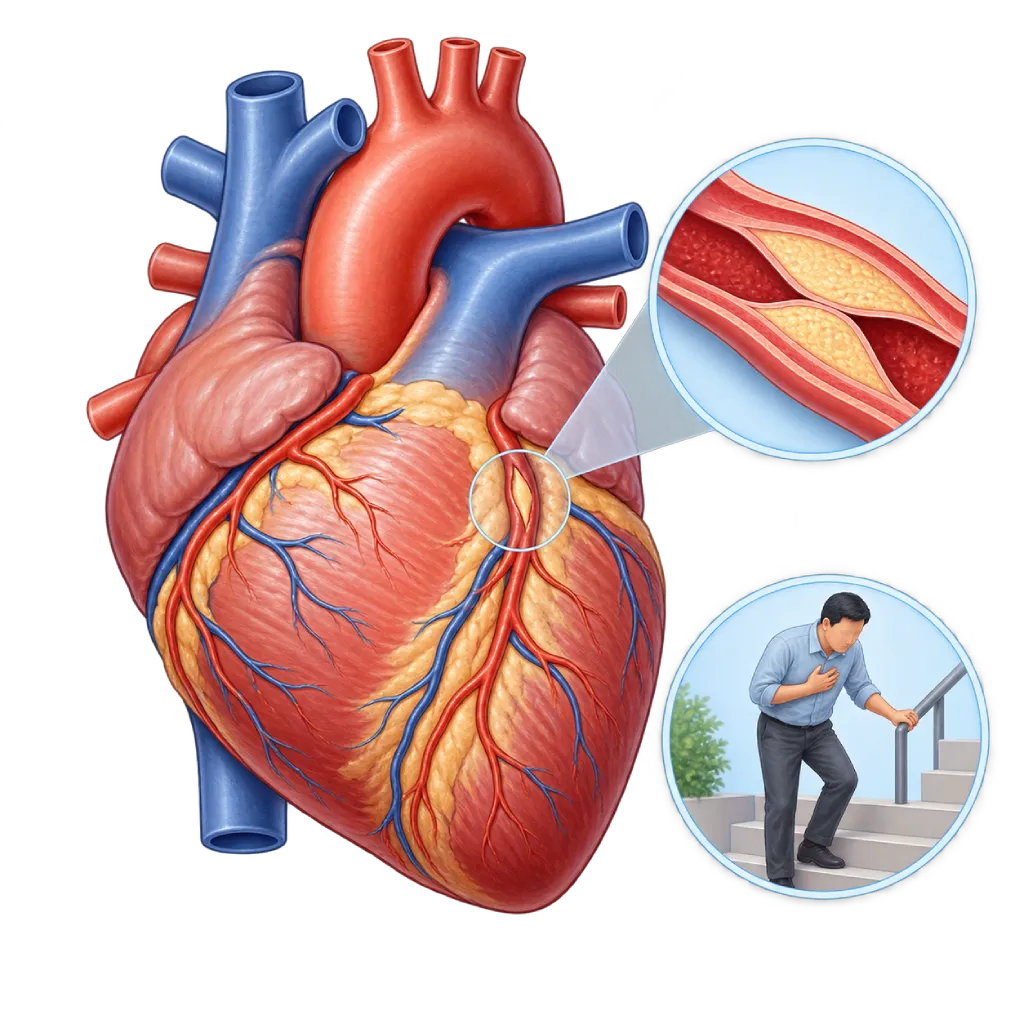
Stable angina is pain or pressure in the chest that appears in a predictable pattern, usually during physical activity or strong emotion, and eases within a few minutes with rest. It generally signals a fixed narrowing of the coronary arteries.
SourcesSigns That Need Urgent Help
- Chest pain at rest or chest pain that wakes you from sleep
- Angina that is more frequent, lasts longer, or is triggered by lighter activity than usual
- Pain that does not ease with rest or a nitrate as it usually does
- Chest pain with a cold sweat, nausea, or severe shortness of breath
- Fainting or nearly fainting
If these signs appear, go to the nearest emergency department right away or call Heart Attack Center 1500 258.
01 / Understanding the condition
About Stable Angina
Stable angina is a type of angina pectoris whose pattern stays relatively the same over time. Chest pain or pressure appears when the heart is under strain, for example when you walk uphill or climb stairs, and eases after you rest. In the 2024 ESC guidelines, stable angina is part of chronic coronary syndromes, a group of long-lasting coronary disease conditions that do not occur suddenly.
Why Pain Appears During Activity
Fatty plaque in the walls of the coronary arteries narrows the path for blood flow. At rest, the remaining flow is still enough for the heart muscle. When you walk briskly, lift something heavy, are out in cold air, have just eaten a large meal, or are emotionally upset, the heart needs more oxygen. The narrowing limits that extra flow, so pain appears. The pain usually lasts a few minutes and eases within about five minutes after rest or after using a fast-acting nitrate.
How It Differs from Other Types
Its triggers are predictable, and the level of activity that brings on pain tends to be the same from day to day. Stable angina does not appear at rest and does not worsen over a matter of days. If the pattern changes and the pain becomes more frequent, more severe, or appears at rest, this points to unstable angina, covered on the Unstable Angina page. Chest pain at rest at night with arteries that look normal points more toward angina caused by spasm of the blood vessels, covered on the Vasospastic Angina page.
Assessing the Severity of Angina
Doctors often use the Canadian Cardiovascular Society (CCS) scale, class I to IV. Class I means pain appears only with strenuous or prolonged activity, while class IV means pain appears with very light activity. This scale helps assess how much angina limits your life and track the results of treatment.
Outlook with Treatment
With medicines taken regularly, lifestyle changes, and regular follow-up, many people with stable angina can control their symptoms and stay active. The ISCHEMIA trial in stable coronary disease showed that an early procedure to open the arteries did not lower the overall risk of death or heart attack compared with medicines alone, but it relieved symptoms more in people who often have angina. For this reason, the choice of procedure is tailored to your symptoms and test results.
02 / Understanding the condition
Symptoms to Recognize.
Common Symptoms
- Pressure, heaviness, or a squeezing feeling in the center of the chest
- Pain that appears at roughly the same level of activity, for example when climbing stairs
- Symptoms that ease within a few minutes after rest or a nitrate
- Pain spreading to the left arm, shoulder, neck, jaw, or back
- Shortness of breath during activity
- Symptoms that come on more easily after a large meal, in cold air, or during strong emotion
Symptoms in Older Adults
In older adults, stable angina is often felt as symptoms other than chest pain.
- Shortness of breath when walking a fair distance or climbing stairs
- Tiring quickly and being able to walk shorter and shorter distances
- Vague discomfort in the chest or upper stomach during activity
- Unknowingly cutting back on activity to avoid symptoms
03 / Understanding the condition
What Causes This Condition?
- Fatty plaque narrowing one or more coronary arteries, covered on the Atherosclerosis page.
- Relatively stable plaque with a thick cap, so the narrowing stays fixed without a new clot
- Increased oxygen demand of the heart during activity, strong emotion, cold air, or after a large meal
- Aggravating factors, such as anemia, uncontrolled blood pressure, an overactive thyroid, or a fast heart rate
- Narrowing of the aortic valve or thickening of the heart muscle, which raises oxygen demand
04 / Understanding the condition
Who Is at Higher Risk?
Lifestyle
Smoking, physical inactivity, a diet high in saturated fat, sugar, and salt, and obesity speed up plaque buildup in the coronary arteries.
Medical
High blood pressure, high LDL cholesterol, diabetes, and chronic kidney disease are the main drivers of coronary artery narrowing.
Genetic
A family history of early coronary artery disease and inherited high cholesterol (familial hypercholesterolemia) make plaque form earlier.
Age
Stable angina is more common after age 45 in men and after menopause in women.
Groups at Higher Risk
- People with Diabetes: Diabetes speeds up atherosclerosis in many arteries at once and can mask chest pain, so it may feel like shortness of breath or fatigue instead.
- People with High Blood Pressure or High Cholesterol: Years of high blood pressure and cholesterol damage the walls of the coronary arteries and speed up their narrowing.
- Smokers: Smoking damages the inner lining of blood vessels, speeds up plaque formation, and reduces the oxygen carried by the blood.
- Patients After Stent Placement or Bypass Surgery: Angina can return if the stent or graft narrows again, or if coronary disease progresses in another area. Covered on the In-Stent Restenosis page.
05 / Understanding the condition
How Is It Diagnosed?
Diagnosing stable angina relies on the story of your symptoms: when the pain appears, what activity triggers it, how long it lasts, and what relieves it. The doctor then does a physical examination, records an ECG, checks your blood for risk factors, and performs echocardiography to assess the heart's pumping and valves.
The 2024 ESC guidelines recommend that doctors estimate the likelihood of coronary disease based on age, sex, symptoms, and risk factors, then choose the appropriate test. When the likelihood is low to moderate, CT coronary angiography can show plaque directly. When the likelihood is higher, stress testing with imaging, such as stress echocardiography, myocardial perfusion imaging, or cardiac MRI, shows whether any part of the heart muscle is short of blood. A treadmill test with ECG is still useful for assessing exercise capacity.
Coronary angiography with a catheter, sometimes with FFR measurement, is done when test results show high risk or when symptoms are not controlled with medicines.
Electrocardiogram (ECG)
A resting recording is often normal but may show a previous heart attack or other abnormalities; a recording taken during pain is more informative.
Echocardiography
Assesses pumping strength, wall motion, and the heart valves, including ruling out aortic valve narrowing as a cause of angina.
CT Coronary Angiography
An initial choice when the likelihood of coronary disease is low to moderate, to see plaque and narrowing without a catheter.
Stress Echocardiography
Shows areas of heart muscle whose movement weakens under stress, a sign of reduced blood flow.
Myocardial Perfusion Imaging
Compares blood flow to the heart muscle at rest and under stress to assess the extent of ischemia.
Treadmill Stress Test
Assesses exercise capacity and the ECG response to exertion; it is now more often used alongside, or replaced by, stress tests with imaging.
Coronary Angiography
Confirms the location and severity of narrowing with a catheter; FFR measurement can be added to decide which narrowings need to be opened.
06 / Understanding the condition
Treatment Options.
Treatment is decided by a doctor after an assessment. The categories below can help you follow the conversation with your doctor.
Lifestyle Changes
Quitting smoking, a heart-healthy diet, regular exercise as advised by your doctor, losing excess weight, and managing stress.
Medicines to Relieve Attacks
Fast-acting nitrates under the tongue or as a spray relieve attacks and can be used before an activity known to trigger pain, as directed by your doctor.
Medicines to Prevent Attacks
Beta blockers or calcium channel blockers are the first choice. Long-acting nitrates, ranolazine, ivabradine, nicorandil, or trimetazidine can be added. Your doctor chooses based on your heart rate, blood pressure, and other conditions.
Medicines to Prevent Coronary Events
Antiplatelets such as aspirin, and statins to lower LDL cholesterol. Other cholesterol-lowering medicines can be added if targets are not reached.
Coronary Revascularization
Stent placement (PCI) or bypass surgery is considered if symptoms remain troublesome despite adequate medicines, or if the narrowing is in a high-risk location such as the left main coronary artery.
Cardiac Rehabilitation
A structured exercise program supervised by a team improves exercise capacity, helps change habits, and builds confidence to be active.
07 / Understanding the condition
Complications to Watch For.
Unstable Angina
A plaque that ruptures can trigger a clot, so symptoms suddenly worsen and need urgent care. Covered on the Unstable Angina page.
Heart Attack
A complete blockage of a coronary artery can damage part of the heart muscle. Covered on the Myocardial Infarction / Heart Attack page.
Weakening of the Heart's Pump
Prolonged or repeated ischemia can weaken the heart muscle, covered on the Ischemic Cardiomyopathy page.
Heart Rhythm Disorders
Heart muscle that is short of blood is more prone to irregular rhythms, such as atrial fibrillation or a fast ventricular rhythm.
Limited Activity
Uncontrolled angina leads people to limit work, exercise, and social activities, lowering their quality of life.
08 / Understanding the condition
What Can You Do?
- Know the activities that trigger your pain and pace yourself, for example by pausing briefly when climbing stairs
- Carry the angina relief medicine you have been prescribed and understand how to use it
- Quit smoking, including e-cigarettes
- Avoid eating large meals shortly before strenuous activity
- Exercise regularly at the intensity recommended by your doctor or rehabilitation program
- Keep your blood pressure, cholesterol, and blood sugar at target
- Take your heart medicines every day as prescribed, even when you have no symptoms
- Get a flu vaccine every year as recommended by your doctor
09 / Understanding the condition
When Should You See a Doctor?
If you start to feel chest pain or pressure during activity, make an appointment with a cardiologist to find the cause. Chest pain that has appeared within the last few days or weeks should be checked promptly, not put off. People with stable angina also need regular follow-up even when their symptoms are under control. Pain at rest, severe pain, or a worsening pattern is an emergency: go to the emergency room right away.
- Chest pain, pressure, or heaviness that appears during activity and eases with rest.
- Shortness of breath or fatigue that makes you cut back on daily activities.
- Side effects from medicines, such as dizziness, headache, or a heart rate that feels too slow.
- Scheduled follow-up to review medicines, lab results, and risk factor targets.
Don't Wait in an Emergency.
If symptoms are severe or come on suddenly, go to the nearest emergency department right away or call Heart Attack Center 1500 258, rather than waiting for an appointment.
10 / Common questions
Questions You May Have.
Frequently asked questions about stable angina.
Is stable angina dangerous if the pain always eases with rest?
Pain that eases with rest is not an emergency, but it still signals narrowing of the coronary arteries. This narrowing can progress, and the plaque can rupture at some point. That is why stable angina needs to be evaluated, treated, and monitored, so that your risk of a heart attack goes down and you know the signs that mean you should go to the emergency room right away.
Does stable angina always require a stent?
Not always. For many people, medicines taken regularly and lifestyle changes are enough to control symptoms and lower risk. A stent or bypass surgery is considered if symptoms remain troublesome despite adequate medicines, or if test results show narrowing in a high-risk location. Your doctor will explain the options based on your symptoms and test results.
Can I exercise with stable angina?
Generally yes, and it is beneficial once your doctor has assessed your condition. Choose gradual exercise such as walking, a stationary bike, or relaxed swimming, starting with a warm-up and ending with a cool-down. Avoid sudden strenuous exercise, especially in cold air or after a large meal. A cardiac rehabilitation program can help set a safe intensity. Stop exercising if chest pain appears.
What is the difference between stable angina and unstable angina?
Stable angina appears with predictable triggers and eases with rest within a few minutes. Unstable angina appears at rest, feels new and severe, or its pattern worsens quickly. Unstable angina is part of acute coronary syndrome and needs to be treated right away in the emergency room, while stable angina is managed through planned follow-up.
Why do I have to take medicine every day when I am not in pain?
Some medicines for stable angina work to prevent problems, not just to relieve pain. Antiplatelets and statins protect the blood vessels and lower the risk of a heart attack, while angina-preventing medicines reduce the number of attacks. The benefit is lost if the medicines are stopped. If you have side effects or concerns, talk with your doctor so the medicines can be adjusted, and do not stop them on your own.
Are there medicines that must not be used together with nitrates?
Yes. PDE5 inhibitors used for erectile dysfunction or pulmonary hypertension, such as sildenafil and tadalafil, can lower blood pressure very sharply when used together with nitrates. Tell your doctor and pharmacist about all the medicines you use, including over-the-counter medicines and supplements, before starting any new medicine.
Sources and Medical Review
Translated from the Indonesian edition medically reviewed by dr. Adrianus Kosasih, Sp.JP(K).
Sources as cited in the Indonesian edition.
- Vrints C, Andreotti F, Koskinas KC, Rossello X, Adamo M, Ainslie J, et al. 2024 ESC Guidelines for the management of chronic coronary syndromes. Eur Heart J. 2024;45(36):3415-537.
- Virani SS, Newby LK, Arnold SV, Bittner V, Brewer LC, Demeter SH, et al. 2023 AHA/ACC/ACCP/ASPC/NLA/PCNA Guideline for the Management of Patients With Chronic Coronary Disease: A Report of the American Heart Association/American College of Cardiology Joint Committee on Clinical Practice Guidelines. Circulation. 2023;148(9):e9-119.
- Joshi PH, de Lemos JA. Diagnosis and Management of Stable Angina: A Review. JAMA. 2021;325(17):1765-78.
- Maron DJ, Hochman JS, Reynolds HR, Bangalore S, O'Brien SM, Boden WE, et al. Initial Invasive or Conservative Strategy for Stable Coronary Disease. N Engl J Med. 2020;382(15):1395-407.
- Lawton JS, Tamis-Holland JE, Bangalore S, Bates ER, Beckie TM, Bischoff JM, et al. 2021 ACC/AHA/SCAI Guideline for Coronary Artery Revascularization: A Report of the American College of Cardiology/American Heart Association Joint Committee on Clinical Practice Guidelines. Circulation. 2022;145(3):e18-114.
- Gulati M, Levy PD, Mukherjee D, Amsterdam E, Bhatt DL, Birtcher KK, et al. 2021 AHA/ACC/ASE/CHEST/SAEM/SCCT/SCMR Guideline for the Evaluation and Diagnosis of Chest Pain: A Report of the American College of Cardiology/American Heart Association Joint Committee on Clinical Practice Guidelines. Circulation. 2021;144(22):e368-454.
Doctors Who Treat This Condition

Dr. med. dr. Denio A. Ridjab, Sp.JP(K)
Interventional Cardiology
Coronary Intervention Procedures +2 centers
Clinical focusInterventional Cardiology · Coronary Artery Disease
View Profile
dr. Adrianus Kosasih, Sp.JP(K)
Interventional Cardiology
Coronary Intervention Procedures
Clinical focusPrimary Coronary Intervention · PCI for Acute Coronary Syndrome
View Profile
dr. Widya T. Suwatri, Sp.BTKV, Subsp. JD(K)
Adult Cardiac Surgery
Advanced Cardiovascular Surgical Care +1 center
Clinical focusMinimally Invasive Cardiac Surgery · Coronary Artery Bypass Surgery
View Profile