
Quick answer
What Is Left Atrial Appendage Closure?
Left atrial appendage (LAA) closure is a procedure to seal the appendage, a small pouch in the left upper chamber of the heart where the majority of clots form in atrial fibrillation. This catheter procedure takes about 1 to 2 hours and is a stroke prevention option for patients who cannot take long-term blood thinners.
Sources01 / Understanding the procedure
About Left Atrial Appendage Closure
What Is Left Atrial Appendage Closure
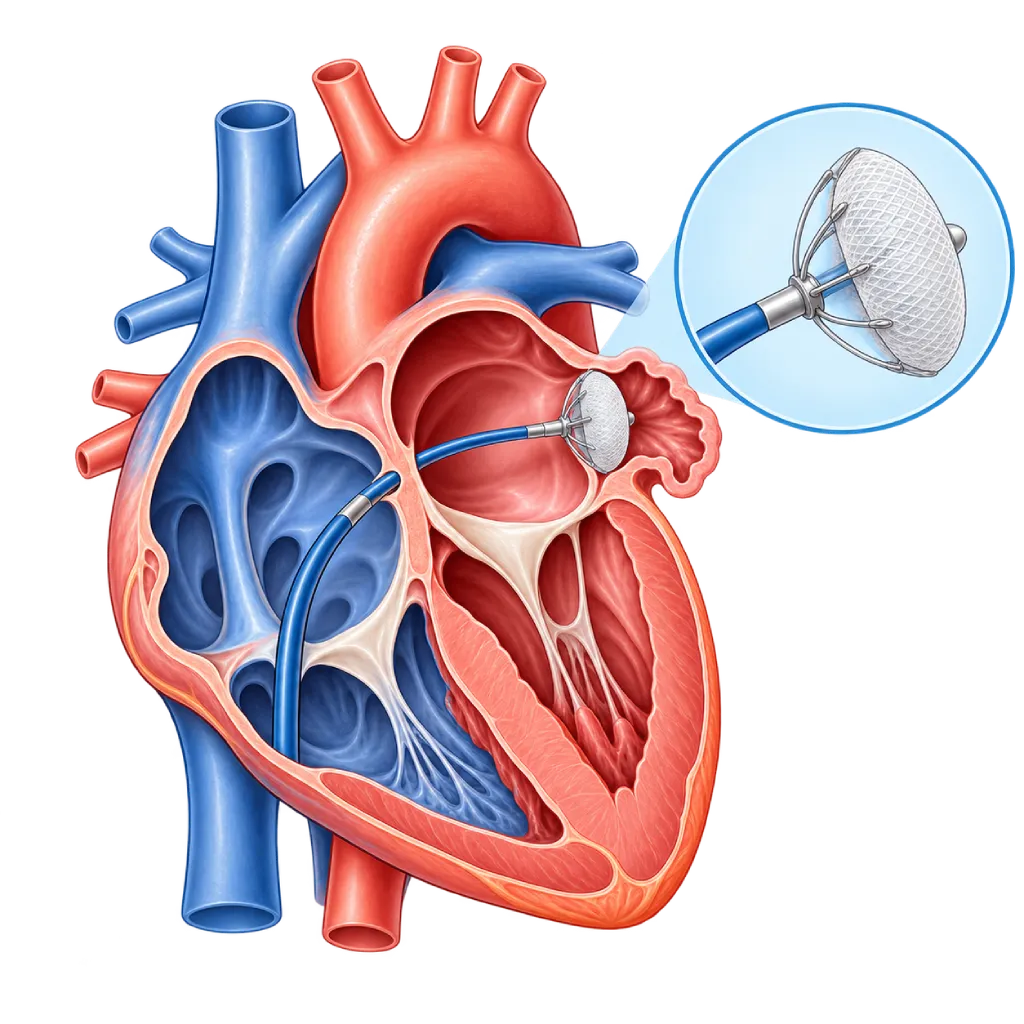
The left atrial appendage (LAA) is a small, finger-shaped pouch in the wall of the heart's left upper chamber (left atrium). In atrial fibrillation, the atria quiver irregularly, so blood in this pouch can easily pool and clot. If a clot breaks loose and travels to the brain, a stroke occurs. LAA closure is a procedure to place a plug device at the opening of this pouch through a catheter, so that clots no longer form there and escape from it.
Who This Procedure Is For
The main way to prevent stroke in atrial fibrillation is blood-thinning medicine (anticoagulants), covered on the Anticoagulation Therapy and Stroke Prevention page. LAA closure is not a replacement for medicine for everyone. It is considered for patients whose stroke risk is high enough but who cannot take anticoagulants long term, for example because of a previous brain bleed, repeated serious bleeding, or a condition that makes bleeding likely.
How the Device Works
The plug device is made of a flexible metal frame covered with fine fabric, shaped like an umbrella or a plug. It is inserted through a vein in the groin, passed across the wall between the atria into the left atrium, then expanded at the opening of the pouch. Over a few weeks to months, heart tissue grows over the surface of the device. During this time, patients still need antithrombotic medicines temporarily.
What Results to Expect
Clinical trials show that LAA closure protects against stroke and blood vessel blockages with results comparable to warfarin and, in high-risk patients, comparable to direct oral anticoagulants, with less bleeding in the long term. The risk of stroke does not disappear completely, because clots occasionally form elsewhere or on the surface of the device. Guidelines position this procedure as an option for patients who are not suitable for anticoagulants, not as the first choice.
Closure During Heart Surgery
In patients with atrial fibrillation who are having heart surgery, such as valve or bypass surgery, the surgeon can close or remove this pouch at the same time. This adds protection against stroke, and blood thinners are usually continued after surgery.
Heart Rhythm Still Needs Treatment
LAA closure does not correct the heart rhythm. Palpitations are still treated with medicines or ablation, covered on the Arrhythmia Management page.
02 / Understanding the procedure
When Is This Procedure Considered?
A doctor may consider this procedure in the situations below. The decision is always made after a thorough assessment.
- Atrial Fibrillation with Stroke RiskA stroke risk score shows that long-term prevention is needed.
- History of Serious BleedingFor example, bleeding in the brain or digestive tract while taking blood thinners.
- Persistent High Bleeding RiskFor example, a blood vessel abnormality or a clotting disorder that cannot be corrected.
- Atrial Fibrillation Not Caused by Valve DiseaseNo mechanical valve or mitral valve narrowing that would still require warfarin.
Situations to Consider First
- Clot in the AppendageThe procedure is postponed until the clot has cleared with treatment.
- Anticoagulants Needed for Another ReasonFor example, a mechanical valve or a vein clot; closure does not replace these medicines.
- Unsuitable Appendage ShapeThe size or shape of the pouch does not allow the device to sit stably.
- Very Limited Life ExpectancyThe benefits of the procedure are only felt in the long term, so this needs to be weighed together with your doctor.
- Active InfectionA planned procedure is postponed until the infection is resolved.
03 / Before the procedure
How Should You Prepare?
LAA closure is a planned procedure, decided after discussion with a cardiologist and, if needed, a neurologist.
Tests before the procedure. An echocardiogram through the esophagus (TEE) or a cardiac CT scan to measure the pouch and confirm there is no clot, plus an ECG and blood tests.
Blood thinners. Follow your doctor's instructions on when to stop or continue your medicine. Do not change your medicines on your own.
Kidney function and allergies. Tell the team if you have kidney problems or an allergy to contrast dye, medicines, or nickel.
Fasting. Follow the fasting schedule from the anesthesia team, usually several hours before the procedure.
Companion. Arrange for someone to accompany you for the overnight hospital stay and the trip home.
Unsure about the preparation instructions? Ask our team before the procedure.
04 / During the procedure
How Is the Procedure Done?
LAA closure is done in the catheterization lab and takes about 1 to 2 hours. It is usually done under general anesthesia when guided by TEE, or with a sedative when guided by echocardiography from inside the heart.
Reaching the Left Atrium
The catheter is inserted through a vein in the groin up to the right atrium, then passed through the wall between the atria with a special needle to reach the left atrium.
Measuring the Pouch
The size and shape of the appendage are assessed with echocardiography and contrast dye to choose the device size.
Placing the Device
The device is expanded at the opening of the pouch. The doctor checks its position, stability, and seal before releasing it.
Completing the Procedure
The catheter is removed, and the puncture site is pressed or closed with a small stitch. The small hole in the wall between the atria usually closes on its own.
05 / Benefits and risks
Benefits and Risks Should Be Discussed Together.
Every medical procedure has benefits and risks. Your doctor will explain both for your situation before the procedure.
Benefits You Can Expect
- Long-Term Stroke ProtectionPrevents clots from the appendage in patients who are not suitable for anticoagulants.
- Less Long-Term BleedingAfter the initial period, the majority of patients no longer need long-term anticoagulants.
- No Cut in the ChestThe device is inserted through a blood vessel in the groin; patients usually go home the next day.
- A One-Time ProcedureThe device stays in place and does not need to be replaced.
The benefits of a procedure are not a promise of a cure. Ask how the results will affect your care plan.
Risks You Should Know
- Fluid or Blood Around the HeartRare; if there is a large amount, it needs to be drained with a needle or a further procedure.
- Clot on the Device SurfaceCan form in the first few months, so it is looked for at follow-up tests.
- Gap at the Edge of the DeviceA small leak around the device may remain and is assessed at follow-up visits.
- Device Moving Out of PlaceRare; the device can be retrieved through a catheter or, occasionally, with surgery.
- Stroke During or After the ProcedureRare; blood thinners are given during the procedure to prevent it.
- Problems at the Puncture SiteBruising, bleeding, or a lump in the groin, usually mild.
Risks can differ from person to person. A full explanation and consent are given after an individual assessment.
06 / After the procedure
What Is Recovery Like?
Most patients go home the next day, after an echocardiogram confirms the device position and that there is no fluid around the heart.
Medicines after the procedure. For a few weeks to months, patients take temporary antithrombotic medicines, such as an anticoagulant or two antiplatelet medicines, then usually aspirin long term. The type and duration are decided by your doctor.
Follow-up tests. A TEE or cardiac CT scan is done about 1 to 3 months after the procedure to check for gaps at the edge of the device and clots on the device.
Activity. Light activity can begin within a few days. Avoid heavy lifting for about one week.
Infection prevention. For the first 6 months, tell your dentist that you recently had a device placed, because preventive antibiotics may be needed.
Warning signs. Go to the emergency room right away if you have:
- Facial drooping, weakness on one side of the body, or slurred speech
- Chest pain, shortness of breath, or fainting
- Vomiting blood, black stools, or bleeding that does not stop
- Growing swelling or bleeding in the groin
Know the Signs That Need Prompt Care.
Follow the team's guidance on warning signs. If severe or sudden symptoms appear after the procedure, go to the nearest emergency department right away or call Heart Attack Center 1500 258.
07 / Team and support
Doctors and Procedure Support
The doctors below are listed for this procedure. Listed by name, not by ranking.

dr. BRM Ario S. Kuncoro, Sp.JP(K)
Echocardiography & Cardiovascular Imaging
Cardiovascular Diagnostic Center +2 centers
Clinical focusAdvanced and 3D Echocardiography · Transesophageal Echocardiography
View Profile
Dr. dr. Faris Basalamah, Sp.JP(K)
Interventional Cardiology
Coronary Intervention Procedures +1 center
Clinical focusComplex Coronary Intervention · Cardiac Electrophysiology
View Profile
dr. Sunu B. Raharjo, Sp.JP(K), Ph.D.
Arrhythmia and Electrophysiology
Arrhythmia and Device Center
Clinical focusClinical and Interventional Electrophysiology · Cardiac Arrhythmia Ablation
View ProfileCT Scan 512 Slices
A CT scanner that produces up to 512 image slices in a single rotation to show the coronary arteries, calcium in the artery…
The availability of technology and test support is confirmed with the team. Technology is chosen according to clinical need.
08 / Common questions
Before You Plan the Procedure.
Frequently asked questions about left atrial appendage (LAA) closure for stroke prevention in atrial fibrillation.
Can I stop taking blood thinners after LAA closure?
In the majority of patients, anticoagulants can be stopped after the initial period, usually once a follow-up test shows the device is sealing the pouch well. For a few weeks to months, temporary antithrombotic medicines are still needed, usually followed by aspirin. If you need anticoagulants for another reason, such as a vein clot, that medicine is continued.
Is LAA closure better than blood thinners?
Not for everyone. For most patients with atrial fibrillation, oral anticoagulants remain the main way to prevent stroke. LAA closure is an option for patients who cannot take anticoagulants long term, for example because of serious bleeding. The decision is made together with your doctor by weighing stroke risk, bleeding risk, and your preferences.
Will my atrial fibrillation be cured after this procedure?
No. LAA closure only prevents clots from the appendage and does not correct the heart rhythm. Palpitations and an irregular rhythm are still treated with rhythm-control medicines or ablation when needed. Controlling blood pressure, blood sugar, and weight, along with healthy habits such as quitting smoking, remains important to lower stroke risk.
How long will I stay in the hospital, and when can I resume activities?
Most patients stay one night and go home the next day. Light activity, including office work, can usually begin within a few days. Avoid heavy lifting and strenuous exercise for about one week, or as your doctor advises. Do not miss your follow-up TEE or CT scan about 1 to 3 months after the procedure.
How safe is this procedure?
Like other heart procedures, LAA closure carries risks, such as fluid around the heart, the device moving out of place, or a clot on the device. Serious complications are uncommon and can usually be treated. The team assesses the shape of the appendage with TEE or CT before the procedure, monitors with echocardiography during the procedure, and checks again before you go home.
What is the difference between catheter LAA closure and closure during heart surgery?
Catheter closure is done without opening the chest, using a device placed from a blood vessel in the groin. Surgical closure is done by a surgeon in patients with atrial fibrillation who are already having heart surgery, such as valve or bypass surgery, by stitching, clipping, or removing the pouch. After closure during surgery, anticoagulants are usually still continued.
Sources and Medical Review
Translated from the Indonesian edition medically reviewed by dr. Sunu B. Raharjo, Sp.JP(K), Ph.D..
Sources as cited in the Indonesian edition.
- Van Gelder IC, Rienstra M, Bunting KV, et al. 2024 ESC Guidelines for the management of atrial fibrillation developed in collaboration with the European Association for Cardio-Thoracic Surgery (EACTS). Eur Heart J. 2024;45(36):3314-3414.
- Joglar JA, Chung MK, Armbruster AL, et al. 2023 ACC/AHA/ACCP/HRS Guideline for the Diagnosis and Management of Atrial Fibrillation: A Report of the American College of Cardiology/American Heart Association Joint Committee on Clinical Practice Guidelines. Circulation. 2024;149(1):e1-e156.
- Glikson M, Wolff R, Hindricks G, et al. EHRA/EAPCI expert consensus statement on catheter-based left atrial appendage occlusion: an update. EuroIntervention. 2020;15(13):1133-1180.
- Reddy VY, Doshi SK, Kar S, et al. 5-Year Outcomes After Left Atrial Appendage Closure: From the PREVAIL and PROTECT AF Trials. J Am Coll Cardiol. 2017;70(24):2964-2975.
- Osmancik P, Herman D, Neuzil P, et al. Left Atrial Appendage Closure Versus Direct Oral Anticoagulants in High-Risk Patients With Atrial Fibrillation. J Am Coll Cardiol. 2020;75(25):3122-3135.
- Whitlock RP, Belley-Cote EP, Paparella D, et al. Left Atrial Appendage Occlusion during Cardiac Surgery to Prevent Stroke. N Engl J Med. 2021;384(22):2081-2091.