
Quick answer
What Is Cardiac Tumors?
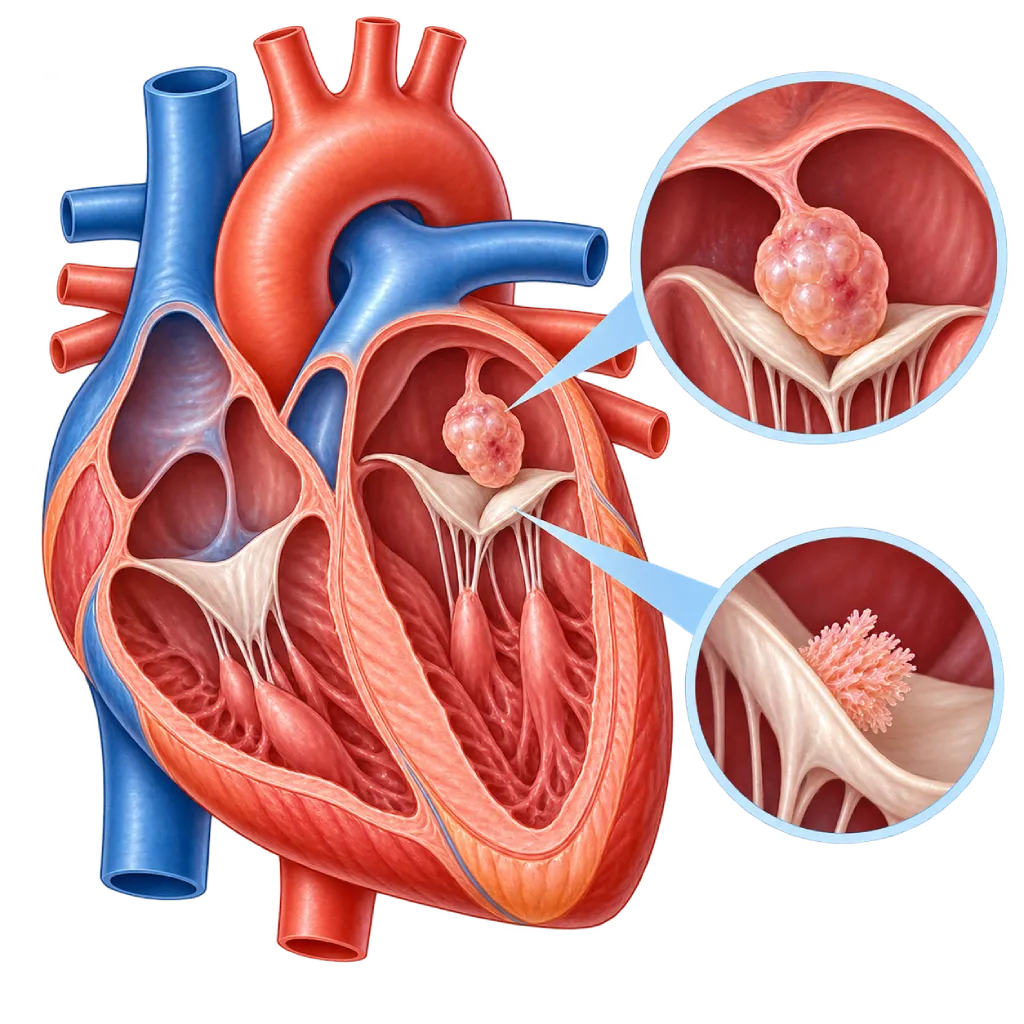
A cardiac tumor is a growth of tissue in the wall, chambers, valves, or surrounding sac of the heart. Tumors that start in the heart itself are rare and mostly benign, such as myxoma, while cancer spreading from other organs is found more often.
SourcesSigns That Need Urgent Help
- Weakness on one side of the body, an uneven face, or slurred speech
- Fainting, especially when changing position or during activity
- Severe shortness of breath or being unable to lie down
- Chest pain lasting more than a few minutes
- A leg or arm that suddenly becomes cold, pale, and painful
- A very fast heartbeat with severe dizziness
If these signs appear, go to the nearest emergency department right away or call Heart Attack Center 1500 258.
01 / Understanding the condition
About Cardiac Tumors
A cardiac tumor is a growth of tissue in the wall, chambers, valves, or surrounding sac of the heart. Tumors that arise from the heart's own tissue are called primary tumors and are very rare. The majority of primary tumors are benign, meaning they do not spread to other organs. Secondary tumors, which are cancers from other organs that have spread to the heart or the sac around it, are found much more often than primary tumors. Cardiac tumors can be found at any age, from an unborn baby to an older adult.
Types of Cardiac Tumors
In adults, myxoma is a frequently found benign tumor. Myxomas usually grow in the left atrium, attached to the wall between the atria, and are more common in women aged 30 to 60. Papillary fibroelastoma is a small tumor attached to a valve. In babies and children, rhabdomyoma is found more often and is frequently linked to tuberous sclerosis, an inherited condition that also affects the brain, skin, and kidneys; many of these tumors shrink on their own. Primary malignant tumors, such as sarcoma, are rare. Cancers that can spread to the heart include lung cancer, breast cancer, melanoma, lymphoma, and leukemia.
How Tumors Cause Problems
Even a benign tumor can affect the heart because of where it sits. A tumor in an atrium can obstruct blood flow through a valve, causing shortness of breath or fainting, sometimes depending on body position. Pieces of the tumor or clots on its surface can break off and block blood vessels in the brain or legs, covered on the Stroke page and the Arterial Embolism page. Tumors can also disturb the heart rhythm or cause fluid in the sac around the heart. Myxomas sometimes cause whole-body symptoms, such as fever, weakness, weight loss, and joint pain.
Lumps That Are Not Tumors
A lump seen in the heart on echocardiography is not always a tumor. Blood clots, infected deposits on a valve (covered on the Infective Endocarditis page), and normal structures with varying shapes can look similar. For this reason, the doctor uses several tests to confirm what it is before deciding on treatment. Benign tumors removed with surgery generally have good outcomes, with regular monitoring for possible regrowth.
02 / Understanding the condition
Symptoms to Recognize.
Common Symptoms
Many cardiac tumors cause no symptoms and are found by chance. When symptoms occur, they depend on the location and size of the tumor.
- Shortness of breath, especially during activity or when lying down
- Dizziness or fainting, sometimes when changing position
- Palpitations or an irregular pulse
- Low-grade fever, weakness, weight loss, or joint pain
- Swelling in the legs or abdomen
- Chest pain
Symptoms in Infants
In babies and children, rhabdomyoma is a commonly found type. The majority cause no symptoms and shrink on their own, but they need monitoring.
- A lump in the heart seen on a pregnancy ultrasound or echocardiography
- A heart murmur during an examination
- A heartbeat that is too fast or irregular
- Fast breathing, trouble feeding, or poor weight gain
- White patches on the skin or seizures, which may point to tuberous sclerosis
03 / Understanding the condition
What Causes This Condition?
- Myxoma, a benign tumor that often grows in the left atrium in adults
- Papillary fibroelastoma, a small benign tumor attached to a heart valve
- Rhabdomyoma and fibroma, types found more often in babies and children
- Primary malignant tumors, such as cardiac sarcoma or lymphoma, which are rare
- Cancer spreading from other organs, such as the lungs, breast, melanoma, lymphoma, or kidney
- Inherited syndromes, such as tuberous sclerosis or Carney complex, in a small proportion of cases
04 / Understanding the condition
Who Is at Higher Risk?
Genetic
Carney complex can cause myxomas that recur or occur more than once, while tuberous sclerosis often comes with rhabdomyomas in babies and children.
Age
Myxomas are usually found at ages 30 to 60, while rhabdomyomas and fibromas are found more often in unborn babies, infants, and children.
Medical
A history of cancer, especially lung cancer, breast cancer, melanoma, lymphoma, or leukemia, increases the likelihood of a secondary tumor in the heart or the sac around it.
Other
Myxomas are more common in women than in men. No lifestyle habit is known to cause primary cardiac tumors.
Groups at Higher Risk
- People with Cancer That Has Spread: Lung cancer, breast cancer, melanoma, lymphoma, and leukemia can spread to the heart or the sac around it, often with fluid around the heart.
- Families of People with Carney Complex: Close relatives are advised to have regular echocardiography because myxomas can appear at a young age and recur.
- Babies and Children with Tuberous Sclerosis: Rhabdomyomas are often found in this group and are usually monitored with echocardiography until they shrink.
- Patients After Myxoma Removal: Regular follow-up echocardiography helps find tumor regrowth early.
05 / Understanding the condition
How Is It Diagnosed?
A cardiac tumor is often first seen on echocardiography, either because of symptoms or by chance. Echocardiography shows the location, size, stalk, and movement of the lump and its effect on the valves. Echocardiography through the esophagus (transesophageal) gives a clearer image of small lumps or lumps in the atria. The doctor then confirms whether the lump is a tumor, a blood clot, an infected deposit on a valve, or a normal structure. Cardiac MRI assesses the nature of the tissue and helps tell apart benign tumors, malignant tumors, and clots. A cardiac CT scan assesses how the lump relates to nearby blood vessels and the coronary arteries before surgery, and looks for cancer in other organs. A PET scan is used when a malignant tumor or cancer spread is suspected. Blood tests can show signs of inflammation, and blood cultures are done if infection is suspected. The type of tumor is confirmed by examining the tissue after surgery or, in certain cases, through a biopsy.
Echocardiography
The first test to see the location, size, stalk, and movement of the tumor and its effect on the valves. It can be followed by an exam through the esophagus for a clearer image.
Cardiac MRI
Assesses the tissue characteristics of the lump to tell apart benign tumors, malignant tumors, and blood clots.
Cardiac CT Scan
Assesses how the tumor relates to nearby blood vessels, calcium, and the coronary arteries before surgery.
Cardiac PET Scan
Assesses tissue activity when a malignant tumor is suspected and looks for spread to other organs.
Electrocardiogram (ECG)
Looks for rhythm problems or electrical changes caused by a tumor in the heart wall.
Tissue examination (histopathology) after surgery or through a biopsy to confirm the type of tumor.
06 / Understanding the condition
Treatment Options.
Treatment is decided by a doctor after an assessment. The categories below can help you follow the conversation with your doctor.
Surgical Tumor Removal
Myxomas and other benign tumors that cause symptoms or risk releasing fragments are generally removed with open-heart surgery, sometimes through a small incision. The outcome is generally good.
Regular Monitoring
Small benign tumors without symptoms, such as some fibroelastomas on the right side of the heart, lipomas, or rhabdomyomas in children, can be monitored with echocardiography.
Treatment of Primary Malignant Tumors
Planned together by the heart, surgical, and oncology teams, and may include surgery when possible, chemotherapy, and radiotherapy.
Treatment of Secondary Tumors
Focuses on treating the original cancer. Fluid in the sac around the heart that compresses the heart can be drained with a needle or another procedure.
Managing Complications
Medicines for rhythm problems, blood thinners in certain cases, and heart failure treatment as needed, with the type decided by the doctor.
Genetic Counseling
Recommended when the tumor is linked to Carney complex or tuberous sclerosis, for testing and monitoring of family members.
07 / Understanding the condition
Complications to Watch For.
Stroke and Arterial Embolism
Pieces of the tumor or clots on its surface can break off and block blood vessels in the brain or legs. These conditions are covered on the Stroke page and the Arterial Embolism page.
Obstructed Blood Flow
A tumor in an atrium can move into the valve opening as the heart fills, causing shortness of breath, fainting, or symptoms that resemble a narrowed valve.
Heart Rhythm Disorders
Tumors in the heart wall, such as fibroma or rhabdomyoma, can disturb the heart's electrical system and cause a rhythm that is too fast or too slow.
Pericardial Effusion and Tamponade
Malignant tumors and cancer spread often cause fluid in the sac around the heart. A large amount of fluid can compress the heart, covered on the Cardiac Tamponade page.
Heart Failure
A large tumor can interfere with the filling or pumping of the heart, causing shortness of breath and swelling.
Tumor Regrowth
A small proportion of myxomas grow back after surgery, especially those linked to Carney complex, so regular monitoring is needed.
08 / Understanding the condition
What Can You Do?
- The majority of cardiac tumors cannot be prevented, but they can be found earlier if symptoms are checked promptly
- Have follow-up echocardiography regularly after myxoma surgery as scheduled by your doctor
- Family members of people with Carney complex are advised to have regular heart checks
- Babies with rhabdomyoma need to be checked for tuberous sclerosis and monitored regularly
- People with cancer should report new shortness of breath, chest pain, or swelling
- Do not ignore fainting without a clear cause or a newly found heart murmur
09 / Understanding the condition
When Should You See a Doctor?
Cardiac tumors are rare, and their symptoms resemble many other heart conditions. See a cardiologist if you have the following symptoms, or if echocardiography finds a lump in your heart. Stroke symptoms or fainting need emergency help right away.
- Shortness of breath that is getting worse, especially when lying down or changing position
- Fainting or nearly fainting without a clear cause
- Fever, weakness, and weight loss together with a heart murmur
- Palpitations or an irregular pulse
- New shortness of breath, chest pain, or swelling in a person with cancer
- A pregnancy ultrasound showing a lump in the baby's heart
Don't Wait in an Emergency.
If symptoms are severe or come on suddenly, go to the nearest emergency department right away or call Heart Attack Center 1500 258, rather than waiting for an appointment.
10 / Common questions
Questions You May Have.
Frequently asked questions about cardiac tumors.
Is a cardiac tumor always cancer?
No. The majority of tumors that start in the heart itself are benign, such as myxoma, papillary fibroelastoma, and rhabdomyoma. Malignant tumors that start in the heart are rare. In people who have cancer in another organ, a lump in the heart or the sac around it is more likely to be a spread of that cancer. The type of tumor is confirmed through imaging tests and tissue examination.
Does a myxoma have to be removed with surgery?
In general, yes. Removal of a myxoma is recommended soon after diagnosis, because the tumor can obstruct blood flow or release fragments that block blood vessels in the brain. Surgery is done with the help of a heart-lung machine, sometimes through a small incision. After removal, the majority of patients recover well and have regular echocardiography to monitor for possible regrowth.
How does the doctor tell a tumor apart from a blood clot in the heart?
Blood clots usually form where blood flow is slow, for example in an atrium during atrial fibrillation or in a ventricle with a weak wall after a heart attack. Cardiac MRI can distinguish a clot from tumor tissue based on tissue characteristics, including with the use of contrast. The doctor also reviews your medical history and, in certain cases, checks whether the lump shrinks after blood thinners are given.
Can a cardiac tumor grow back after it is removed?
For myxomas that occur without a family history, the tumor rarely grows back after it is removed completely. The chance of recurrence is higher for myxomas linked to Carney complex, an inherited condition that also causes skin spots and hormone problems. For this reason, follow-up echocardiography is recommended regularly, on a schedule set by your doctor.
Does rhabdomyoma in a baby need surgery?
In the majority of cases, no. Rhabdomyomas in babies often shrink on their own within the first months or years of life. Surgery is considered if the tumor obstructs blood flow or causes rhythm problems that are hard to control. Because rhabdomyoma is often linked to tuberous sclerosis, the baby also needs to be checked for abnormalities in the brain, skin, and kidneys.
Do people with cancer need to have their heart checked?
Not all people with cancer need a special heart examination. However, new shortness of breath, chest pain, palpitations, or swelling need to be checked, because they can be caused by cancer spreading to the sac around the heart, fluid around the heart, or effects of cancer treatment. Heart disease caused by cancer treatment is covered on the Cancer Therapy-Related Heart Disease page.
Sources and Medical Review
Translated from the Indonesian edition medically reviewed by dr. BRM Ario S. Kuncoro, Sp.JP(K).
Sources as cited in the Indonesian edition.
- Tyebally S, Chen D, Bhattacharyya S, Mughrabi A, Hussain Z, Manisty C, et al. Cardiac Tumors: JACC CardioOncology State-of-the-Art Review. JACC CardioOncol. 2020;2(2):293-311.
- Maleszewski JJ, Basso C, Bois MC, Glass C, Klarich KW, Leduc C, et al. The 2021 WHO Classification of Tumors of the Heart. J Thorac Oncol. 2022;17(4):510-8.
- Basso C, Rizzo S, Valente M, Thiene G. Cardiac masses and tumours. Heart. 2016;102(15):1230-45.
- Mankad R, Herrmann J. Cardiac tumors: echo assessment. Echo Res Pract. 2016;3(4):R65-77.
- Northrup H, Aronow ME, Bebin EM, Bissler J, Darling TN, de Vries PJ, et al. Updated International Tuberous Sclerosis Complex Diagnostic Criteria and Surveillance and Management Recommendations. Pediatr Neurol. 2021;123:50-66.
- Bussani R, De-Giorgio F, Abbate A, Silvestri F. Cardiac metastases. J Clin Pathol. 2007;60(1):27-34.
Doctors Who Treat This Condition

dr. BRM Ario S. Kuncoro, Sp.JP(K)
Echocardiography & Cardiovascular Imaging
Cardiovascular Diagnostic Center +2 centers
Clinical focusAdvanced and 3D Echocardiography · Transesophageal Echocardiography
View Profile
Dr. dr. Dudy A. Hanafy, Sp.BTKV, Subsp. JD(K), MARS
Adult Cardiac Surgery
Advanced Cardiovascular Surgical Care +1 center
Clinical focusMinimally Invasive Cardiac Surgery · Coronary Artery Bypass Surgery
View Profile
dr. Radityo Prakoso, Sp.JP(K)
Pediatrics & Congenital Heart Disease
Congenital and Structural Heart Center
Clinical focusPediatric Cardiology Consultation · Congenital Heart Disease Care
View Profile