
Quick answer
What Is Atrial Flutter?
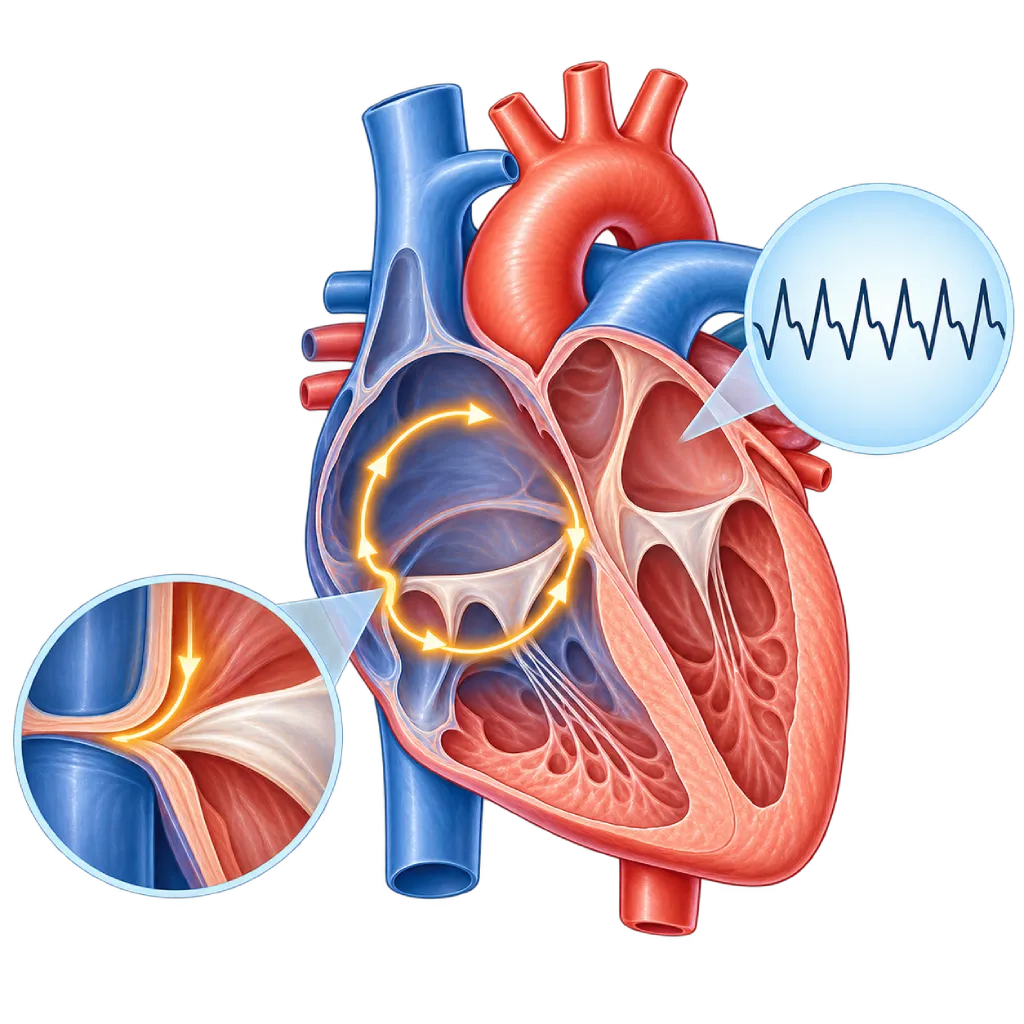
Atrial flutter is a rhythm disorder in which an electrical signal circles quickly and regularly in the upper chambers of the heart. The heart rate can be very fast, and like atrial fibrillation, this condition increases the risk of stroke, so it needs treatment.
SourcesSigns That Need Urgent Help
- A drooping face, weakness in an arm or leg on one side, or slurred speech
- Sudden blurred or lost vision
- Fainting or nearly losing consciousness
- Severe chest pain
- Severe shortness of breath or shortness of breath when lying down
- A very fast heartbeat with a cold sweat and paleness
If these signs appear, go to the nearest emergency department right away or call Heart Attack Center 1500 258.
01 / Understanding the condition
About Atrial Flutter
Atrial flutter is a heart rhythm disorder that starts in the atria, the upper chambers of the heart. In this condition, an electrical signal keeps circling around one large loop in the atria, so the atria beat very fast, about 250 to 350 times per minute. The AV node, the electrical gateway to the ventricles, filters out some of these signals. As a result, the ventricles usually beat more slowly, often around 150 times per minute, and the rhythm is regular.
Typical and Atypical Flutter
In typical flutter, the signal circles in the right atrium around the tricuspid valve and passes through a narrow strip of tissue called the cavotricuspid isthmus. This strip is the target of ablation. Atypical flutter uses other pathways, often around scar tissue after heart surgery or atrial fibrillation ablation, and mapping it is more complex.
How It Relates to Atrial Fibrillation
Atrial flutter is different from atrial fibrillation, in which the signals are chaotic so the heartbeat is irregular. However, the two often occur in the same person, and many people with flutter later develop atrial fibrillation as well. Stroke risk in flutter is assessed in the same way as in atrial fibrillation, covered on the Atrial Fibrillation page.
Who Gets It
Atrial flutter is more common in men and older adults. It often occurs alongside hypertension, heart failure, valve disease, chronic obstructive pulmonary disease, sleep apnea, or a history of heart surgery. An overactive thyroid gland and heavy drinking can also trigger it. Some people feel palpitations, tiredness, or shortness of breath; others feel nothing at all. Because the ventricular rate often stays around 150 beats per minute, the heart works hard continuously. If this lasts for weeks, the heart muscle can weaken, a condition that usually improves once the heart rate is controlled.
Treatment of atrial flutter aims to prevent stroke, control the heart rate, and restore a normal rhythm. In recurrent typical flutter, catheter ablation of the cavotricuspid isthmus can prevent flutter from returning over the long term, so it is often recommended early. The choice of medication, cardioversion, or ablation is made together with your doctor based on your symptoms, other conditions, and stroke risk.
02 / Understanding the condition
Symptoms to Recognize.
Common Symptoms
- A fast, regular pounding heartbeat
- Weakness and tiring quickly during activity
- Shortness of breath, especially when climbing stairs or walking fast
- Dizziness or feeling light-headed
- Discomfort or pressure in the chest
- Reduced exercise ability compared with usual
Symptoms in Older Adults
In older adults, atrial flutter is often not felt as palpitations and is only discovered because of general symptoms or during an ECG.
- Weakness and tiring easily for no clear reason
- Worsening shortness of breath or leg swelling
- Confusion or difficulty concentrating
- Falling easily or nearly fainting
- Heart failure that flares up again or is hard to control
03 / Understanding the condition
What Causes This Condition?
- An electrical signal circling in a large loop in the right atrium (typical flutter)
- Scar tissue after heart surgery or atrial fibrillation ablation (atypical flutter)
- Enlarged atria due to hypertension, valve disease, or heart failure
- Chronic obstructive pulmonary disease, sleep apnea, or pulmonary embolism
- An overactive thyroid gland
- Drinking too much alcohol
- Congenital heart disease, especially after corrective surgery
04 / Understanding the condition
Who Is at Higher Risk?
Lifestyle
Heavy drinking, smoking, excess body weight, and lack of physical activity increase the risk of flutter and atrial fibrillation.
Medical
Hypertension, heart failure, valve disease, coronary artery disease, chronic obstructive pulmonary disease, sleep apnea, and thyroid disorders make the atria prone to electrical problems.
Age
The risk of atrial flutter rises with age, and the condition is more common in men.
Other
A history of heart surgery, including surgery for congenital heart disease, and a history of atrial fibrillation ablation leave scar tissue that can become a pathway for atypical flutter.
Groups at Higher Risk
- Older Adults: Atrial flutter is far more common in older age, often together with hypertension and other heart disease.
- People with Chronic Lung Disease: Chronic obstructive pulmonary disease and sleep apnea strain the right atrium, where typical flutter circles.
- People with Heart Failure or Valve Disease: Enlarged and stretched atria more easily become a pathway for circling signals.
- People Who Have Had Heart Surgery: Scar tissue in the atria, including after congenital heart surgery, can trigger flutter years later.
- People with Atrial Fibrillation: Flutter and atrial fibrillation often alternate in the same person, so both need to be monitored.
05 / Understanding the condition
How Is It Diagnosed?
The diagnosis can usually be made with an ECG. In typical flutter, the atrial waves look like evenly lined-up saw teeth, especially in the leads that view the bottom of the heart. If the heart rate is so fast that these waves are hidden, the doctor can slow it down temporarily so the pattern becomes visible. If flutter comes and goes, a Holter monitor or long-term recorder helps capture it.
Echocardiography assesses the size of the atria, the valves, and pumping strength. Before cardioversion, the doctor may perform echocardiography through the esophagus (transesophageal echocardiography) to make sure there are no clots in the atria. Blood tests check thyroid function, electrolytes, and kidney function to choose safe medications. The doctor also calculates a stroke risk score, the same as in atrial fibrillation. An electrophysiology study is done to confirm the signal pathway, usually at the same time as ablation.
Electrocardiogram (ECG)
Shows the characteristic sawtooth atrial waves of typical flutter, as well as the ventricular rate.
Holter Monitoring
Captures flutter that comes and goes and assesses the heart rate throughout the day.
Echocardiography
Assesses the size of the atria, the valves, and pumping strength. Transesophageal echocardiography can look for clots before cardioversion.
Thyroid Function Test
Looks for an overactive thyroid gland as a trigger of flutter.
Kidney Function Test
Assesses kidney function as a basis for choosing clot-preventing medication and its dose.
Electrophysiology Study
Confirms the circling signal pathway, especially in atypical flutter, usually at the same time as ablation.
06 / Understanding the condition
Treatment Options.
Treatment is decided by a doctor after an assessment. The categories below can help you follow the conversation with your doctor.
Medication to Prevent Blood Clots
Oral anticoagulants are given based on the stroke risk score, the same as in atrial fibrillation. Your doctor decides the type, dose, and duration of use.
Medication to Control Heart Rate
Beta blockers or calcium channel blockers slow the ventricular rate. In flutter, the heart rate is sometimes harder to control with medication than in atrial fibrillation.
Electrical Cardioversion
A controlled electric shock under brief anesthesia that restores a normal rhythm. Beforehand, the doctor makes sure the clot risk has been addressed with medication or an echocardiography examination.
Catheter Ablation of the Cavotricuspid Isthmus
Creates a small line of scar tissue in the cavotricuspid isthmus so the signal can no longer circle. Guidelines recommend ablation for recurrent typical flutter.
Treating Underlying Conditions
Controlling blood pressure, heart failure, lung disease, sleep apnea, thyroid problems, and alcohol use helps prevent flutter and atrial fibrillation from coming back.
07 / Understanding the condition
Complications to Watch For.
Stroke and Embolism
Blood that is not pumped well in the atria can form clots that travel to the brain or other organs. The risk is assessed with the same score as in atrial fibrillation.
Tachycardia-Induced Cardiomyopathy
A fast ventricular rate over weeks can weaken the heart muscle. Pumping function usually improves once the heart rate or rhythm is controlled.
Heart Failure
In a heart that is already weak or stiff, flutter can trigger shortness of breath and swelling that need treatment.
Very Fast Ventricular Rate
Sometimes almost every atrial signal is passed on to the ventricles, for example during exercise or due to certain medications, so the heart rate becomes very fast and can cause fainting.
Progression to Atrial Fibrillation
Many people with flutter later develop atrial fibrillation as well, including after successful flutter ablation, so monitoring is still needed.
08 / Understanding the condition
What Can You Do?
- Keep your blood pressure at the target agreed with your doctor
- Limit or stop drinking alcohol
- Lose weight if you are overweight and stay physically active
- Get checked if you snore loudly and often feel sleepy during the day
- Stop smoking and keep chronic lung disease under control
- Take your clot-preventing medication on schedule and do not stop it on your own
- Continue follow-up visits after ablation to watch for possible atrial fibrillation
09 / Understanding the condition
When Should You See a Doctor?
Make an appointment with your doctor if you feel a fast, regular heartbeat, tire easily, or have unusual shortness of breath, especially if you are older or have heart or lung disease. Early treatment helps prevent stroke and weakening of the heart. Go to the emergency room right away if warning signs appear.
- A fast heartbeat that keeps coming back or lasts for hours
- A resting pulse of about 150 beats per minute or more
- Worsening tiredness, shortness of breath, or leg swelling
- Palpitations again after ablation or cardioversion
- A drooping face, weakness in one arm, slurred speech, fainting, or severe chest pain: go to the emergency room right away
Don't Wait in an Emergency.
If symptoms are severe or come on suddenly, go to the nearest emergency department right away or call Heart Attack Center 1500 258, rather than waiting for an appointment.
10 / Common questions
Questions You May Have.
Frequently asked questions about atrial flutter.
What is the difference between atrial flutter and atrial fibrillation?
Both start in the atria. In flutter, the signal circles in one regular loop, so the heartbeat is usually fast and regular. In atrial fibrillation, the signals in the atria are chaotic, so the heartbeat is irregular. Both increase the risk of stroke and often occur in the same person. Ablation for typical flutter is generally simpler than ablation for atrial fibrillation.
Do I need to take blood thinners?
The need for clot-preventing medication is decided with the same stroke risk score used in atrial fibrillation, for example based on age, hypertension, diabetes, history of stroke, and heart failure. If your risk is high enough, your doctor will recommend an oral anticoagulant. Do not start or stop this medication on your own, because your doctor also weighs your risk of bleeding.
Can ablation cure atrial flutter?
In typical flutter, cavotricuspid isthmus ablation can prevent flutter from coming back in many patients. However, some patients later develop atrial fibrillation, because both often come from the same underlying disease. For this reason, follow-up visits and rhythm monitoring are still needed, and the decision to stop blood thinners after ablation is made by your doctor.
Can atrial flutter go away on its own?
Flutter can appear briefly and then stop on its own, but it often comes back or becomes persistent. Flutter triggered by a temporary condition, such as after surgery or during a lung infection, sometimes does not return once the trigger has resolved. Even so, stroke risk still needs to be assessed from the start, and your doctor will decide whether medication or a procedure is needed.
Can I exercise if I have atrial flutter?
Light to moderate physical activity is generally recommended once your heart rate is under control. During exercise, flutter is sometimes passed to the ventricles faster, so your heart's response needs to be known first. Your doctor may recommend a treadmill test or Holter monitoring. Stop the activity if you feel dizzy, very short of breath, or have chest pain, then contact your doctor.
Sources and Medical Review
Translated from the Indonesian edition medically reviewed by Dr. dr. Faris Basalamah, Sp.JP(K).
Sources as cited in the Indonesian edition.
- Brugada J, Katritsis DG, Arbelo E, et al. 2019 ESC Guidelines for the management of patients with supraventricular tachycardia. The Task Force for the management of patients with supraventricular tachycardia of the European Society of Cardiology (ESC). Eur Heart J. 2020;41(5):655-720.
- Van Gelder IC, Rienstra M, Bunting KV, et al. 2024 ESC Guidelines for the management of atrial fibrillation developed in collaboration with the European Association for Cardio-Thoracic Surgery (EACTS). Eur Heart J. 2024;45(36):3314-3414.
- Joglar JA, Chung MK, Armbruster AL, et al. 2023 ACC/AHA/ACCP/HRS Guideline for the Diagnosis and Management of Atrial Fibrillation: A Report of the American College of Cardiology/American Heart Association Joint Committee on Clinical Practice Guidelines. Circulation. 2024;149(1):e1-e156.
- Page RL, Joglar JA, Caldwell MA, et al. 2015 ACC/AHA/HRS Guideline for the Management of Adult Patients With Supraventricular Tachycardia. Circulation. 2016;133(14):e506-e574.
- Cosio FG. Atrial Flutter, Typical and Atypical: A Review. Arrhythm Electrophysiol Rev. 2017;6(2):55-62.
Doctors Who Treat This Condition

dr. Sunu B. Raharjo, Sp.JP(K), Ph.D.
Arrhythmia and Electrophysiology
Arrhythmia and Device Center
Clinical focusClinical and Interventional Electrophysiology · Cardiac Arrhythmia Ablation
View Profile
Dr. dr. Dicky A. Hanafy, Sp.JP(K)
Arrhythmia and Electrophysiology
Arrhythmia and Device Center +1 center
Clinical focusElectrophysiology and Arrhythmia Ablation · Pacemaker and ICD Implantation
View Profile
Dr. dr. Faris Basalamah, Sp.JP(K)
Interventional Cardiology
Coronary Intervention Procedures +1 center
Clinical focusComplex Coronary Intervention · Cardiac Electrophysiology
View Profile