
Quick answer
What Is Tachycardia-Bradycardia Syndrome?
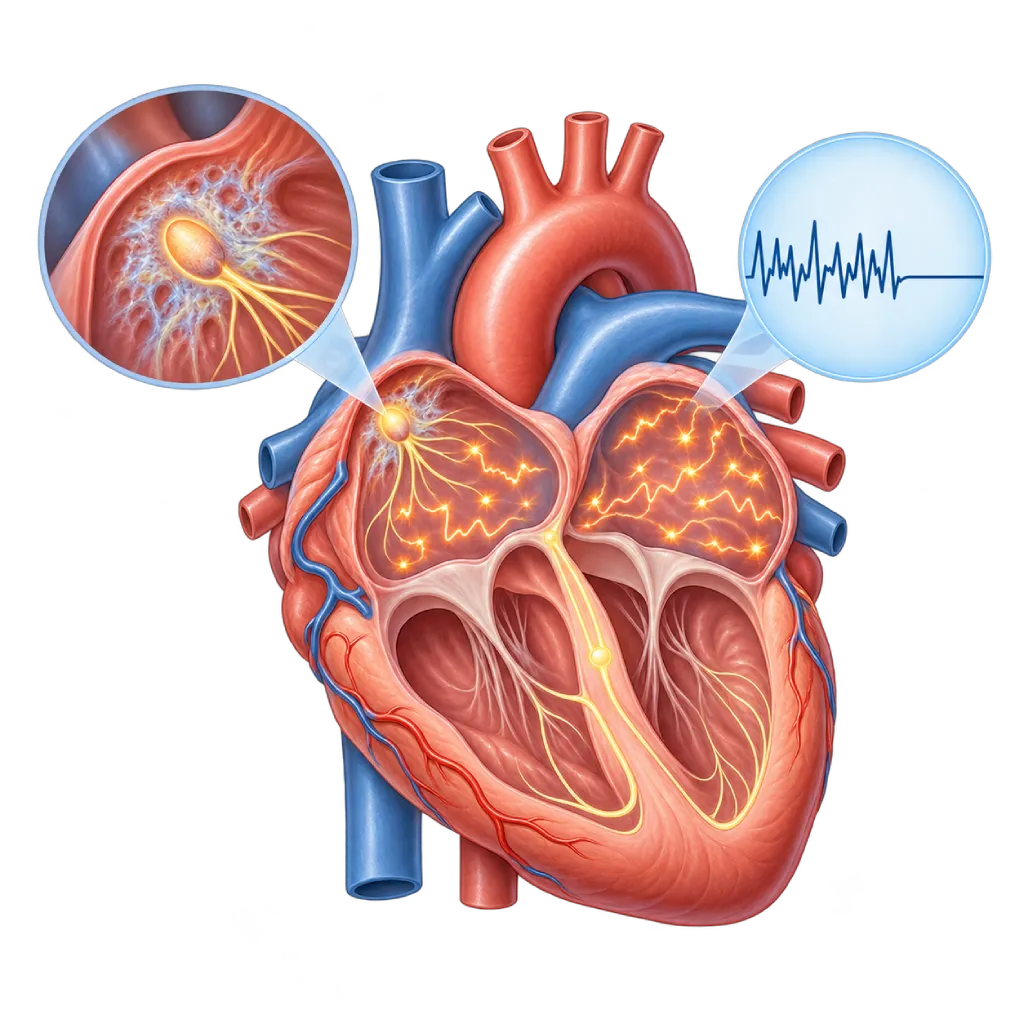
Tachycardia-bradycardia syndrome is a form of sinus node dysfunction in which the heart rate alternates between too fast and too slow, often with a long pause after an episode of palpitations that can cause dizziness or fainting.
SourcesSigns That Need Urgent Help
- Fainting, especially if it leads to a fall or injury
- Drooping face, weakness in one arm, or slurred speech
- Severe chest pain
- Severe shortness of breath or shortness of breath when lying down
- Very slow heartbeat with severe weakness, confusion, or a cold sweat
- Very fast palpitations that do not stop, with severe dizziness
If these signs appear, go to the nearest emergency department right away or call Heart Attack Center 1500 258.
01 / Understanding the condition
About Tachycardia-Bradycardia Syndrome
Tachycardia-bradycardia syndrome is one form of sick sinus syndrome, a disorder of the sinus node, the heart's natural pacemaker in the right atrium. In this syndrome, the heart rate alternates between too slow (bradycardia) and too fast (tachycardia). The fast phase is usually atrial fibrillation, and sometimes atrial flutter or atrial tachycardia.
Long Pauses After Episodes of Palpitations
The characteristic feature of this syndrome appears when an episode of fast heartbeat stops. The weak sinus node is slow to start working again, so the heart stops beating for a moment, sometimes for several seconds. During this pause, blood flow to the brain decreases, so you may feel very dizzy, have your vision go dark, or faint. Outside these episodes, the heart rate is often too slow and does not rise enough during activity, so you tire quickly.
The symptoms of this syndrome come and go, so an ECG recorded once often looks normal. Many people are only diagnosed after fainting, falling, or having their heart rhythm recorded over several days. Once treatment is underway, many people with this syndrome can return to their daily activities.
Why It Happens
The main cause is age-related change in the tissue of the sinus node and the atria, in which connective tissue replaces the pacemaker cells. That is why this syndrome is more common in older adults. Long-standing atrial fibrillation can also weaken the sinus node, and the reverse is also true. Heart disease, previous heart surgery, an underactive thyroid, electrolyte disturbances, and sleep apnea can also play a role. Medicines that slow the heart rate can make the pauses longer.
Finding the Right Balance in Treatment
Medicines that slow the heart rate during fast episodes can make the slow heart rate and the pauses worse. That is why many patients need a pacemaker, a device that keeps the heart rate from becoming too slow, so that medicines to control the fast heart rate can be used safely. In some patients, atrial fibrillation ablation can reduce the pauses so that a pacemaker can be avoided. The accompanying atrial fibrillation also increases the risk of stroke, so the doctor assesses whether you need medicine to prevent blood clots.
The slow heart rate is covered on the Bradycardia page, while the fast phase is covered on the Atrial Fibrillation page.
02 / Understanding the condition
Symptoms to Recognize.
Common Symptoms
- Severe dizziness or vision going dark when an episode of palpitations stops
- Fainting or nearly fainting
- Fast palpitations that alternate with a heartbeat that feels slow
- Weakness and tiring quickly, especially during activity
- Shortness of breath during light activity
- Brief confusion or difficulty concentrating
03 / Understanding the condition
What Causes This Condition?
- Age-related changes in the tissue of the sinus node and the atria
- Long-standing atrial fibrillation that changes the atrial tissue
- Heart disease such as long-standing hypertension, coronary artery disease, cardiomyopathy, or amyloidosis
- Damage to the sinus node after heart surgery
- Medicines that slow the heart rate, such as beta blockers, calcium channel blockers, or digoxin
- An underactive thyroid gland, electrolyte disturbances, or sleep apnea
04 / Understanding the condition
Who Is at Higher Risk?
Age
This syndrome is found mainly in older adults, because the tissue of the sinus node and the atria changes over time.
Medical
Atrial fibrillation, hypertension, coronary artery disease, heart failure, cardiomyopathy, hypothyroidism, and sleep apnea are associated with sinus node dysfunction.
Genetic
In a small number of people, especially younger people, sinus node dysfunction is linked to ion channel gene abnormalities and can be found in several members of a family.
Other
A history of heart surgery involving the atria, including surgery for congenital heart disease, and the use of medicines that slow the heart rate can make this syndrome worse.
Groups at Higher Risk
- Older Adults: This syndrome is found mainly in older age and is often only recognized after fainting or a fall.
- People with Atrial Fibrillation: Atrial fibrillation and sinus node dysfunction make each other worse, so long pauses can appear when an episode stops.
- People Taking Heart Rate Control Medicines: Medicines that slow the heart rate can unmask sinus node dysfunction that was not noticeable before; the doctor needs to review the medicines if dizziness appears.
- People Who Have Had Heart Surgery: Surgery involving the atria can damage the sinus node or the surrounding tissue.
05 / Understanding the condition
How Is It Diagnosed?
The doctor asks about your symptoms, especially dizziness or fainting that appears after palpitations, as well as all the medicines you take. An ECG can show a slow heart rate, sinus pauses, or atrial fibrillation, but it is often normal if taken outside an episode. That is why a Holter recording over 24 to 48 hours or a long-term recorder is used to capture the alternation between fast and slow heart rates, including the pause after an episode stops. If symptoms are infrequent, a small recorder implanted under the skin can record the rhythm for up to several years.
Echocardiography assesses the size of the atria, the valves, and the heart's pumping strength. Blood tests check the thyroid and electrolytes. A treadmill test can show whether the heart rate rises enough during activity. The doctor also assesses whether symptoms improve when certain medicines are adjusted, and calculates the stroke risk if atrial fibrillation is present.
Electrocardiogram (ECG)
Can show a slow heart rate, sinus pauses, or atrial fibrillation, although it is often normal if taken outside an episode.
Holter Monitoring
Records the rhythm for 24 to 48 hours to capture the alternation between fast and slow heart rates and the pauses after an episode stops.
Implantable Loop Recorder (ILR)
A small recorder under the skin that records the rhythm for up to several years, when fainting or dizziness occurs only rarely.
Echocardiography
Assesses the size of the atria, the valves, and the heart's pumping strength as a basis for choosing treatment.
Thyroid Function Test
Looks for an underactive thyroid gland, which can slow the heart rate.
Treadmill Stress Test
Assesses whether the heart rate rises enough during activity and whether activity triggers symptoms.
06 / Understanding the condition
Treatment Options.
Treatment is decided by a doctor after an assessment. The categories below can help you follow the conversation with your doctor.
Reviewing Medicines That Slow the Heart Rate
The doctor assesses whether any medicine is making the slow heart rate worse and adjusts it. Do not stop your heart medicines on your own without talking to your doctor.
Pacemaker Implantation
A pacemaker keeps the heart rate from dropping too low and prevents long pauses. Guidelines recommend a pacemaker when a slow heart rate or pauses cause symptoms.
Medicines to Control Heart Rate and Rhythm
Once a pacemaker is in place, beta blockers, calcium channel blockers, or antiarrhythmic medicines can be used more safely to control the fast phase.
Medicines to Prevent Blood Clots
Oral anticoagulants are given according to the stroke risk score if atrial fibrillation or atrial flutter is present. The doctor decides the type and dose.
Atrial Fibrillation Ablation
In some patients whose pauses only appear after an atrial fibrillation episode stops, ablation can reduce the episodes and the pauses so that a pacemaker may not be needed.
07 / Understanding the condition
Complications to Watch For.
Fainting and Injuries from Falls
Long pauses can cause sudden fainting. In older adults, a fall can lead to a broken bone or a head injury.
Stroke
The accompanying atrial fibrillation can form clots in the atria. The risk is assessed with a stroke risk score and prevented with medicine when needed.
Heart Failure
A heart rate that is too slow or too fast for a long time can keep the heart from pumping enough blood, leading to shortness of breath and swelling.
Permanent Atrial Fibrillation
Over time, atrial fibrillation episodes can become more frequent and longer until they eventually become permanent.
08 / Understanding the condition
What Can You Do?
- Bring a list of all your medicines to every doctor's appointment
- Do not add or stop heart medicines without talking to your doctor
- Control your blood pressure, body weight, and alcohol use
- Get checked if you snore loudly and often feel sleepy during the day
- Sit or lie down right away if you suddenly feel very dizzy
- Avoid driving or working at heights until your doctor has assessed your risk of fainting
- Attend your pacemaker checkups as scheduled once the device is in place
09 / Understanding the condition
When Should You See a Doctor?
Make an appointment with a doctor if you often feel dizzy, nearly faint, or tire quickly, especially if the symptoms appear after palpitations or when your heartbeat feels slow. Bring a record of your symptoms and a list of your medicines. Go to the emergency room right away if danger signs appear.
- Severe dizziness or vision going dark after an episode of palpitations stops
- A resting pulse that is often below 50 beats per minute, with weakness
- Fast palpitations that alternate with a slow heartbeat
- Dizziness after starting or increasing a heart medicine
- Fainting, chest pain, severe shortness of breath, or signs of stroke: go to the emergency room right away
Don't Wait in an Emergency.
If symptoms are severe or come on suddenly, go to the nearest emergency department right away or call Heart Attack Center 1500 258, rather than waiting for an appointment.
10 / Common questions
Questions You May Have.
Frequently asked questions about tachycardia-bradycardia syndrome.
How is tachycardia-bradycardia syndrome different from ordinary atrial fibrillation?
In ordinary atrial fibrillation, the main problem is a fast, irregular heartbeat. In tachycardia-bradycardia syndrome, the sinus node is also weak, so outside an episode the heart rate is too slow, and a long pause can appear after an episode stops. That is why treatment needs to balance both, and it often requires a pacemaker so that medicines to control the fast heart rate can be used safely.
Will I definitely need a pacemaker?
Not always. A pacemaker is recommended when a slow heart rate or long pauses cause symptoms such as dizziness or fainting, or when the medicines needed for the fast phase make the heart rate too slow. In some patients, atrial fibrillation ablation can reduce the pauses so that a pacemaker is not needed. Your doctor will weigh these options with you based on the results of your rhythm recordings.
Does a pacemaker also treat a fast heart rate?
A pacemaker mainly prevents the heart rate from becoming too slow and prevents long pauses. It does not stop atrial fibrillation. However, with a pacemaker in place, your doctor can give medicines to control the fast heart rate more safely. A pacemaker also records atrial fibrillation episodes, which helps your doctor monitor your condition and assess whether you need medicine to prevent blood clots.
Does this syndrome increase the risk of stroke?
Yes, mainly because of the atrial fibrillation that comes with it. Blood that is not pumped well in the atria can form clots that travel to the brain. Your doctor calculates your stroke risk with the same score used in atrial fibrillation, then decides whether you need medicine to prevent blood clots. Having a pacemaker implanted does not replace medicine to prevent blood clots.
Can I drive if I have this syndrome?
If you have fainted or nearly fainted, avoid driving until your doctor has assessed the cause and treatment is underway. Once a pacemaker is in place and your symptoms are under control, many people can drive again after a certain period, as advised by their doctor. This rule is important for your safety and the safety of others on the road.
Sources and Medical Review
Translated from the Indonesian edition medically reviewed by Dr. dr. Faris Basalamah, Sp.JP(K).
Sources as cited in the Indonesian edition.
- Glikson M, Nielsen JC, Kronborg MB, et al. 2021 ESC Guidelines on cardiac pacing and cardiac resynchronization therapy. Eur Heart J. 2021;42(35):3427-3520.
- Kusumoto FM, Schoenfeld MH, Barrett C, et al. 2018 ACC/AHA/HRS Guideline on the Evaluation and Management of Patients With Bradycardia and Cardiac Conduction Delay: A Report of the American College of Cardiology/American Heart Association Task Force on Clinical Practice Guidelines and the Heart Rhythm Society. Circulation. 2019;140(8):e382-e482.
- Van Gelder IC, Rienstra M, Bunting KV, et al. 2024 ESC Guidelines for the management of atrial fibrillation developed in collaboration with the European Association for Cardio-Thoracic Surgery (EACTS). Eur Heart J. 2024;45(36):3314-3414.
- De Ponti R, Marazzato J, Bagliani G, Leonelli FM, Padeletti L. Sick Sinus Syndrome. Card Electrophysiol Clin. 2018;10(2):183-195.
- Jackson LR 2nd, Rathakrishnan B, Campbell K, et al. Sinus Node Dysfunction and Atrial Fibrillation: A Reversible Phenomenon? Pacing Clin Electrophysiol. 2017;40(4):442-450.
Doctors Who Treat This Condition

Dr. dr. Dicky A. Hanafy, Sp.JP(K)
Arrhythmia and Electrophysiology
Arrhythmia and Device Center +1 center
Clinical focusElectrophysiology and Arrhythmia Ablation · Pacemaker and ICD Implantation
View Profile
dr. Sunu B. Raharjo, Sp.JP(K), Ph.D.
Arrhythmia and Electrophysiology
Arrhythmia and Device Center
Clinical focusClinical and Interventional Electrophysiology · Cardiac Arrhythmia Ablation
View Profile
Dr. dr. Faris Basalamah, Sp.JP(K)
Interventional Cardiology
Coronary Intervention Procedures +1 center
Clinical focusComplex Coronary Intervention · Cardiac Electrophysiology
View Profile