
Quick answer
What Is Cardiac Sarcoidosis?
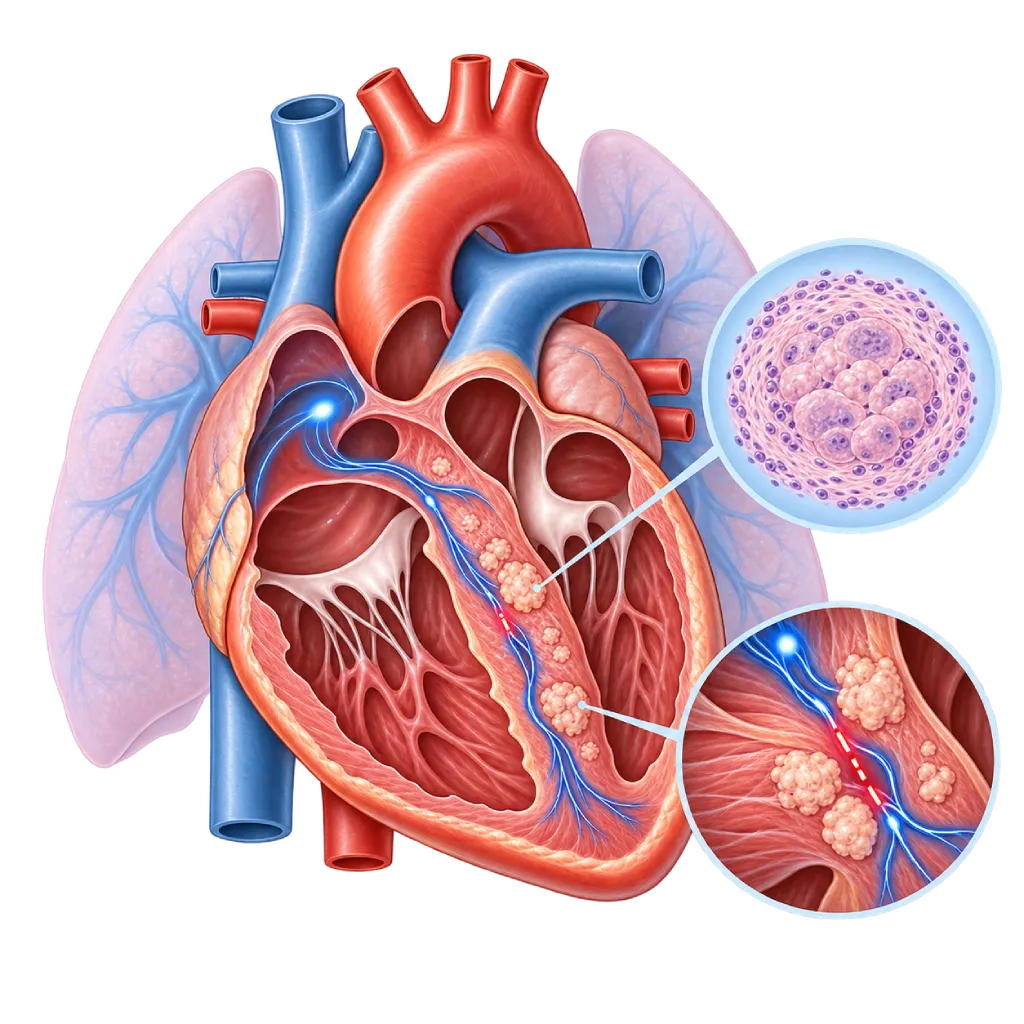
Cardiac sarcoidosis is inflammation that forms clusters of inflammatory cells (granulomas) in the heart muscle. It can cause heart block, rhythm disorders, and heart failure, and it often occurs alongside sarcoidosis in the lungs.
SourcesSigns That Need Urgent Help
- Fainting, especially during activity
- A very slow heartbeat with weakness, severe dizziness, or confusion
- A very fast, pounding heartbeat with chest pain, shortness of breath, or nearly fainting
- Severe shortness of breath at rest or being unable to lie flat
- More than one shock from an ICD within a short time
If these signs appear, go to the nearest emergency department right away or call Heart Attack Center 1500 258.
01 / Understanding the condition
About Cardiac Sarcoidosis
Sarcoidosis is an inflammatory disease that forms small clusters of inflammatory cells, called granulomas, in various organs. The organs usually affected are the lungs and the lymph nodes in the chest, but the skin, eyes, and heart can also be affected. It is called cardiac sarcoidosis when granulomas grow in the heart muscle. Heart involvement that causes symptoms is found in about 5 in 100 people with sarcoidosis, while imaging finds it in about 20 to 25 in 100, the majority of whom have no symptoms yet. A small number of people have sarcoidosis only in the heart, without involvement of other organs.
Effects on the Heart
Granulomas and the scar tissue they leave behind often appear in the wall between the heart chambers (septum) and the wall of the left ventricle. These areas are close to the heart's electrical pathways, so a typical early problem is heart block, in which electrical conduction slows down or is interrupted. Heart block is covered on the Atrioventricular Block page. Scar tissue can also trigger fast rhythms from the ventricles, covered on the Ventricular Tachycardia page. If the inflammation is widespread, the heart's pumping strength declines and heart failure develops.
Clues That Need Attention
The 2024 American Heart Association (AHA) scientific statement lists several clues: heart block with no clear cause before age 60, ventricular tachycardia without coronary artery disease, or cardiomyopathy with an unusual scar pattern. People with sarcoidosis in other organs are advised to have heart screening, at least a symptom interview and an ECG, even if they have no heart symptoms.
Treatment
Treatment has two parts. First, calming the inflammation with corticosteroids, often together with other immunosuppressive medications, with regular PET monitoring. Second, treating its effects on the heart: a pacemaker or ICD for heart block and rhythm disorders, ablation for recurrent ventricular tachycardia, and heart failure medications. Cardiac sarcoidosis is one of the causes of infiltrative cardiomyopathy, covered on the Infiltrative Cardiomyopathy page. Treatment involves cardiologists, pulmonologists, and other specialists depending on the organs affected. With early diagnosis and appropriate treatment, many people can carry on with their daily activities, although long-term monitoring is still needed.
02 / Understanding the condition
Symptoms to Recognize.
Common Symptoms
Some people have no heart symptoms, and the condition is only discovered on an ECG or imaging.
- A heartbeat that feels slow, pounding, or skipping
- Dizziness or nearly fainting
- Shortness of breath and tiring easily during activity
- Swelling in the feet or legs
- Chest discomfort
- A long-lasting dry cough or shortness of breath due to lung sarcoidosis
- Lumps or reddish patches on the skin, or red and painful eyes
03 / Understanding the condition
What Causes This Condition?
- The cause of sarcoidosis is not yet known for certain
- It is thought to be an excessive immune reaction to an environmental trigger in people with a certain genetic tendency
- Inflammatory cells cluster to form granulomas in the heart muscle, especially in the septum and the wall of the left ventricle
- Granulomas and scar tissue disrupt the heart's electrical pathways and pumping strength
- It can accompany sarcoidosis in the lungs, lymph nodes, skin, or eyes, or affect only the heart
04 / Understanding the condition
Who Is at Higher Risk?
Medical
Having sarcoidosis in the lungs, lymph nodes, skin, or eyes. Some people with sarcoidosis have heart involvement that has not yet caused symptoms.
Age
It is usually diagnosed between the ages of 25 and 60. Heart block with no clear cause before age 60 should prompt a search for possible cardiac sarcoidosis.
Genetic
A family history of sarcoidosis and variations in immune-regulating genes (HLA) are linked to a higher risk. Cardiac sarcoidosis is also reported more often in Japan.
Other
Exposure to dust, chemicals, or mold in the workplace is thought to play a role in sarcoidosis, although the link is not yet certain.
Groups at Higher Risk
- People with Sarcoidosis of the Lungs or Other Organs: Some have heart involvement without symptoms, so heart screening with a symptom interview and an ECG is recommended.
- Adults Under Age 60 with Heart Block: Heart block with no clear cause at this age should prompt a search for possible cardiac sarcoidosis.
- People with Unexplained Ventricular Tachycardia: A ventricular rhythm disorder without coronary artery disease can be the first sign of cardiac sarcoidosis.
05 / Understanding the condition
How Is It Diagnosed?
Diagnosing cardiac sarcoidosis combines several tests because no single test can always confirm it. An ECG and a Holter recording look for heart block, bundle branch block, and extra beats. An echocardiogram assesses pumping strength and thinning of the septum. A cardiac MRI with contrast shows scar tissue patterns that point to sarcoidosis, while a PET scan with FDG assesses inflammation that is still active. Before the PET scan, you follow a low-carbohydrate, high-fat diet and then fast, so that normal heart muscle does not also light up on the images.
A definite diagnosis requires evidence of granulomas from a biopsy. Because granulomas in the heart are scattered unevenly, a heart muscle biopsy often misses them, so doctors first look for other organs that are easier to reach, such as the lymph nodes in the chest through bronchoscopy. If a biopsy of another organ shows sarcoidosis and the heart imaging is consistent, the diagnosis can be made. Doctors also rule out other causes, such as coronary artery disease and other types of myocarditis.
Electrocardiogram (ECG)
Looks for heart block, bundle branch block, and extra beats. Recommended as screening for everyone with sarcoidosis.
Holter Monitoring
Records the heart rhythm for 24 to 48 hours to find heart block or rhythm disorders that come and go.
Echocardiography
Assesses pumping strength, wall motion, and thinning of the base of the septum, which is typical of sarcoidosis.
Cardiac MRI
Shows patterns of scar tissue and inflammation. The extent of scarring helps assess the risk of rhythm disorders and the need for an ICD.
Cardiac PET Scan
PET with FDG assesses active inflammation and is used to monitor the response to treatment. It requires a special diet and fasting beforehand.
Endomyocardial Biopsy
Takes a small sample of heart muscle to look for granulomas. A negative result does not rule out the diagnosis because granulomas are scattered unevenly.
A chest CT and a biopsy of the chest lymph nodes through bronchoscopy to look for sarcoidosis in organs that are easier to reach.
06 / Understanding the condition
Treatment Options.
Treatment is decided by a doctor after an assessment. The categories below can help you follow the conversation with your doctor.
Corticosteroids
The main medication for calming active inflammation. Your doctor decides the starting dose and how to lower it gradually.
Other Immunosuppressive Medications
Such as methotrexate or biologic TNF inhibitors, used to reduce the need for steroids or when the inflammation is not yet controlled.
Pacemaker or ICD
For heart block or the risk of ventricular rhythm disorders. If a pacemaker is needed, an ICD that also works as a pacemaker is often considered.
Catheter Ablation
For ventricular tachycardia that keeps recurring despite medication and an ICD.
Heart Failure and Rhythm Medications
Given according to pumping function and the type of rhythm disorder, with regular monitoring.
Heart Transplant
Considered for advanced heart failure or rhythm disorders that cannot be controlled in other ways.
07 / Understanding the condition
Complications to Watch For.
Heart Block
Electrical conduction slows down or is interrupted, so the heartbeat becomes too slow and can cause fainting. Covered on the Atrioventricular Block page.
Ventricular Tachycardia
Scar tissue triggers fast rhythms from the ventricles that can cause fainting or cardiac arrest. Covered on the Ventricular Tachycardia page.
Heart Failure
Widespread inflammation and scarring weaken the heart's pump, causing shortness of breath, swelling, and tiring easily.
Atrial Rhythm Disorders
Atrial fibrillation and other atrial rhythm disorders can occur if the inflammation affects the upper chambers of the heart.
Side Effects of Long-Term Treatment
Long-term corticosteroids can raise blood sugar and body weight and increase the risk of infection and bone loss, so your doctor monitors the dose.
08 / Understanding the condition
What Can You Do?
- If you have sarcoidosis in the lungs, skin, or eyes, ask for a heart checkup, at least with an ECG
- Report palpitations, dizziness, or nearly fainting to your doctor
- Take your anti-inflammatory medications on schedule and do not stop them on your own
- Have repeat PET or MRI scans on schedule to assess your response to treatment
- Have your pacemaker or ICD checked regularly, including through remote monitoring if recommended
- Do not smoke, and avoid exposure to dust or fumes at work
- While taking steroids, have your blood sugar, blood pressure, and bone health checked regularly
- Complete your vaccinations as your doctor advises, because immunosuppressive medications increase the risk of infection
09 / Understanding the condition
When Should You See a Doctor?
See a cardiologist if you have sarcoidosis and have the following symptoms, or if an abnormality is found on your ECG. If you faint, have a very fast pounding heartbeat, or have severe shortness of breath at rest, go to the emergency room right away.
- A heartbeat that feels slow, pounding, or skipping
- Dizziness or nearly fainting
- Shortness of breath and tiredness that are getting worse
- Swelling in the feet
- Heart block before age 60 with no clear cause
- Sarcoidosis in the lungs, skin, or eyes when your heart has never been checked
Don't Wait in an Emergency.
If symptoms are severe or come on suddenly, go to the nearest emergency department right away or call Heart Attack Center 1500 258, rather than waiting for an appointment.
10 / Common questions
Questions You May Have.
Frequently asked questions about cardiac sarcoidosis.
Is cardiac sarcoidosis contagious or inherited?
Sarcoidosis is not contagious. It is also not passed down directly like a hereditary disease, although a family history of sarcoidosis slightly increases the risk. Experts think sarcoidosis develops from an excessive immune reaction to an environmental trigger in people with a certain genetic tendency. Family members do not need special testing unless they have symptoms.
I have lung sarcoidosis without heart symptoms. Do I need to be checked?
Yes. Heart involvement can occur without symptoms, while heart block or rhythm disorders can appear suddenly. The 2024 AHA scientific statement recommends screening for everyone with sarcoidosis in other organs, at least with a symptom interview and an ECG, which can be supplemented with an echocardiogram or a Holter recording. If an abnormality is found, your doctor continues with a cardiac MRI or PET scan.
Why do I need a special diet before a cardiac PET scan?
Normal heart muscle uses sugar for energy, so it can also take up the FDG tracer that inflammatory cells absorb. A low-carbohydrate, high-fat diet beforehand, followed by a few hours of fasting, makes the heart muscle switch to using fat. That way, what lights up on the images is the inflammation, not normal heart muscle. The testing team will give you detailed instructions about which foods you can and cannot eat.
Why does my doctor recommend an ICD instead of a regular pacemaker?
In cardiac sarcoidosis, heart block and ventricular tachycardia often occur together because they come from the same scar tissue. An ICD can work as a pacemaker when the heartbeat is too slow, while also stopping ventricular rhythms that are too fast. That is why, if a pacemaker is needed, guidelines suggest considering an ICD. The final decision is based on your pumping function, the extent of scarring on MRI, and your history of rhythm disorders.
How long do I need to take steroids?
The duration differs for each person. Steroids are usually given for several months at a dose that is lowered gradually, and then your doctor assesses the response with a repeat PET scan. If the inflammation returns or the steroid dose is hard to lower, your doctor may add another immunosuppressive medication so the steroid dose can be reduced. Do not stop steroids suddenly, because your body needs time to start producing its own hormones again.
Can heart block from sarcoidosis recover?
Some cases can improve after the inflammation is calmed with medication, especially if treatment starts early. However, improvement cannot be guaranteed, and heart block can come back. That is why guidelines generally still recommend a pacemaker or ICD for severe heart block, even if the rhythm appears to improve after treatment. Your doctor will explain the device options that suit your condition.
Sources and Medical Review
Translated from the Indonesian edition medically reviewed by dr. Santi R. Dewayanti, Sp.P.
Sources as cited in the Indonesian edition.
- Cheng RK, Kittleson MM, Beavers CJ, Birnie DH, Blankstein R, Bravo PE, et al. Diagnosis and Management of Cardiac Sarcoidosis: A Scientific Statement From the American Heart Association. Circulation. 2024;149(21):e1197-216.
- Birnie DH, Sauer WH, Bogun F, Cooper JM, Culver DA, Duvernoy CS, et al. HRS expert consensus statement on the diagnosis and management of arrhythmias associated with cardiac sarcoidosis. Heart Rhythm. 2014;11(7):1304-23.
- Terasaki F, Azuma A, Anzai T, Ishizaka N, Ishida Y, Isobe M, et al. JCS 2016 Guideline on Diagnosis and Treatment of Cardiac Sarcoidosis: Digest Version. Circ J. 2019;83(11):2329-88.
- Zeppenfeld K, Tfelt-Hansen J, de Riva M, Winkel BG, Behr ER, Blom NA, et al. 2022 ESC Guidelines for the management of patients with ventricular arrhythmias and the prevention of sudden cardiac death. Eur Heart J. 2022;43(40):3997-4126.
- Arbelo E, Protonotarios A, Gimeno JR, Arbustini E, Barriales-Villa R, Basso C, et al. 2023 ESC Guidelines for the management of cardiomyopathies. Eur Heart J. 2023;44(37):3503-626.
- Birnie DH, Nery PB, Ha AC, Beanlands RS. Cardiac Sarcoidosis. J Am Coll Cardiol. 2016;68(4):411-21.
Doctors Who Treat This Condition

Dr. med. dr. Denio A. Ridjab, Sp.JP(K)
Interventional Cardiology
Coronary Intervention Procedures +2 centers
Clinical focusInterventional Cardiology · Coronary Artery Disease
View Profile
dr. Santi R. Dewayanti, Sp.P
Pulmonology
Clinical focusLung and Respiratory Disease · Asthma and COPD
View Profile
Dr. dr. Dudy A. Hanafy, Sp.BTKV, Subsp. JD(K), MARS
Adult Cardiac Surgery
Advanced Cardiovascular Surgical Care +1 center
Clinical focusMinimally Invasive Cardiac Surgery · Coronary Artery Bypass Surgery
View Profile