
Quick answer
What Is Mitral Valve Prolapse?
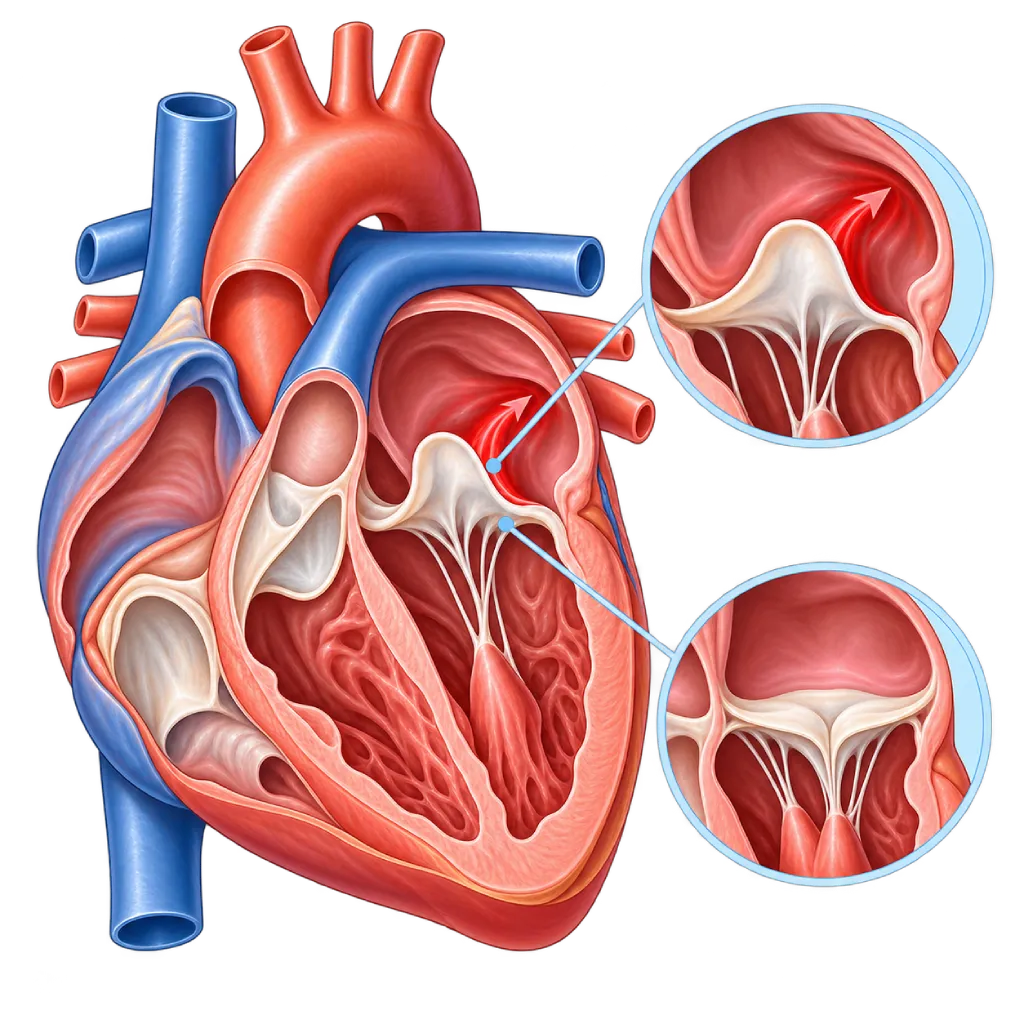
Mitral valve prolapse is a condition in which the leaflets of the mitral valve bulge into the left atrium as the heart pumps. Most cases are harmless and only need monitoring, but a small number develop into a valve leak that needs treatment.
SourcesSigns That Need Urgent Help
- Severe shortness of breath that comes on suddenly
- Coughing up pink, frothy sputum
- Fainting, especially without warning signs or during activity
- A very fast heartbeat with dizziness, shortness of breath, or chest pain
- Sudden weakness on one side of the body, facial drooping, or slurred speech
If these signs appear, go to the nearest emergency department right away or call Heart Attack Center 1500 258.
01 / Understanding the condition
About Mitral Valve Prolapse
The mitral valve sits between the left atrium and the left ventricle of the heart. It has two leaflets held by fine cords (chordae) so that it closes tightly when the ventricle pumps. In mitral valve prolapse, part of a valve leaflet bulges or balloons toward the left atrium as it closes, like a sail pushed by the wind.
Mitral valve prolapse is found in about 2 to 3 out of every 100 people. The Framingham study showed that most people with prolapse live normal lives without complications. Today the diagnosis is made using stricter echocardiography criteria, so fewer people are diagnosed with prolapse than a few decades ago.
Causes and Forms
Prolapse occurs because the valve tissue changes. In myxomatous degeneration, also called Barlow's disease, the valve leaflets become thick, redundant, and floppy. This form is often found at a younger age and can run in families. In older age, the valve leaflets more often become thin and the cords break easily. Prolapse is also more common in Marfan syndrome and other connective tissue disorders.
When Prolapse Becomes a Problem
The main problem is a valve leak (mitral regurgitation). Some people have only a mild leak throughout their lives. In others, the leak increases slowly, or a valve cord breaks so that a severe leak appears suddenly. A severe leak strains the heart and is covered on the Mitral Regurgitation page.
A small number of patients develop rhythm disorders that originate in the ventricles, especially when both valve leaflets prolapse, there is scarring (fibrosis) in the muscle that supports the valve, or the valve ring is displaced from the heart wall (mitral annular disjunction). The 2022 EHRA expert consensus statement calls this arrhythmic mitral valve prolapse, which requires more detailed rhythm testing and imaging.
Symptoms such as palpitations, atypical chest pain, or anxiety are often linked to prolapse, but studies have not always found a direct connection. Your doctor will look for other causes if your symptoms do not match the findings on the valve. If the leak is not severe, most people with prolapse can work, exercise, and go through pregnancy as usual.
02 / Understanding the condition
Symptoms to Recognize.
Common Symptoms
Many people with prolapse do not feel any symptoms.
- A clicking sound or heart murmur heard by the doctor, often without symptoms
- Palpitations, or a feeling that the heart skips a beat
- Atypical chest pain that is not related to activity
- Tiring easily or shortness of breath during activity as the leak increases
- Dizziness or lightheadedness
- Shortness of breath when lying flat once the leak has become severe
03 / Understanding the condition
What Causes This Condition?
- Myxomatous degeneration (Barlow's disease): the valve leaflets become thick, redundant, and floppy
- A lack of supporting tissue in older age, so the valve leaflets become thin and the valve cords break easily
- Heredity; prolapse can be found in several members of the same family
- Connective tissue disorders such as Marfan syndrome, Ehlers-Danlos syndrome, or Loeys-Dietz syndrome
- Certain congenital heart defects, for example in some people with an atrial septal defect
04 / Understanding the condition
Who Is at Higher Risk?
Genetic
Prolapse can run in families. Several causative genes have been identified, and Marfan syndrome and other inherited connective tissue disorders increase the likelihood.
Age
Barlow-type prolapse is often found in young to middle-aged people, while broken valve cords and severe leaks are more common after age 50.
Medical
Chest or spine deformities, such as a sunken chest and scoliosis, sometimes accompany prolapse, as do some congenital heart defects.
Other
Male sex, age over 50, thick valve leaflets, and a leak that is already moderate when first found are linked to the leak worsening over time.
Groups at Higher Risk
- Family Members of People with Prolapse: Prolapse can be inherited, so close family members may be advised to have an echocardiogram if there is a history of severe prolapse or sudden death.
- People with Marfan Syndrome and Connective Tissue Disorders: Floppy valve tissue makes prolapse more common, and it needs to be monitored together with aortic enlargement.
- People Over Age 50: Valve cords break more easily and leaks worsen more often at this age, especially in men.
- People with Prolapse and Rhythm Disorders: Palpitations, fainting, or extra beats from the ventricles in people with prolapse require more detailed rhythm testing.
05 / Understanding the condition
How Is It Diagnosed?
Prolapse is often first suspected from a clicking sound or heart murmur during a routine checkup. Echocardiography, an ultrasound of the heart, confirms the diagnosis when a valve leaflet bulges 2 millimeters or more past the valve ring toward the left atrium. Echocardiography also measures the leak and assesses the size and function of the left ventricle, which determine your checkup schedule.
If you often have palpitations, have fainted, or have a family member who died suddenly at a young age, your doctor may recommend long-term rhythm recording and cardiac MRI to look for scarring in the heart muscle. Before valve repair, echocardiography through the esophagus gives a detailed picture of the parts of the valve that need to be repaired.
Physical Examination
The doctor listens for a click in the middle of the heartbeat and a heart murmur, which can change when you stand, squat, or lie down.
Echocardiography
The main test to confirm prolapse, showing which parts of the valve leaflets are affected and measuring the leak, as well as the size and function of the left ventricle.
Transesophageal echocardiography (through the esophagus), including three-dimensional images, maps the valve leaflets in detail to plan valve repair.
Electrocardiogram (ECG)
Records the heart rhythm and looks for extra beats or changes that accompany prolapse.
Holter Monitoring
Rhythm recording for 24 to 48 hours, or longer if needed, to look for rhythm disorders in people who have palpitations or have fainted.
Cardiac MRI
Looks for scarring (fibrosis) in the muscle that supports the valve and measures the leak, especially in prolapse with rhythm disorders.
06 / Understanding the condition
Treatment Options.
Treatment is decided by a doctor after an assessment. The categories below can help you follow the conversation with your doctor.
Regular Monitoring
Prolapse with no leak or a mild leak only needs an echocardiogram every 3 to 5 years, and more often if the leak increases.
Medication for Palpitations
Beta blocker medications can help relieve palpitations. Your doctor decides whether medication is needed and at what dose.
Mitral Valve Repair
The main option for a severe leak due to prolapse. Your own valve is repaired through surgery, including through small incisions, and this is generally preferred over valve replacement.
Mitral Valve Clip Through a Catheter
In patients at high risk for surgery, the leak can be reduced with a clip placed through a catheter from a blood vessel in the groin.
Treatment of Rhythm Disorders
In arrhythmic prolapse, your doctor may recommend medication, ablation, or an ICD depending on the type and severity of the rhythm disorder.
07 / Understanding the condition
Complications to Watch For.
Mitral Regurgitation
The leak can increase slowly or appear suddenly if a valve cord breaks. Covered on the Mitral Regurgitation page.
Heart Rhythm Disorders
Extra beats are fairly common; a small number of patients develop dangerous ventricular rhythms, especially in arrhythmic prolapse.
Atrial Fibrillation
A left atrium that has enlarged because of mitral leakage is prone to irregular rhythm. Covered on the Atrial Fibrillation page.
Infective Endocarditis
A prolapsed, leaking valve is more easily colonized by germs from the bloodstream. Covered on the Infective Endocarditis page.
Heart Failure
A severe leak that is left untreated makes the left ventricle enlarge and then weaken. Covered on the Heart Failure page.
08 / Understanding the condition
What Can You Do?
- Follow the echocardiography schedule your doctor recommends, even without symptoms
- Keep your teeth and mouth clean and have regular dental checkups
- Control your blood pressure so the load on the mitral valve does not increase
- Limit caffeine, alcohol, and smoking if they trigger palpitations
- Tell your close family members if your prolapse is severe or comes with rhythm disorders, because family screening may be considered
- Report new symptoms such as shortness of breath or fainting to your doctor
09 / Understanding the condition
When Should You See a Doctor?
See a cardiologist if a doctor finds a clicking sound or heart murmur, or if you often have palpitations for no clear reason. People already known to have prolapse need a checkup sooner than scheduled if their symptoms change. Go to the emergency room right away if severe shortness of breath comes on suddenly, you faint, or you have a very fast heartbeat with dizziness.
- Shortness of breath or tiring quickly during activities that used to feel light
- Palpitations that become more frequent or feel irregular
- You have fainted or nearly fainted
- A family history of sudden death at a young age
- Fever lasting more than a few days for no clear reason, if your prolapse comes with a leak
Don't Wait in an Emergency.
If symptoms are severe or come on suddenly, go to the nearest emergency department right away or call Heart Attack Center 1500 258, rather than waiting for an appointment.
10 / Common questions
Questions You May Have.
Frequently asked questions about mitral valve prolapse.
Is mitral valve prolapse dangerous?
For most people, no. Many people with prolapse who have no leak or only a mild leak live normal lives without symptoms and without activity restrictions. What matters is the severity of the leak, the size and function of the left ventricle, and whether there are rhythm disorders. For this reason, your doctor recommends regular echocardiograms to make sure your prolapse stays stable.
Is mitral valve prolapse the same as a leaky heart?
Not exactly. Prolapse describes a valve leaflet that bulges toward the left atrium, and it may or may not come with a valve leak. The everyday term leaky heart is also often used for a hole in the wall between the heart chambers, which is a different condition. Your echocardiogram results will show whether your valve leaks and how severe the leak is.
Can people with prolapse exercise?
Most people with prolapse who have no severe leak and no rhythm disorders can exercise, including in competitive sports. The 2020 ESC sports cardiology guidelines recommend a more detailed assessment if there is a history of fainting, rhythm disorders from the ventricles, a severe leak, an enlarged left ventricle, or a family history of sudden death. Discuss your exercise plans with your doctor.
Can prolapse go away on its own?
Prolapse is a change in the shape of the valve tissue, so it generally does not go away. However, in many people the prolapse does not get worse for many years. Medication does not correct the valve shape, but it can help with palpitations. If the leak becomes severe, mitral valve repair can make the valve close tightly again, often while keeping your own valve.
When does prolapse need surgery?
Surgery is considered when the leak is severe and causing symptoms, or when there are no symptoms yet but the left ventricle starts to enlarge or weaken beyond certain limits, atrial fibrillation develops, or the pressure in the lungs rises. In prolapse, valve repair is preferred over replacement. The decision is made by the heart team based on your echocardiography results and your condition.
Does prolapse affect pregnancy?
Prolapse without a severe leak generally does not interfere with pregnancy and childbirth. Leaking valves tend to be better tolerated during pregnancy than narrowed valves. If the leak is severe or there are rhythm disorders, pregnancy should be planned together with a cardiologist and an obstetrician, including a review of the medications you are taking.
Sources and Medical Review
Translated from the Indonesian edition medically reviewed by Dr. dr. Dafsah A. Juzar, Sp.JP(K).
Sources as cited in the Indonesian edition.
- Vahanian A, Beyersdorf F, Praz F, Milojevic M, Baldus S, Bauersachs J, et al. 2021 ESC/EACTS Guidelines for the management of valvular heart disease. Eur Heart J. 2022;43(7):561-632.
- Otto CM, Nishimura RA, Bonow RO, Carabello BA, Erwin JP 3rd, Gentile F, et al. 2020 ACC/AHA Guideline for the Management of Patients With Valvular Heart Disease: A Report of the American College of Cardiology/American Heart Association Joint Committee on Clinical Practice Guidelines. Circulation. 2021;143(5):e72-e227.
- Sabbag A, Essayagh B, Barrera JDR, Basso C, Berni A, Cosyns B, et al. EHRA expert consensus statement on arrhythmic mitral valve prolapse and mitral annular disjunction complex in collaboration with the ESC Council on valvular heart disease and the European Association of Cardiovascular Imaging endorsed by the Heart Rhythm Society, by the Asia Pacific Heart Rhythm Society, and by the Latin American Heart Rhythm Society. Europace. 2022;24(12):1981-2003.
- Delling FN, Vasan RS. Epidemiology and Pathophysiology of Mitral Valve Prolapse: New Insights Into Disease Progression, Genetics, and Molecular Basis. Circulation. 2014;129(21):2158-2170.
- Freed LA, Levy D, Levine RA, Larson MG, Evans JC, Fuller DL, et al. Prevalence and Clinical Outcome of Mitral-Valve Prolapse. N Engl J Med. 1999;341(1):1-7.
- Lazam S, Vanoverschelde JL, Tribouilloy C, Grigioni F, Suri RM, Avierinos JF, et al. Twenty-Year Outcome After Mitral Repair Versus Replacement for Severe Degenerative Mitral Regurgitation: Analysis of a Large, Prospective, Multicenter, International Registry. Circulation. 2017;135(5):410-422.
- Pelliccia A, Sharma S, Gati S, Back M, Borjesson M, Caselli S, et al. 2020 ESC Guidelines on sports cardiology and exercise in patients with cardiovascular disease. Eur Heart J. 2021;42(1):17-96.
Doctors Who Treat This Condition

dr. Widya T. Suwatri, Sp.BTKV, Subsp. JD(K)
Adult Cardiac Surgery
Advanced Cardiovascular Surgical Care +1 center
Clinical focusMinimally Invasive Cardiac Surgery · Coronary Artery Bypass Surgery
View Profile
Dr. dr. Dafsah A. Juzar, Sp.JP(K)
Interventional Cardiology
Coronary Intervention Procedures +1 center
Clinical focusComplex Coronary Intervention · Cardiac Catheterization
View Profile
Dr. dr. Dudy A. Hanafy, Sp.BTKV, Subsp. JD(K), MARS
Adult Cardiac Surgery
Advanced Cardiovascular Surgical Care +1 center
Clinical focusMinimally Invasive Cardiac Surgery · Coronary Artery Bypass Surgery
View Profile